
Free Flight: Sport/Scale
Bill Warner
KNOCK, KNOCK! O.K., gang — got a riddle for ya! What does U.S.A. stand for (and yer first guess doesn't count)? Think. Give up? It's the Utah State Aeromodellers!
One of the fun things about doing a column is that you get nifty little newsletters from all over, and they are great indicators of what is really happening in modeling today. The big activity in our country is not the big championship (which gets all the publicity) but the small get-together of kindred spirits to fly and have fun. Here's a quote from their newsletter, the Dope Bucket:
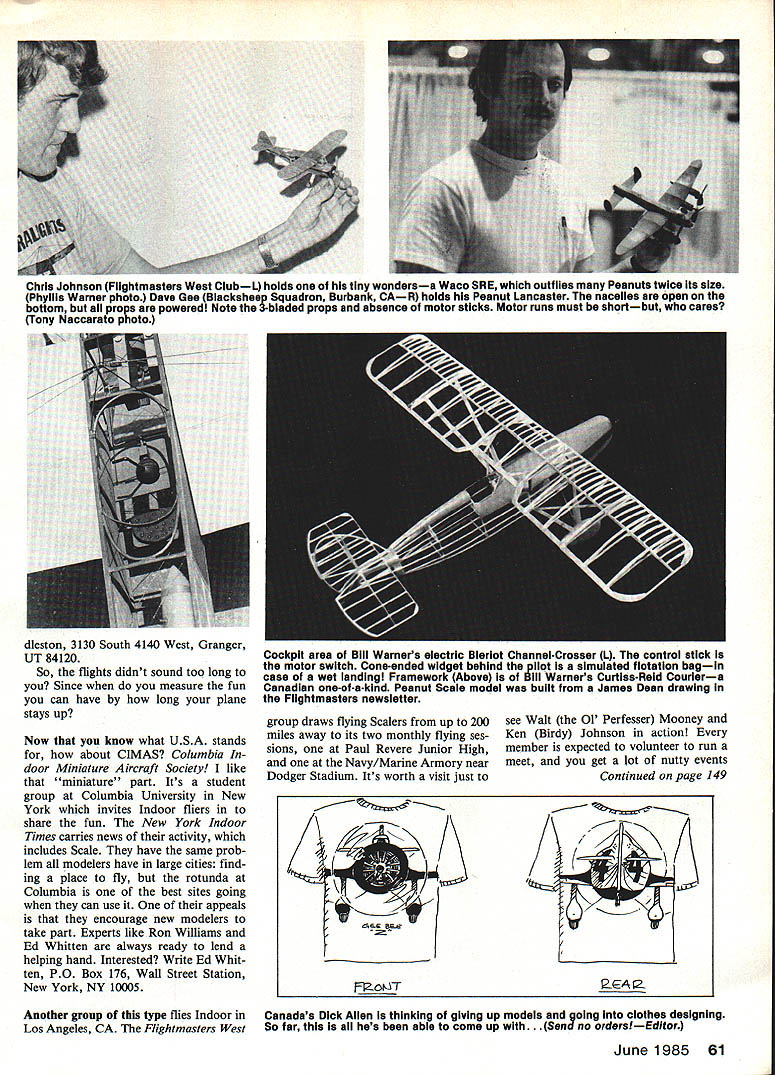
"There were four Peanuts out, two of which were new and untried. None were trimmed out, so it was a test session for all. Frank Anderson had a new 'Yellow Baron' Fokker DR1 triplane from a Lee's Hobbies kit. It looks promising as a good flier, if not much for duration. The only time I have on it is five seconds from ROG. He may have had a better one. Monte Young showed up with a new red Cougar from a Peck Polymers kit. His best recorded time was 12.6 seconds, but I think he had some longer ones. The landings, when he missed the wall, were beautiful, as it seemed to flare out as it reached ground effect. My old Micro-Dyne Farman Mosquito gave 11.8 seconds, but no two flights patterned the same. It's just too old and worn out. Jon Zeisloft's Ord-Hume from Model Builder put in several good flights, but no one recorded them."
Certainly sounds like they are keeping Indoor Scale alive in an area of the country not renowned for its model activity! Hats off to 'em. For more information on what they're up to, contact:
- Laron Huddleston, 3130 South 4140 West, Granger, UT 84120.
So, the flights didn't sound too long to you? Since when do you measure the fun you can have by how long your plane stays up?
Columbia Indoor Miniature Aircraft Society (CIMAS)
Now that you know what U.S.A. stands for, how about CIMAS? Columbia Indoor Miniature Aircraft Society! I like that "miniature" part. It's a student group at Columbia University in New York which invites Indoor fliers in to share the fun. The New York Indoor Times carries news of their activity, which includes Scale. They have the same problem all modelers have in large cities: finding a place to fly, but the rotunda at Columbia is one of the best sites going when they can use it.
One of their appeals is that they encourage new modelers to take part. Experts like Ron Williams and Ed Whitten are always ready to lend a helping hand. Interested? Write:
- Ed Whitten, P.O. Box 176, Wall Street Station, New York, NY 10005.
Flightmasters West (Los Angeles)
Another group of this type flies Indoor in Los Angeles, CA. The Flightmasters West group draws flying Scalers from up to 200 miles away to its two monthly flying sessions, one at Paul Revere Junior High and one at the Navy/Marine Armory near Dodger Stadium. It's worth a visit just to see Walt (the Ol' Perfesser) Mooney and Ken (Birdy) Johnson in action!
Every member is expected to volunteer to run a meet, and you get a lot of nutty events — added to the usual Scale offerings, such as a "Phantom Flash" class or an all-Ornithopter event. They work in conjunction with the junior high club, the Revere Model Aircraft Society, and it's a great place for junior modelers of all ages to get advice! Drop yours truly a line if you'd like more info (a SASE would be nice).
San Diego Scale Staff
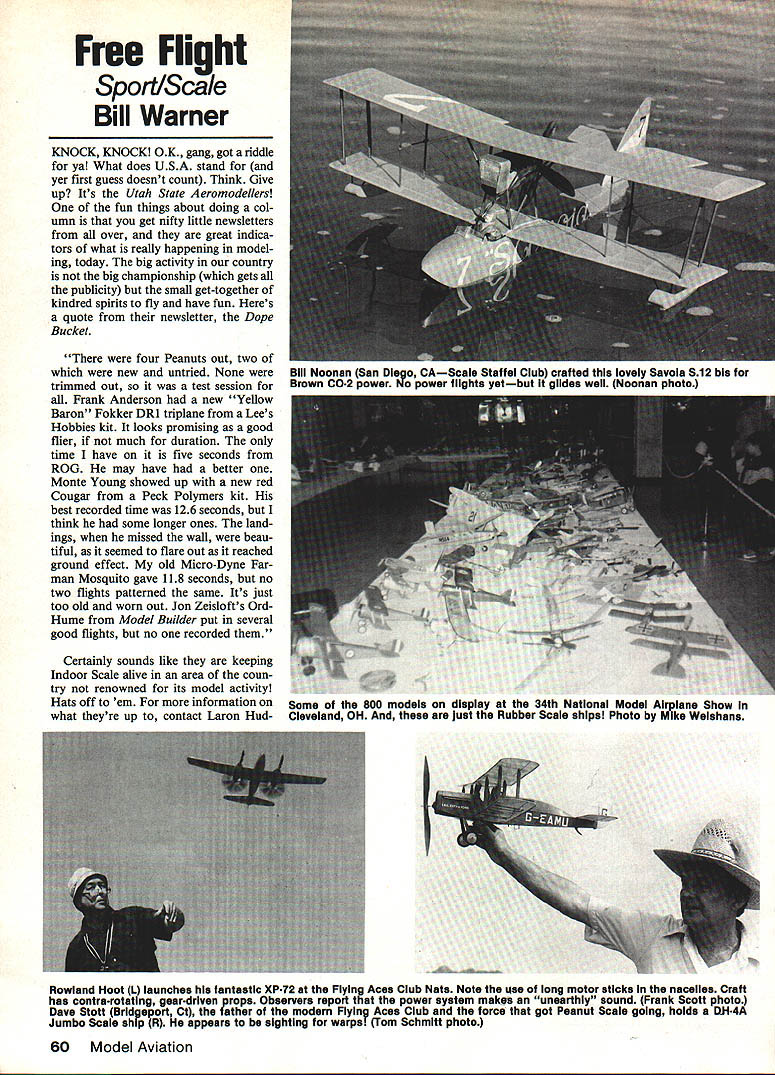
A group that has more fun than a termite in a Guillot's kit is the Scale staff down San Diego way. Boasting such luminaries as Bob and Sandy Peck, Bill Noonen, and Bill Hannan, you might expect some great flying sessions. Their Indoor site, the San Carlos Recreation Center, is not large, but fun is not measured by ceiling height.
Contact:
- T. A. Wilson, 10329 Santana Ranch Dr., Santee, CA 92115.
Blacksheep Squadron (Burbank)
Before we leave the Coast, the Blacksheep Squadron from Burbank certainly deserves mention. Their Indoor flying sessions at Burbank Jr. High bring together about 40 very enthusiastic and creative modelers. Their interests run the gamut from RC to Indoor electric.
Contact:
- Tony Naccarato, 2121 N. Hollywood Way, Burbank, CA 91505.
If you have a group in your area doing FF Scale stuff, let us know who people can get in touch with. Apologies to the dozens of other groups that are active, but with which I have lost contact of late.
Happy Hints
- Windshields (tip from Ernie Wrisley, San Diego): The easiest way to make windshields is to cut a pattern out of paper first. One sheet of typing paper can supply you with the five or six tries it may take before you have one that is just right. When you have one that fits, tape it to cardboard, then tape your plastic over it and score it with a sharp knife tip or a scriber around the edge. No need to cut all the way through; it will crease right along the score. I generally make a one-sided pattern, then fold it and cut the other half the same. Little pencil notations on the pattern will help you adjust the next one a little higher here or a little lower there. Each rough pattern you make will be a bit better than the last until you finally get the fit you want.
- Laminated outlines (tip from Vince Ferrarese, Wyandotte, MI): Making laminated wing tips, rudders, and stab outlines is great — except when it comes to making the form! Using a curve made by sticking dozens of pins inside your outline is okay sometimes, but the real way to do it is with a cutout form. Vince sharpens a block of 1x stock, uses it as a plug form, and fills the void with hot glue to make the ideal material. Go around the edge with a crayon or drip-coat with epoxy so that the hot glue can't bond to the form. The crayon or epoxy keeps the glue from bonding to the block so the cured laminations release cleanly. He also suggests dipping pins in a candle to keep the laminations from sticking. Recently I tried using long strips of .025-in. plastic sheet to hold the laminated material to the form. It helps in going around corners, where even the best pin techniques sometimes allow cracking, and it keeps the pins from leaving little dents in the part.
- Decals (Doug Wilkey, D.C. Maxecuters' Max-Fax): This might be a great way to do that decal you've always had trouble with. You'll need your artwork xeroxed — even in color, if you live near a color copying center. Remember, it can be reduced down, and a couple of different sizes won't cost much more and might be useful later if you decide to build a Peanut (or smaller) version.
- Take some clear contact paper (plastic), peel off the backing, and carefully stick it down onto your xerox.
- Using a rolling pin, press the contact sheet down solidly.
- Soak it in warm water for five minutes (or longer) and gently begin rubbing the paper off; it will sort of roll off. Keep soaking and rolling until all the fibers are gone.
- Hold up to the light to make sure all the fibers are off; use tweezers to remove any that remain.
- When it's dry, the "decal" can be applied to the model with Spray-Mt or Scotch 77. You can spray Testors' Dull-Kote or Micro-Scale Matte Finish over it as well as clear gloss finish — the vinyl plastic will not be affected (let's hope).
I always make extra decals and practice with them on old models before I go and break one on the new baby! Doug always tries to fill up a whole sheet with artwork before going a buck-and-a-half for a color xerox shot. Ralph Kuenz (the legendary Von Rotenson) has used this method on his Curtiss Helldiver, and it looks great. As anyone who has ever turned down a modeling subject because of all the artwork on it knows, now you may have an answer to your prayers! If you tend to break motors and blow out the sides of your models occasionally, you'll find two benefits: the decal adds some strength to the tissue, and you can make extras easily just by keeping your artwork on file.
Contests and Closing Notes
Just prior to press time, we got word that the Flying Aces postal contest (where modelers send in their Peanut flight times from all over) may soon be extended to RC Scale as well. Modelers will fly their scale maneuvers, award themselves points, and send them on a postcard to the contest HQ. Sounds like fun, doesn't it? I can't wait to see how it turns out!
A major French model magazine offers its readers free classified ads. Many of these are from young modelers begging for free RC equipment from generous older modelers. I was reminded of Doug Gillies' childhood in depression Glasgow. He told of using wood from packing crates, glue which took two weeks to dry, and paint bummed up from any redecorating project in the neighborhood. My, we've come a long way...
Bill Warner 423-C San Vicente Blvd. Santa Monica, CA 90402.
Transcribed from original scans by AI. Minor OCR errors may remain.

