
Free Flight: Sport/Scale
Bill Warner
Vegas Vultures visit
What could be more fun than finding a Mills .75 at a garage sale, getting Don Srull's autograph, or receiving a letter saying you are a winner in the Publishers Central Bureau Sweepstakes? A visit to the lair of the notorious Vegas Vultures, that's what! I try to get out to Las Vegas at least once a year to steal all of the Vultures' secrets and have done so for the past 20 years. Am I loaded with secrets? Actually, the real reason for going is to try to convince the legendary Bobby Haight to finish all of those wonderful projects he has been putting off for so long. Having a nice, half-built Fairey Swordfish to show friends that happen to drop by is nice, but...
Bobby's garage-cum-building-room is so loaded with great stuff that one of his visitors from "Back East" sent him a snapshot taken in it—and Bobby couldn't figure out which was "up"! The best way to describe it is to think of the Smithsonian in Reader's Digest format. His very talented wife, Doris, has a booming doll business which takes up the rest of the house, and there is no room for expansion. If any of you are buying a house, get a notarized contract from your wife on how much space you get (and how much you can have an option on when you go into quarter scale).
Foam brushes, silk covering, and other discoveries
A supply of those foam sponge paintbrushes (available at your local paint store) led to the discussion of their uses in FF modeling—and to the interesting revelation that they will seal silk about twice as well as a bristled brush: two coats of clear nitrate as opposed to four! That alone made the trip worthwhile.
On the topic of silk, I related the sad experience I had last summer covering my Parnall Elf. I made the error of covering with dry silk for the first time—and discovered with horror that it went all loose after water-spraying...and stayed that way! Well, back to wet covering for me!
Other goodies in the Vultures' bag of tricks included:
- a .055-in. diameter, abrasive-coated string (we know it will be useful, but haven't figured out just how yet);
- a plastic, 99-cent, gravity-operated angle-checker from a hardware store bargain counter which works better than one of those expensive incidence-checkers on the hobby market; and
- lots of thin lead that covers wine bottle corks that can be used to wrap around prop shafts, landing gear struts, or about anything for a neat application of weight.
Diesel break-in and El Dorado Dry Lake
Bobby does not fly many glow engines, and we went outside to work on a break-in job. In case you are not familiar with diesels, they are happiest when they have a couple of hours running on them, and this has to be done at a fairly low speed, with the mixture set on the rich side. First, you mount up the little monster on a stand, fuel it up with fresh diesel fuel (remembering that ether tends to sneak out of cans and leave you with some nice kerosene that won't even pop if you let it get old). Back out the compression screw a bit, open up the needle valve, flip by hand a few times to make sure no fuel is between the head and the piston forming a dreaded "hydraulic lock." Apply the electric starter (the coward's way)... sort of like fishing for trout at one of those little lakes where they raise trout and you pay for what you catch — a can't-miss setup. Choke with your finger and she's off! Beautiful sound. A bit more down on the compression, a bit leaner on the needle, and the nice healthy purr of a well-fed PAW lulls the neighbors to sleep for another 10 minutes on the run-in log.
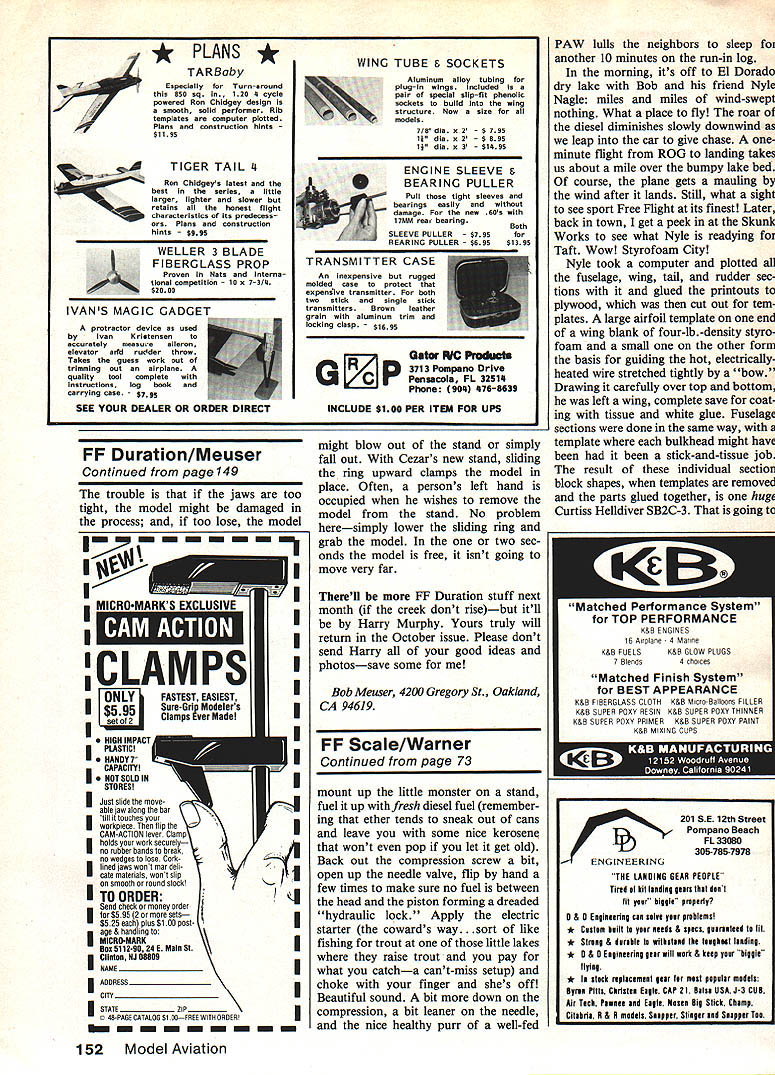
In the morning, it's off to El Dorado Dry Lake with Bob and his friend Nyle Nagle: miles and miles of wind-swept nothing. What a place to fly! The roar of the diesel diminishes slowly downwind as we leap into the car to give chase. A one-minute flight from ROG to landing takes us about a mile over the bumpy lake bed. Of course, the plane gets a mauling by the wind after it lands. Still, what a sight to see Sport Free Flight at its finest! Later, back in town, I get a peek in at the Skunk Works to see what Nyle is readying for next. Wow! Styrofoam City!
Styrofoam construction — "Styrofoam City"
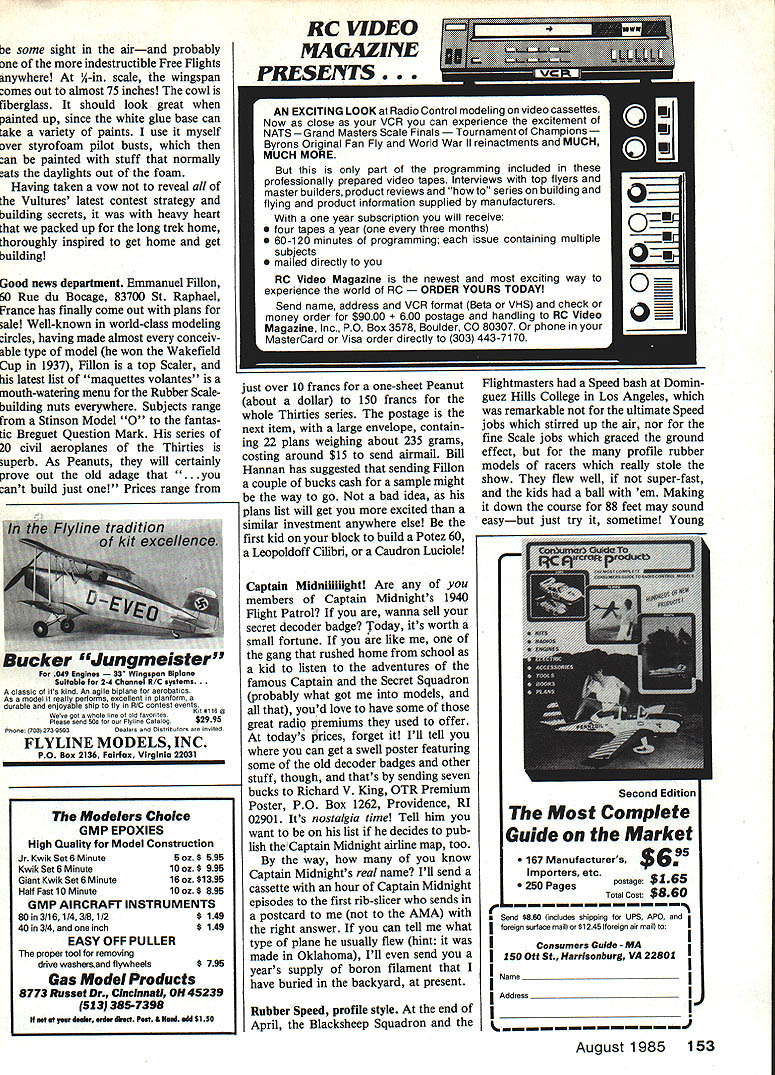
Nyle took a computer and plotted all the fuselage, wing, tail, and rudder sections with it and glued the printouts to plywood, which was then cut out for templates. A large airfoil template on one end of a wing blank of four-lb.-density styrofoam and a small one on the other end formed the basis for guiding the hot, electrically-heated wire stretched tightly by a "bow." Drawing it carefully over top and bottom, the wing was left in one complete piece for coating with tissue and white glue. Fuselage sections were done in the same way, with a template where each bulkhead might have been had it been a stick-and-tissue job. The result of these individual sections is broad shapes; when templates are removed and the parts glued together, the Curtiss Helldiver SB2C-3 is born—Styrofoam City indeed!
It'll be some sight in the air—and probably one of the more indestructible Free Flights anywhere! At 1/4-scale, the wingspan comes out to almost 75 inches! The cowl is fiberglass. It should look great when painted up, since the white glue base can take a variety of paints. I use it myself for styrofoam pilot busts, which then can be painted with stuff that normally eats the daylights out of the foam.
Having taken a vow not to reveal all of the Vultures' latest contest strategy and building secrets, it was with a heavy heart that we packed up for the long trek home, thoroughly inspired to get home and get building!
Emmanuel Fillon's scale series
Good news department. Emmanuel Fillon, 60 Rue du Bocage, 83700 St. Raphael, France has finally come out with plans for a scale series! Well-known in world-class modeling circles, having made almost every conceivable type of model (he won the Wakefield Cup in 1937), Fillon is a top scaler, and his latest list of "maquettes volantes" is a mouth-watering menu for the rubber-scale-builder nuts everywhere. Subjects range from a Stinson Model "O" to the fantastic Breguet Quinton Mark. His series of 20 civil aeroplanes of the Thirties is superb. As peanuts, they will certainly prove out the old adage that "... you can't build just one!"
Prices range from just over 10 francs for a one-sheet Peanut (about a dollar) to 150 francs for the double Thirties series. The postage is the next item, with a large envelope containing 22 plans weighing about 235 grams, costing around $15 to send airmail. Bill Hannan has suggested that sending Fillon a couple of bucks cash for a sample might be the way to go. Not a bad idea, as his plans list will get you more excited than a similar investment anywhere else! Be the first kid on your block to build a Potez 60, a Leopoldoff Cilibri, or a Caudron Luciole!
Captain Midnight nostalgia
Captain Midnight! Are any of you members of Captain Midnight's 1940 Flight Patrol? If you are, wanna sell your secret decoder badge? Today, it's worth a small fortune. If you are like me, one of the gang that rushed home from school as a kid to listen to the adventures of the famous Captain and the Secret Squadron (probably what got me into models, and all that), you'd love to have some of those great radio premiums they used to offer. At today's prices, forget it!
I'll tell you where you can get a swell poster featuring some of the old decoder badges and other stuff, though: send seven bucks to Richard V. King, OTR Premium Poster, P.O. Box 1262, Providence, RI 02901. It's nostalgia time! Tell him you want to be on his list if he decides to publish the Captain Midnight airline map, too.
By the way, how many of you know Captain Midnight's real name? I'll send a cassette with an hour of Captain Midnight episodes to the first rib-slicer who sends in a postcard to me (not to the AMA) with the right answer. If you can tell me what type of plane he usually flew (hint: it was made in Oklahoma), I'll even send you a year's supply of boron filament that I have buried in the backyard, at present.
Rubber Speed — profile style
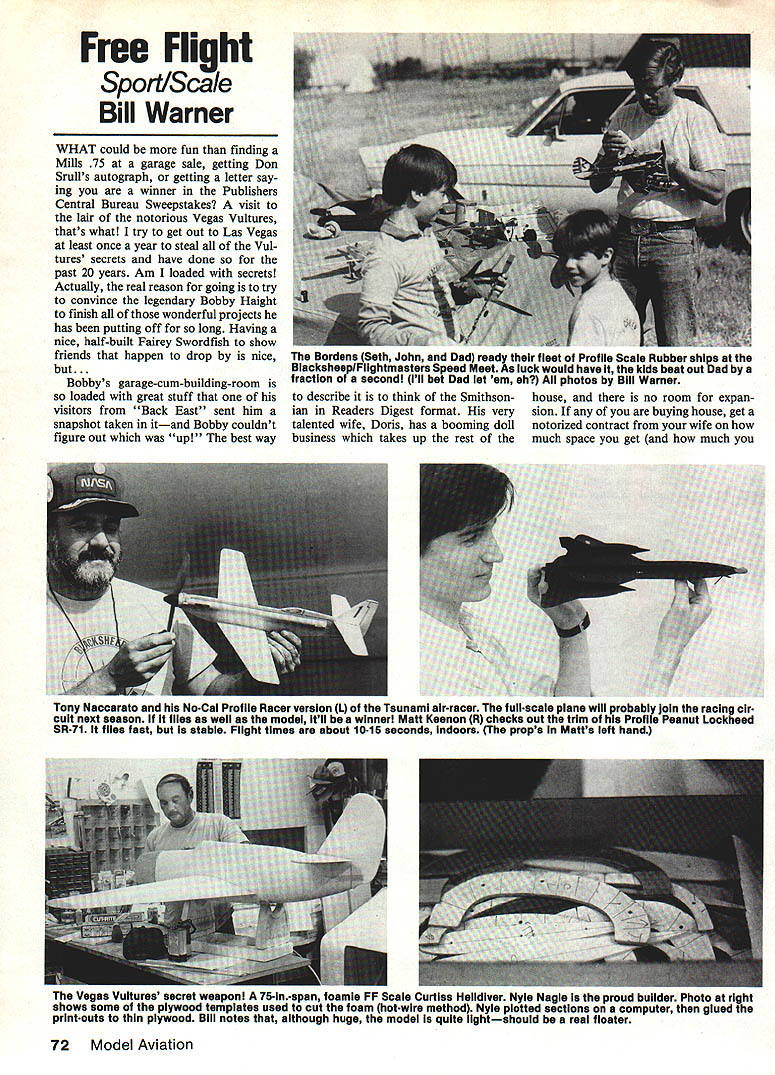
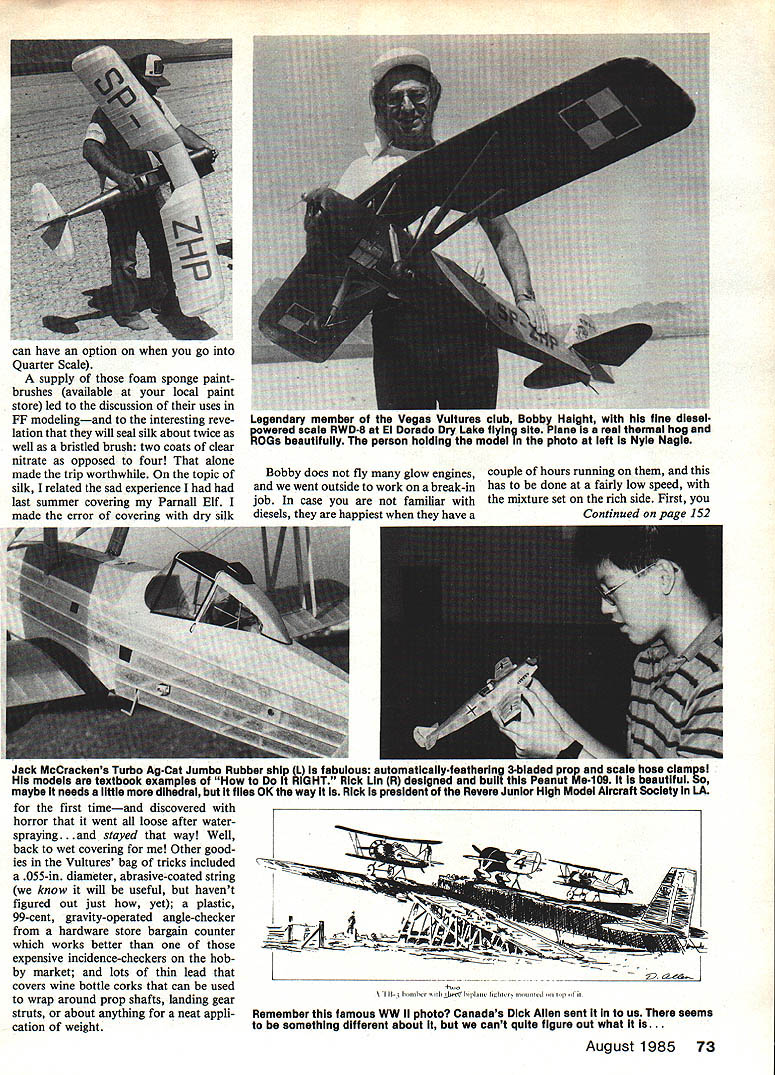
At the end of April, the Blacksheep Squadron and the Flightmasters had a Speed bash at Dominguez Hills College in Los Angeles, which was remarkable not for the ultimate Speed jobs which stirred up the air, nor for the fine Scale jobs which graced the ground effect, but for the many profile rubber models of racers which really stole the show. They flew well, if not super-fast, and the kids had a ball with 'em. Making it down the course for 88 feet may sound easy—but just try it, sometime!
John and Seth Borden made many great runs and wound up placing higher than many of the adults!
The Lo-Cal event has secured a place on the model scene, and if you haven't tried one yet, why not go for it? An evening's work is all it takes, and you'll fly it when you are leaving your good Scale job in the trunk due to wind, trees, or just plain pavement-phobia!
Photos and contact
Send in your interesting, black-and-white, contrasty 5 x 7 photos (with a SASE, if you want 'em back). I'll try to use as many as I can, especially the ones with the bikini-clad exhibitors. Five bucks for every one published. Even good color prints can be used.
Bill Warner 423-C San Vicente Blvd. Santa Monica, CA 90402
Transcribed from original scans by AI. Minor OCR errors may remain.

