
Free Flight
SPORT/SCALE
Bill Warner
Authentic, full-color, Wallace Rigby–designed card-stock fighters from 1944 are available again! Nostalgia buffs will please read this column.
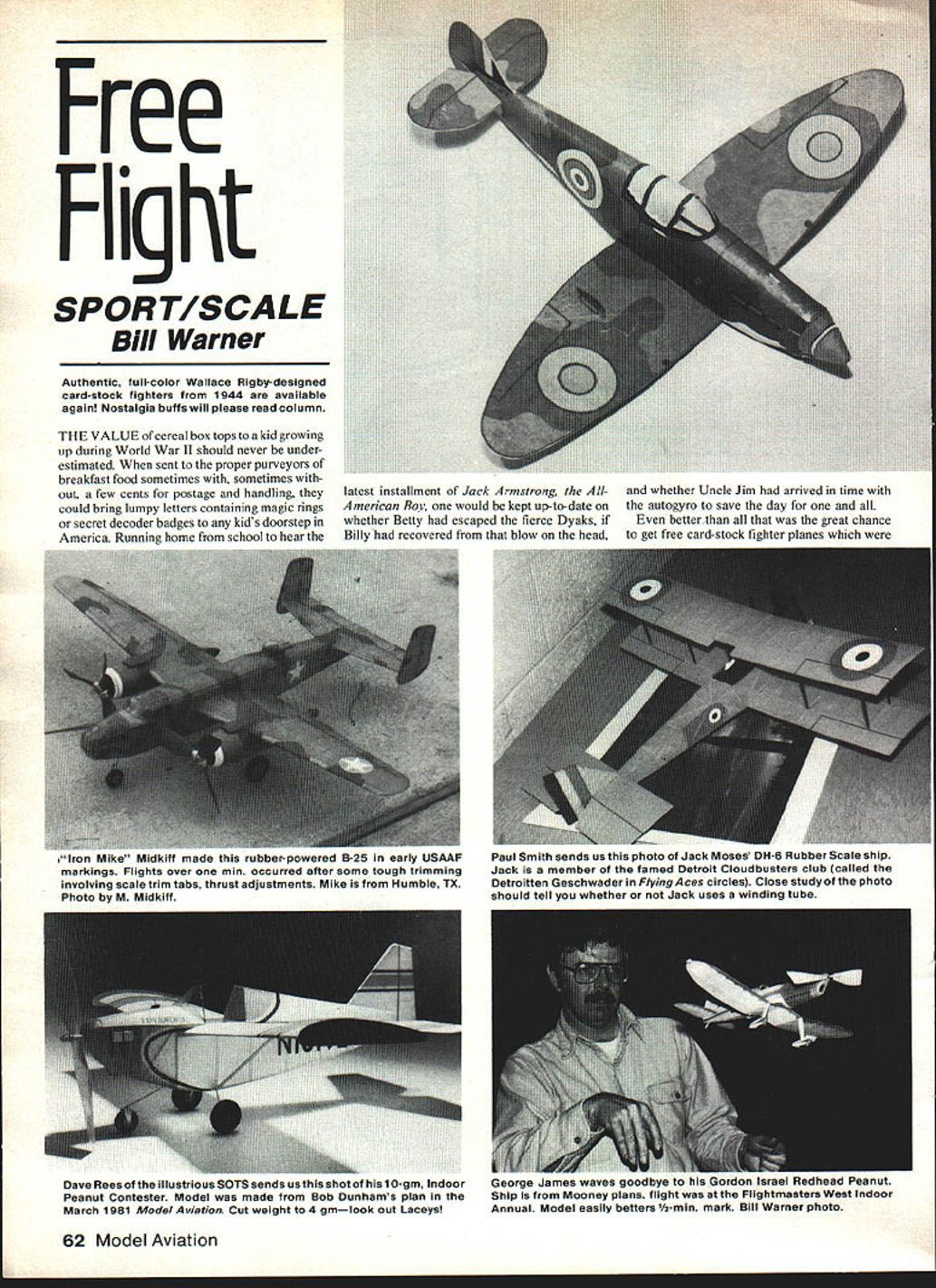
The value of cereal box tops to a kid growing up during World War II should never be underestimated. When sent to the proper purveyors of breakfast food, sometimes with, sometimes without, a few cents for postage and handling, they could bring lumpy letters containing magic rings or secret decoder badges to any kid's doorstep in America. Running home from school to hear the latest installment of Jack Armstrong, the All-American Boy, one would be kept up-to-date on whether Betty had escaped the fierce Dyaks, if Billy had recovered from that blow on the head, and whether Uncle Jim had arrived in time with the autogyro to save the day for one and all. Even better than all that was the great chance to get free card-stock fighter planes which were paper models that used a penny for nose ballast and spanned a mere 10 inches. Well, nostalgia buffs, the planes are back! Selling at $2.50 a copy or $26 for a complete set of fourteen at your local air museum, they are fun—and certainly more fun to give a kid than a birthday card!
Besides the exact full-color reproductions of the Tru-Flite Jack Armstrong models, Bob Fudold, the man behind this daring venture, has also re-done the P-40 and Zero with cambered wings. Having had a couple of hundred junior-high students make the P-40, I can attest that it is a fun model for a group or class project, and group discounts are available. For more information on how to be the first kid on your block to get one, contact Bob Fudold, Saf-Flite Models, Box No. 62, Roseville, MI 48066. Bob is a nice guy and will make sure that you get the scoop on where you can get yours. (No box tops, please.)
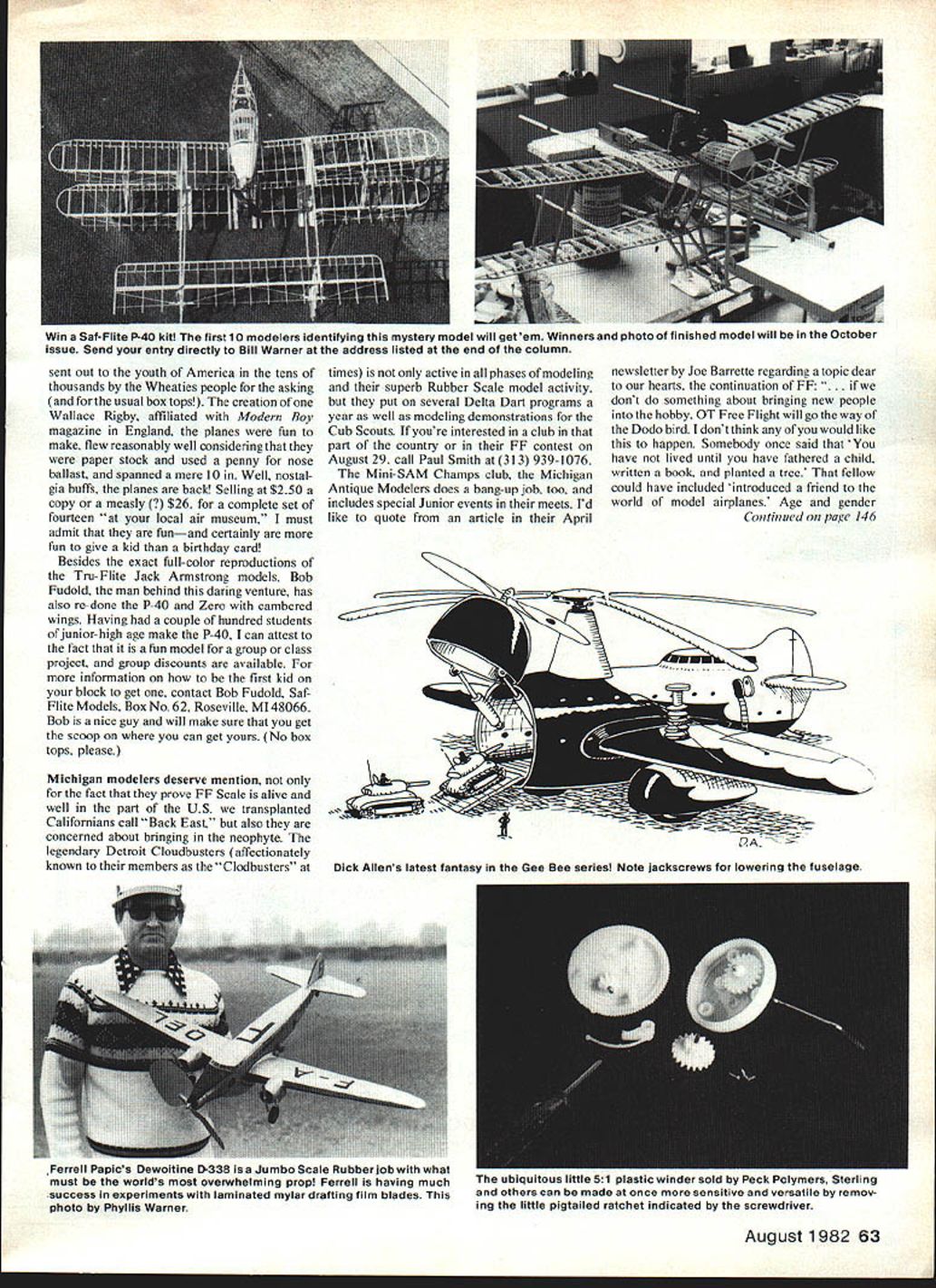
Michigan modelers deserve mention, not only because they prove free-flight scale is alive and well in the part of the U.S. we transplanted Californians call "Back East," but also because they are concerned about bringing in the neophyte. The legendary Detroit Cloudbusters (affectionately known to their members as the "Clodbusters") are active in all phases of modeling and in superb rubber-scale model activity. They put on several Delta Dart programs a year as well as modeling demonstrations for the Cub Scouts. If you're interested in a club in that part of the country or in their free-flight contest on August 29, call Paul Smith at (313) 939-1076.
The Mini-SAM Champs club, the Michigan Antique Modelers, does a bang-up job, too, and includes special junior events in their meets. I'd like to quote from an article in their April newsletter by Joe Barrette regarding a topic dear to our hearts, the continuation of free flight: "... if we don't do something about bringing new people into the hobby, OT Free Flight will go the way of the Dodo bird. I don't think any of you would like this to happen. Somebody once said that 'You have not lived until you have fathered a child, written a book, and planted a tree.' That fellow could have included 'introduced a friend to the world of model airplanes.'" The specific form of outreach should not matter. The importance is the gesture of bringing our craft to those who do not yet know the joys of flying model airplanes.
If you are moved to get involved with this great group, call Karl Spielmaker at (616) 538-3077. Yes, they fly Rubber Scale!
Webster's New Collegiate Dictionary defines "warp" as: "To change the form of (a wing) by twisting." Warping is sometimes used to maintain the lateral equilibrium of an airplane. From my experience, warps more commonly mess up the lateral equilibrium (as well as the longitudinal) of my models. The way we "maintain" equilibrium is by un-warping the darn things. Give me a flat wing and stab any old day. "But!" I hear you shout, "How about wash-in to fight torque effect and washed-out tips to minimize tip stall?" Well, if you're that far into it, skip the rest of this column, as we're going to learn to build flat today. If, as Walt Mooney opines, 90% of the crashes could be prevented by moving the C.G. forward and increasing the angular difference between the wing and the tailplane, the other 10% can probably be prevented just by building flat—i.e., without unintended warps.
Building warpless structures that are light enough to fly well is an art. A few tips that may be of use include:
- Build on a flat surface.
- Make sure parts fit together nicely without bending the leading edge (L.E.) or trailing edge (T.E.) to get a rib to fit and then gluing in the stress.
- Select B- or C-grain wood strong enough to resist twists but not so heavy as to produce a structure which will have to fly fast just to stay in the air. (Small warps become dangerous as speed increases.)
Two master modelers, Phil Cox of Highland, Ind., and Cliff McBaine of La Habra, Calif., would like to share some of their methods for non-warping surfaces. Phil states that proper wood selection, placing sufficient gussets and spars, etc., can make a difference. In addition, Phil emphasizes the importance of laying on the tissue with the grain running 90° to the ribs (spanwise) with no bias, which could give uneven pull when it tightens. In case you have never thought much about grain direction in tissue, try tearing a corner of a sheet and see in which direction it tears the easiest. This is the grain direction. Phil and Cliff both recommend plasticized dope—that is, dope on the order of Sig Lite-Cote or nitrate dope with a few drops of a plasticizer (such as TCP) added, or a non-tautening nitrate such as Aerodyne.
If you are willing to go to any lengths to prevent warps, here's Cliff's method in a nutshell:
- Select C-grain balsa for L.E., T.E., and ribs; make sure it all fits nicely without stress; and assemble it pinned down to a board.
- Spray with water (Cliff suspects that ammonia weakens balsa) and allow 12 hours to dry.
- Dope the structure with Aerodyne nitrate dope or equivalent and wait another 12 hours.
- Tissue-cover, spray with water, pin down, and wait overnight before doping.
- Dope tissue with 50/50 thinned Aerodyne and, when touch-dry, pin back down for 24 hours.
- Give it a second coat, and leave it on the board for 48 hours.
- Six hours in the hot sun while still pinned down finishes the job.
Wow! I defy anything to warp after that treatment!
From Baron Von Heinigeraber in Wappingers Falls, N.Y., comes a tip on scale finish after you have made that dead-flat wing. He has had success using a water-based plastic model paint called Polly-S for camouflage streaking on a DR-1 wing as well as for blue undersides. Well-thinned, he says, it adds almost no weight. Earl Van Corder, the senior junior columnist over at Flying Models, confirms this and states further that the baron would never lie to us. He should not, as the baron uses Earl's address on his letters.
From Count Alex Pisano comes this useful tidbit: save your wife's snagged pantyhose. They make great filler material for dope or enamel prior to spraying.
Before leaving, I'd like to convince those of you who haven't yet procured Ron Williams' classic Building and Flying Indoor Model Airplanes to have your local bookstore order one for you soon. You won't be sorry, even at $14.95. Published by Simon and Schuster, Simon and Schuster Building, Rockefeller Center, 1230 Avenue of the Americas, New York, NY 10020, the book contains a treasure trove of how-to information on most phases of indoor flying—from building a model box to a larger-than-Peanut Lacey M-10 with scale documentation included. (Editor: Also available to AMA members from AMA HQ Supply & Service for $10.50 each.) The pictures are a delight, making it a great gift for non-English speakers! Williams is a great modeler and a superb illustrator. Buy it!
Next time we'll discuss some of the more interesting ways to remove those pesky warps in models that you built before you learned about the McBaine method!
Bill Warner 423-C San Vicente Blvd. Santa Monica, CA 90402
Transcribed from original scans by AI. Minor OCR errors may remain.

