
Free Flight: Sport/Scale
Bill Warner
A Fine Book
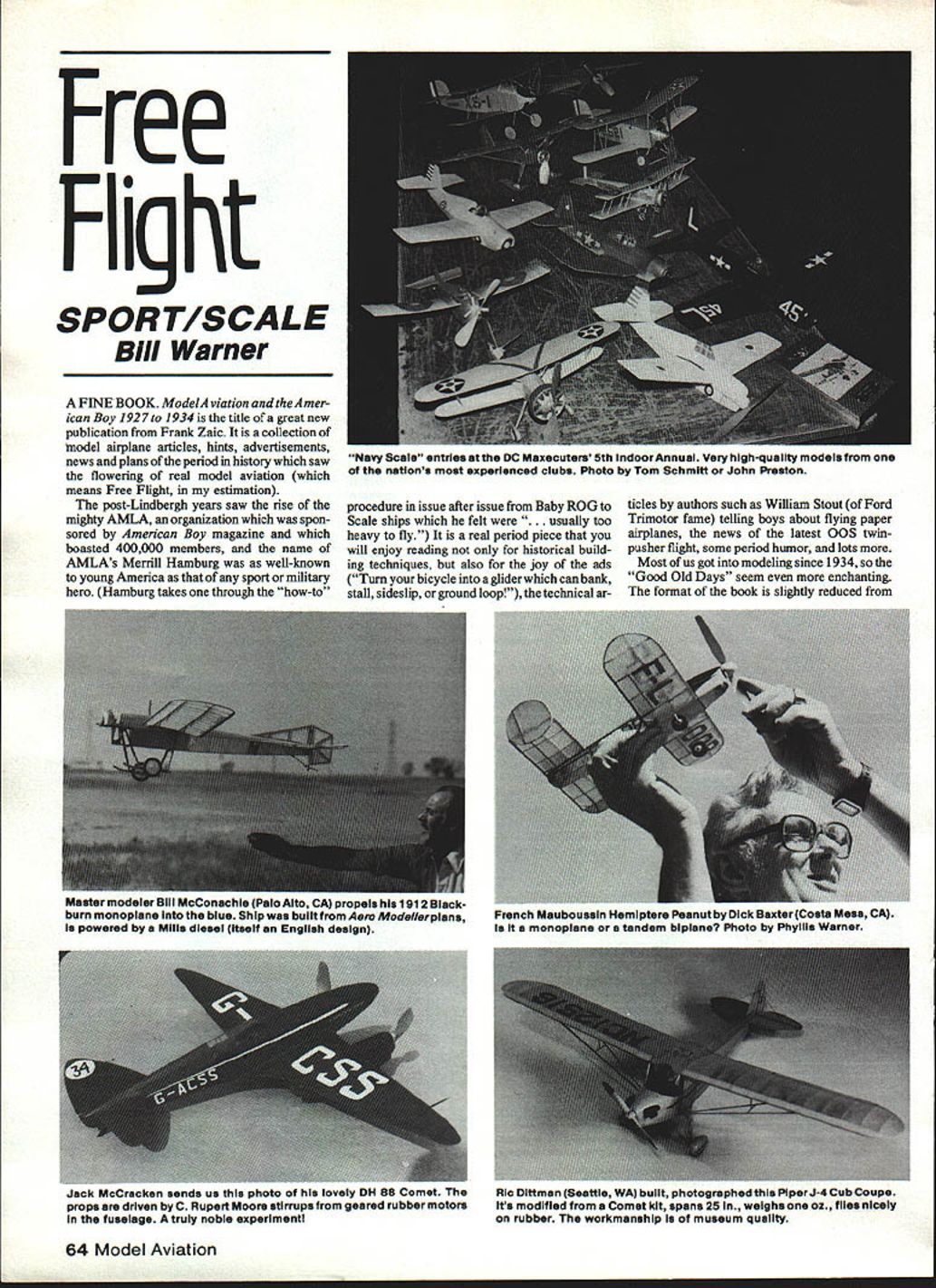
A FINE BOOK, Model Aviation and the American Boy 1927 to 1934, is the title of a great new publication from Frank Zaic. It is a collection of model airplane articles, hints, advertisements, news and plans of the period in history which saw the flowering of real model aviation (which means Free Flight, in my estimation).
The post-Lindbergh years saw the rise of the mighty AMLA, an organization which was sponsored by American Boy magazine and which boasted 400,000 members. AMLA's Merrill Hamburg was as well-known to young America as any sport or military hero. Hamburg takes one through the "how-to" procedure in issue after issue from Baby ROG to scale ships which he felt were "... usually too heavy to fly." It is a real period piece that you will enjoy reading not only for historical building techniques, but also for the joy of the ads ("Turn your bicycle into a glider which can bank, stall, sideslip, or ground loop!"), the technical articles by authors such as William Stout (of Ford Trimotor fame) telling boys about flying paper airplanes, the news of the latest OOS twin-pusher flight, some period humor, and lots more.
Most of us got into modeling since 1934, so the "Good Old Days" seem even more enchanting. The format of the book is slightly reduced from that of the magazine to 9 in. by 12 in.—but the excitement is all there. Frank spent about 15 years getting this great collection together, and it's well worth the price (which should be in the neighborhood of $10 plus postage when it hits the market).
Quickie hints
- Still looking for the ideal all-around cement? Try Testors "green-tube" cement for wood models, fast drying. Most modelers who try it swear by it, not at it.
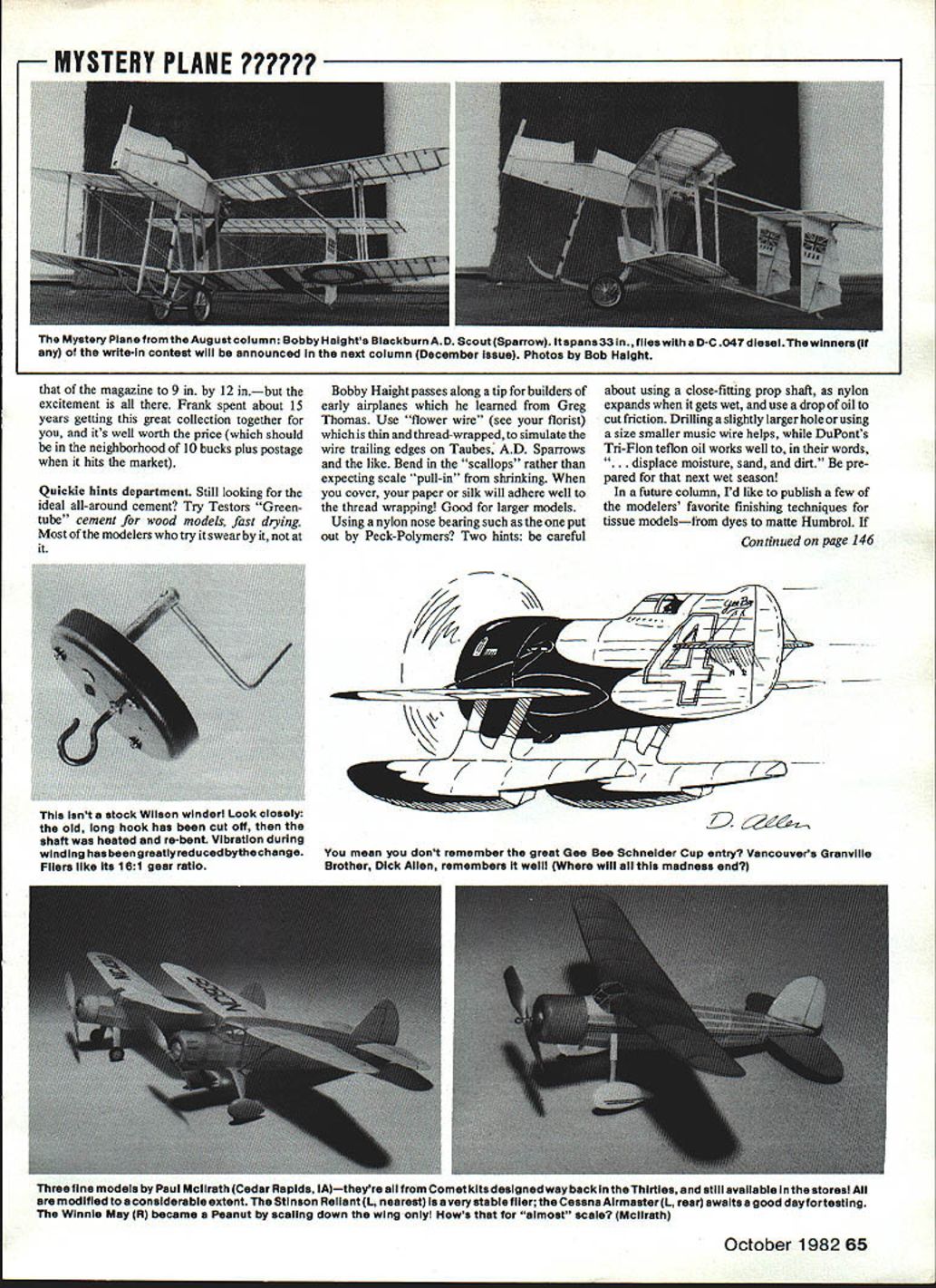
- Bobby Haight passes along a tip for builders of early airplanes (learned from Greg Thomas): use "flower wire" (see your florist) which is thin and thread-wrapped, to simulate the wire trailing edges on Taubes, A.D. Sparrows and the like. Bend in the "scallops" rather than expecting scale "pull-in" from shrinking. When you cover, your paper or silk will adhere well to the thread wrapping. Good for larger models.
- Using a nylon nose bearing such as the one put out by Peck-Polymers? Two hints:
- Be careful about using a close-fitting prop shaft, as nylon expands when it gets wet — drilling a slightly larger hole or using a size smaller music wire helps.
- Use a drop of oil to cut friction. DuPont's Tri-Flon Teflon oil works well to, in their words, "...displace moisture, sand, and dirt." Be prepared for that next wet season!
In a future column, I'd like to publish a few modelers' favorite finishing techniques for tissue models — from dyes to matte Humbrol. If you have something that works well for you, why not drop me a line?
Removing warps
Removing warps saves planes. We don't like to see a good plane crash because of a little twisted wing, but how often do we check before that fatal spiral dive takes place? After much consultation and field-testing, a few important facts emerge.
- Build warp-free structures and use low-shrink covering and doping techniques (see the August 1982 M.A., p. 146) so as to get a jump on the problem.
- Dewarp your wings and tail surfaces over a steaming flat pan of water (not a teakettle). Twist the wing or tail part in the opposite direction from the warp and heat the covering until the wrinkles disappear—then move to a cooler part of the room until the job cools, after which the part is released.
To detect warps: hold the model out at arm's length with the prop facing you, close one eye, and level-sight along the bottom of the wing near the fuselage. Then sight out along the wing toward the tip. If you see more and more of the underside as you move out, your wing has wash-in. Washout can be spotted by turning the tail toward you and repeating the process.
On planes with wing struts, it may be necessary to cut one of the struts on the bias, take out the warp, and re-glue the strut. It is easier to shorten one than to lengthen the other. Dewarping with a pair of struts holding in the warp is well-nigh impossible.
When you get to the field, taking warps out becomes harder unless you bring along a source of steam (see my March 1980 FF Scale column). There is no one "best" way for field warp removal. The old "breathe hard on it a few times and twist" method is the most common, but unless you check just before each launch you may find it has reverted to the original about two seconds after launch.
Heat application via a hair dryer is fine if you have power. You could even get one of the little plastic steam travel irons that Haight uses that takes plain water and salt. For those who have no AC outlet, a propane torch, Sterno can, lighted cigarette, or car exhaust may have to do. These methods, however, do occasionally set wings alight, make little round burn marks, or splatter black spots on your plane.
If you do use a risky heat method, interpose a hand between the flame and the wing now and then to check the heat. Also remember that heat can put 'em in as well as take 'em out, so keep your model in the shade as much as possible, out of direct sun and trunks, and never in the back window (even plastic props have been known to melt there).
Taking out a drastic warp is more of a problem and can't be done easily in the field. My French connection in Nice, Guy Guidicci, pokes the tissue between the ribs and loads the wing in the tub overnight. It is not recovered until it has had a couple of weeks on the building board.
TWA award and closing
This month's TWA (Thermal Worthy Aircraft) award goes to Flightmaster Roy Mayes, who won not only the Power Scale event at the 1982 U.S. FF Champs at Taft with his electric Dormoy bathtub, but also the Rubber Scale event with a 10-plus-minute OOS on a fine Aeronca Sedan. Bravo!
Until next time, thermals and unwarped wings to ya'!
Bill Warner 423-C San Vicente Blvd. Santa Monica, CA 90402.
Transcribed from original scans by AI. Minor OCR errors may remain.

