
Free Flight: Sport/Scale
Bill Warner
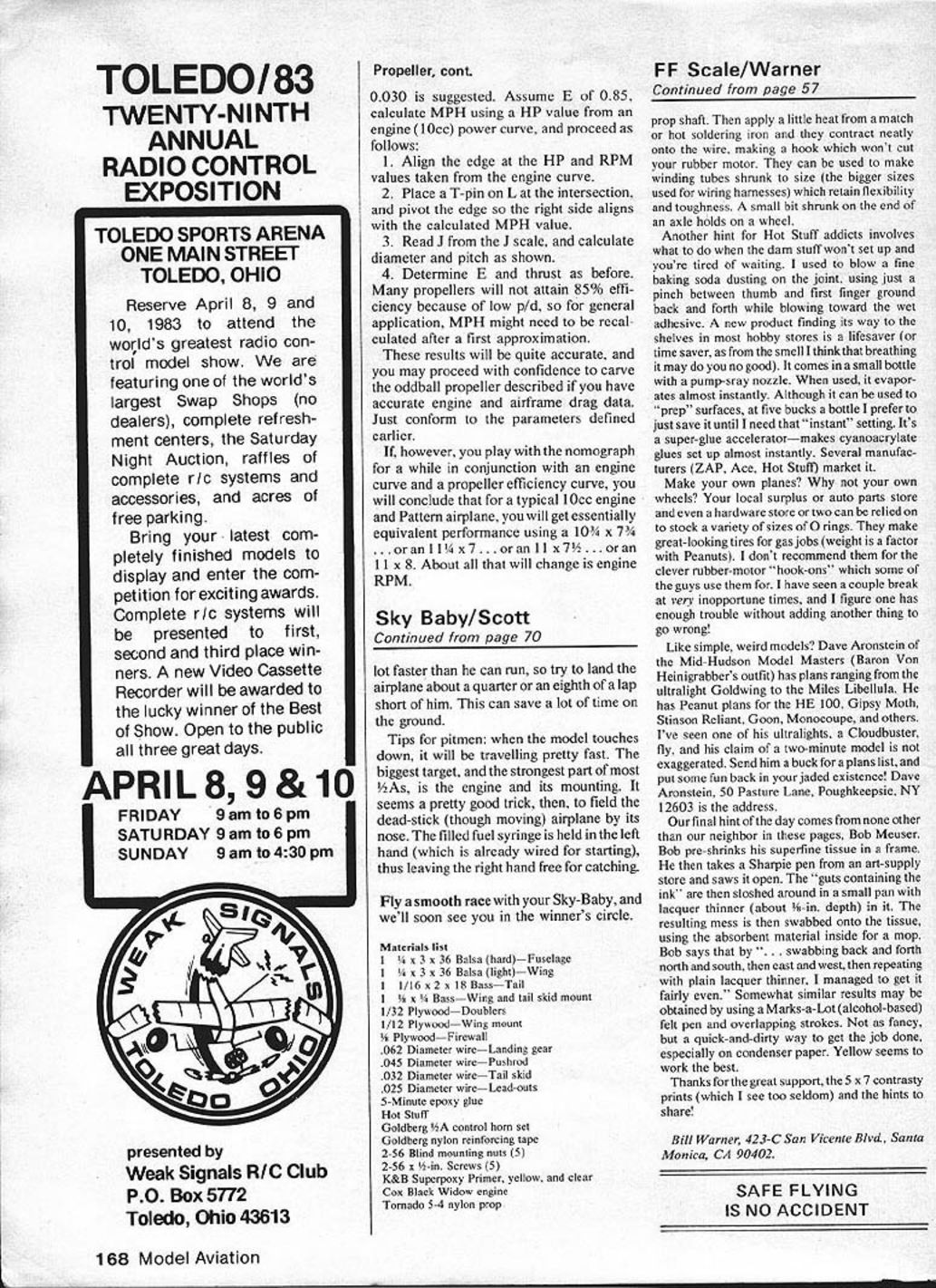
This month's coveted TWA award: an 18 minutes, 1 second flight on his Peanut Tailwind by Fred Ewing. This Thermal-Worthy Aircraft, a flying museum-piece if ever I saw one, landed only 200 feet from the launch site, believe it or not! Fred's Tailwind, a modified Andrew Morehouse kit from Peck-Polymers, stayed over the site for the entire time, becoming a tiny speck in the sky as it rode three different thermals. It's fitting that the fantastic flight took place at the 1982 Eastern U.S. Free Flight Championships and garnered a well-deserved first in Peanut before an astonished crowd of fellow SOTS and assorted competitors.
Specifications on the model:
- Weight: 13 grams including nose weight
- Prop: Sleek Streak prop cut down to 4½ in.
- Motor: One loop of FAI 3/32-in. rubber, 20 in. long, braided, with 1,568 winds
- Finish: Model airbrushed overall with a very thin coat of white dope and airbrushed yellow trim
- Flight trim: left-left
Let's hope Peck has a good stock of those kits for all of you gum-banders out there who are going to try to duplicate Fred's historic flight!
The Great Mystery Plane Contest brought many more entries than I had anticipated! All 10 of the Saf-Flite P-40s were gone in the first two days! We certainly have an informed readership. Thanks to all of you! The winners are:
- Byron Calomiris, Long Beach, CA
- Dick Castle, San Diego, CA
- George Hume, Torrance, CA
- Vic Larsen, Roanoke, TX
- Steve Riley, Auburn, WA
- Robert Sennett, Warsaw, IN (has it drawn to 16-in. span if any of you want to build one)
- Newt Stansfield, Milwaukee, WI
- Chuck Wenlock, Las Vegas, NV
- Joe Wagner, New Wilmington, PA
- David Watson, San Diego, CA
- John Blagg, U.K.
Carey Chen had the first correct Canadian entry.
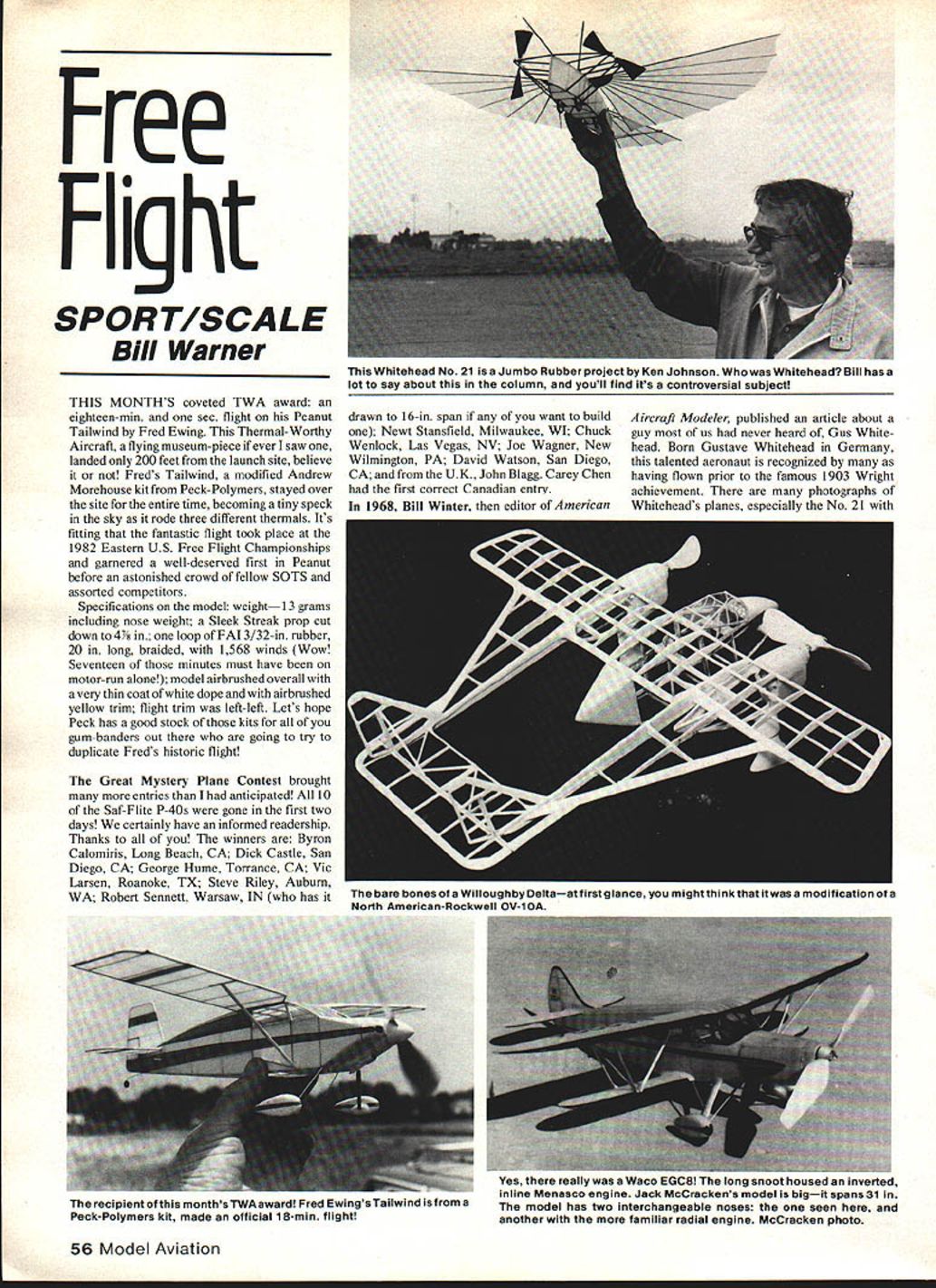
In 1968, Bill Winter, then editor of American Aircraft Modeler, published an article about a guy most of us had never heard of, Gus Whitehead. Born Gustave Whitehead in Germany, this talented aeronaut is recognized by many as having flown prior to the famous 1903 Wright achievement. There are many photographs of Whitehead's planes, especially the No. 21.
On August 14, 1901, he purported to have made aviation history near Bridgeport, Conn. Witnesses have signed affidavits and made recordings; newspapers and magazines reported Whitehead's work. Stella Randolph and others have written books and published pro-Whitehead evidence. Using the Freedom of Information Act, Major O'Dwyer secured a copy of the contract signed by the Smithsonian and the Wright estate in 1948, which granted the former the rights to display the original Wright flier. A very curious clause states the Smithsonian is America's final authority on what does or does not constitute the first flight, and that it will not recognize anyone who might have flown prior to the Wrights.
Authors at the National Air and Space Museum may have been involved in a somewhat less-than-enthusiastic search for the truth, citing the disappearance of material relating to Whitehead from Smithsonian files. The Smithsonian did send a representative to interview the woman who claimed to have seen Whitehead fly and has been arranging interviews with the world's leading pro-Wright historians.
Scientific American, on January 27, 1906, published an account of an exhibition of aeronautical apparatus of the Aero Club of America. Photographs of the flying machines exhibited included a single blurred photograph of a large birdlike machine, propelled by compressed air, constructed by Whitehead in 1901. Mrs. Randolph and others contend that some original photographs were turned over to the Smithsonian and that the Smithsonian now says it cannot find the file. Major O'Dwyer contends that a single blurred photo exists and perhaps may yet be found. The puzzle may be a photo on the wall at the 69th Regiment Armory in New York City, where the first aeronautical exhibit was held; four or five Whitehead photos were shown there.
Without taking sides, one can readily see the amount of work done. Ken Johnson has made Free Flight models of Whitehead No. 21 (see Model Builder, July 1982) and has made No. 21 fly by adding a vertical stabilizer in the present photos. The new book, however, gives evidence that there was a vertical rudder fitted underneath the horizontal stabilizer, and that it doubled as a water rudder.
If you are a nut on aviation history, I would think that this book would be one you or your local library should have. It may be obtained by sending $25, cash or bank check, to Fritz Majer & Sohn, 8801 Leutershausen, West Germany. The book is in English and is superbly done. The title is History by Contract. Any information on the whereabouts of the missing photo may be sent to me, and I will forward it to Major O'Dwyer who is continuing the fight to get Whitehead the recognition for his accomplishments.
Happy Hints Department
Have you tried heat-shrink tubing? It comes in all sizes and is easily obtainable from electrical suppliers. The smallest sizes are great for slipping over the hook on a prop shaft. Then apply a little heat from a match or hot soldering iron and they contract neatly onto the wire, making a hook which won't cut your rubber motor. They can be used to make winding tubes shrink to size (the bigger sizes used for wiring harnesses) which retain flexibility and toughness. A small bit shrunk on the end of an axle holds on a wheel.
Another hint for Hot Stuff addicts involves what to do when the darn stuff won't set up and you're tired of waiting. I used to blow a fine baking soda dusting on the joint, using just a pinch between thumb and first finger, and blowing toward the wet adhesive. A new product finding its way to the shelves in most hobby stores is a lifesaver (or time saver—from the smell I think that breathing it may do you no good). It comes in a small bottle with a pump-spray nozzle. When used, it evaporates almost instantly. Although it can be used to "prep" surfaces, at five bucks a bottle I prefer to just save it until I need that "instant" setting. It's a super-glue accelerator—makes cyanoacrylate glues set up almost instantly. Several manufacturers (ZAP, Ace, Hot Stuff) market it.
Make your own planes? Why not your own wheels? Your local surplus or auto parts store and even a hardware store or two can be relied on to stock a variety of sizes of O-rings. They make great-looking tires for gas jobs (weight is a factor with Peanuts). I don't recommend them for the clever rubber-motor "hook-ons" which some of the guys use them for. I have seen a couple break at very inopportune times, and I figure one has enough trouble without adding another thing to go wrong!
Like simple, weird models? Dave Aronstein of the Mid-Hudson Model Masters (Baron Von Heinigerbacher's outfit) has plans ranging from the ultralight Goldwing to the Miles Libellula. He has Peanut plans for the HE 100, Gipsy Moth, Stinson Reliant, Goon, Monocoque, and others. I've seen one of his ultralights, a Cloudebuster, fly, and his claim of a two-minute model is not exaggerated. Send him a buck for a plans list, and put some fun back in your jaded existence!
- Dave Aronstein, 50 Pasture Lane, Poughkeepsie, NY 12603
Our final hint of the day comes from none other than our neighbor in these pages, Bob Meuser. He pre-shrinks his superglue tissue in a frame. He then takes a Sharpie pen from an art-supply store and saws it open. The "guts containing the ink" are then sloshed around in a small pan with lacquer thinner (about 1/8-in. depth) in it. The resulting mess is then swabbed onto the tissue, using the absorbent material inside for a mop. Bob says that by "swabbing back and forth north and south, then east and west, then repeating with plain lacquer thinner, I managed to get it fairly even." Somewhat similar results may be obtained by using a Marks-A-Lot (alcohol-based) felt pen and overlapping strokes. Not as fancy, but a quick-and-dirty way to get the job done, especially on condenser paper. Yellow seems to work the best.
Thanks for the great support, the 5 x 7 contrasty prints (which I see too seldom) and the hints to share!
Bill Warner 423-C San Vicente Blvd. Santa Monica, CA 90402
Transcribed from original scans by AI. Minor OCR errors may remain.

