
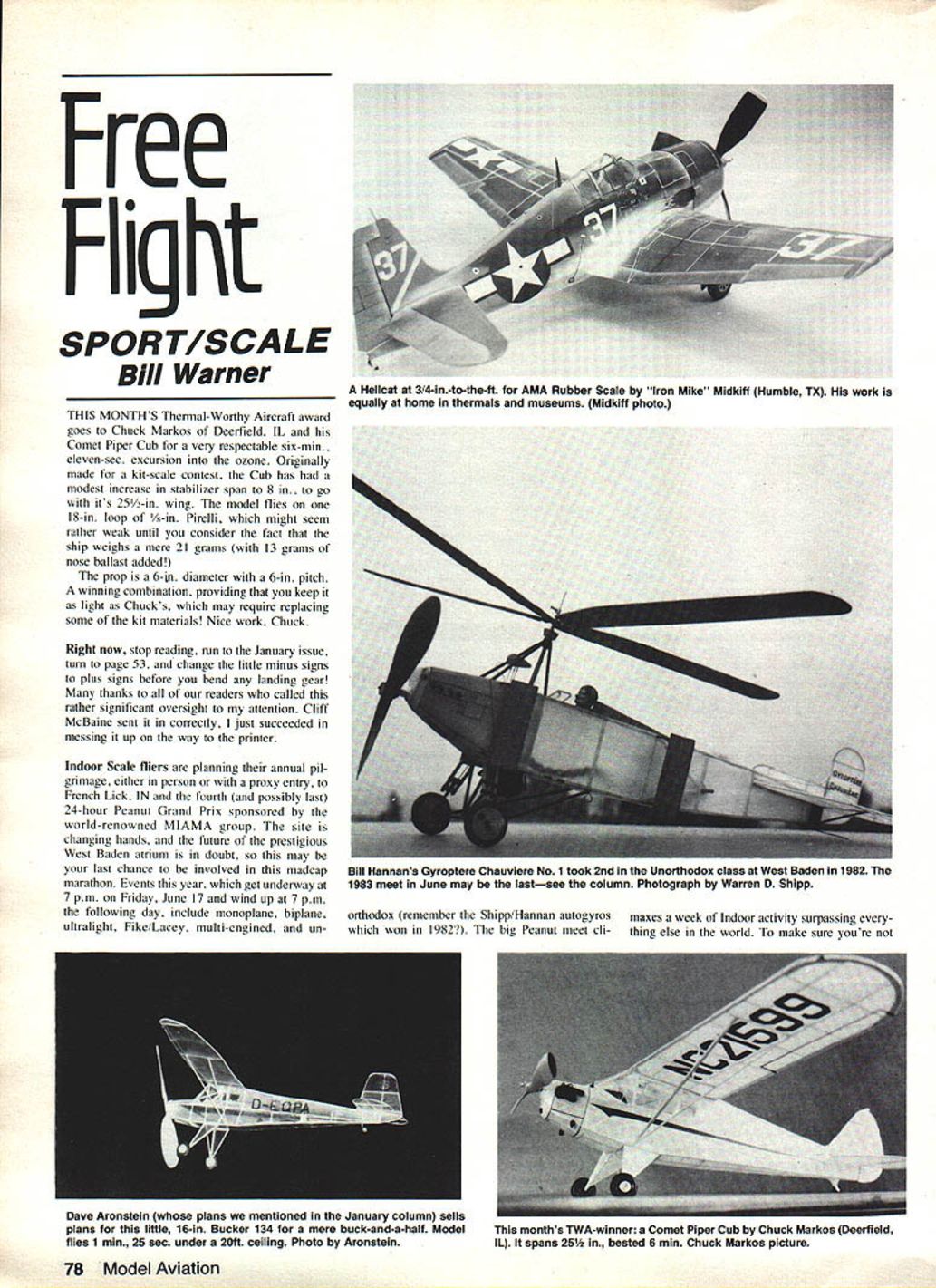
Free Flight SPORT/SCALE
Bill Warner
Thermal-Worthy Aircraft
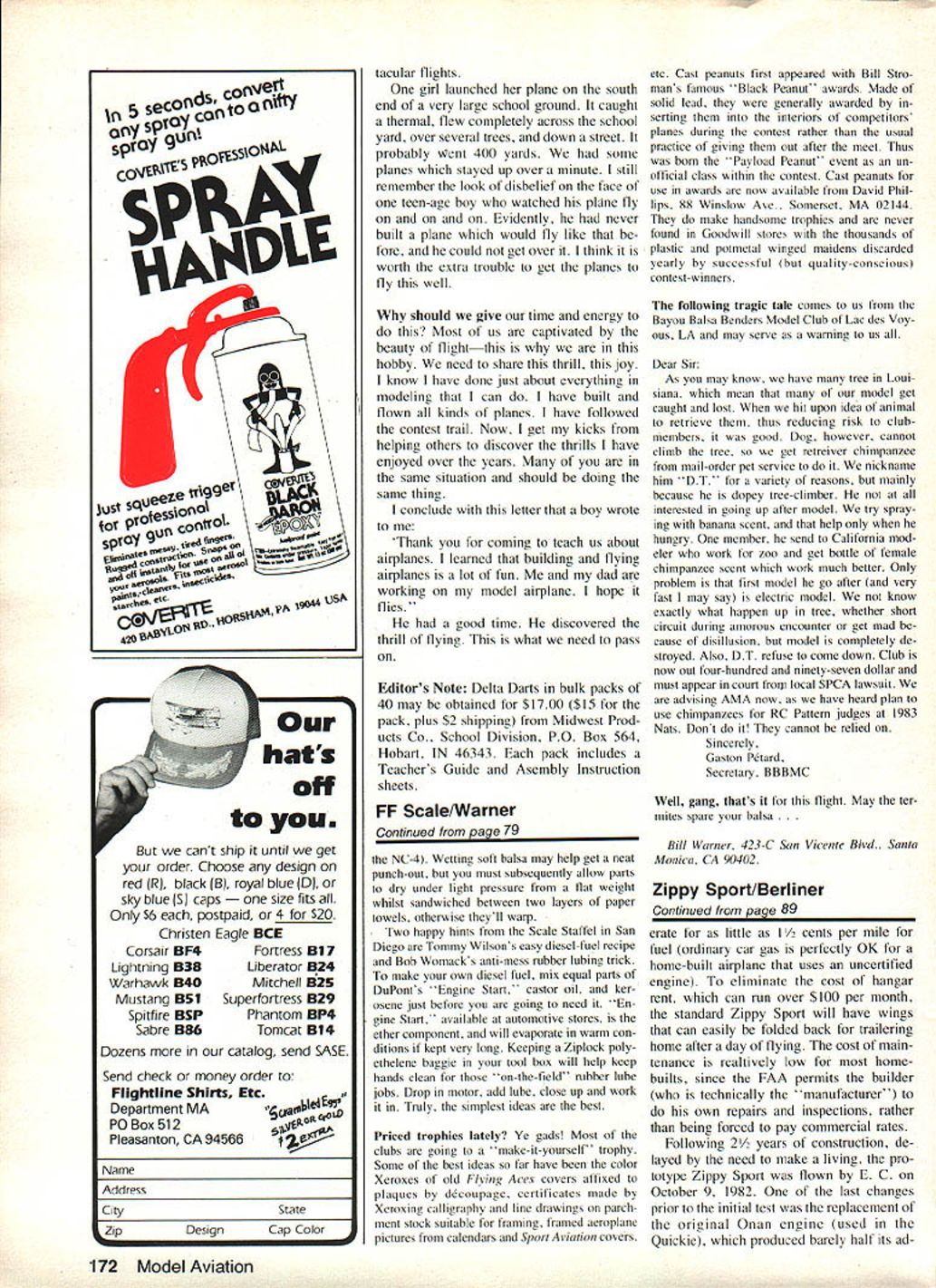
This month's Thermal-Worthy Aircraft award goes to Chuck Markos of Deerfield, IL, and his Comet Piper Cub for a very respectable six minutes, eleven seconds excursion into the ozone. Originally made for a kit-scale contest, the Cub has had a modest increase in stabilizer span to 8 in., to go with its 25½-in. wing. The model flies on one 18-in. loop of 5/64-in. Pirelli, which might seem rather weak until you consider that the ship weighs a mere 21 grams (with 13 grams of nose ballast added). The prop is 6 in. in diameter with a 6-in. pitch. A winning combination—provided that you keep it as light as Chuck's, which may require replacing some of the kit materials. Nice work, Chuck.
Corrections
Right now, stop reading, run to the January issue, turn to page 53, and change the little minus signs to plus signs before you bend any landing gear! Many thanks to all of our readers who called this rather significant oversight to my attention. Cliff McBaine sent it in correctly. I just succeeded in messing it up on the way to the printer.
Events: 24-Hour Peanut Grand Prix
Indoor scale fliers are planning their annual pilgrimage—either in person or with a proxy entry—to French Lick, IN and the fourth (and possibly last) 24-hour Peanut Grand Prix sponsored by the world-renowned MIAMA group. The site is changing hands, and the future of the prestigious West Baden atrium is in doubt, so this may be your last chance to be involved in this madcap marathon.
- Events begin at 7 p.m. on Friday, June 17 and wind up at 7 p.m. the following day.
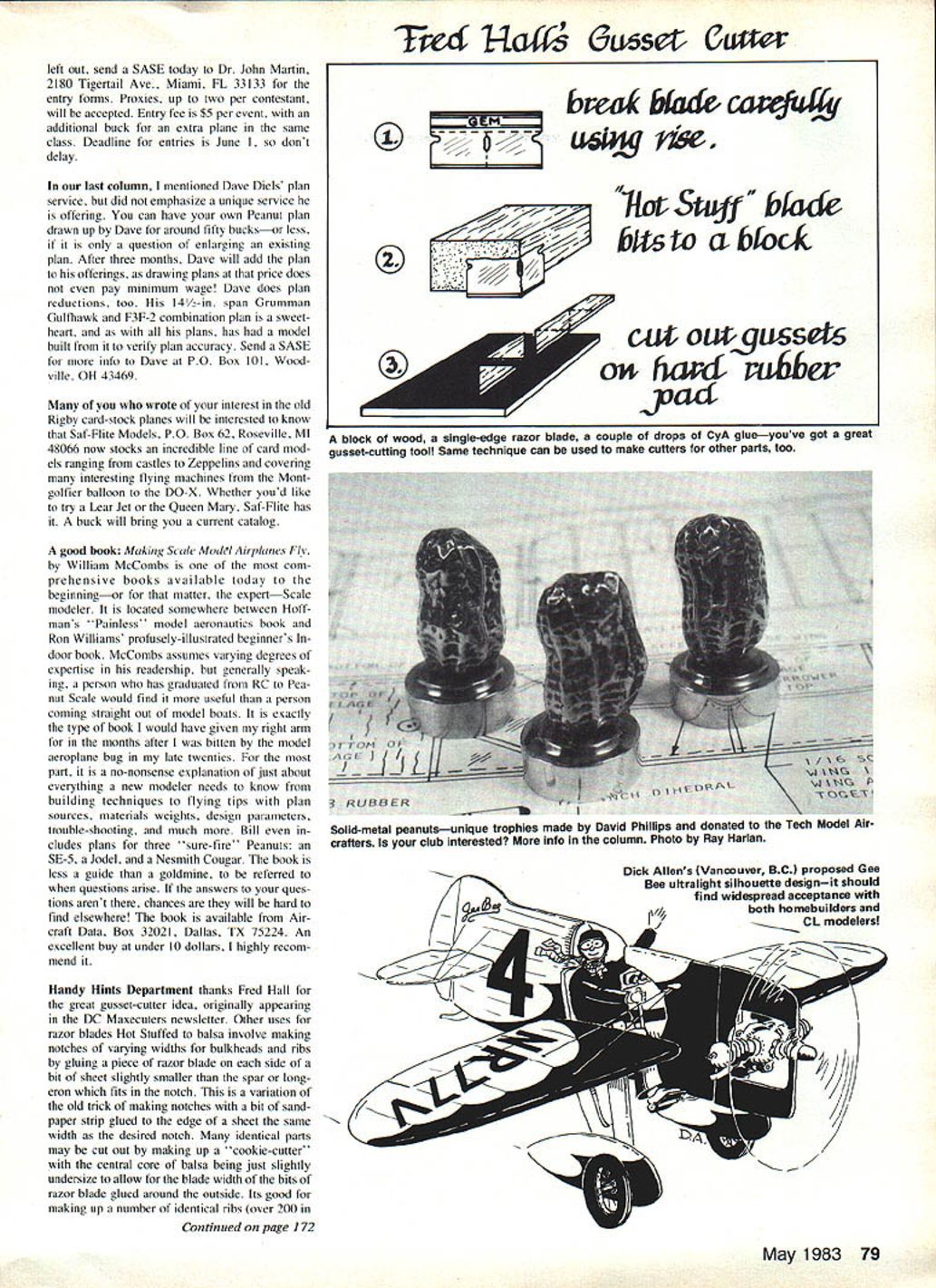
- Classes include: monoplane, biplane, ultralight, Fike/Lacey, multi-engined, and unorthodox (remember the Shipp/Hannan autogyros which won in 1982?).
- Proxies: Up to two per contestant will be accepted.
- Entry fee: $5 per event, plus $1 for an extra plane in the same class.
- Deadline: June 1.
To get entry forms, send a SASE to Dr. John Martin, 2180 Tigertail Ave., Miami, FL 33133.
Plan Services
In our last column I mentioned Dave Diels' plan service but did not emphasize a unique offering: you can have your own Peanut plan drawn up by Dave for around $50—or less if it is only a question of enlarging an existing plan. After three months Dave will add the plan to his offerings (drawing plans at that price does not even pay minimum wage!). Dave does plan reductions too. His 14½-in. span Grumman Gulfhawk and F3F-2 combination plan is a sweetheart, and, as with all his plans, a model has been built from it to verify accuracy. Send a SASE for more info to Dave at P.O. Box 101, Woodville, OH 43469.
Supplies and Resources
Many of you who wrote about your interest in the old Rigby card‑stock planes will be pleased to know that Saf‑Flite Models, P.O. Box 62, Roseville, MI 48066 now stocks an incredible line of card models ranging from castles to Zeppelins and covering many interesting flying machines from the Montgolfier balloon to the DO‑X. Whether you'd like to try a Lear Jet or the Queen Mary, Saf‑Flite has it. A dollar will bring you a current catalog.
Recommended Book
Making Scale Model Airplanes by William McCombs is one of the most comprehensive books available today for both beginner and expert scale modelers. It lies somewhere between Hoffman's "Painless" model aeronautics book and Ron Williams' profusely illustrated beginner's indoor book. McCombs assumes varying degrees of expertise in his readership, but generally a person who has graduated from RC to Peanut Scale will find it especially useful.
The book covers building techniques, flying tips, plan sources, materials, weights, design parameters, troubleshooting, and much more. Bill even includes plans for three "sure-fire" Peanuts: an SE‑5, a Jodel, and a Nesmith Cougar. The book is less a guide than a goldmine to be referred to when questions arise. If the answers to your questions aren't there, chances are they'll be hard to find elsewhere. Available from Aircraft Data, Box 32021, Dallas, TX 75224. An excellent buy at under $10—I highly recommend it.
Handy Hints
Thanks to Fred Hall for the great gusset‑cutter idea, originally appearing in the DC Maxecuters newsletter. Other uses for razor blades "hot-stuffed" to balsa include making notches of varying widths for bulkheads and ribs by gluing a piece of razor blade on each side of a bit of sheet slightly smaller than the spar or longeron which fits in the notch. This is a variation of the old trick of making notches with a strip of sandpaper glued to the edge of a sheet the same width as the desired notch.
Many identical parts may be cut out by making up a "cookie-cutter" with the central core of balsa slightly undersize to allow for the blade width of the razor bits glued around the outside. It's a great way to produce a number of identical ribs.
Teaching and Outreach
One girl launched her plane on the south end of a very large schoolground. It caught a thermal, flew completely across the schoolyard, over several trees, and down a street—probably about 400 yards. We had some planes that stayed up over a minute. I still remember the look of disbelief on the face of one teenage boy who watched his plane fly on and on and on. Evidently he had never built a plane which would fly like that before, and he could not get over it. I think it is worth the extra trouble to get planes to fly this well.
Why should we give our time and energy to do this? Most of us are captivated by the beauty of flight—this is why we are in this hobby. We need to share this thrill, this joy. I know I have done just about everything in modeling that I can do. I have built and flown all kinds of planes and have followed the contest trail. Now I get my kicks from helping others discover the thrills I have enjoyed over the years. Many of you are in the same situation and should be doing the same thing.
I conclude with this letter that a boy wrote to me:
"Thank you for coming to teach us about airplanes. I learned that building and flying airplanes is a lot of fun. My dad and I are working on my model airplane. I hope it flies."
He had a good time. He discovered the thrill of flying. This is what we need to pass on.
Editor's Note
Delta Darts in bulk packs of 40 may be obtained for $17.00 ($15 for the pack, plus $2 shipping) from Midwest Products Co., School Division, P.O. Box 564, Hobart, IN 46343. Each pack includes a Teacher's Guide and Assembly Instruction sheets.
FF Scale/Warner
Continued from page 79
Wetting soft balsa may help get a neat punch‑out, but you must subsequently allow parts to dry under light pressure between two layers of paper towels; otherwise they'll warp.
Two happy hints from the Scale Staffel in San Diego are Tommy Wilson's easy diesel‑fuel recipe and Bob Womack's anti‑mess rubber‑lubing trick.
- Diesel fuel: Mix equal parts of DuPont's "Engine Start," castor oil, and kerosene just before use. "Engine Start," available at automotive stores, provides the ether component and will evaporate in warm conditions if kept too long.
- Rubber lube: Keep a Ziplock polyethylene baggie in your tool box to help keep hands clean for those on‑the‑field rubber jobs. Drop in the motor, add lube, close up, and work it in. Simple and effective.
Trophies
Priced trophies lately? Ye gads! Most clubs are going to "make‑it‑yourself" trophies. Some good ideas:
- Xeroxes of old Flying Aces covers affixed to plaques by decoupage.
- Certificates made by xeroxing calligraphy and line drawings on parchment stock suitable for framing.
- Framed airplane pictures from calendars and Sport Aviation covers.
Cast peanuts first appeared with Bill Stroman's famous "Black Peanut" awards. Made of solid lead, they were sometimes inserted into competitors' planes during contests (rather than being handed out afterward), which led to the unofficial "Payload Peanut" event. Cast peanuts for use in awards are now available from David Phillips, 88 Winslow Ave., Somerset, MA 02144. They make handsome trophies.
A Cautionary Tale
The following tragic (and cautionary) tale comes from the Bayou Balsa Benders Model Club of Lac des Voyous, LA:
Dear Sir:
As you may know, we have many trees in Louisiana, which means that many of our models get caught and lost. When we hit upon the idea of using an animal to retrieve them, thus reducing risk to club members, it seemed good. Dogs, however, cannot climb the tree, so we ordered a retriever chimpanzee from a mail‑order pet service. We nicknamed him "D.T." for a variety of reasons.
He is a dopey tree‑climber. He is not at all interested in going up after models unless he is hungry, and spraying banana scent helps only then. One member sent to California to order someone who works for a zoo and got a bottle of female chimpanzee scent, which worked much better. Only problem: the first model he went after (and very fast, I may say) was an electric model. We do not know exactly what happened up in the tree—whether a short circuit during the arousal encounter or something else—but the model was completely destroyed. Also, D.T. refused to come down. The club is now out four hundred and ninety‑seven dollars and must appear in court from a local SPCA lawsuit. We are advising the AMA now, as we have heard plans to use chimpanzees for RC Pattern Judges at the 1983 Nats. Don't do it! They cannot be relied on.
Sincerely, Gaston Petard, Secretary, BBBMC
Well, gang, that's it for this flight. May the termites spare your balsa...
Bill Warner 423‑C San Vicente Blvd. Santa Monica, CA 90402
Transcribed from original scans by AI. Minor OCR errors may remain.

