


Free Flight
Duration
Bob Meuser
Time out! Yes, even our tireless Contributing Editor Bob Meuser needs to take a little time off every now and then. We've asked long-time FF flier/writer/editor/publisher Bill Hartill to take over for Bob this month.
Defining Free Flight — Duration
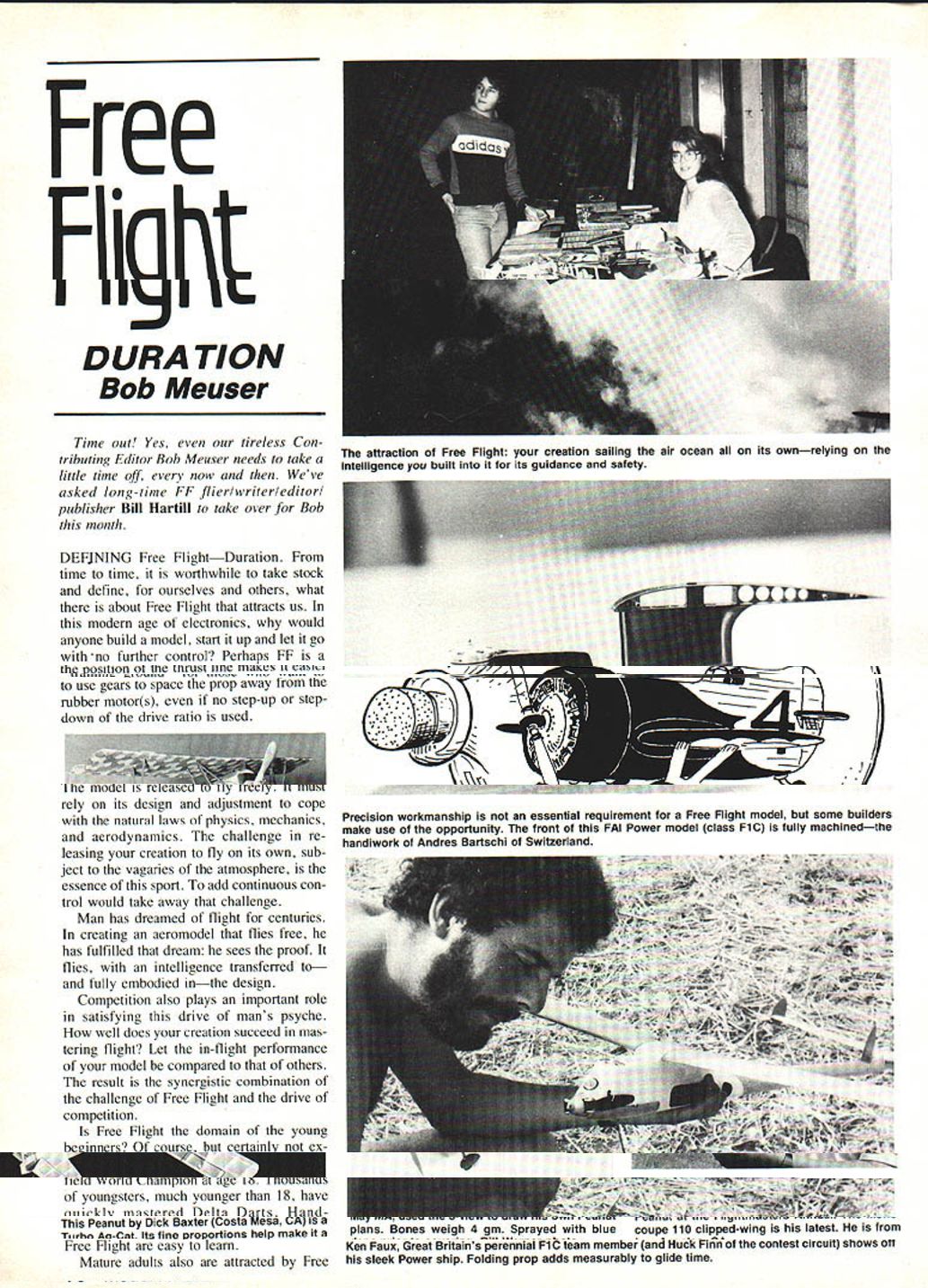
From time to time it is worthwhile to take stock and define, for ourselves and others, what there is about Free Flight that attracts us. In this modern age of electronics, why would anyone build a model, start it up and let it go with no further control?
The model is released to fly freely. It must rely on its design and adjustment to cope with the natural laws of physics, mechanics, and aerodynamics. The challenge in releasing your creation to fly on its own, subject to the vagaries of the atmosphere, is the essence of this sport. To add continuous control would take away that challenge.
Man has dreamed of flight for centuries. In creating an aeromodel that flies free, he has fulfilled that dream: he sees the proof. It flies, with an intelligence transferred to—and fully embodied in—the design.
Competition also plays an important role in satisfying this drive of man's psyche. How well does your creation succeed in mastering flight? Let the in-flight performance of your model be compared to that of others. The result is the synergistic combination of the challenge of Free Flight and the drive of competition.
Is Free Flight the domain of the young beginners? Of course, but certainly not exclusively. Field world champions at age 18 are not uncommon. Thousands of youngsters, much younger than 18, have quickly mastered Delta Darts.
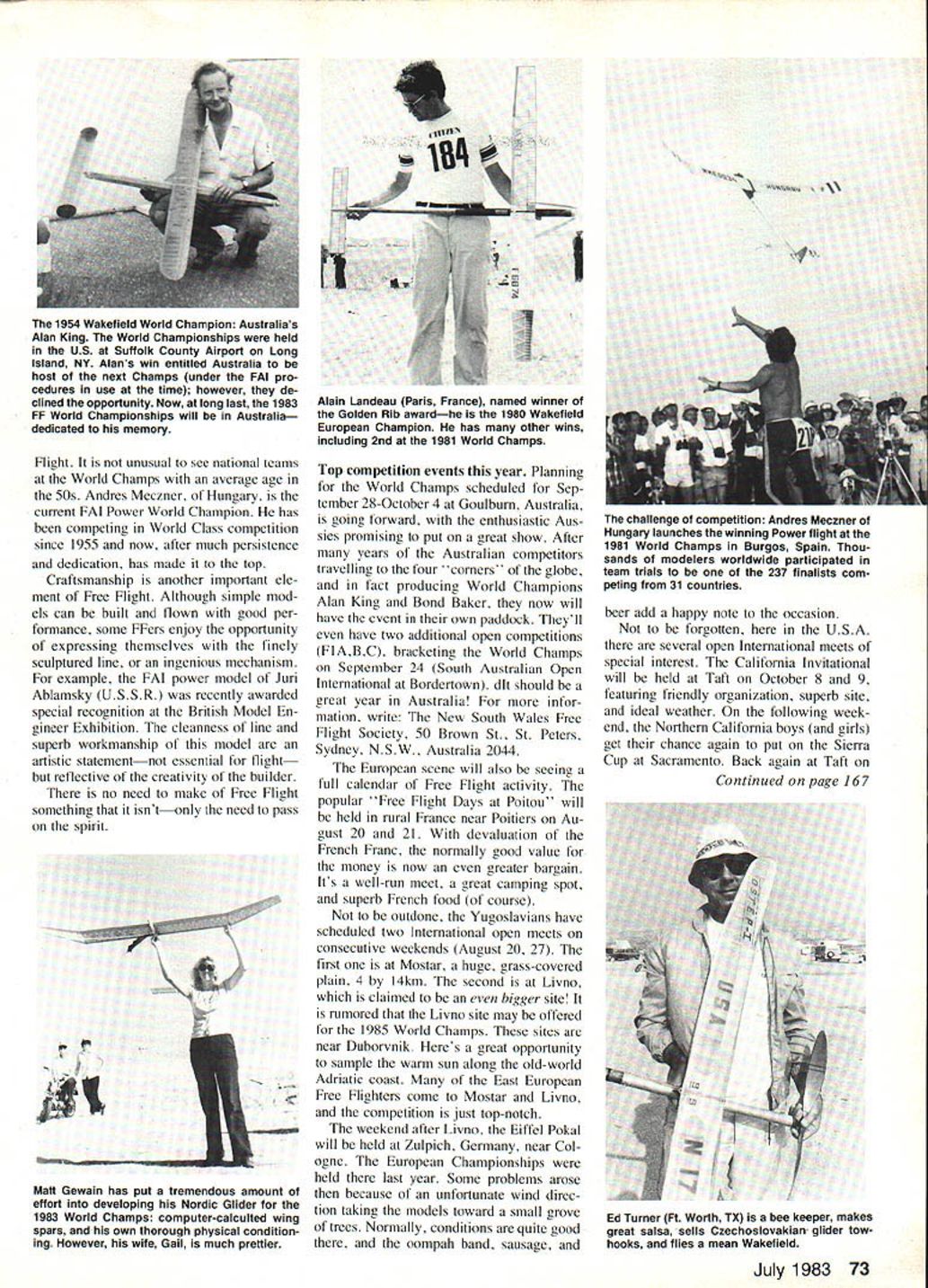
Flight. It is not unusual to see national teams at the World Champs with an average age in the 50s. Andres Mezcner, of Hungary, is the current FAI Power World Champion. He has been competing in World Class competition since 1955 and now, with much persistence and dedication, has made it to the top.
Craftsmanship
Craftsmanship is another important element of Free Flight. Although simple models can be built and flown with good performance, some FFers enjoy the opportunity of expressing themselves with the finely sculptured line or an ingenious mechanism. For example, the FAI power model of Yuri Ablamsky (U.S.S.R.) was recently awarded special recognition at the British Model Engineering Exhibition. The cleanness of line and superb workmanship of this model are an artistic statement—not essential for flight—but reflective of the creativity of the builder.
There is no need to make of Free Flight something that it isn't—only the need to pass on the spirit.
Top competition events this year
Planning for the World Champs scheduled for September 28–October 4 at Goulburn, Australia, is going forward, with the enthusiastic Aussies promising to put on a great show. After many years of Australian competitors travelling to the four "corners" of the globe, and in fact producing World Champions Alan King and Bond Baker, they now will have the event in their own paddock. They'll even have two additional open competitions (F.I.A.B.C.), bracketing the World Champs with the South Australian Open Invitational at Bordertown on September 24. It should be a great year in Australia!
For more information, write: The New South Wales Free Flight Society, 50 Brown St., St. Peters, Sydney, N.S.W., Australia 2044.
- Europe: The popular "Free Flight Days at Poitou" will be held in rural France near Poitiers on August 20 and 21. With devaluation of the French franc, the normally good value for the money is now an even greater bargain. It's a well-run meet, a great camping spot, and superb French food.
- Yugoslavia: Two international open meets on consecutive weekends (August 20, 27). The first is at Mostar, a huge, grass-covered plain, 4 by 14 km. The second is at Livno, claimed to be an even bigger site. It is rumored that the Livno site may be offered for the 1985 World Champs. These sites are near Dubrovnik—great opportunities to sample the warm sun along the old-world Adriatic coast. Many East European Free Flighters attend Mostar and Livno, and the competition is top-notch.
- Germany: The Eiffel Pokal at Zulpich (near Cologne) follows the Yugoslav meets. The European Championships were held there last year. Some problems arose then because of an unfortunate wind direction that took models toward a small grove of trees. Normally conditions are quite good there, and the oompah band, sausage, and beer add a happy note to the occasion.
- U.S.A.: Several open international meets of special interest. The California Invitational will be held at Taft on October 8 and 9, featuring friendly organization, a superb site, and ideal weather. The following weekend, the Northern California flyers put on the Sierra Cup at Sacramento.
Bentom Bi-matic gearbox
Jim Algar, editor of the Flightmasters monthly newsletter, has studied the Bentom Bi-matic box, and his description helps make sense out of what goes on inside.
First, there is a front and a rear chamber, each with a slip-gear that only engages in one direction, thereby allowing free-wheeling. The front chamber's gears are for hand-winding the model (they are not designed for the likes of us who use rubber winders). They give you 1:1 when putting the winds in. During the prop run, the rear chamber comes into play and drives the prop twice for each turn of the motor, with the front gears just going along for the ride in the disengaged mode.
In the drawing, Figure 1 shows C (to which the rubber is attached) driving the slip-gear B; the length of its slot engages the prop-shaft gear A. Figure 2 shows what happens to these gears when the rubber has done its job. Figure 3 helps you see where the front slip-gear is during the no-power mode. Finally, in Figure 4, cranking the prop (gear D) drives the slip-gear into engagement with the rubber motor gear F, and you are about ready to fly again.
The fact that the gearbox will shift gears when you are playing around with it and manage to turn it 90° so that the slip-gears are gravity-operated does not mean that it shifts in flight. (Still, it would be nice if it could be made to do so, wouldn't it?)
California Model Imports, P.O. Box 1695, Garden Grove, CA 92642 distributes Bentom. The large unit is $4.95, and the small one is $9.95 (the small one is more expensive because it has a styrofoam ready-made plane attached). Let us know how these gearboxes perform in your models!
Handy Hints
- Use butyrate dope thinner to shrink Microlite windows on your next superlight indoor model. Dick Baxter tried it on his 4-gram LET XZ 37-7 Indoor Peanut, and it works great.
- Terry Hall has been seen at the Revere JHS Sunday indoor meets with a Sterling winder and counter setup, using a drive disc just behind the hook to turn a counter via a rubber belt. The wooden mounting for the winder can be held between your knees, allowing you to wind when all the others are too busy to hold your model.
- Nick DeCarlis made up a counter a couple of years back using a cheap pocket calculator whose "plus" button was hit once each turn by a cam.
Zippy Sport → Peanut build
Yesterday, when the May 1983 issue of Model Aviation arrived, I was enchanted by the little Zippy Sport article and three-view. With one day of vacation left, I decided to draw it up as a Peanut and build it, and, if possible, have it done to include with this column.
Well, gang, you may be able to build a normal Peanut from a plan in a day, but all I got done was the frame! What you see is about 16 hours' work from the time I started drawing it up to picture time. Presently at four grams, I figure another two or three grams will finish it. With the long nose, it should balance without added ballast.
I mention the Zippy because it was a challenge to see how fast a model could go from the three-view to the flying stage (I'd guess about 26 hours in all), and to use this as leverage to goad a few of my friends who "just don't have time to build a model" into getting going on one. Peanut models give you more fun per hour invested than any other. I think—even ones for which you have to sketch up your own plan can be made in the time many of us waste in front of the tube, using our lunch break for eating instead of slicing ribs, or sleeping in on our days off. Come on — right now list 10 models you'd like to build, and get one of them started by tonight!
Making the Zippy gave me an opportunity to try rounding a bunch of 1/20 balsa sticks for all the bracing struts visible through the "large-glassed" area. A brass plate with small holes worked like a charm. With a little sanding sealer and 400-grit sanding, they should look like exterior detail. I sprayed the entire framework with thinned blue nitrate dope (Old-Timer Models). Normally I would spray only the part that shows inside, but I figured I might use condenser paper covering which shows up the underlying structure. At least it will be consistent.
Believe It or Not Department
Bill Stroman (Norwalk, CA) has built a completely weightless Peanut! To prove it, he stood on the bathroom scale and had his wife, Sharon, hand him the aforesaid model. The reading on the scale did not budge!
The next time you are readying a plastic (nylon) prop for use on your gassie, remember the old trick of boiling it in an uncovered pot for 30 minutes, letting it stay in until the water cools. If you add some dye to the water, not only will you have a prop which will not become brittle and break, but one with a scale color to it. Explaining the brown dot to your spouse may prove difficult, but the appearance of the model will more than make up for it! Remember to store plastic props wrapped in a damp paper towel in a water-tight baggie between uses. Nylon's affinity for water can be a plus for you as well as an aid in keeping John Preston happy.
Well, guys and gals, keep your rubber out of the sun, your open cockpits filled with three people, and your eyes on the skies!
Bill Warner 423-C San Vicente Blvd., Santa Monica, CA 90402.
Transcribed from original scans by AI. Minor OCR errors may remain.

