
Free Flight SPORT/SCALE
Bill Warner
Overweight kit models, revisited
Bill Miller is not a newcomer to Scale. Flying Aces members know him well as the creator of the Hungorilla, a mythical simian whose power is unleashed the instant the unwary modeller winds in that "one turn too many" and who shreds all but the most solid of models from the inside out. Bill is a devotee of the Guillow's (pronounced GWILL-ows) kits, which many have found lacking in performance, and I would like to present his case for the "heavy" model.
Bill points out that in the mid-Thirties Cleveland used to advertise a "hollowing-out" option for their Superscale kits which involved leaving out ribs and stringers, hollowing block parts, etc., to get flight performance. His technique is to use the kit stringer wood for the wing LE and TE, as well as for the top, bottom, and side keels. The fuselage and tail formers are then given the "diet" treatment with an X-Acto knife or a Dremel tool, taking excess material out of the inside outlines. He opens up the nose for a larger nose plug, which allows stretch-winding, and leaves off the landing gear on planes that had retracts. Every other wing rib is consigned to the scrap heap, as are all but one or two spars on the top of the wing. He says that he finds the heavy wood in the kits a blessing, and that he is too heavy-handed and impatient to make a go of the "boutique" kits often praised in this column.
Good point. Modelers come in all preferences!
Miller's lightening technique and performance
The 900-series kits from Guillow, says Bill, fly great unaltered with a loop each of 1/2-in. and 1/4-in. Sig flat rubber, sometimes with a larger nose plug and prop. He especially likes the instructions in the 900- and 600-series for their clarity—easy for the "technically illiterate" to follow. I certainly have noticed that about their plans, too. It is unfortunate that more kids do not take the time to read them. I have about a hundred kids ranging from 11 to 15 years old in aviation classes and a model club, and believe me, following directions is not their strong point.
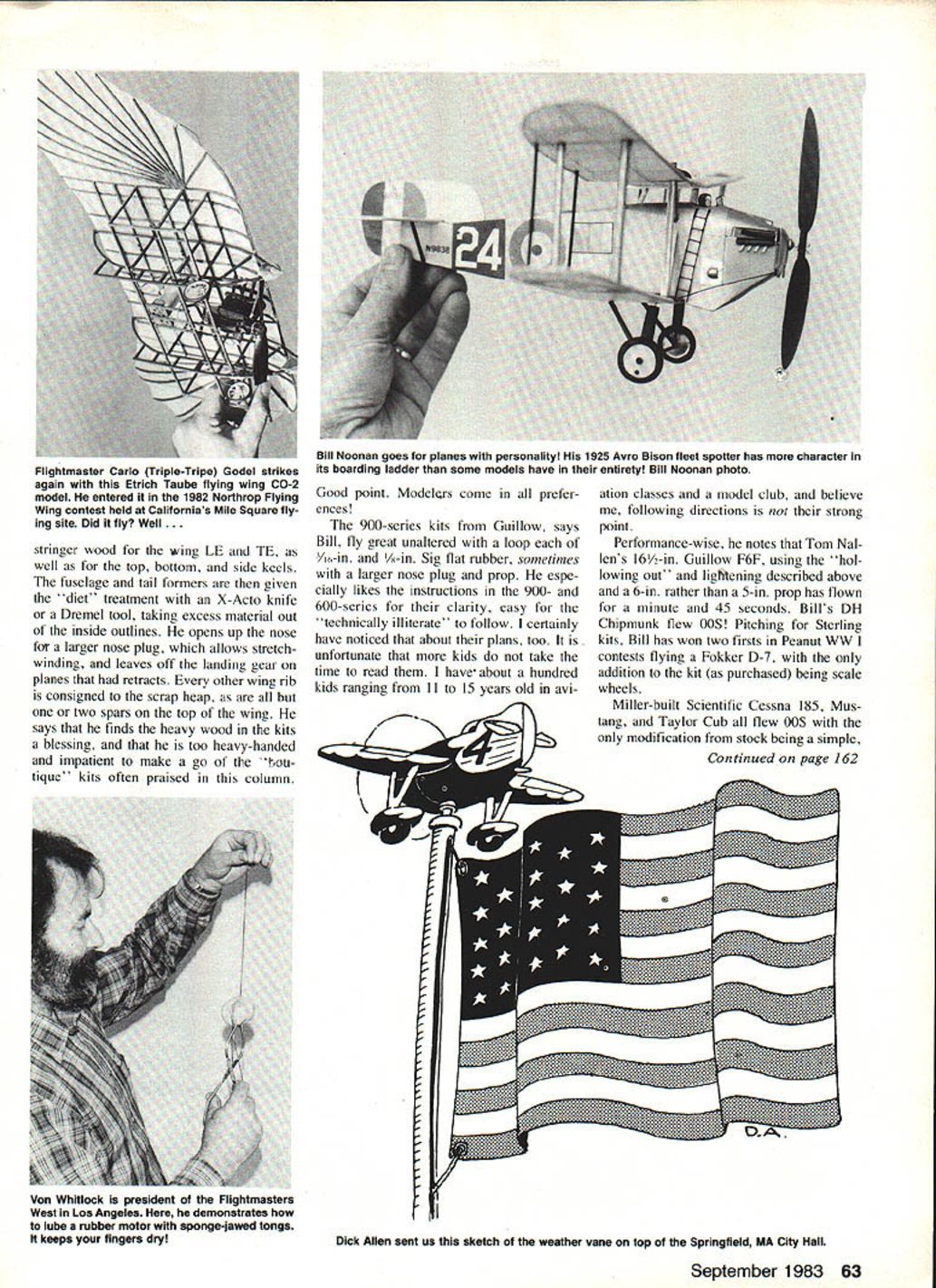
Performance-wise, he notes that Tom Nallen's 16-in. Guillow F6F, using the "hollowing out" and "lightening" described above and a 6-in. rather than a 5-in. prop, has flown for a minute and 45 seconds. Bill's DH Chipmunk flew OOS. Pitching Sterling kits, Bill has won two firsts in Peanut WW I contests flying a Fokker D-7, with the only addition to the kit (as purchased) being scale wheels.
Miller-built Scientific Cessna 185, Mustang, and Taylor Cub all flew OOS with the only modification from stock being a simple removable nose block. The Mustang was lost on a 10-minute-plus flight with a Guillow's 6-in. plastic prop—certainly impressive!
Well, Bill certainly has done well in defending a point of view which I will admit is not much in vogue in the West. He opines that the fact that prevailing winds bring all the air pollution garbage toward the East (he lives in the historic town of Fairfield, CT) makes it necessary to have sturdier planes which can punch up through the mess and then just ride around on top of it. Interesting theory!
Guillow kits tested by junior modelers
I also heard from Guillow, who, though not rebutting any of the points made in the discussion sparked by Will Volny, sent me four of their kits which they felt were their best fliers. These were:
- Arrow (non-scale)
- Lancer (non-scale)
- Piper Super Cub (semi-scale)
- Fairchild 24 (semi-scale)
I promised to turn them over to my testing committee of experienced junior modelers with the admonition to build them per plan and no changes allowed.
An initial burst of enthusiasm saw three students in my model club at Paul Revere Junior High in Los Angeles madly going at the Lancer, one even offering to come in after school and finish it himself. An attractive kit, but not finished despite their best efforts.
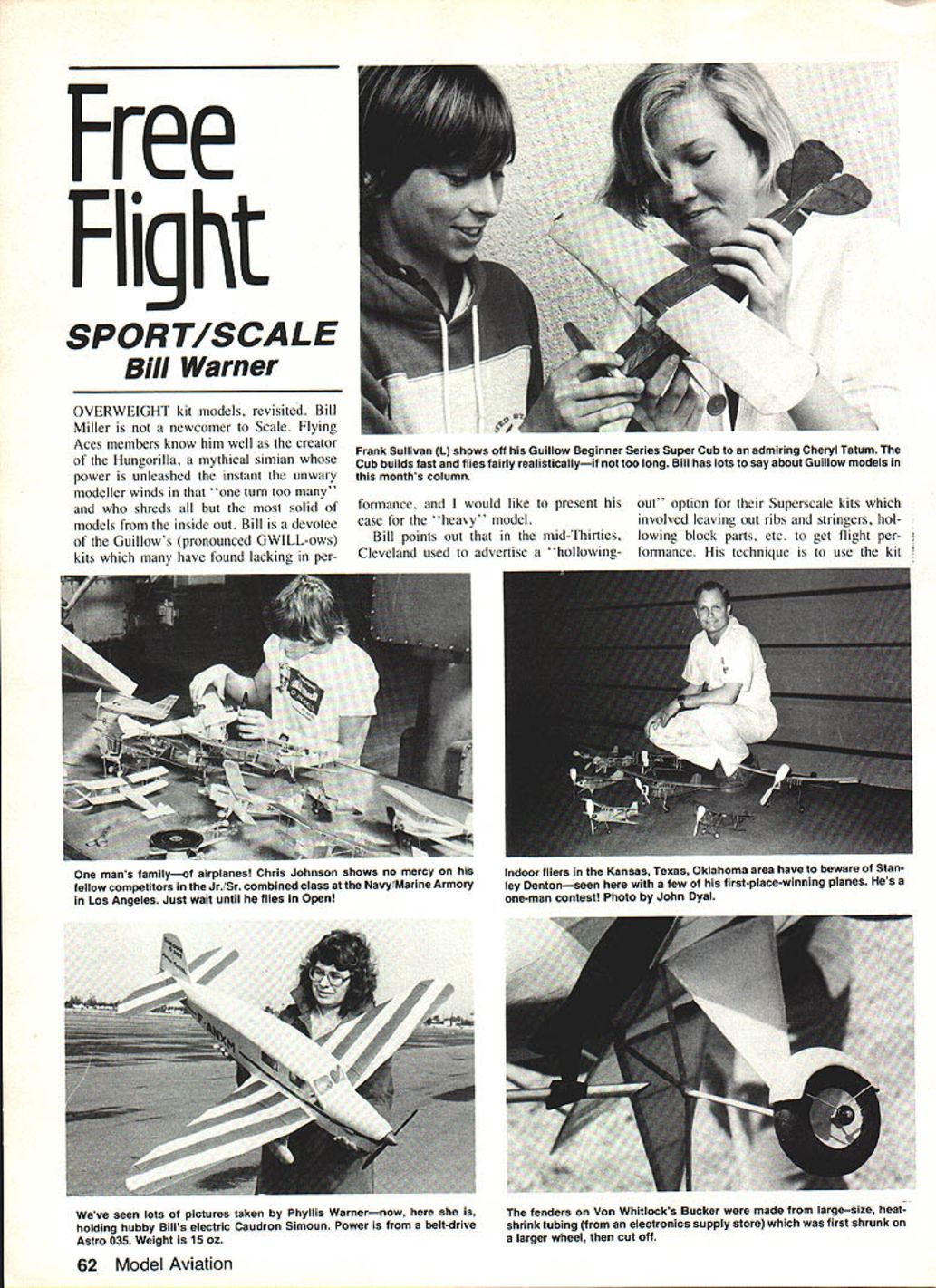
Frank Sullivan took the Super Cub home and returned with it in nothing flat. It drew plenty of compliments, and even flew for about 30 ft. It was heavy, but aerodynamic, and the fact that it did not attain 500 ft. altitude or stay up for a couple of minutes did not seem to bother the admiring crowd outside my classroom.
The next plane to come in was the Arrow, assigned to Ricky Lin. It had a half-inch warp in the right wing, but it looked great, and he had offers from admirers to buy it on the spot. At this writing, he's de-warping it for the first flight. It's really tail-heavy and will require about a half a golf-ball of clay, at least. Would a kid in Podunk, Iowa know about warps or center-of-gravity position if he, as most kids, did not study the directions? Still, the Arrow is a really attractive design. We'll see how much fun it is stretch-winding a motor and then trying to get it back in that tiny nose-plug hole!
The Fairchild, due to a refusal on the part of its 13-year-old builder to follow directions, flew well. He made a removable noseblock, giving about a half-inch square opening in the nose for stretch-winding. Beautiful flights of about 30 seconds were possible.
Complaints from the kids centered around the use of plastic vacu-formed parts which either were not fully formed (exhaust array on the Arrow) or sturdy enough (nose on the Super Cub). The die-cut parts also gave trouble, as they did not always fit. Ricky, especially, had problems dealing with the weight of materials, having already made five Peck-Polymers kits. He was used to contest balsa, and it was hard to get used to the kit wood which was almost three times the density.
Verdict: progression for modelers
The verdict? Starting with Guillow, Comet, Sterling, or Scientific is fine if you do not expect more than they can deliver. Reading their generally well-thought-out directions can provide you with a wealth of information. The next level involves Miller's lightening or "hop-up" routine, which can render kits flyable without the use of "contest" materials. My own feeling is that from there one goes to the "boutique" kit (Miller's term), such as Pecks, Dubois, Classic Models, Flyline, Golden Age, etc. From there, the plan model where one selects the appropriate materials rather than just using "what's in the kit," and eventually to drawing up one's own models from three-views seem to be a logical progression. Still, most modelers, no matter how advanced, delight in seeing a good kit. A good kit is a promise of flight, of compliments, of personal satisfaction. I'm sure all kit makers would like to have their clients succeed. Let's encourage them to keep improving their products!
"May the termites spare your balsa." An innocent little sign-off line in a recent column, but one which brought a sad letter from Bob Lickfeld out in New Mexico.
Pest infestation: Dermestes maculatus
Bob's son was doing a 4-H project on tanning hides. One evening, while out there in the quiet, Bob heard a faint "scritch-scritch-scritch" sound which led to the styrofoam box of a Mattel Vacu-Form set. Close inspection showed that the sounds were coming from the foam itself! Indeed there were innumerable 1/8-in.-diameter holes in the foam which had little furry beasts in them. Said beasts were busy "eating" (or at least boring into) the foam!
Most of Bob's collection of balsa kits, finished airplanes, and stocks of balsa wood were riddled with 1/16-in.-diameter holes, each containing a furry larva. He sent me samples of the damaged materials, including a piece of Microlyde Indoor wood which had been slant-bored along with thirty-nine others! Bob observed that nothing was spared unless it presented a smaller cross-section than the bugs! What a way to lighten up your models!
A trip to the entomologist at the local university revealed that the culprits were the offspring of the hide and leather beetle, Dermestes maculatus. They love soft burrowing material, and balsa is a natural if there are no hides around. Bob sealed all of the infested materials into plastic trash bags along with Shell "No-Pest Strips," and the problem disappeared. Still, I got rid of the samples he sent me posthaste, well-wrapped in metal foil! I considered sending them to Meuser, but . . .
Happy hint: single-edged razor blades
This month's happy hint has to do with a great source of single-edged razor blades. Since the great shaving revolution involving stainless steel blades (great for beards, lousy for anything else), modelers have been up against it for a blade that would hold an edge. The newsletter of the San Diego Scale Staffer recently recommended a source of single-edged blades for a reasonable price. When my order for a hundred arrived, I was happy—the blades being average carbon steel. My next order, however, was filled with PAL-brand blades, blued and all, and they really hold an edge! A hundred of these little beauties will cost you only four dollars and twenty-five cents, postpaid from:
Cobbie's Gifts P.O. Box 2 Deal, NJ 07723
Ask for the PAL blades.
Closing
Well, gang, I'm trying to get caught up with the letters which keep this column going. Wish we had space for all of 'em! They are much appreciated. Until next time, may Dermestes maculatus spare yer balsa (and styrofoam, for the RC crowd!).
Bill Warner 423-C San Vicente Blvd. Santa Monica, CA 90402.
Transcribed from original scans by AI. Minor OCR errors may remain.

