
Free Flight
SPORT/SCALE Bill Warner
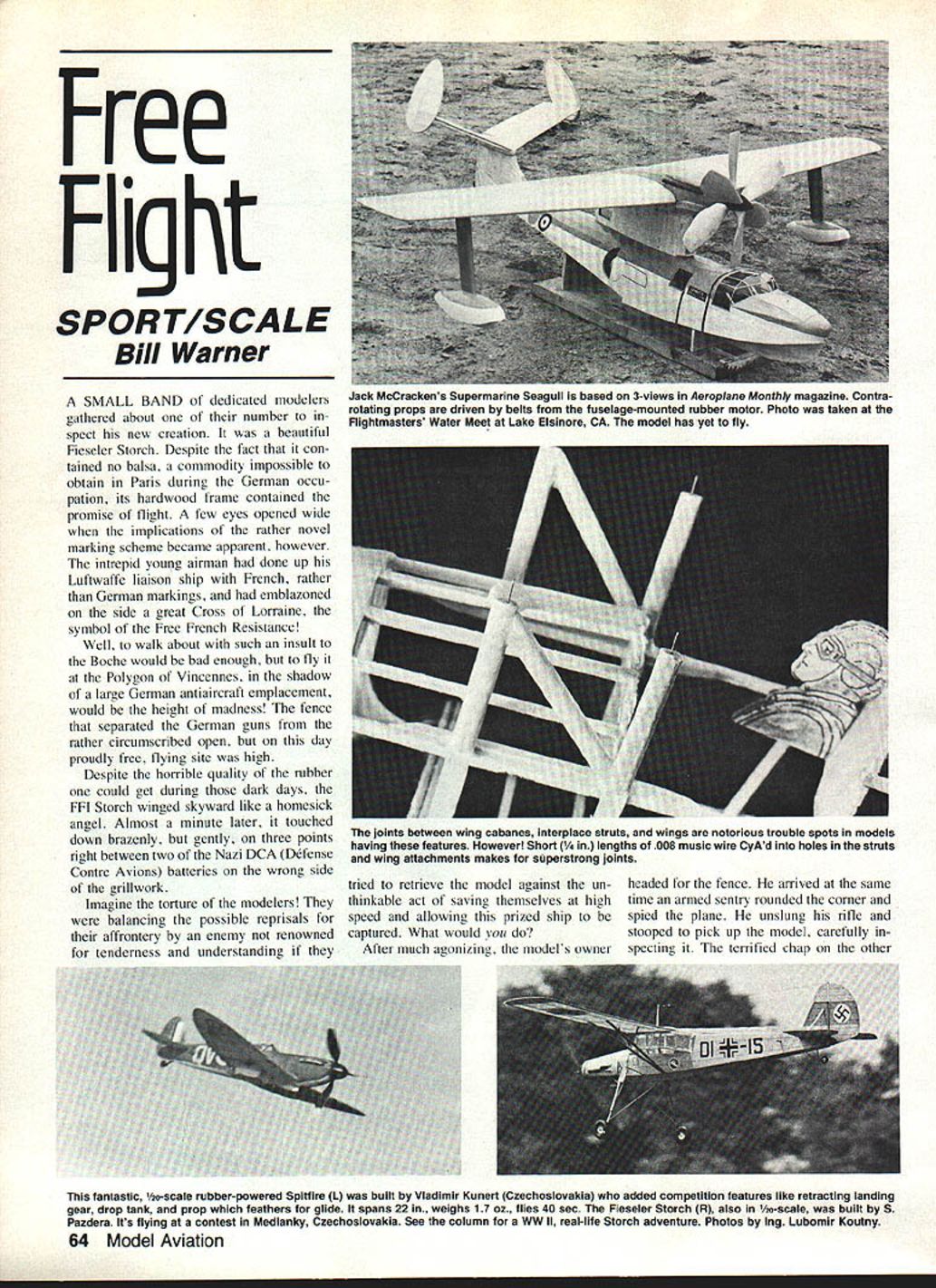
A small band of dedicated modelers gathered about one of their number to inspect his new creation. It was a beautiful Fieseler Storch. Despite the fact that it contained no balsa—a commodity impossible to obtain in Paris during the German occupation—its hardwood frame contained the promise of flight. A few eyes opened wide when the implications of the rather novel marking scheme became apparent, however. The intrepid young airman had done up his Luftwaffe liaison ship with French, rather than German, markings, and had emblazoned on the side a great Cross of Lorraine, the symbol of the Free French Resistance.
Well, to walk about with such an insult to the Boche would be bad enough, but to fly it at the Polygon of Vincennes, in the shadow of a large German antiaircraft emplacement, would be the height of madness! The fence that separated the German guns from the rather circumscribed open, but on this day proudly free, flying site was high.
Despite the horrible quality of the rubber one could get during those dark days, the FFI Storch winged skyward like a homesick angel. Almost a minute later it touched down brazenly, but gently, on three points right between two of the Nazi DCA (Defense Contre Avions) batteries on the wrong side of the grillwork.
Imagine the torture of the modelers! They were balancing the possible reprisals for their affront by an enemy not renowned for tenderness and understanding if they tried to retrieve the model against the unthinkable act of saving themselves at high speed and allowing this prized ship to be captured. What would you do?
After much agonizing, the model's owner headed for the fence. He arrived at the same time an armed sentry rounded the corner and spied the plane. He unslung his rifle and stooped to pick up the model, carefully inspecting it. The terrified chap on the other side of the fence stood frozen in his tracks, knowing in his heart that the end had come. The German's eyes met his, and our hero watched the approach of this grey-uniformed warrior with model in one hand and rifle in the other. To the amazement of all present, the German pitched the Fieseler expertly over the fence along with the command to beat it! Our friends needed no encouragement in that department, and though they laughed about it later, at the time it was a deadly-serious business.
It is too bad that the person who related that incident to me, the famous Maurice Bayet, who did so much to further aeromodelling in France with Le Modèle Réduit d'Avion over a 40-year period, cannot be at the 1984 Flying Aces Nats (Mk. IV), where French, German, American, Russian, and other enmities are forgotten and the spirit of true aeromodelling transcends wars, occupations, and other petty inventions of mankind.
Cosponsored by the great Detroitten Geschwader (the Cloudbusters) and the Michigan Exchange Clubs, this big Flying Aces biennial bash will be CD'd by none other than the one-and-only Von Rottensox (Ralph Kuenz). It will be held at Bar-le-Duc (the Ford Motor Co. test track 20 miles out of Detroit) for two days: July 14 and 15. Come celebrate Bastille Day and participate in the fun!
Events will include:
- FAC Rubber and Peanut
- WW I and WW II Combat
- FAC Power
- Embryo Endurance
- and lots more
If you are not yet a member of the famed Flying Aces, why not whip off a check for nine bucks to FAC GHQ, c/o Lin Reichel, 3301 Cindy Ln., Erie, PA 16506? They put out a great quarterly newsletter and keep a great spirit alive!
Warning! Do heed those words of wisdom on the CyA accelerator bottles! We often disregard that sort of thing. Smokers stare blankly at the Surgeon-General's warning on cigarette packs 20 or 30 times a day. Nobody would think of ingesting Drano, so who reads the possible consequences of doing so? Still, there is merit in hearing a tale of woe which could happen to you. If the problem with CyA adhesive getting accidentally in places where it does not belong (between fingers and balsa, in eyes, etc.) is a familiar one, the expanding use of the spray-on "kick-inducers" is going to cause more difficulties due to the fact that it is not as selectively applied and can easily get on your hands, where it evaporates instantly and is invisible. It goes unnoticed until you rub an eye—and then you notice it in a hurry! This happened to me at high speed in the fast lane of the San Diego Freeway the other day. With a lot of luck and several paper cups of water held upside down on the afflicted eye, we got through it OK, and much the wiser.
Wash up immediately after using the stuff!
Making round sticks from square balsa is a cinch with a "Drill and Wire Gauge Index for Machine Screw Taps," says Ernie Wrisley of the San Diego Scale Staffel. Pull the balsa through progressively smaller holes in this flat steel plate, reversing with each pull until the planing action stops. The item is available at your local tool store.
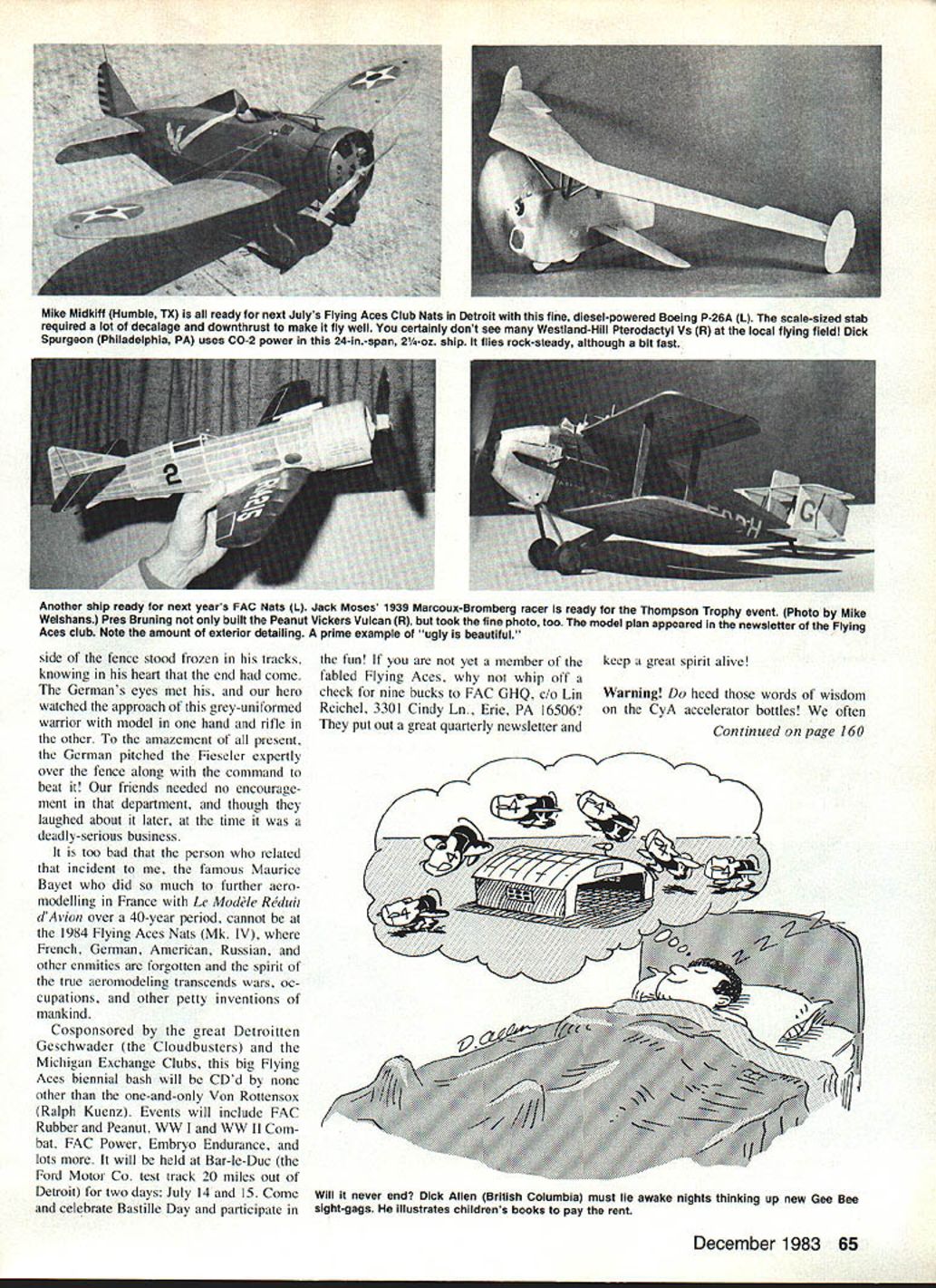
The Westland-Hill Pterodactyl is not a subject that will ever be modelled in the numbers of the Piper Cub, Lacey M-10, or similar types. Still, it has class, and courageous builders like Dick Spurgeon who have done it up for FF deserve special commendation. Dick's Mark V Pterodactyl was built to test the stability of the configuration and features scale surfaces and outlines, a variable-incidence lower wing, adjustable rudders and ailerons, no wing struts or outriggers, and a profile fuselage aft of the nose. It spans 24 in. and uses a stable NACA 23013 section. The flight pattern is consistent: rock-steady, spirally-stable, and fast.
Dick's next project is a more detailed version. His approach to a difficult subject is worthy of note, and I would certainly advise anyone who is going to attempt a plane of unusual configuration to do a really simple version first to familiarize yourself with the quirks and exigencies of the particular monster you want to make in super-scale.
Bill Hannan has had a great influence on Free Flight modeling over the past 20 years via his editorship of the Flightmasters newsletter, his plan business, his "Hannan's Hangar" column in Model Builder, and his numerous articles and plans which have appeared in over 15 different publications, earning him a worldwide reputation. He is a scrupulous researcher, an outstanding craftsman, a fine graphic artist and designer, and is well-known as a bit of a philosopher to boot. Most of Bill's loyal fans have not had the opportunity to see all of his work—mainly because we can't subscribe to all of the magazines and journals which have presented his efforts.
Volume I of Bill's Scrapbook of Scale is one of the "must-have" tomes in any scale modeler's library. The rich variety of material runs from the outstanding Gee-Bee "Z" drawings Bill did for the Williams Brothers kit to his Pilatus Porter Peanut plan which won a NFFS Outstanding Model of the Year award. Weird and wonderful canards, autogyros, pioneer planes, etc., are here in three-view form which will set you to slicing balsa tonight. If you liked Peanut Power, Bill's classic, you'll really enjoy Scrapbook of Scale. Send $8.95 plus 65c postage (plus 6% tax in CA) to W. C. Hannan Graphics, P.O. Box "A", Escondido, CA 92025.
Cut-and-try has always been a standby of FF modelers. Paul McIlrath up in Cedar Falls, IA, has built more super fliers than I can count. I was, therefore, surprised when he wrote that he had a Kinner "Playboy" (a low-winger with large wheel pants and struts) which had no natural stability, whatever! He replaced the "billboard-sized" gear with wire struts a la PT-19, tried all the adjustment tricks in the book, and then tried hacking off pieces of the fin and rudder. Paul states: "The fin area is now down to about half of the original, and the ship is actually beginning to fly. It will even recover from wing-low attitudes. Of course, it now looks like the planes I used to draw in kindergarten."
I have seen several hopeless cases improved by hacking away great pieces of rudder. Both too much and too little fin seem to have some of the same symptoms. Well, having had a Guillows Hawker Hurricane which gave me the same problem many years ago, and which improved only after knocking 1/3 off the vertical stabilizer, I know what Paul is talking about. After the correct area is determined, one simply makes a new part with the outline roughly the same as the original—only smaller. Maybe you won't win Scale points for it, but the name of the game is flying, too.
I had a Wickner "Wicko" Mooney plan which could not be adjusted without adding vertical stabilizer area. Walt's flew fine as he designed it. Well, it may be in the area of mysticism rather than aeronautical engineering, but in some hard cases you might try adding vertical area, or the reduction of it when all else has failed. Chopping the rudder down has long been a remedy for spiral instability, and enlarging it a cure for Dutch roll (tail wagging), but certain combinations of things and certain propeller/power combinations do unusual things. A good discussion of these problems can be found in Bill McComb's Making Scale Model Airplanes Fly (Aircraft Data, Box 32021, Dallas, TX 75224).
The indoor season is back, and some of the models which will most certainly make their appearance at many indoor sites around the country are sure to come from the new Indoor Model Supply line. Lew Gitlow and Gerald Myers have produced a Waterman Racer, a Zippy Sport, a Heath Parasol, and a 1929 Alco Sport, complete with documentation sheets which promise to be popular introductions to indoor Peanut for the outdoor flier. Featuring "iron-on" patterns for plywood and tissue markings, the kits are unique. The 1937 Aeronca "K" has a 9-in. fuselage and comes out a bit larger than the others. The IMS catalog is $1.50 from P.O. Box "C," Garberville, CA 95440.
Well, gang, may your positively-charged models stay away from negatively-charged trees...
Bill Warner 423-C San Vicente Blvd. Santa Monica, CA 90402
Transcribed from original scans by AI. Minor OCR errors may remain.

