


Free Flight World Championships
Fliers from many nations competed at Roskilde, Denmark, on July 6 to 12 to determine individual and team champions in Nordic, Wakefield and Power.
Text and photos by I. W. Kaynes
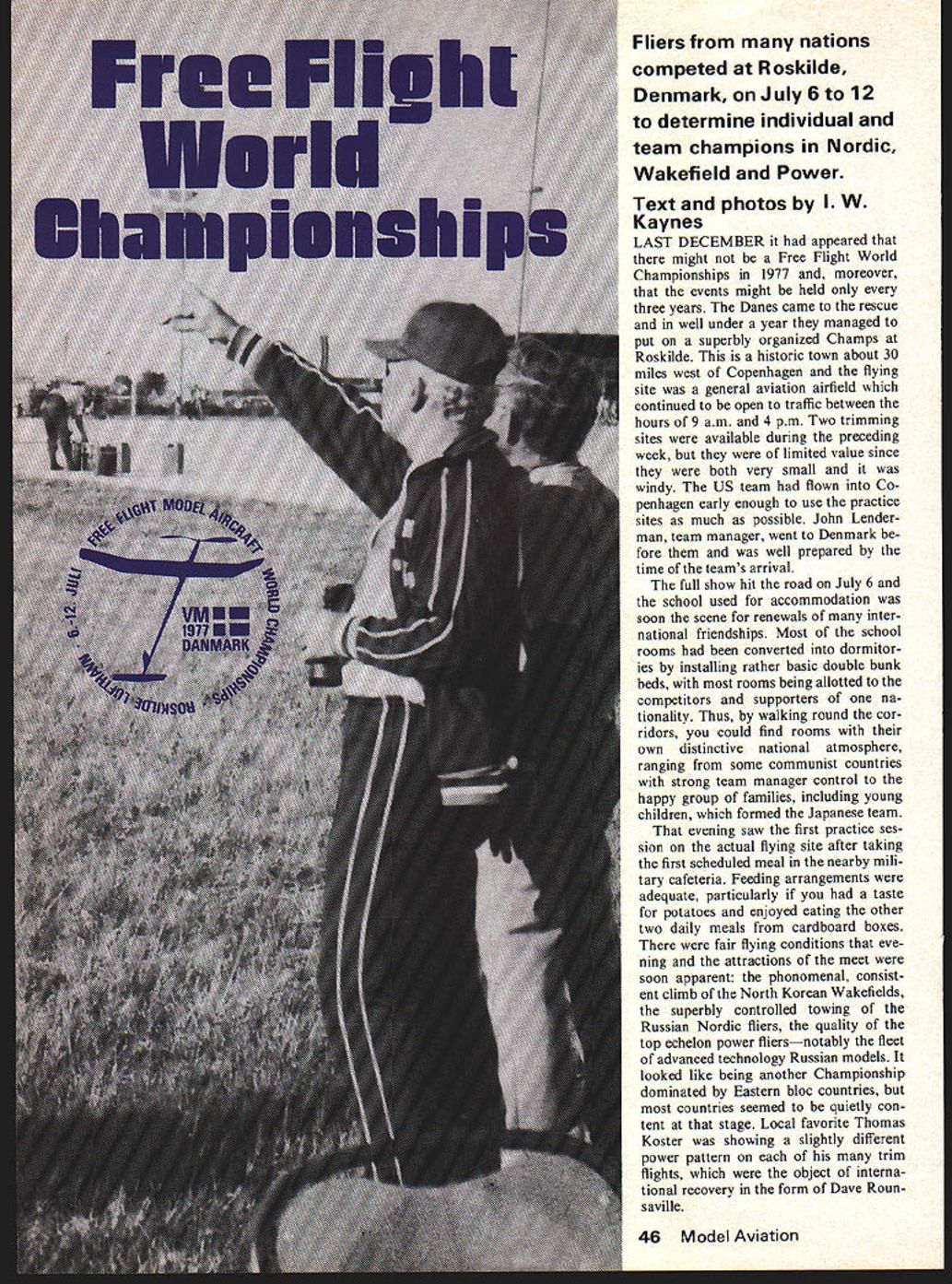
LAST DECEMBER it had appeared that there might not be a Free Flight World Championships in 1977 and, moreover, that the events might be held only every three years. The Danes came to the rescue and in well under a year they managed to put on a superbly organized Champs at Roskilde. This is a historic town about 30 miles west of Copenhagen and the flying site was a general aviation airfield which continued to be open to traffic between the hours of 9 a.m. and 4 p.m. Two trimming sites were available during the preceding week, but they were of limited value since they were both very small and it was windy. The US team had flown into Copenhagen early enough to use the practice sites as much as possible. John Lenderman, team manager, went to Denmark before the team and was well prepared by the time of the team's arrival.
The full show hit the road on July 6 and the school used for accommodation was soon the scene for renewals of many international friendships. Most of the school rooms had been converted into dormitories by installing rather basic double bunk beds, with most rooms being allotted to the competitors and supporters of one nationality. Thus, by walking round the corridors, you could find rooms with their own distinctive national atmosphere, ranging from some communist countries with strong team manager control to the happy group of families, including young children, which formed the Japanese team.
That evening saw the first practice session on the actual flying site after taking the first scheduled meal in the nearby military cafeteria. Feeding arrangements were adequate, particularly if you had a taste for potatoes and enjoyed eating the other two daily meals from cardboard boxes. There were fair flying conditions that evening and the attractions of the meet were soon apparent: the phenomenal, consistent climb of the North Korean Wakefields, the superbly controlled towing of the Russian Nordic fliers, the quality of the top echelon power fliers—notably the fleet of advanced technology Russian models. It looked like being another Championship dominated by Eastern bloc countries, but most countries seemed to be quietly content at that stage. Local favorite Thomas Koster was showing a slightly different power pattern on each of his many trim flights, which were the object of international recovery in the form of Dave Rounsaville. After staying on the field until late in the evening there was a short night for rest before we all reassembled for the only morning practice session at Roskilde before the contest started. Conditions were very similar and, in fact, it was hard to realize that it was not just one long and confused flying period. There was only the slightest thermal activity in the very early morning and it seemed to promise a Champs decided on still-air performance in the early rounds. This impression was reinforced on Thursday evening by the last trimming session being held in superb calm weather, with everyone exercising their most extreme performance ships and tweaking them up to the limit of optimum performance in still air. During the day, model processing had been underway and the expectation of good weather had influenced contestants' choice of models to include at least one suited to still-air among the three allowed.
The team managers had been to their first and only briefing meeting, which was a bit chaotic and overshadowed by unclear instructions about motorized retrieving. Initially, the contest director had forbidden this. John Lenderman protested and the organizers gave a compromise ruling that each team could station one automobile 500 yards downwind for use as a collecting base and means of returning models. John had anticipated difficulties in this area and had rented a motor bike so as to extend his available options. In contrast to the problems at Plovdiv in 1975, timekeepers were instructed to time repeat flights whenever these were claimed and to argue the validity of the reasons afterwards, with a defined chain of command leading from them to the chief timekeeper, to the CD and then to the International jury.
Another contrast with the Bulgarian version of a FF Champs was in the opening ceremony. Whereas they had laid on a showpiece function with large displays in a central stadium, the ceremony in Denmark was predominantly an affair for the modelers. Held on the airfield, it entailed a local band marching out, a short address from the local mayor, and the orderly raising of the national flags in front of the assembled teams. The band then marched off and the fliers were free to prepare for the next trimming period. The program showed 31 countries attending, but for unstated reasons the Cuban team did not materialize—made more puzzling by some of them flying in the Pierre Trebod open international in France the fol- lowing month.
nordic
F1A NORDIC:
- K. Abadjiev Bulgaria 1257
- A. Lepp U.S.S.R. 1244
- W. Kraus Austria 1234
Team: North Korea
Wakefield
The contest started early on Friday when Wakefield was to be flown. I do mean early. The public address at the school came on the air with the message, "It is two o'clock in the morning; breakfast is now being served; the buses to the airfield will leave at a quarter to three and not a minute later." By the third day this was to become a really well known sentence, either by its waking up competitors from much needed sleep or be telling the social element that it was time to break up the party or leave the bar! When we had stumbled outside, we all wondered if we were really awake, for the world was found to be cold, wet and windy. A total contrast to the state just five hours earlier and it caused much head scratching by competitors who had become used to the idea of flying their calm-air ships.
At the scheduled time of 3:50 all the timekeepers were at their poles with the containers of processed rubber motors, and the green flare went up to signify the start of round 1. In the moderate wind of about 12 mph, and with light rain, there was an understandable reluctance to fly immediately but, when it became clear that there would be no sudden change in weather, a few of the brave started to fly. These early flights did nothing to encourage those still waiting and Walt Ghio opened the US team's efforts with what appeared to be one of the best flights until then. It was just 13 seconds short of three minutes and had been quite difficult to see in the dark mist at low level, even through the binoculars used by the timers.
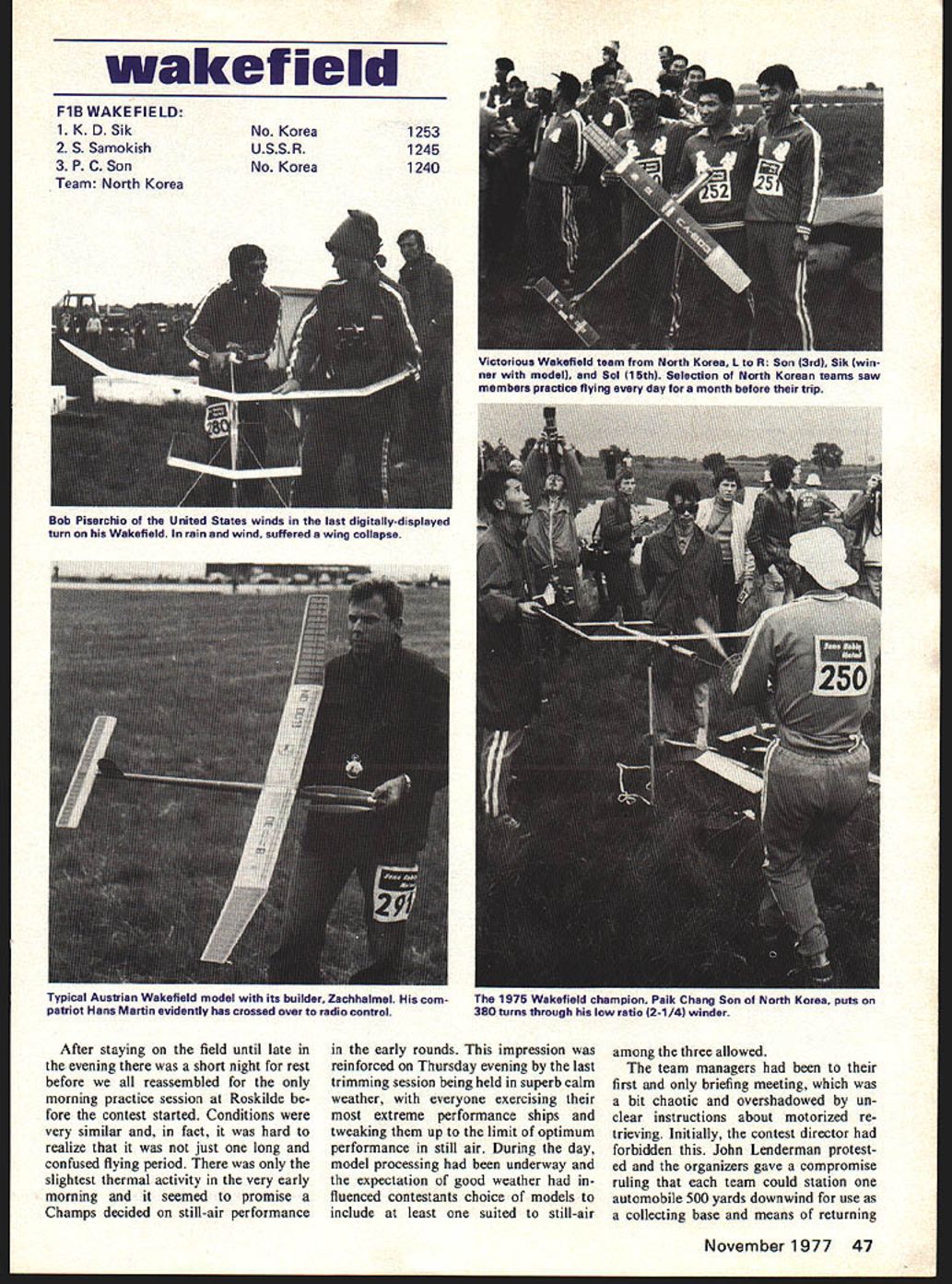
Bob Piserchio was next to fly, but suffered disaster when the wings folded as he launched and then the broken airframe dived into the timekeepers at a pole two positions away from us. This impact changed the damage of his White-type model from a simple wing break to a whole lot of compound fractures. The later reflight yielded less than two minutes despite a climb full of promise. Willard Smitz did little better in equally unhelpful air.
Attention turned to the North Koreans to see if they could be as impressive as they had appeared in the fine weather work-outs. Sure enough they did. Kim Dong Sik returning a max with 25 seconds glide time to spare. He had launched in a lull in the wind and was also strongly guided by their thermistor; five other models went up into the same air just after he launched and they all landed well before he did. The North Korean team moved straight to the lead with only nine seconds short of a triple max in the first round, and that time was dropped by the defending champion Paik Chang Son.
The Canadians were one of the countries to wait as late as possible before flying - in the hopes of an improvement which did not materialize and Jack McGillivray blew some motors so that he was left with no time to pick his air and had to launch moments before the red flare.
We were surprised to find that round 1 had produced as many as 12 maxes for the total of 80 contestants. It appeared certain that few of these would survive in the difficult weather and thus there would not be a very large fly-off. But, in the short break before round 2, the rain stopped and in the ever-brightening light the day looked much better. The breeze had increased and lift was still elusive.
Walt was first away again, with help from hand-held bubble machines and Bob White on thermistor. His climb looked most impressive with the two-stage VIT system perfectly choreographing the change from left turn on the initial burst to standard right turn during the cruise. It didn't impress the thermal god and was thrown back to earth after 106 seconds.
While the weather felt normal on the ground it was apparent that the lulls in the wind, which would have been associated with thermals if flying at usual midday times, did not necessarily signify anything in the Danish early morning. Thermal detection was having mixed success. A few teams had bubble machines, some relied on Mylar streamers, others worked from thermistors. All fixed devices were supposed to be erected 25 metres upwind of the launch poles, but some strayed a little nearer to the poles and Pete Williams of the British team actually had his model ensnared by some Mylar just after launch.
It was interesting to compare the Canadians and North Koreans; they were flying from adjacent poles and both using temperature measuring aids, but their scores showed a great disparity and so either the air they picked, or the models, or maybe their biorhythms were just not in the same class. Perhaps that is unfair on the Canadians. Any team shows up poorly when compared with the little people from north of the 38th parallel.
Round 2 had Piserchio come within 7 seconds of a max, but it was not until round 4 that he and Smitz both boosted team spirits by showing that maxes could indeed be scored. The wind was not as strong as it had been for parts of the team selection finals, but the thermal picking conditions had been quite alien. Other nations had more trouble launching in the breeze, mainly when flying the cam-type models that had been working so well on the evening before.
Well-known Swiss free flighter Dieter Siebmann scored a disastrous 36 seconds on his first flight with his high aspect ratio model and his team mate Hans Reifler suffered two flights of one minute. Hans had earlier been showing off his small tailplane model; it had started life with a tail area of just 25 sq. in. but power stability had been inadequate. So he had increased it by about 30%. I bet he could have used that morning!
Swedish Wakes similarly follow a national trend of high aspect ratio models with long moment arms and small tails. Jan Zetterdahl had machines as pretty and well made as usual, notable for a pylon attached to the aluminum tube fuselage by an adjustable screw clamp, and a triple fin layout with a very small central fin carrying the autorudder which used large deflections in each direction. However, when a model was badly launched it attempted to loop and impacted behind one of the organizers' vans. A party of Swedes set off in pursuit and all emerged from behind the van carrying a few pieces each.
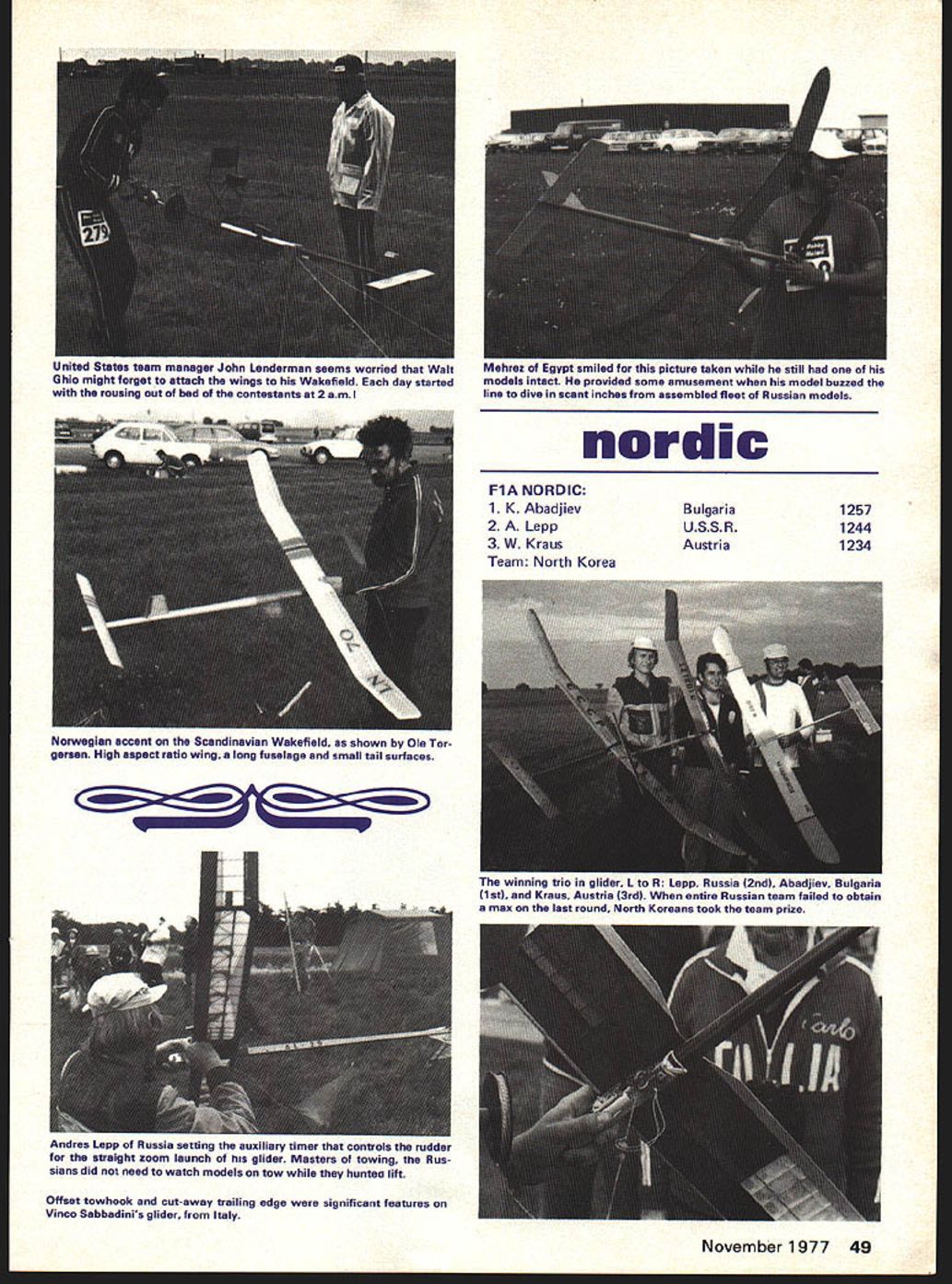
Egyptian Hisham Mehrez provided some amusement and almost an incident when his Wake buzzed the line and then chose to dive to the ground just inches from the assembled fleet of Russian models. He gave up after managing a total time of 69 seconds on four flights.
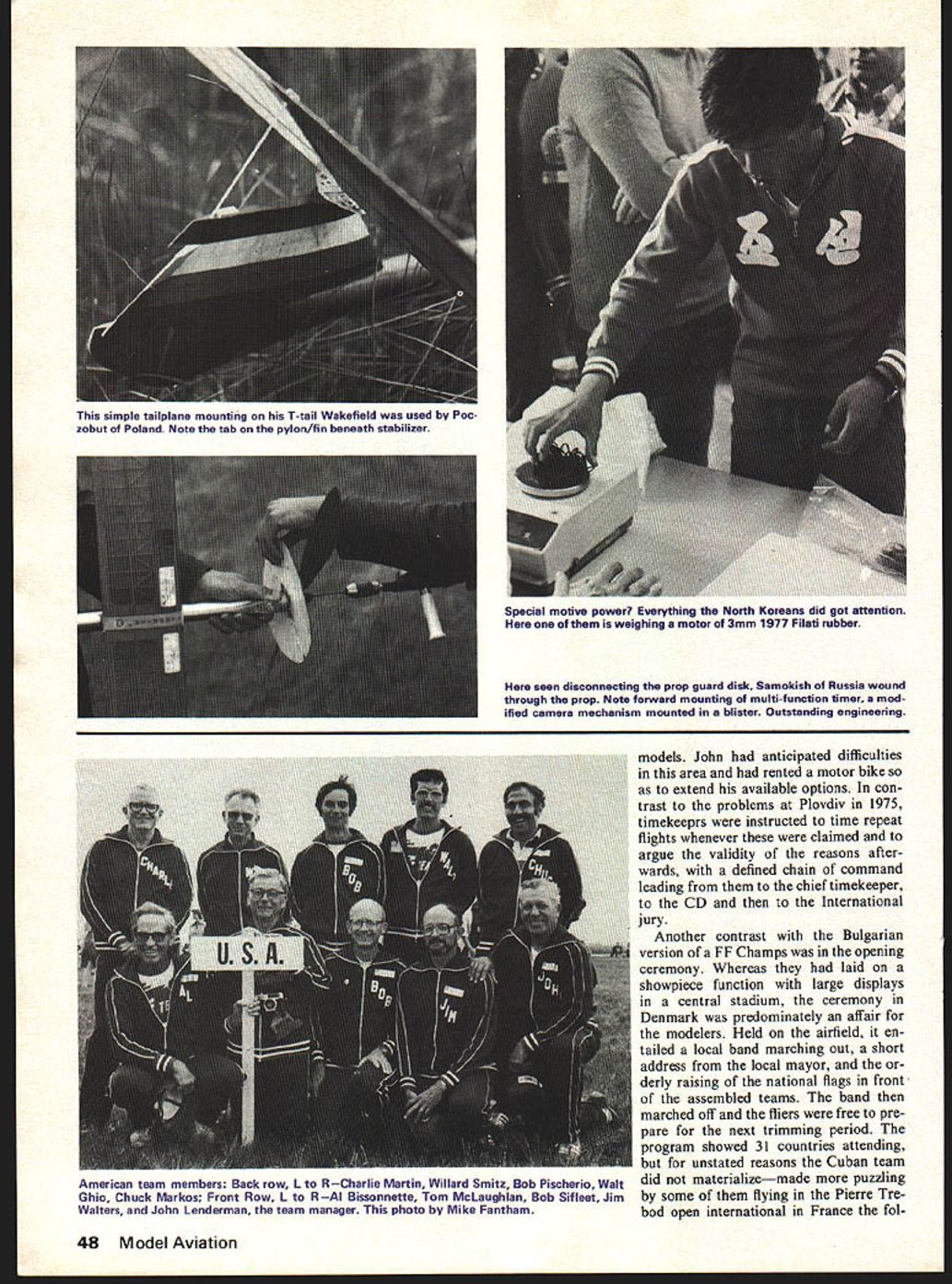
Perfect scores soon reduced to just one. Shibachi Masabumi of Japan had failed in round 3 and both Werner Nimtsch (West Germany) and Arcangel Armesto (Argentina) had dropped out in round 4. The lead was held by Sergey Samokish, one of the two young unknowns who joined with Silber to make up the Russian team. His model was outstanding in engineering detail: the timer was a modified camera mechanism mounted in a blister on top of the fuselage just behind the prop; VIT auto-rudder, and DT lines were carried in a low duct on top of the gold anodized motor tube to the rear of the pylon, where they were joined to the lines in the rear fuselage by tiny connectors that required tweezers to hook up. The tissue-covered wing had a Benedek 6356 section, which is quite a glider type of airfoil to use on a Wake but this one certainly climbed as well as gliding.
The fifth round closed the morning's flying and Willard Smitz maxed again and thus moved up to 16th place, despite having dropped more than two minutes in total. This spread of scores indicates the difficulties. Sergey Samokish lost 29 seconds and this put him down to third place behind two North Koreans, which country had a clear 100-second lead on team scores, although they had not made a full score in any one of the morning rounds. In fact, the Italians and Czechs were the only teams to have managed a triple max and they were placed second and fifth respectively, ahead of the USA in sixth.
"Lunch" was served in the cafeteria at 9:30 a.m. and the competitors then crept away to lick their wounds and catch some welcome sleep. Samokish managed to add to his flight time during the interlude. After much discussion with the timekeepers, a complaint from the Russian manager that the times had been muddled within his team was upheld. This maneuver took Samokish to equal second place and moved down his teammate by the redistributed 14 seconds.
Other happenings during the break was a fall of heavy rain. The Roskilde airfield was somewhat different in the afternoon in that it was warmer, fresher, and had a small crowd of spectators. Aviation interest had arrived in the form of the prototype de Havilland Dash 7 STOL transport on a sales demonstration of Europe. Was it a form of support for the Canadian team with their computer-designed Nordic section? That section being used by Mike McMahon had a reflex trailing edge and looked as improbable aerodynamically as the high-lift devices on the Dash 7.
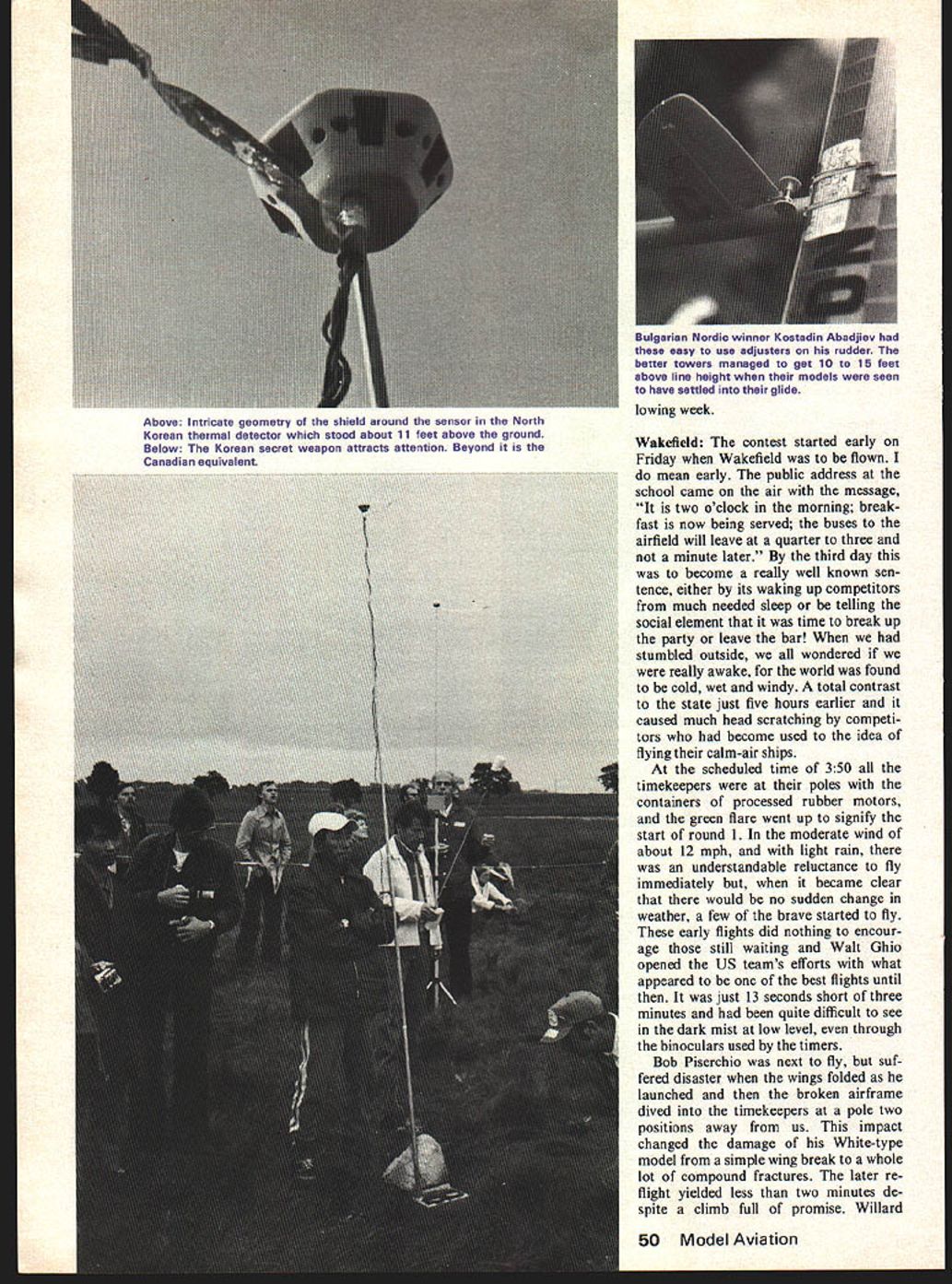
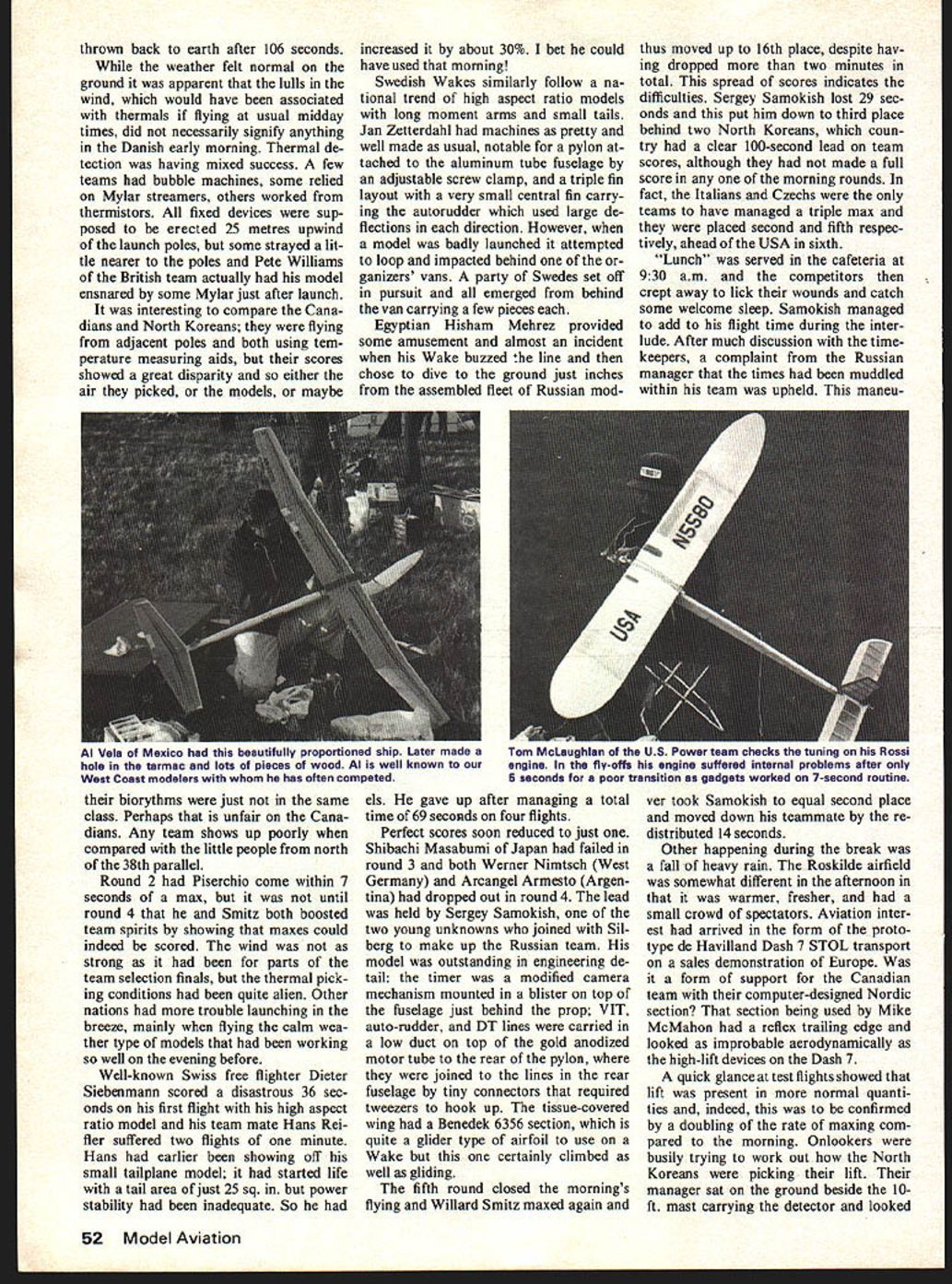
A quick glance at test flights showed that lift was present in more normal quantities and, indeed, this was to be confirmed by a doubling of the rate of maxing compared to the morning. Onlookers were busy trying to work out how the North Koreans were picking their lift. Their manager sat on the ground beside the 10-ft. mast carrying the detector and looked at the two meters which were linked to it. It was understood that these both showed temperature, on different sensitivity scales. There was some low-key communication within the group before deciding when the flier should start winding and, when he had wound, there was usually little delay before he got the instruction to launch from the meter man. Often there was little attention paid to such signs as lulls in the wind and all must have been determined from the instrument.
The defending champion showed rare fallibility in round 6 when he launched in what seemed to be the inflow after a thermal and made a flight of 2 minutes 55 seconds, while Ghio, flying in the same air, climbed as high and went on to max. Piserchio had a stall build-up about one minute into his flight and it cost him at least half a minute. 1973 Champ Joachim Loffler made a diabolical cross-wind launch, but the model managed to recover and maxed, in contrast to his five flights in the early session not including a single three-minute flight.
With no fly-off in prospect, the evening continued with interest in whether the leaders would continue to max and they all did. The North Koreans had thus wiped the field with individual first and third placings, plus a win for their team. The winning Wakefield is similar to that used by the previous champion, who was using a model which agreed with the details presented by Bob Meuser in the January and April 1977 issues of Model Aviation.
Some of Kim Dong Sik's airplanes have motor tubes of aluminum and some are balsa. The prop is carved from an indigenous Korean hardwood and has narrow-chord blades of thin section. He had many spare and quite differing group blades in his box, along with the components of six models packed in a compact box no larger than 30 by 12 in.
The FAI medals were presented to the top three in a short prize-giving on a rostrum at the airfield and then the winners gave a press conference. They were aided by an interpreter from their Danish embassy, who was disappointed that it involved representatives from just a few model magazines and none from the national media, and we learned some fascinating background to the North Korean modelers.
The rubber they used was said to have been obtained through official channels from Italy this year and looked much like the 1977 Filati/Pirelli. Upon being asked if he had a free choice of when to launch, Kim Dong Sik replied that he took into account many factors: the state of his model, the wind, the thermal conditions, but also the opinion of his team manager and coach! They had found the weather more difficult and windier than they were used to. The team had been selected during a workout in which the top five contenders flew every day for one month. Despite that amount of time spent just flying he said that they were not professional and explained that he worked in a factory making scales. The interview concluded with a little piece of propaganda that they do it for the glory of the peasants and farm workers and president Kim Il Sung.
That was a non-sequitur reply to a question as to whether they were going to the Pierre Trebod! Meanwhile, the Japanese were keen to emphasize that Masabumi had taken the highest place for a privately- paid, free-country entry.
Glider: After five hours taken up by rest for the glider fliers or sorrow-drowning for the rubberband brigade, everyone was back into the routine of going to the airfield for commencing flying at 3:50 a.m. This time we were relieved to find that there was no rain and rather less wind, but it was rather dark as round 1 started. USA had drawn a launch pole next to USSR for the day, giving us a close view of the apparent masters of glider flying. However, soon after the start Jim Walters proceeded to give a most adept display of towing when he moved across the wind to a path and then circled downwind. The catapult launch was first class but the air was not quite adequate and he was 18 seconds short of a max. Likewise both Charlie Markos and Bob Sifelet were a little below the magic three minutes, of which a total of 24 were recorded by the field of 82 entries. USSR and Israel both had full team scores in what was assumed would prove to have been the most difficult time of the day. The latter team included an interesting model flown by Giora Herzberg, well designed and having a slotted tailplane airfoil among its features.
The Russians continued in this manner in round 2, when the Yugoslavs and the Austrians also had treble maxes. The latter team was notable for having two members not equipped for circle towing, namely Kraus and 1976 European Champion Zach; they were lucky to contact gentle lift just before running out of upwing towing space and then they had more good fortune in that the gliders did not go behind a ridge, which was causing some flights from that end of the line to be clocked off before they landed. The weather then steadily improved and lift became easier to find, but only four people managed to make quadruple maxes: Kostadin Abadjiev, the sole representative and late entry from Bulgaria, the Russian masters Andres Lepp and Victor Chop, and East German Klaus Thormann. While some competitors seemed content to waste some minutes waiting on the ground before launching, the top-grade circle towers were putting on an impressive display.
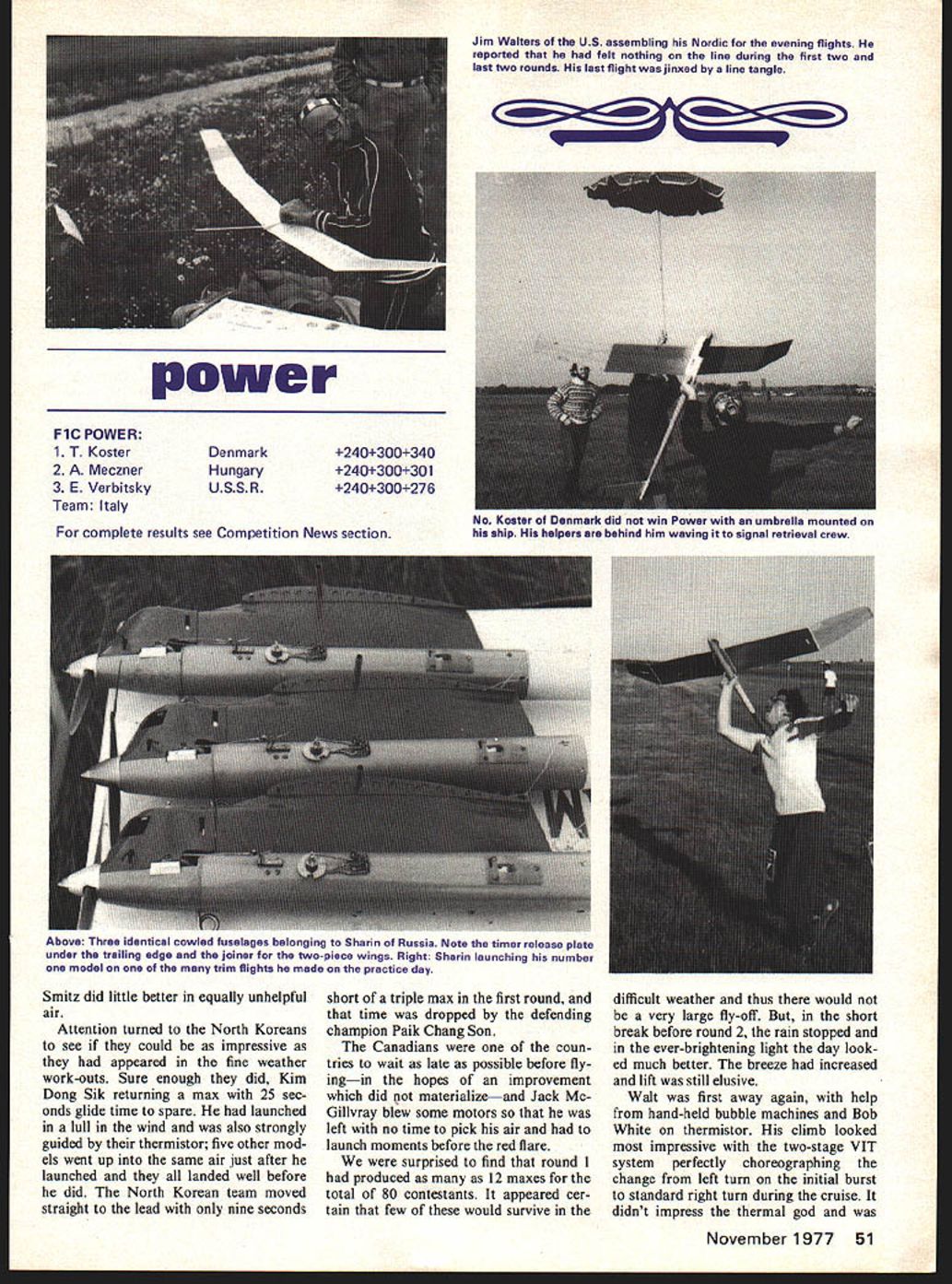
Russian towing was so well practiced that they were rarely seen to look at the model while they concentrated on watching for signs of thermals. Their technique was to launch as soon as the timekeepers were available, and then to circle into a position downwind of the line. They towed quite slowly in a straight line when wanting to feel the air. If it warranted further investigation, they would stand still and pull in line, maintaining line tension so that the glider continued in a straight line upwind of them. Releasing this excess line allowed the model to enter circle mode, and they did not need to run far downwind to return to a tight-line straight tow after the circle. There was little evidence that the Russians were actually measuring the quality of the lift during the circles. Their fitness showed when they wanted to dash off in pursuit of a model in good air or in sudden acceleration that they managed prior to release. Some good catapult launches were seen to have gained perhaps 10 or 15 feet above line height when the model had settled into its glide, the North Korean Nordics often showing pronounced wing flutter during the zoom.
Most towhooks were variants of the Russian type, with different mechanisms giving the basic functions of straight tow, slack-line circle tow, high-tension zoom and unlatch. Lepp was flying models similar to the ones flown in Bulgaria in 1975, which had been built with an aileron in order to keep the inner wing from dropping during the zoom. This was now locked in neutral and, instead, a timer was used to hold the rudder straight for about three seconds after release. Thus, the glider would climb away from the line straight ahead and the timer was set to put on glide turn at the instant that the speed dropped to normal glide speed, avoiding the danger of "wing drop" on the one hand, and of "stalling off the top" on the other hand. They had a single pennant on their towline, which was released on a ten-foot line when the hook unlatched. This gave the timekeepers some problems in that they could be fooled into starting the watches when the pennant started to move, a few seconds before actual release.
In round 4 Walters towed alongside Lepp and differences in towing could be watched before they both launched into good air. Sifelet untangled a line cross-while launching for a flight that cruised across the field at about 80 feet altitude, and Markos also maxed to make for a fully successful round. Round 5 was a little windier and, right after the green flare, Jim Walters' Go-Bird was on the line and circling off downwind. After a little while a North Korean towed along the launch line and released over the US pole into good lift for a max. A pity that Jim wasn't there, since his flight from downwind went behind the ridge to lose 11 seconds. Sifelet also blew that round, as did Chop. The Russian team ended the morning 26 seconds ahead of the North Koreans and there were just three individuals left with full houses. The scoreboard was continually being updated as results came in and were processed on a Wang mini-computer system. This had been loaned for the Champs and its output results sheets were distributed with the aid of a copier lent by 3M, complete with a large donation of paper.
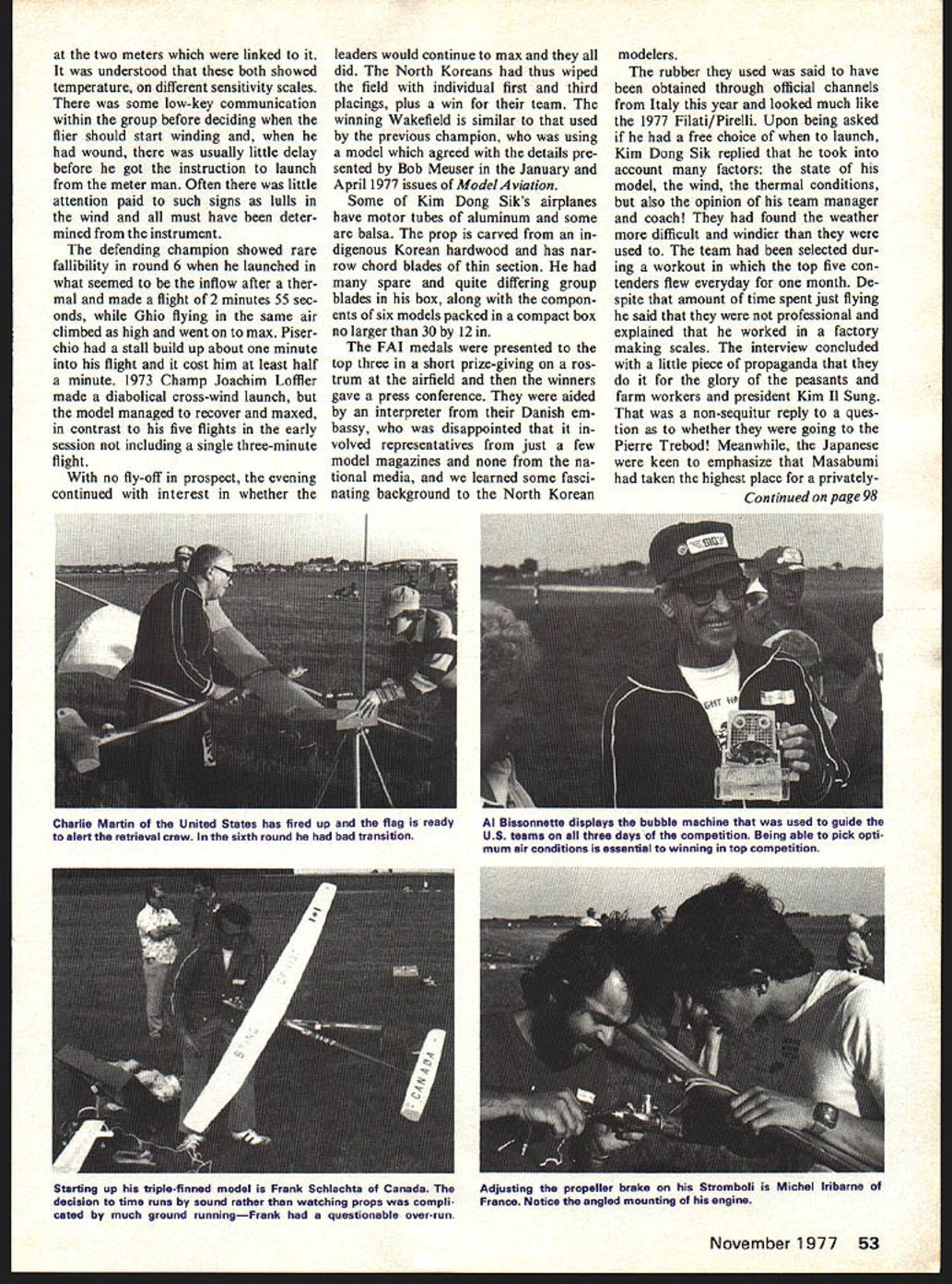
This time, the intermission before the evening flights was dry and quite sunny, but it was becoming overcast and it all cooled down, so that the last two rounds were more difficult than the morning ones. Jim Walters complained that he had felt nothing on the line during either the first two or last two rounds. His last flight was enlivened by a line tangle which he succeeded in escaping from, and went on to score 151 seconds for a 15th place, the highest on the US team, which was poor reward for the work that the team (as in the other classes) had put into the Champs.
The certainty of a fly-off had gone in the sixth round when Thormann made a bad flight and Abadjiev was in deficit by three seconds. Thus, Lepp just needed a max in the last round and he was assured of the Championship. After towing for more than ten minutes he launched and, within a few seconds, it was obvious that the air was not very good. The model managed 2 minutes 44 seconds and then we all watched Abadjiev, who was towing a long way downwind.
Undoubtedly having heard the importance of a good time, he continued to tow for almost a half-hour before finally finding the air he wanted. It was sufficient to keep the model up until it D/Ted and he took the title. Lepp's disappointment was apparent when he sportingly greeted the Bulgarian on his way back from that flight.
The top placed Nordic of 1977 has a Benedek 7457 section and a well-engineered fuselage. During the celebrations that night Kostadin showed how to reduce the fuselage to a pile of little pieces and screws: the hook was made from sheet dural and could be removed without losing its settings, the nose unscrewed, the wing joiner was in two pieces (one each side) which could be removed, and the rear end adjustments could be made with neat thumb-wheel screws.
The whole Russian team had all failed to max in the last round and this let the North Koreans take the team prize, followed by the Russians and then the Czechs.
Power: By Sunday it was difficult to imagine that normal life had ever consisted of anything other than going flying at three in the morning, feeling tired, and seeing the world through a blur. The more astute noticed that morning was different from the others in that it had a clear sky and very light winds. While this pleased the power fliers to whom the day belonged, it caused rubber and glider fliers to wonder what might have happened if they had been blessed with weather as good as this.
Test flying went on until the last moments before the green flare was fired, even to the extreme of an East German hurriedly being stopped from launching after the signal and thereby making an inadvertent official flight. The first away was fittingly the defending Champ Lars G. Olofsson, with a poor transition and consequent stalls not preventing a max. Like the 1975 title holders in the other classes, Lars G was flying as a member of his national squad rather than as an individual, which he would have been entitled to do if not on the team, but at the cost of not being part of an organized group. Al Bisonette was the first American to fly, with a good pattern and a precise 6.9-second engine run giving a max. He was soon followed by Charlie Martin and Tom McLaughlan to give a perfect team score.
The timekeepers had been instructed to time the runs on sound rather than by watching the prop as specified (impractically) in the FAI Sporting Code. This was complicated by a lot of ground running on the flight line and a few over-runs were soon reported. Canadian Frank Schlachta suffered one of these when his model looped as the engine cut and the altitude probably influenced the timekeepers in thinking that it was still under power after more than seven seconds, whereas the team claimed they had timed it at six seconds. Apart from such hang-ups from the problems of timing runs, there was general satisfaction with the ability of the timekeepers at the contest, almost all of them being practicing free-flighters, mainly from the host country.
Round 2 had Charlie glide down quickly at first after a tight climb until the air came to his rescue and he just made the max. Tom was also safe but Al stalled badly all the way down and landed at 2 minutes 19 seconds. It was largely a story of such glitches being responsible for the few sub-maximum flights, another example being West German Franz Baumann D/Ting early on an otherwise certain three minutes. That team was taking advice from Reiner Hofsaas using his two-channel thermal detector to give records of both temperature and horizontal wind speed.
By the last two rounds in the morning it was still sunny and getting warmer, so that the name of the game was to avoid the strengthening downdrafts. The wind had increased and gave some trouble to the retrieving crews, since the power models were landing in wheat fields that were within the confines of the airfield. Repeated appeals were broadcast not to wander around in the crops while searching, and particularly not to ride bikes or drive cars through them (the North Koreans had been driving their black "diplomatic" Mercedes limousine over some rather unlikely parts of the countryside). Some teams were using radio links with their crews but were complaining that the air was too crowded to get their messages across. The common alternative was to wave flags to indicate launch, with extra agitation to show if there had been an over-run with consequent need for a quick recovery. The USA was displaying an anonymous red and white flag, while the Italians emphasized their national characteristics by blowing whistles, shouting and gesticulating to their downwind helpers, who must have had superb hearing.
The morning closed with Martin and McLaughlan among the total of 31 still in the running for a fly-off place. The Canadian, British and Italian teams had all flown a faultless session, to give a rather unaccustomed Western appearance to the leader board.
As usual, the evening section of the program was watched by spectators, more numerous today, and a wind shift meant that they could be accommodated ideally at the entrance to the field from where they had a good view of launches and could be readily controlled. The launch line was near to the apron and it was lucky that an aircraft was not hit when a model was splattered there on a test flight. More frightening was a crash of one of Rado's hot high aspect ratio, sheeted foam-wing ships. It dived into the crowd 200 yards upwind and punched a hole in a VW camper, but it was fortunate that the only injury was slight grazing of a small boy. Lars Olofsson joined in the model donking with his number-one ship when the VIT line of stranded wire broke. He had already had an over-run and so scored 5 seconds and his reserve was only good for 55 seconds in the last round. Exit champion.
Problems hit the US team in round 6. Charlie had a bad transition to spoil his score and Al came down early. The strength of the lift and the downers was such that the overall max rate was half that of the morning. There was drama when Tom tried to complete his seventh max. The bubbles had looked good, the thermals agreed but, in the moments it took to fire up and launch, the wind had increased suddenly as the bump went away. The ship veered over and ended up heading toward terra firma from an altitude of 150 feet. Somehow it pulled out and preserved the model for a reflight, since the timekeepers had been unable to hear when the motor had cut. The second flight was an anticlimax of an easy max, to be followed by the other two team members also maxing for a team place of sixth.
Frank Schlachta dropped a few seconds on his last flight and the Canadian team took runner-up position behind the Italians, who had all made it to the fly-off. Dick Johnson had made two bad flights that afternoon, so the British team plunged from equal first to eighth. The inevitable North Koreans were third.
There were 22 people on the line for the fly-off. This was being flown to increasing maximums on a constant 7 seconds run. As a special concession, the FAI allowed the 1979 method to be followed, whereby there is a 15-minute launch period for all competitors with two attempts allowed. Dave Sugden was first into the air for the four-minute stage and was quickly followed by others launching together. Pity the timekeepers. To much amazement, Tom McLaughlan's folding-prop white model had its engine stop abruptly with internal problems at five seconds, from where the transition was poor as the gadgets continued to work as though for a seven-second run and there resulted a disappointing 2½-minute flight.
Newcomer to British power flying, Martyn Cowley managed no better when he was shot down by a glide stall which had plagued him all day, perhaps related to the fact that he had only finished building his models after arriving in Denmark! Sharin missed the chance of another stage by a mere three seconds. His ships had the fine engineering that characterized all of the Russian models, particularly notable being the automatic switch which was cocked when he took hold of the milled metal launch grips on the fuselage sides and then started the timer as he released the model.
The five-minute flight was to be attempted by 13 contestants and these included Koster, whose good model had landed in the woods. He took out the reserve for trimming and demonstrated its status by diving it into the concrete, causing a hurried departure for a lot of Danes to help fetch the number-one ship. As usual with his dramas, this kept up to near the start of the next flight but then his "Speed Cream" was safely retrieved and it was soon making another max.
For Thomas this is a comparatively conservative model, with sheeted wings of moderate aspect ratio and 6% flat-bottom airfoil, triple fins, and lacking either of the gadgets with which he has been associated recently—flaps and electronic timers. He was joined by seven others for the next round, among which conventionally proportioned structures characterized the models of Meczner (Hungary), Velunsek (Yugoslavia) and Lustrati (Italy). Higher aspect ratios were favoured by Sugden, Schaller and Reda. Verbitsky's models were similar in layout to those which he had flown at Plovdiv, but were notable for having wings covered in 0.001 aluminium sheet, acquired from the helicopter industry. Applied to a sheet-covered rib framework with an aluminium tube leading edge it gave extremely high torsional stiffness. One had been unintentionally dismantled when it flew into some power lines—inadvisable with a metal airplane, but it gave us an opportunity to examine the structure through the resulting holes. Apparently owing to illness after a snake bite at the USSR Nats, Eugeny could not attend the Champs in person and his models were proxy-flown by Silberg, who threw them with as much vigour as he puts into launching his own Wakefields.
This gathering produced a classic display of the best in power flying. Urs Shaller probably reached the greatest altitude when he looped over the top, but he recovered at a height which was on a par with the others. Drift was still towards the trees and it was getting gloomy near the ground. The first time reported was 4.36 from Verbitsky, then Reda was given 4.13 as a flight which went behind the trees, and Meczner's timers were found to have seen him to the ground for 4.51. Koster had flown nearly last and his timekeepers were still staring downwind. Eventually, they announced a time of 5.40, to give the local man victory by a clear margin of 39 seconds. There was much jubilation that Thomas had at last succeeded in adding the power crown to the one that he had won in 1965 for Wakefield, and moreover that it should have happened at "his" world champs. He had been responsible for much of the planning that had made it run so smoothly and had been helping with the daily running, to the extent that five hours earlier the same afternoon he had been directing cars into the airfield parking lots!
The parties went on through the night with real vigor, none with more energy than in the Danish room. Despite the overall fatigue, different nationalities were toasting one another in many strange and potent liquids as well as swapping T-shirts and modeling gear. The Russian team did well in this direction, since their CCCP shirts were in great demand, and the British in the room next to them were keen to lay their hands on some of their equipment. No-one traded for Silberg's Wakefield, which he was putting on sale at $180.
Little energy remained by morning for the tourist trip which had been arranged. For an additional fee, this gave a visit to a local reconstruction of a Viking settlement and a few hours in Roskilde where the main tourist attraction was the museum of ships which had been recovered from the sea after 1000 years and reconstructed.
There were no such differences of objectives that evening. Everyone joined the buses for the ride to Ringsted Speedway track where the banquet was held. A good meal was served but the prize presentation took place on the dance floor of the split-level restaurant, and so very few people could see the climax of the Championships. Later, we could walk round the tables and note the one overflowing with the North Korean's bounty. When time dictated that we join the buses back to the school, the festive spirit still continued and there was very little sleep before we had to bid farewells until the next time.
Transcribed from original scans by AI. Minor OCR errors may remain.

