
Free Flight World Championships
Whenever the best fliers in the world gather to battle it out in Power, Wakefield, and Nordic Towline, the scene is best described as "something else." An Israeli won Wakefield, an Italian won Power, a Dane won Nordic. And the Chinese were there, truly world-class competitors with balsa-less models. Perhaps more than any other World Championships, the free-flight donnybrook is steeped in the things that might have been: near misses, endless heartbreaks, and stirring deeds. For seven days in October, Taft—and its famous Kitty Litter factory—was the center of the free-flight universe. — Bob Meuser
Yugoslavia had offered to host the 1979 World Free Flight Championships, and its offer had been accepted by the FAI, the organization governing international aero-sport activities. The offer was later made contingent on the exclusion of South Africa, which made the offer unacceptable. With little time for the necessary homework, the U.S. offered to host the Champs as a backup to any other country's offer. But no other offer was made, and the U.S. offer was accepted. The organizers—the Southern California Aero Team (SCAT), the National Free Flight Society (NFFS), and the AMA—had a tiger by the tail.
It is no easy task to provide meals, lodging, and transportation for some 600 contestants, supporters, officials, staff, and volunteer workers. The flying site, some 45 miles from the headquarters at the Bakersfield Inn, required improvements to accommodate such a mob. Arrangements for the various peripheral activities such as the opening ceremony, the awards banquet, and the First International Symposium of the NFFS had to be made. The competition itself, played according to stringent rules, involved model processing, impounding of rubber motors, issuing standard fuel for the power models, and coordinating dozens of volunteers to handle timekeeping, scorekeeping, crowd control, publication of results, and a host of other chores.
This was the Big League, and it made the U.S. Free Flight Champs and even the Nats seem like sand-lot games in comparison. To say that it went off without a hitch would be untrue, but there were few hitches, and the few that occurred were unhitched in a hurry. Considering that, aside from AMA activities, the whole thing was put together by amateurs with no previous experience in running a World Champs, it stands as a tribute to American know-how, Yankee ingenuity, and the efficacy of dedicated volunteers.
Despite the great distance from most of the FAI-member nations in western Europe, participation was down only 15 to 20% from that at Champs held in Europe, largely due to lack of participation by the Iron Curtain countries for "political reasons," as Sandy Pimenoff, FAI official, put it in his speech at the awards banquet. For the first time, the People's Republic of China participated—its first participation in any international sporting competition outside the Orient in recent history. New Zealand, because of shorter travel distance, was able to send teams whereas before their activity had been largely confined to sending models to be flown by proxy.
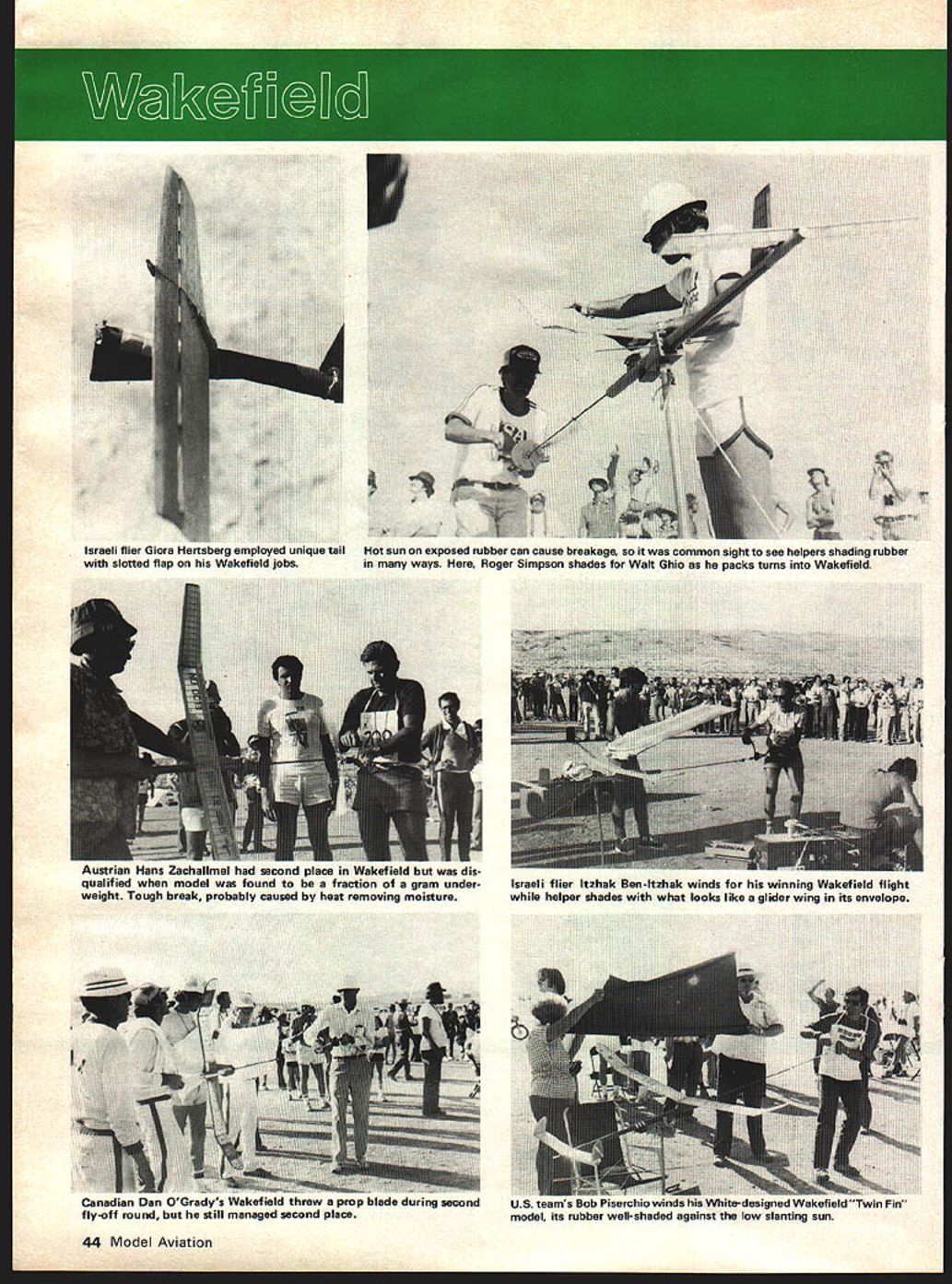
All eyes were on the Chinese team, the Great Unknown. Would they turn up with exotic bamboo-and-rice-paper creations or ultra-sophisticated designs using boron fiber, epoxy, and plastic films? Something in between was the way it turned out. Their models were constructed almost entirely from a local wood called t'unga, fine-grained and with a density less than spruce and equal to only the hardest balsa. Their tissue was similar to Western tissue but rather rough. Balsa was used sparingly—on diagonal ribs of some models—and their models were not overweight. The rubber used in their Wakefields was made in China and seemed roughly equal in quality to what others used, although they used more strands of smaller cross-section. Their made-in-China clockwork timers resembled the German Seelig timers more than the Japanese timers commonly seen here. Their Wakefield models incorporated timer-operated linear cams to adjust tailplane incidence continuously during the initial burst of power.
Aeromodeling is a recognized sport in China and is taught in the schools. Several hundred participated in the team-selection process, with regional semi-finals and finals in Peking. The average age of the team was 38; all were married and raising children. Team members came from all walks of life, from "professionals" to "workers." They were not the round-faced, ever-happy peasants sometimes depicted in official literature; they were much like competitors everywhere.
The site, near the oil town of Taft, wasn't perfect but was adequate. The weather was about what could be expected from 10-year statistics: maximum temperature did not exceed 90°F (that was on the first day of competition), no rain, and only moderate winds.
It is a funny game we play. Perfection is the norm; launching into well-chosen thermals, flight after flight, is scarcely worthy of mention. It is the minor deviations from perfection that separate the heroes from the rest. This report, then, is largely a chronicle of goof-ups.
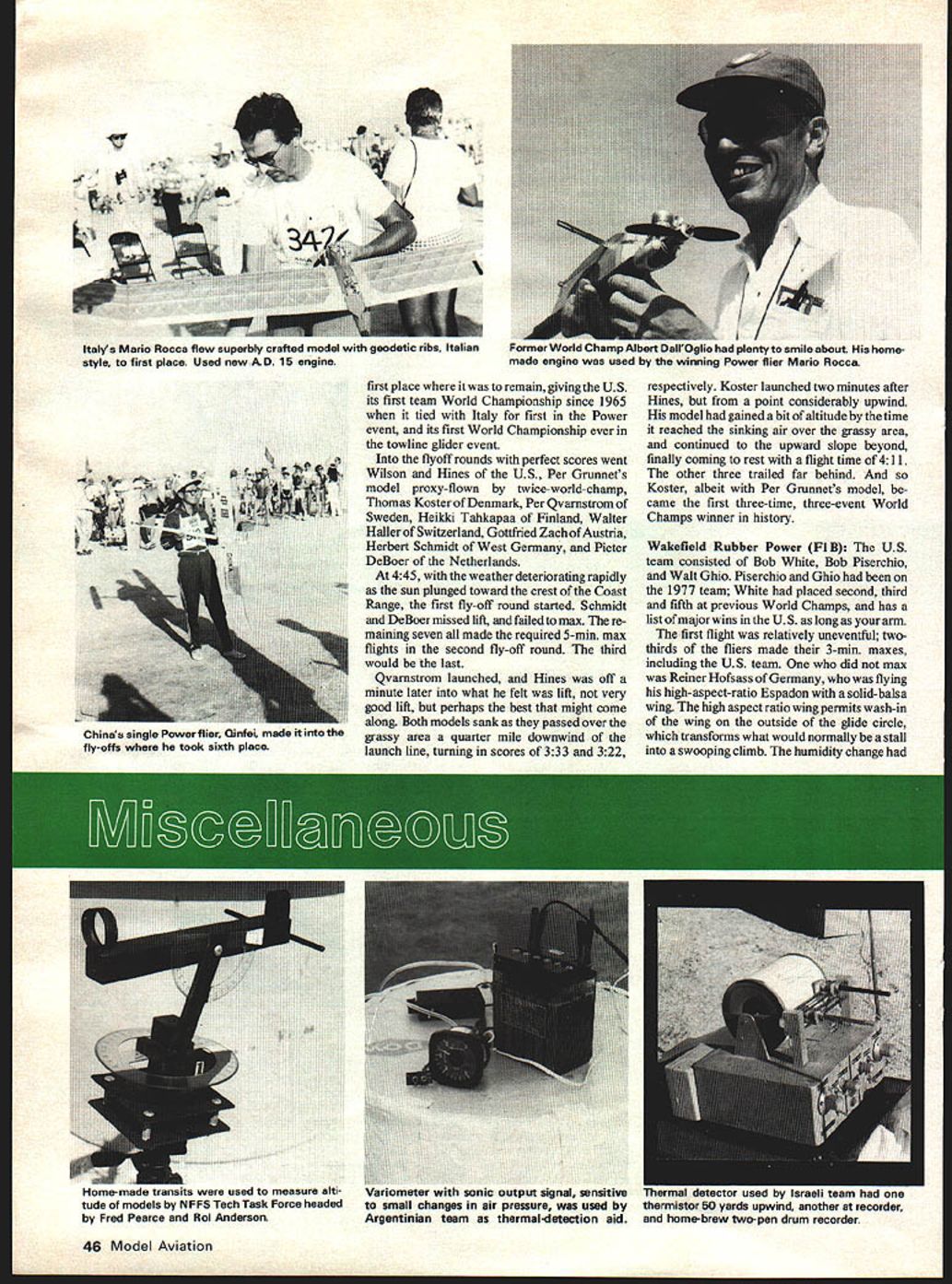
Nordic A/2 Towline Glider (FIA)
Without engine or rubber motor, towline glider models seem deceptively simple—perhaps they were a decade ago. But the invention of circle towing and zoom launches by the Russians, and their subsequent development throughout the world, has changed all that. Trick mechanisms are used to actuate the rudder, and sometimes the horizontal tail, into three or four positions corresponding to the phases of towing, launching, and gliding. Wings must be strong enough to support a load of 10 to 15 times the model's weight during the zoom launch, and may have over 500 parts. The physical skill and stamina required are a combination of those of a middle-distance runner and a dancer; one expert even recommends jogging backwards as part of the conditioning routine.
The U.S. team consisted of Jim Wilson, Lee Hines, and Jim Walters. Wilson and Hines had done extremely well in local competition but had not previously participated in a World Champs. The third member was to have been Bob Isaacson, making it a 100% Southern California team, but he dropped out because of a knee injury. Walters, who took fourth place in the U.S. team-selection finals, had participated in two previous World Champs and had scored highest among U.S. competitors on both occasions.
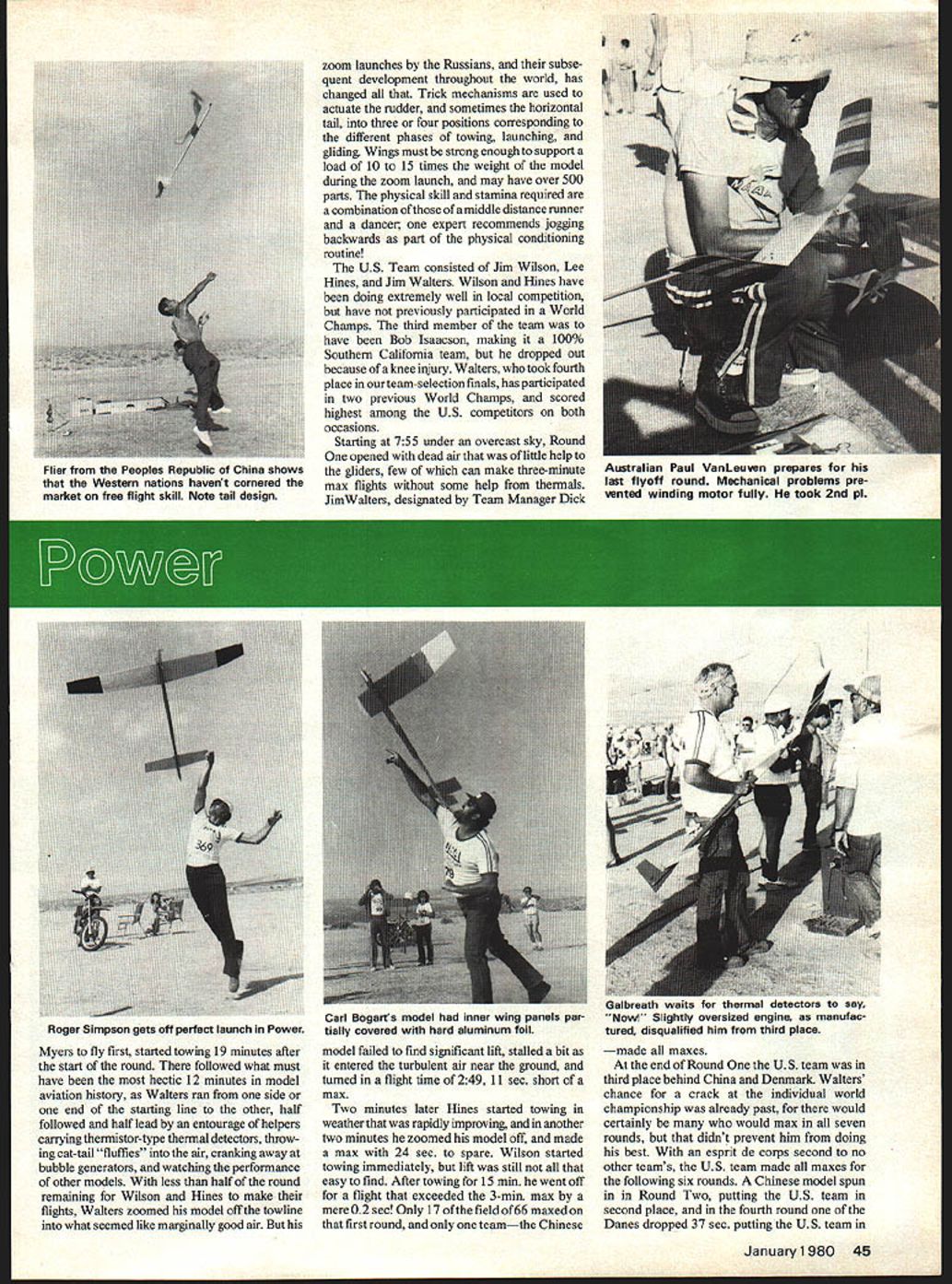
Round One opened at 7:55 under an overcast sky with dead air that was of little help to the gliders—few of which can make three-minute max flights without thermal assistance. Walters, designated by Team Manager Dick Myers to fly first, started towing 19 minutes after the round began. What followed must have been the most hectic 12 minutes in model aviation history: Walters ran from one side of the starting line to the other, followed and led by an entourage of helpers carrying thermistor-type thermal detectors, throwing cat-tail "fluffies" into the air, cranking away at bubble generators, and watching other models. With less than half the round remaining for Wilson and Hines, Walters zoomed his model off the towline into marginal air. The model failed to find significant lift, stalled in the turbulent air near the ground, and turned in a flight time of 2:49—11 seconds short of a max.
Two minutes later Hines started towing in improving weather and made a max with 24 seconds to spare. Wilson towed immediately but after 15 minutes of towing produced a flight that exceeded the 3-minute max by a mere 0.2 seconds. Only 17 of the field of 66 maxed in that first round, and only one team—the Chinese—made all maxes.
At the end of Round One the U.S. team was in third place behind China and Denmark. Walters' chance for an individual world championship was already past, but the U.S. team rallied: with esprit de corps, they made all maxes for the following six rounds. A Chinese model spun in Round Two, putting the U.S. team in second place, and in Round Four one of the Danes dropped 37 seconds, putting the U.S. team in first place where it would remain, giving the U.S. its first team World Championship in towline glider since 1965 (when it tied with Italy in Power).
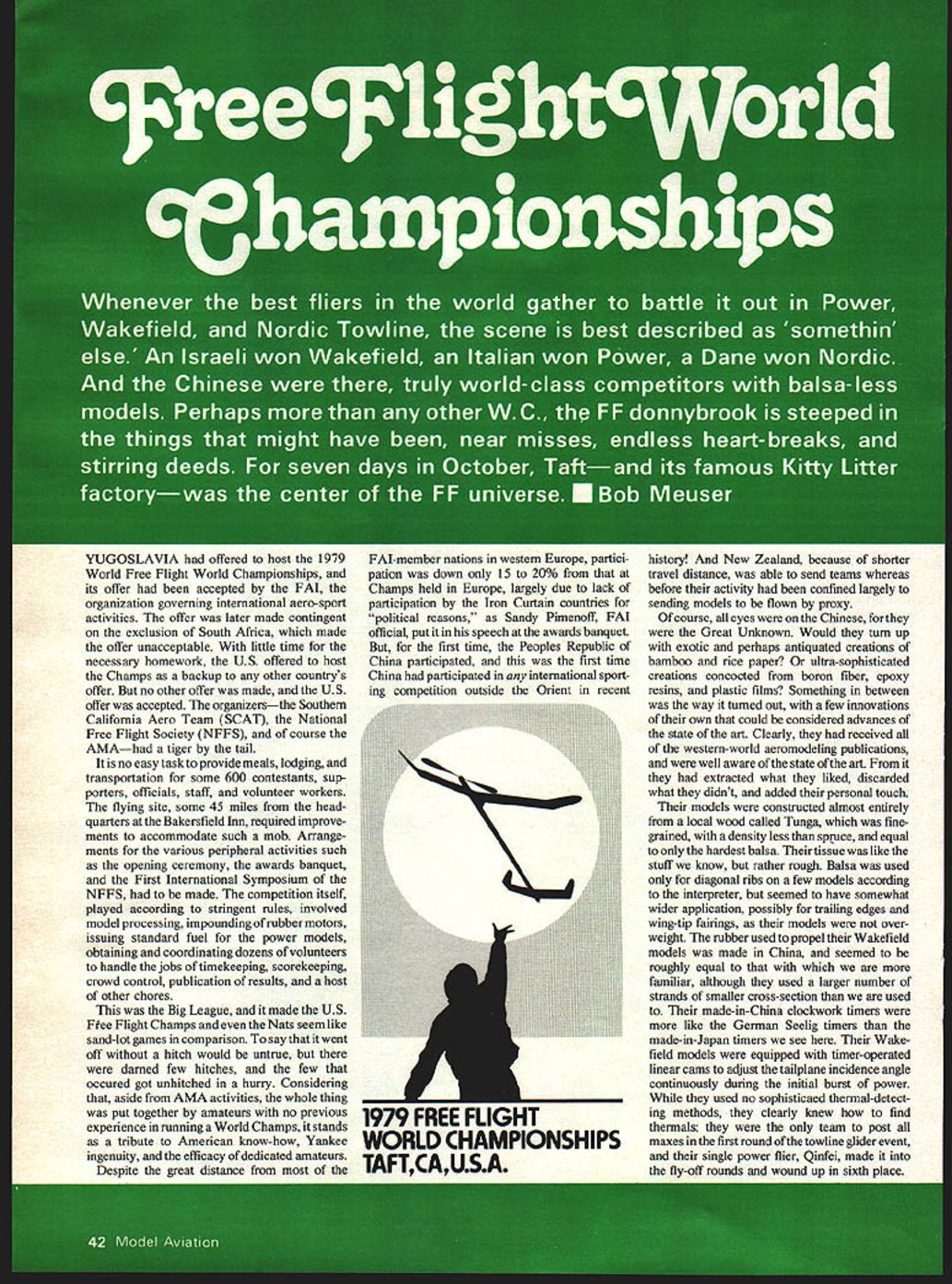
Into the fly-offs with perfect scores went Wilson and Hines of the U.S., Per Grunnet's model proxy-flown by twice-world-champ Thomas Koster of Denmark, Per Qvarnstrom of Sweden, Heikki Tahkappa of Finland, Walter Haller of Switzerland, Gottfried Zach of Austria, Herbert Schmidt of West Germany, and Pieter DeBoer of the Netherlands.
At 4:45 the first fly-off round started as weather deteriorated. Schmidt and DeBoer missed lift and failed to max. The remaining seven all made the required 5-minute max flights in the second fly-off round. In the final round Qvarnstrom launched, Hines followed and both sank over a grassy area downwind, turning in 3:33 and 3:22 respectively. Koster, launching from a more upwind point, had his model gain altitude and continue to the upward slope beyond, finishing with 4:11. The others trailed far behind. Koster, flying Grunnet's model, became the first three-time, three-event World Champion in history.
Wakefield
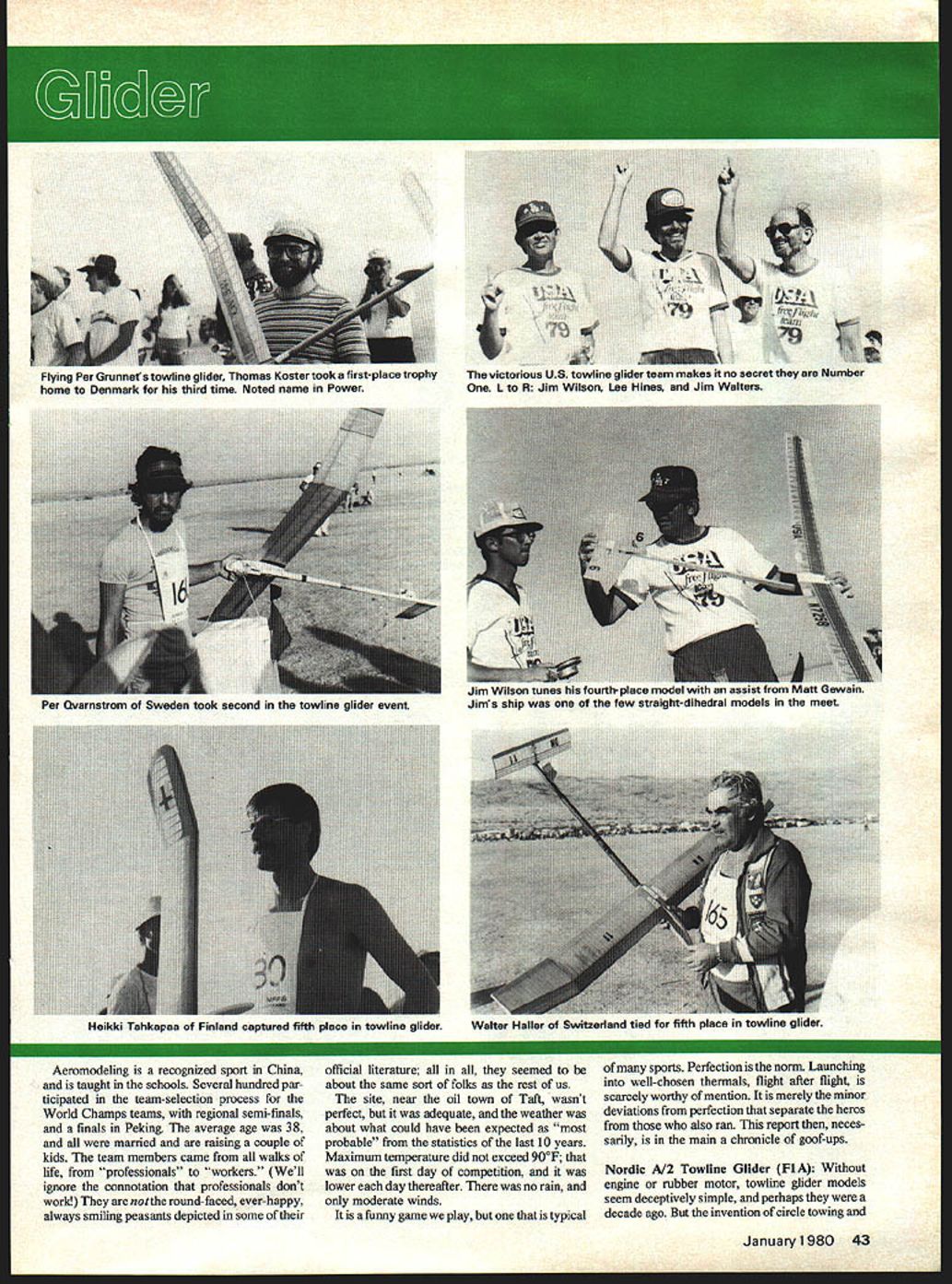
Israeli flier Giora Hertsberg employed a unique tail with a slotted flap on his Wakefield models.
Hot sun on exposed rubber can cause breakage, so it was common to see helpers shading rubber in many ways. Here, Roger Simpson shaded Walt Ghio's rubber as he packed turns into a Wakefield motor.
Austrian Hans Zachallmel originally placed second in Wakefield but was later disqualified when his model was found to be a fraction of a gram underweight—likely due to moisture loss in the low humidity.
Israeli flier Itzhak Ben-Itzhak winds for his winning Wakefield flight while a helper shades the motor with what looks like a glider wing in its envelope.
Canadian Dan O'Grady's Wakefield threw a prop blade during the second fly-off round, but he still managed to finish second.
U.S. team member Bob Piserchio winds his White-designed Wakefield "Twin Fin" model, its rubber well-shaded against the low slanting sun.
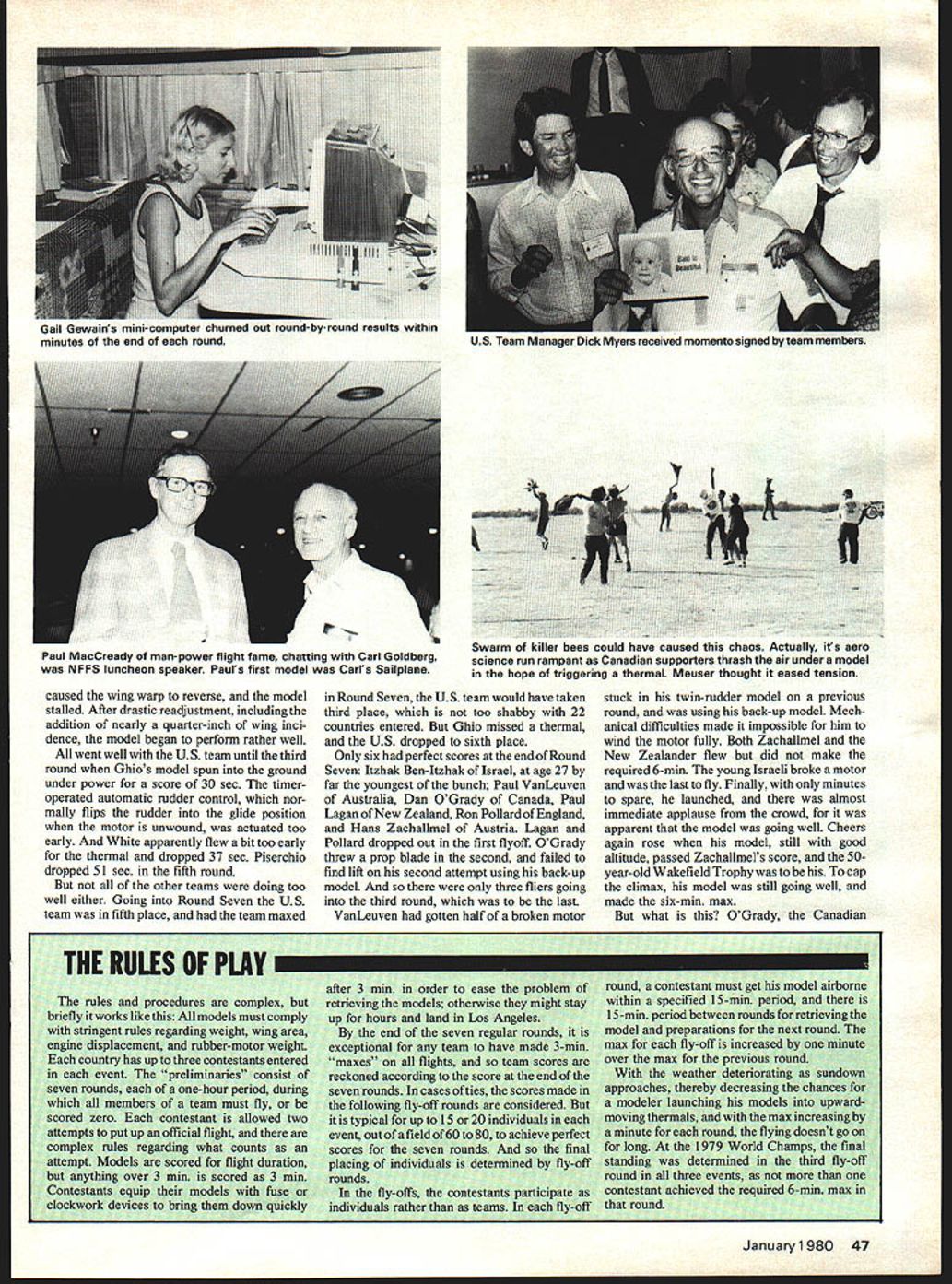
Wakefield Rubber Power (F1B)
The U.S. team consisted of Bob White, Bob Piserchio, and Walt Ghio. Piserchio and Ghio had been on the 1977 team; White had placed second, third, and fifth at previous World Champs and had many major U.S. wins.
The first flight round was relatively uneventful; two-thirds of the fliers made their 3-minute maxes, including the U.S. team. One who did not was Reiner Hofsass of Germany, flying a high-aspect-ratio Espadon with a solid-balsa wing. Humidity changes had reversed the wing warp, causing a stall; after drastic readjustment, including adding nearly a quarter-inch of wing incidence, the model began to perform well.
The U.S. team did well through much of the event, but problems occurred. In the third round Ghio's model spun into the ground under power for a score of 30 seconds—the timer-operated automatic rudder control had actuated too early. White dropped 37 seconds by apparently flying too early for the thermal. Piserchio dropped 51 seconds in the fifth round. Going into Round Seven the U.S. team was in fifth place; a team max in Round Seven would have given them third place overall, but Ghio missed a thermal and the U.S. dropped to sixth.
Only six fliers had perfect scores at the end of Round Seven: Itzhak Ben-Itzhak of Israel (age 27), Paul VanLeuven of Australia, Dan O'Grady of Canada, Paul Lagan of New Zealand, Ron Pollard of England, and Hans Zachallmel of Austria. Lagan and Pollard dropped out in the first fly-off. O'Grady threw a prop blade in the second fly-off and failed to find lift on his second attempt using his backup model. VanLeuven had a broken motor fragment stuck in his twin-rudder model from a previous round and had mechanical difficulties winding the motor fully.
O'Grady's situation included a dramatic timing incident: on one round his model, which had lost a prop blade earlier, was being prepared for flight. The timekeeper raised the gun to signal the end of the round, but it misfired. He reloaded, O'Grady launched, and a second later the gun fired. If it could be determined that the prop blade flew off before launch, perhaps the earlier flight would have counted; but it turned out the model was underweight without the missing prop blade, and the previous score stood.
After the event ended, top-placing models were checked for compliance. Zachallmel's model was found to be underweight by about half a gram; the low humidity had apparently dried out the wood since the model was weighed in three days earlier. Scales and master weights were checked and rechecked, but even allowing for possible small error, the model was underweight and was disqualified. That disqualification moved VanLeuven and O'Grady into second and third positions. Finally, the young Israeli Itzhak Ben-Itzhak launched with minutes to spare and achieved the six-minute max—winning the 50-year-old Wakefield Trophy.
THE RULES OF PLAY
The rules and procedures are complex, but briefly it works like this:
- All models must comply with stringent rules regarding weight, wing area, engine displacement, and rubber-motor weight.
- Each country may enter up to three contestants in each event.
- The preliminaries consist of seven rounds, each a one-hour period during which all members of a team must fly, or be scored zero.
- Each contestant is allowed four attempts to put up an official flight; there are complex rules about what counts as an attempt.
- Models are scored for flight duration, but anything over 3 minutes is scored as 3 minutes in the preliminaries. Contestants equip models with fuse or clockwork devices to bring them down quickly after 3 minutes to ease retrieval.
- Team scores are reckoned according to performance at the end of the seven rounds. In case of ties, fly-off results are considered.
- It is typical for up to 15 or 20 individuals in each event (from a field of 60 to 80) to achieve perfect scores over the seven rounds, so final individual placings are determined by fly-offs.
In the fly-offs, contestants participate as individuals rather than as teams. In each fly-off round, a contestant must get his model airborne within a specified 15-minute period, and there is a 15-minute interval between rounds for retrieval and preparation. The max for each fly-off increases by one minute over the previous round’s max. As sundown approaches and thermals weaken while the required max increases, the flying typically concludes within a few fly-off rounds. At the 1979 World Champs, final standings in all three events were determined in the third fly-off round, since not more than one contestant achieved the required 6-minute max in that round.
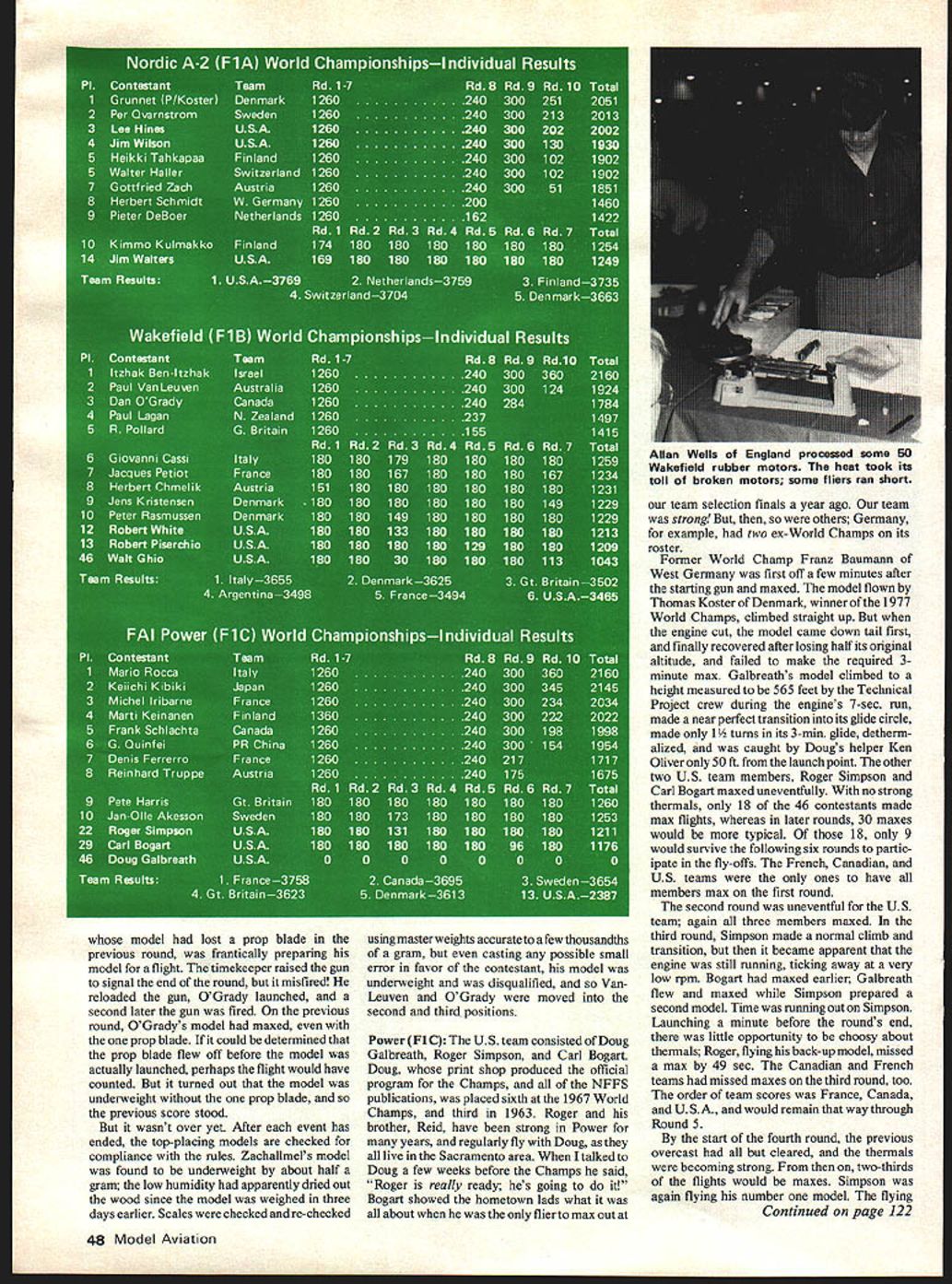
Power (F1C)
The U.S. Power team consisted of Doug Galbreath, Roger Simpson, and Carl Bogart. Doug’s print shop produced the official program for the Champs and many NFFS publications; he had placed sixth at the 1967 World Champs and third in 1963. Roger and his brother Reid have been strong in Power for many years. Bogart had been the only flier to max out at the U.S. team selection finals a year earlier. But other teams were strong too—Germany, for example, had two ex-World Champs on its roster.
Former World Champ Franz Baumann of West Germany was first off and maxed. Thomas Koster of Denmark, winner in 1977, climbed straight up on his first climb but, when the engine cut, his model came down tail-first, recovered after losing half its altitude, and failed to make the required 3-minute max. Galbreath’s first flight climbed to a height measured at 565 feet during the engine’s 7-second run, made a near-perfect transition into glide, thermalized, and was caught only 50 feet from the launch point. Simpson and Bogart also maxed. With few strong thermals, only 18 of 46 contestants maxed that first round, and only nine would survive to the fly-offs.
Rounds 2 and 3 had mixed fortunes. In Round 3 Simpson experienced an engine over-run pattern and then, launching a minute before the round’s end on a backup model, missed a max by 49 seconds. The team order through Round 5 was France, Canada, then the U.S.
By Round 4 thermals strengthened and two-thirds of flights became maxes. The U.S. team maxed in Rounds 4 and 5. In Round 6 Galbreath flew near-perfectly; Bogart had an over-run; Simpson delayed and then flew a poor powered pattern, scoring 1:36 and dropping the U.S. to fourth place. Round 7 saw all three U.S. members max and several favorites falter.
Nine contestants had perfect scores through Round 7: Doug Galbreath (U.S.), Mario Rocca (Italy), Keiichi Kibiki (Japan), Qinfei (China), Denis Ferrero and Michel Irribame (France), Martti Keinanen (Finland), Frank Schlachta (Canada), and Reinhard Truppe (Austria). All made 4-minute maxes on the first fly-off. In the final fly-off the Italian Rocca was the only one to max; Kibiki and Galbreath posted 5:45 and 4:18 for second and third.
After the event, Galbreath’s engine displacement was measured and found to be microscopically over the 2.5 cc limit. The measuring equipment was checked and the engine was sent to an independent lab; the result confirmed the over-displacement and Galbreath was disqualified. With Galbreath’s scores set to zero, the U.S. team’s overall placing dropped below that of a dozen countries whose engines had not been checked.
It is a hard reality of the sport that strict rules must be enforced, sometimes resulting in disqualifications for minute infractions that did not materially affect performance. While decisions to disqualify are unpleasant for all involved, the rules must prevail to ensure fairness.
Organizers and Key Officials
- Competition Director: Bill Hartill (SCAT)
- Contest Administrator: Hardy Brodersen (NFFS)
- Contest Manager: Bill Bogart (SCAT)
- FAI Jury: Sandy Pimenoff (Finland), Jan Kaynes (England), George Xenakis (U.S.)
- Event Directors: Juan Livetto, Ivy Aker, Ted Carroll
- Chief Timekeeper: Andy Faykun
- Chief Scorekeeper: Gail Gewain
- Processing Director: Bob Hatschek
- Press Coordinator: Jim Quinn
- NFFS International Symposium Coordinator and Editor: Ray Harlan
- NFFS Technical Task Force Director: Fred Pearce (assisted by Dennis Mihora, Chris Matsuno, Andy Bauer, Rod Anderson, and others)
- NFFS Plans Book Editor: Dave Linstrum
- AMA President: Paul Witt
- AMA District X Vice President: Jim Scarborough
- AMA Headquarters staff: John Worth (Executive Director), Frank Ehling (Technical Director), Michele Madison (FAI Activities Coordinator), Giselle Jackson (finance coordination)
- Special contribution: Matt Gewain (donated and programmed an Apple II and dot-matrix printer for data processing)
And many, many others whose voluntary work made the Champs possible.
Transcribed from original scans by AI. Minor OCR errors may remain.

