

Free Flight World Championships
By Bill Hartill. Photos by Bill and Inza Hartill.
A most remarkable Free Flight World Championships was completed August 12 in Burgos, Spain. It was remarkable in that the fliers were treated to a mélange of extremes. The weather, site, organization, and competition all presented many facets of good and bad, making this championships difficult to categorize, except, perhaps, as extraordinary.
First, there was the weather. The organizers had claimed expected winds of 10 km/hr. It was more like three times that, with gusts even higher during the practice days and Nordic day. The Canadian team withdrew in protest. On Wakefield day the winds abated somewhat; on the last day for Power, the weather was near ideal.
The site was much too small for the windy conditions. The wind blew the models into (and in some cases beyond) the city of Burgos. Retrieval became a nightmare, especially for Nordic. Spanish free flighters were aware of the inadequacies of the site and expected weather conditions, and had recommended a better site in the south of Spain. This counsel was rejected by the organizers, La Federación Española de los Deportes Aéreos (FENDA). This group is the aero branch of the Spanish Sporting Council and is equivalent to the National Aeronautic Association (NAA) in the U.S.A.; it also performs functions similar to the Academy of Model Aeronautics. Difficulties of organization and administration that arose were, in the main, due to the unfamiliarity of the FENDA group with competition procedures and requirements. Assistance by the knowledgeable Spanish free flight modelers was offered but apparently not accepted.
Most of the peripheral requirements were adequately provided, such as housing, food, buses, ceremony, and programs. The competition suffered in that no announcements were made in any language, directors were unavailable, and timekeepers were improperly briefed. Without the help of Sandy Pimenoff (CIAM president), the chaos would have been total.
As the competition drew to a close, it appeared that procedures were being smoothed out and a good spirit was evolving. This feeling was shattered on the evening of the last competition day by the "incident." A group of contestants were accosted by two of the FENDA directors and police in the lobby of one of the official lodging places. The newly crowned Wakefield World Champion, Lothar Döring of Germany, was thrown to the floor and beaten, and his camera was broken by police armed with machine guns. This incident, of course, put a damper on the following days' awards ceremony—more of this later.
We found Burgos to be a charming city, small enough to enjoy but with a rich history. One could cover the "Ciudad Centro" on foot and enjoy many ancient buildings, tapas bars, restaurants, and shops. The focal point of the city is the cathedral where, in 1221, King Ferdinand I put the first stone. The great historical hero of Spain, El Cid Campeador, is entombed here. For over a century Burgos was the capital of Spain; it now counts some 200,000 inhabitants. A high wooded bluff overlooks the city from the west; incidentally, this was the landing place of some models that overflowed the city, coming from the aerodrome located to the east.
Housing for contestants was provided in a school (headquarters) and in the Monasterio de las Huelgas. Breakfast and dinner were served at these residences, and the traditional FAI bag lunch was distributed at the airfield. This one consisted of two giant sandwiches, fruit, and a bottle of red wine.
Processing took place in a military building at the airfield. The 10 minutes of processing time per team was hopelessly optimistic, and procedures had to be simplified. No models nor engines were measured, but models were weighed. Entrance to the processing room (which was plenty big enough) was heavily restricted. Even the Japanese team interpreter was denied entrance.
The opening ceremony began at 6 p.m. in front of the aerodrome administration building. The traditional march in review of the teams took place with each team led by a young girl in Spanish costume. It was a stirring sight. Spirits were high, with everyone enjoying the camaraderie of sportsmen from 31 countries. Festivities included parachutists, aerobatics, and (as is inevitable but unappreciated by the free flighters) an RC model demonstration. The scheduled hot air balloon ascent was cancelled because of the high winds.
FFWC — General (Hartill)
Meeting old friends again, we learned of the difficult time the Soviet team had in making the journey. Sixty-five kilometers outside of Moscow, one of their buses collided with a tank truck. Their driver and manager were injured and had to stay behind in a hospital. The team flew to Madrid, then took a train to Burgos, arriving at 5 a.m. the day before the start of competition—all without sleep.
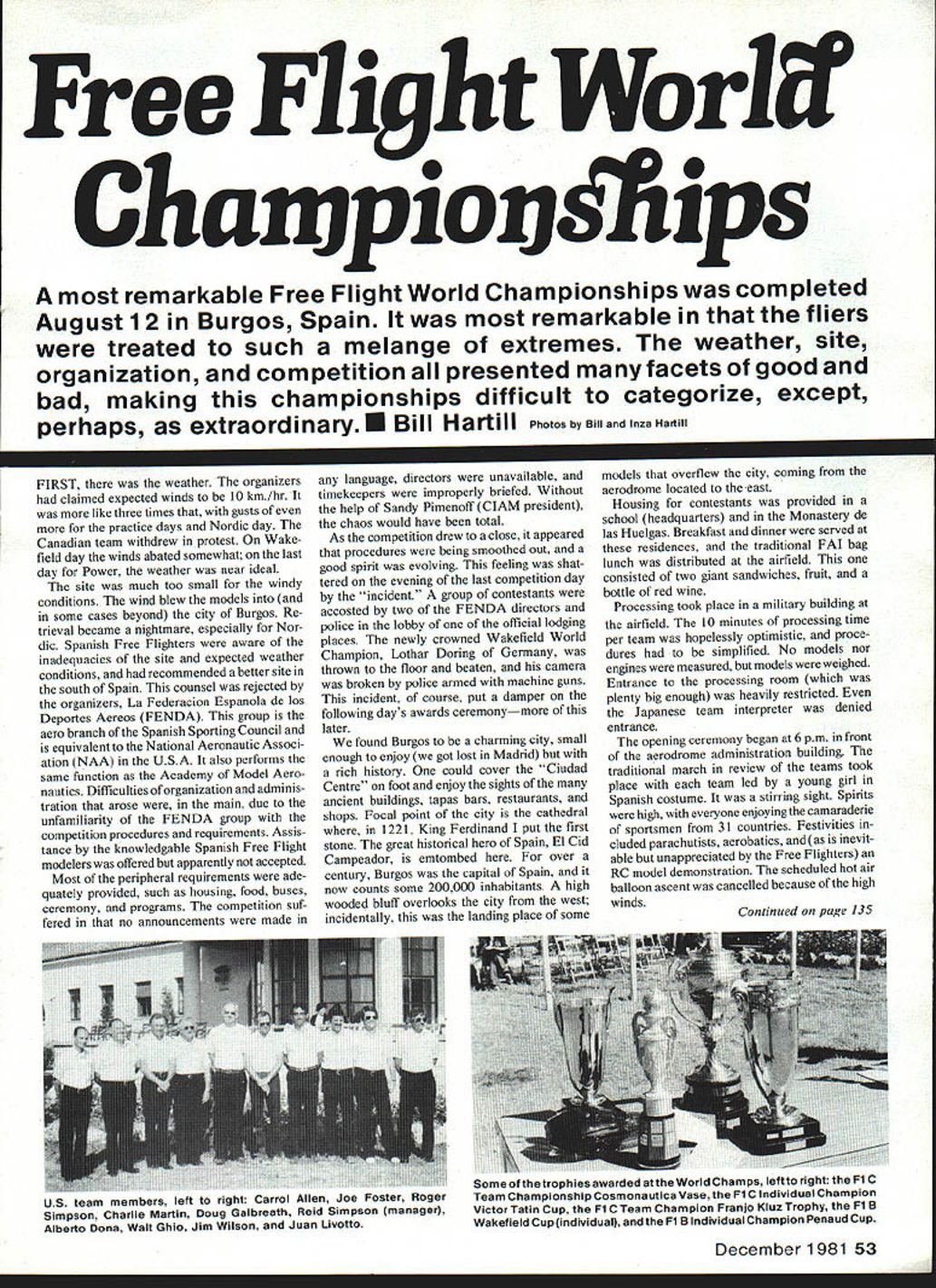
The U.S.A. team, by contrast, was in great shape; they had arrived early (before any of the other teams) and were well acclimatized. Juan Livotto of the Nordic team had visited Burgos about a month prior, scouted the field, arranged a hotel, and laid very useful groundwork for the team's arrival. We also found that the U.S.A. group's fluency in Spanish (especially Livotto, Dona, and Diez) was extremely helpful, particularly with the poor communications by the organizers.
FFWC — Power (Hartill)
In a dramatic moment during the Power event, a competitor smiled and waved at Meczner as he prepared his last model. It was his final effort. Meczner, obviously moved by this turn of events, started his engine, flew a good pattern, and made a comfortable 202 seconds to nail the number one spot.
Engine choice this year was almost universally Rossi. Although many of the new Rossis with the 12 mm shaft were available, most competitors preferred the older model. Galbraith and Simpson (U.S.A.) were using their own "Cossis" (Cox/Rossi parts) to very good effect. The new Nelson 15G appeared too late for this World Championships, although one was flown by Bill East of Australia and it looked promising.
Epilogue. With the end of the competition, congratulations were freely passed around, and we all headed back to the residences for the traditional parties, story-telling, and camaraderie.
All this good fun was marred by the incident described earlier. Lothar Döring, the new Wakefield World Champion, already suffering from phlebitis in a leg, was injured in the incident and taken to a hospital for examination. A number of contestants were not able to get back into their rooms and had to spend the night elsewhere.
On the next day, Sandy Pimenoff of CIAM, having discussed the situation with the organizers and after consultation with the national delegations, took appropriate steps to bring matters to a close. The organizers held a meeting with all the team managers. It was agreed that the awards would be accepted, but that in view of the circumstances, further participation in the ceremonies would be cut short.
This was how this remarkable World Championships drew to a close. Lothar Döring, standing with crutches, received the Wakefield Cup to loud cheers. Sandy Pimenoff spoke of the continuing need to carry forward the spirit of friendship and goodwill that is the basis of free flight competition. It was this spirit that brought together these sportsmen from 31 countries, and it was that spirit we carried away with us.
Transcribed from original scans by AI. Minor OCR errors may remain.

