
Free Flight World Championships
Overview
Wind and rain may be what the 1983 Free Flight World Championships at Goulburn, Australia (September 28–October 4) is remembered for, but it should also be remembered for the excellent job done by the organizing group (their first time) and for the huge flying area, which made the weather more bearable. For the U.S., Matt Gewain is the new F1A Towline Glider World Champion. — Martyn Cowley
Background
While Australians were celebrating their recent capture of the America's Cup, a silver trophy—no less important in the world of aeromodeling—had less conspicuously arrived on the Australian continent for the first time in history. Tradition had been broken in 1954 when an Australian, the late Alan King, won the premier model flying event for the Wakefield Cup. Until then, the individual winner's country would host the next World Championships, but rules were changed to give the team winner that privilege; besides, Australia was too far to go. In fact, the trophy never made it to Australia due to a stopover in England by the World Champion. Similarly, in 1958, fellow Australian Bond Baker won the Wakefield Cup; neither he nor hosting the event made it to Australia.
Some 30 years later, the Free Flight World Championships was finally scheduled "down under." However, much confusion had arisen since Australia first proposed hosting. Offers from other countries (Spain, Argentina and Israel) were being considered, and an offer from Austria at Wiener Neustadt was withdrawn after the FAI had already accepted it.
Selection and Scheduling
By the time the FAI finally selected Australia, it was very late in the two-year cycle—too late, in the FAI's opinion, to schedule the event for early 1983 (the preferred calm of the Australian autumn). Instead, October was chosen to give sufficient time for teams worldwide to prepare models and make travel plans. A gamble was taken: would changeable October spring weather favor so important a model flying event on a huge continent?
Australia was disadvantaged by its size, with modelers spread thin over a vast land mass. As it turned out, a surprisingly small group of very dedicated enthusiasts from New South Wales carried the responsibility of staging the 1983 Free Flight World Championships.
Site and Facilities
Goulburn, about 70 miles inland and midway between Sydney and Canberra, was the site. Upon arrival it was evident the organizers had done their homework. Accommodations were first class, teams being housed for the week at subsidized budget rates—$50 at the modern, partially used Riverina College. Eight small multi-story blocks provided individual rooms with a common sitting room on each floor—ideal for team meetings. Facilities included an excellent cafeteria, a lecture theater used for timekeeper briefings and symposiums, a laundry room (very necessary for such sporting events), and a gymnasium, which was quickly commandeered by indoor enthusiasts.
Extras included an F/F Symposium Report prepared by the NSW F/F Society and an F/F Plans Handbook containing model plans. Participants from the nearby Victorian F/F Society hosted a P/A1 Open International flying field the week before, a very important feature which allowed visiting teams to acclimate, trim models and practice.
Weather and Competition
Saturday's events were blown out by high winds, causing concern. By leapfrogging F1C Power and A1 Glider to Monday, the schedule allowed the weather to turn kind, producing two perfect days for model flying. In the Open International, U.S. team members took six of the top nine places across the three events.
Attendance
It was inevitable when the event was held in Australia that an attendance record wouldn't be set. The difficulty and cost of travel made attendance by many countries unlikely. The USSR and North Korea entered but withdrew at a late date. Surprisingly, some expected countries did not send competitors, notably France and Denmark. With so few countries willing to host this event, there is good reason to allow the contest location to travel around the world: FAI free flight is a global sport, and international travel has become relatively inexpensive and accessible.
In the end, 18 countries were represented in Australia, making for a fairly sizable competition.
Field Conditions
The site was a broad expanse of short, grassy, sheep-grazing land. There was some concern about the number of wire fences dividing the land into paddocks and the associated risk of damage to models and the inconvenience to retrievers faced with climbing fences. The area had suffered a five-year drought, but recent rains had left the field dotted with soggy patches and a newly formed "lake" of standing water in a low-lying area to the north. Generally, the site was acceptable to most nations, being large enough to virtually prevent loss of models in any direction.
Official Proceedings
Official proceedings began with model processing on Thursday, which proceeded with few problems. Friday, the day of the Opening Ceremony at the college, dawned cloudless, bright and calm. Many teams took the opportunity for early-morning trimming at the field, which was about 20 minutes away by car. After lunch, the official practice session enjoyed perfect conditions. With the organization, facilities, and weather seemingly perfect, hopes were high for a classic World Championships.
U.S. Team
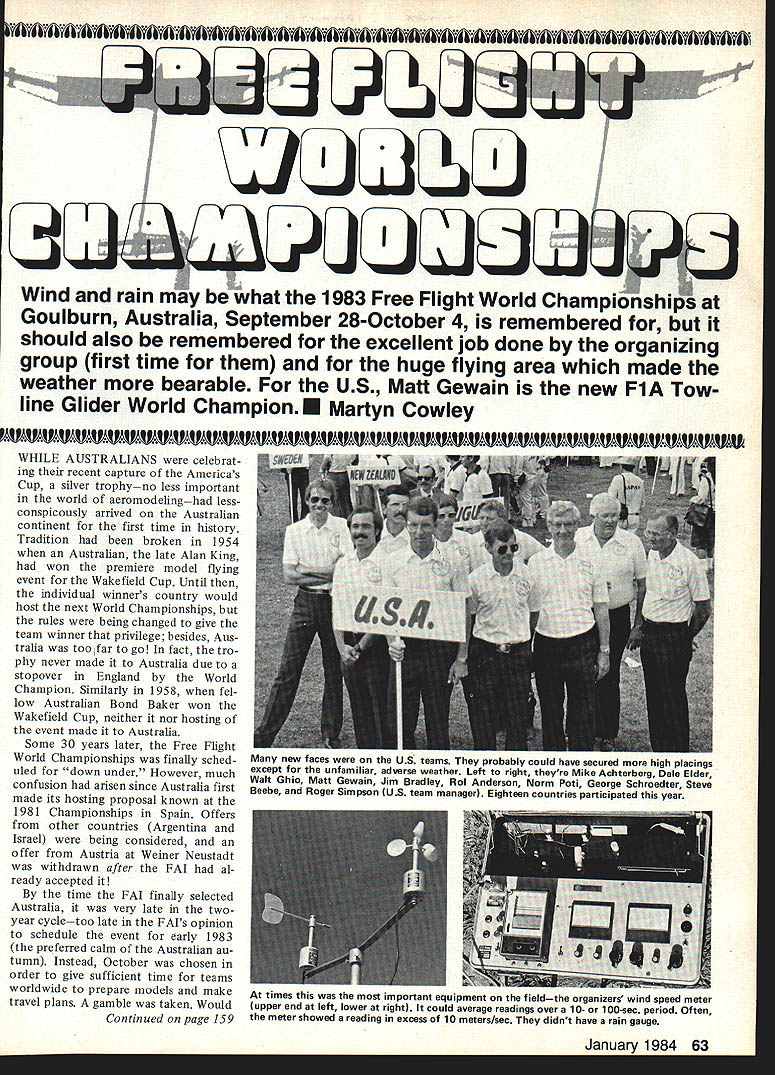
The U.S. team, although composed almost entirely of men new to World Championships, was in good shape for the event.
- F1A Towline Glider: Jim Bradley, Dale Elder, Matt Gewain (team strength on paper; all first-time team members who had practiced together weekly in Florida since April).
- F1B Rubber: Steve Beebe, George Schroedter, Walt Ghio (Ghio's fourth consecutive World Championships; the U.S. is truly world-class in this event).
- F1C Power: Mike Achterberg, Rol Anderson, Norm Poti (the new faces in power; together with Team Manager Roger Simpson, they had dominated the International Power event the preceding week—hopefully a good sign).
Transcribed from original scans by AI. Minor OCR errors may remain.

