
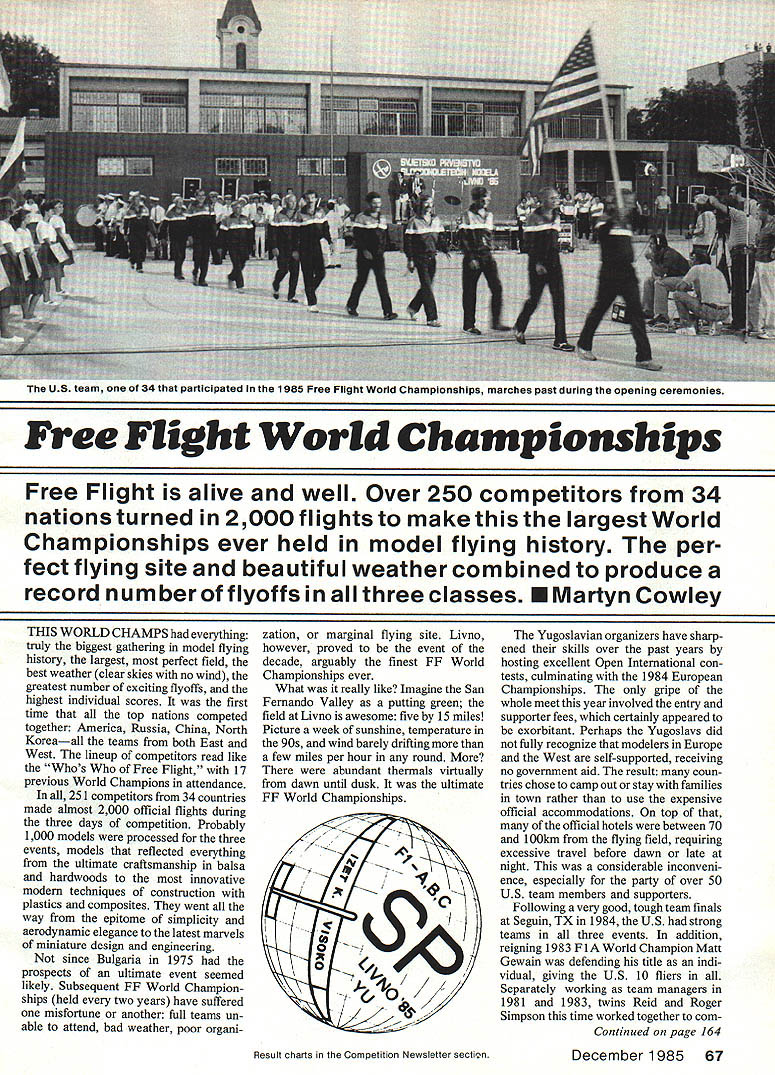
Free Flight World Championships
By Martyn Cowley
Free Flight is alive and well. Over 250 competitors from 34 nations turned in nearly 2,000 flights to make this the largest World Championships ever held in model flying history. The perfect flying site and beautiful weather combined to produce a record number of flyoffs in all three classes.
Overview
This World Championships had everything: the biggest gathering in model flying history, the largest, most perfect field, the best weather (clear skies with almost no wind), the greatest number of exciting flyoffs, and the highest individual scores. It was the first time that all the top nations competed together — America, Russia, China, North Korea — teams from both East and West. The lineup of competitors read like the "Who's Who of Free Flight," with 17 previous World Champions in attendance.
In all, 251 competitors from 34 countries made almost 2,000 official flights during the three days of competition. Probably 1,000 models were processed for the three events, reflecting everything from ultimate craftsmanship in balsa and hardwoods to the most innovative modern techniques of construction with plastics and composites. Models ranged from the epitome of simplicity and aerodynamic elegance to the latest marvels of miniature design and engineering.
Not since Bulgaria in 1975 had the prospects of an ultimate event seemed so likely. Subsequent F/F World Championships (held every two years) had often suffered one misfortune or another: full teams unable to attend, bad weather, poor organization, or marginal flying sites. Livno, however, proved to be the event of the decade — arguably the finest F/F World Championships ever.
Site and weather
Imagine the San Fernando Valley as a putting green: the field at Livno is awesome — five by 15 miles! Picture a week of sunshine, temperatures in the 90s, and wind barely drifting more than a few miles per hour in any round. There were abundant thermals virtually from dawn until dusk. It was the ultimate F/F World Championships.
Organization and accommodations
The Yugoslavian organizers had sharpened their skills over the past years by hosting excellent Open International contests, culminating with the 1984 European Championships. The only gripe of the whole meet involved entry and support fees, which appeared exorbitant. Perhaps the Yugoslavs did not fully recognize that modelers in Europe and the West are self-supported, receiving no government aid. The result: many countries chose to camp out or stay with families in town rather than use the expensive official accommodations. On top of that, many of the official hotels were between 70 and 100 km from the flying field, requiring excessive travel before dawn or late at night. This was a considerable inconvenience, especially for the party of over 50 U.S. team members and supporters.
U.S. team
Following a very good, tough team finals at Seguin, TX in 1984, the U.S. had strong teams in all three events. In addition, reigning 1983 F1A World Champion Matt Gewain was defending his title as an individual, giving the U.S. 10 fliers in all. Twins Reid and Roger Simpson, who had worked as team managers in 1981 and 1983, this time worked together to complete a tour-de-force U.S. team that was long on experience and deep with talent.
Izet Kurtalic Memorial (Open International)
In addition to the World Championships, the Yugoslavs also ran an Open International (the Izet Kurtalic Memorial for F1A, F1B and F1C) on the Friday prior to the WC. This allowed WC teams valuable practice under realistic competition conditions. The U.S. contingent excelled in this event, with eight reaching the flyoffs.
- Bob Isaacson won F1A after four rounds.
- Bob White placed 2nd in F1B; Ed Turner was 3rd.
- Reid and Roger Simpson reached the F1C flyoff, placing 2nd and 4th respectively (Reid was unable to complete the flyoff flights when his model wasn't retrieved in time).
- U.S. three-man teams placed 3rd in Wakefield and 1st and 2nd in Power.
Overall, the U.S. was the Champion Nation in the Open International — a fine demonstration that the U.S. teams were ready for the main events.
FFWC F1A
The F1A event was packed with dozens of models. China's young flier Yue Liang, winner of the Chinese-American Invitational in 1984, released both his model and the towline after a line crossing with Randy Weiler. With no electric timer start, his flight lasted half an hour (the Chinese retrieved the model towed under the model until it landed). Weiler maxed despite gliding into the danger zone at 300 ft. and spinning down.
The Chinese, who returned to international FF events in 1979, have improved dramatically each year, and in these perfect conditions they were flying with great skill. They have a new type of pendulum-launch tow hook which is impossible to unlatch accidentally — a fate which befell, for example, Jim Bradley in the fourth round.
Construction and materials
Many new construction techniques were evident, taking advantage of lightweight foam plastic, glass, and carbon fiber. Belgian Leo Reynders, 1984 winner at Zulpich, flew solid foam-core models with fiberglass skins. Allard van Wallene from Holland used a sandwich of glass and foam for pre-molded upper and lower skins over a spar-and-rib structure. Many others used balsa sheeting faced with pre-cured glass cloth, including respected Czech flier Ivan Horjesi. Such structures offer stronger, more rigid wings, more accurate airfoils, less likelihood of warps, and often less time to build than traditional rib-and-tissue construction. It was a good sign to see so many new F1A models exploiting the obvious benefits of composites.
Competition rounds and results
The closing afternoon rounds were phenomenal. Monster thermals took models almost out of sight upwards, many taking more than 180 seconds simply to come down after activation of the dethermalizer (DT). Round 5 was a farce — everyone who managed to let go of his model maxed. Three no-flights were recorded, and Anton Videsnek got a frustrating 22 seconds. Of the remaining entrants who flew, all maxed. Round 6 ended with 84 maxes; 42 individuals had perfect scores, but Wolfgang Gerlach recorded 122 seconds, taking out the West German team.
These results produced a significant question: should Nordic really be flown midday, or should the Danish approach of early and late rounds be adopted?
The last round proved a big hurdle for many. Britain's top international flier, Mike Fantham, missed his thermal and got a disappointing 95 seconds. Bulgaria's Kraev Stoian was 6 seconds away from the flyoffs, and France's Bernard Brand dropped 8 seconds.
Denmark was one of only four nations remaining with a chance at the team prize. Finn Bjerre was already on a reply when the towline, which had no end marker, slipped through his fingers. The air was so good that it lifted the model and line out of his reach. The electronic timer had started, but with the line still attached, the timekeepers were unable to record a score. Finn was out, and so was the Danish team. Only China, North Korea, and Poland had all three fliers with seven maxes, and 38 individuals had maxed out.
Flyoff (four-minute)
The four-minute flyoff took place roughly 4:40–4:55 p.m. Such a large number of max-outs naturally gave problems to the organizers. Originally scheduled for 4:30, the first flyoff was delayed by 10 minutes. In addition to the full-team scores, the two-man team from East Germany also maxed out, as did the lone entries from Brazil and Mexico.
The wind had been 5–6 mph, but as flyoff time approached it suddenly freshened to a cool 10–12 mph. Randy Weiler and all three North Koreans parked in the same zone. Half the entry — 18 models — were unable to wind. Matt Gewain launched early as the low wind drove toward one of the Chinese models already in the air, and he was followed by a flier from Mexico whose towline became entangled. A commotion started, and FAI delegate Pierre Chaussenot ran up to intervene. Norwegian Svein Arild Larsen, flying an AL2 and AL33, had no timekeepers — nor could anyone time for him, as his winch operator had gone to help disentangle lines.
Transcribed from original scans by AI. Minor OCR errors may remain.

