
Free Flight World Championships
John Oldenkamp
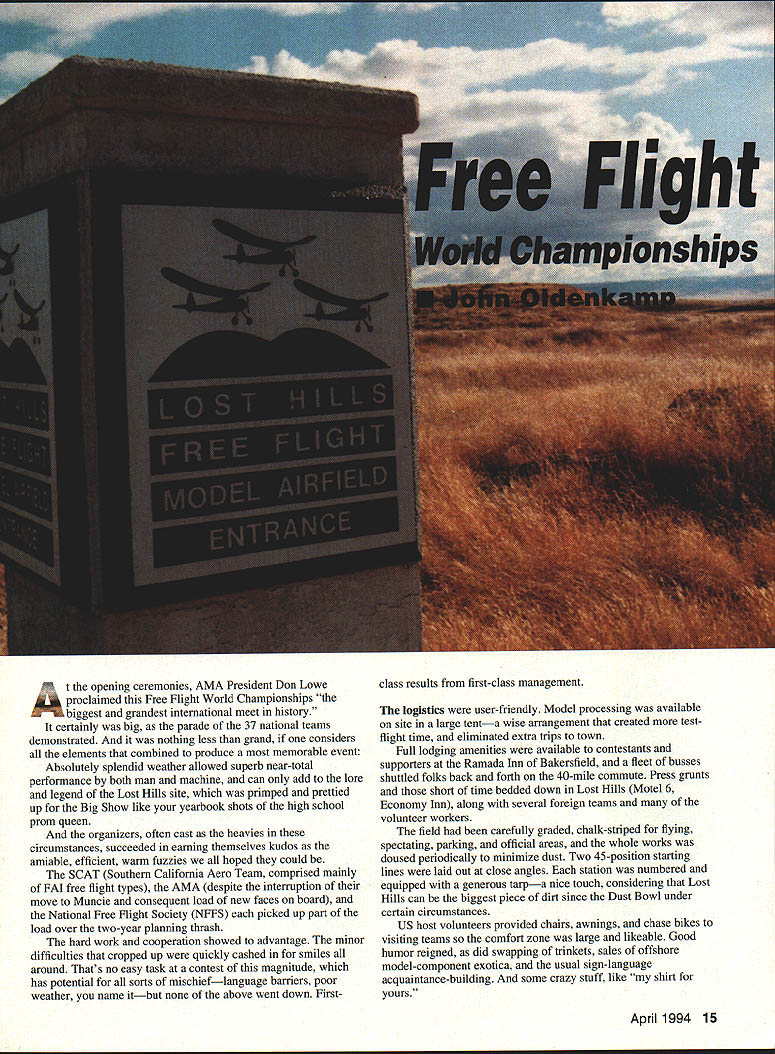
At the opening ceremonies AMA President Don Lowe proclaimed the Free Flight World Championships "the biggest and grandest international meet in history." The parade of 37 national teams showed how large the meet was, and many elements combined to produce a memorable event. Splendid weather allowed near‑total performance by both man and machine and added to the lore of the Lost Hills site, which was primped and prettied up for the Big Show.
Organizers earned kudos for being amiable, efficient, and effective. The Southern California Aero Team (SCAT), comprised mainly of FAI free flight types; the AMA (despite disruptions from its move to Muncie); and the National Free Flight Society (NFFS) each carried part of the load during two years of planning. Hard work and cooperation paid off: minor difficulties were quickly handled and the contest avoided the usual potential mischiefs of international meets — language barriers, poor weather, and the like.
Logistics were user‑friendly:
- On‑site model processing was available in a large tent, creating more test‑flight time and eliminating extra trips to town.
- Full lodging amenities were available at the Ramada Inn of Bakersfield, with a fleet of buses shuttling contestants and supporters on the 40‑mile commute.
- Press and some foreign teams stayed at Lost Hills (Motel 6, Economy Inn) along with many volunteers.
- The field was carefully graded and chalk‑striped for flying, spectating, parking, and official areas, and was doused periodically to minimize dust.
- Two 45‑position starting lines were laid out at close angles; each station was numbered and equipped with a generous tarp.
- US host volunteers provided chairs, awnings, and chase bikes for visiting teams.
Good humor reigned: trinket swapping, sales of exotic components, sign‑language acquaintance‑building, and some quirky bargains like "my shirt for yours."
Much like baseball's World Series, the Free Flight World Championships generated reams of statistics:
- 37 competing national teams
- 927 regular three‑minute max attempts
- 136 flyoff rounds
- Two flight modes (F1B and F1C)
- 312 timers required for flyoffs
Steve Geraghty played a key organizational role in lining up and readying the large timer pool and earned the nickname "Pleader" for his efforts.
Finally, the 1993 World Championships produced two individual champions: Alexander Andriukov (Ukraine) in F1B Wakefield and Randy Archer (United States) in F1C Power.
Event Format and Opening
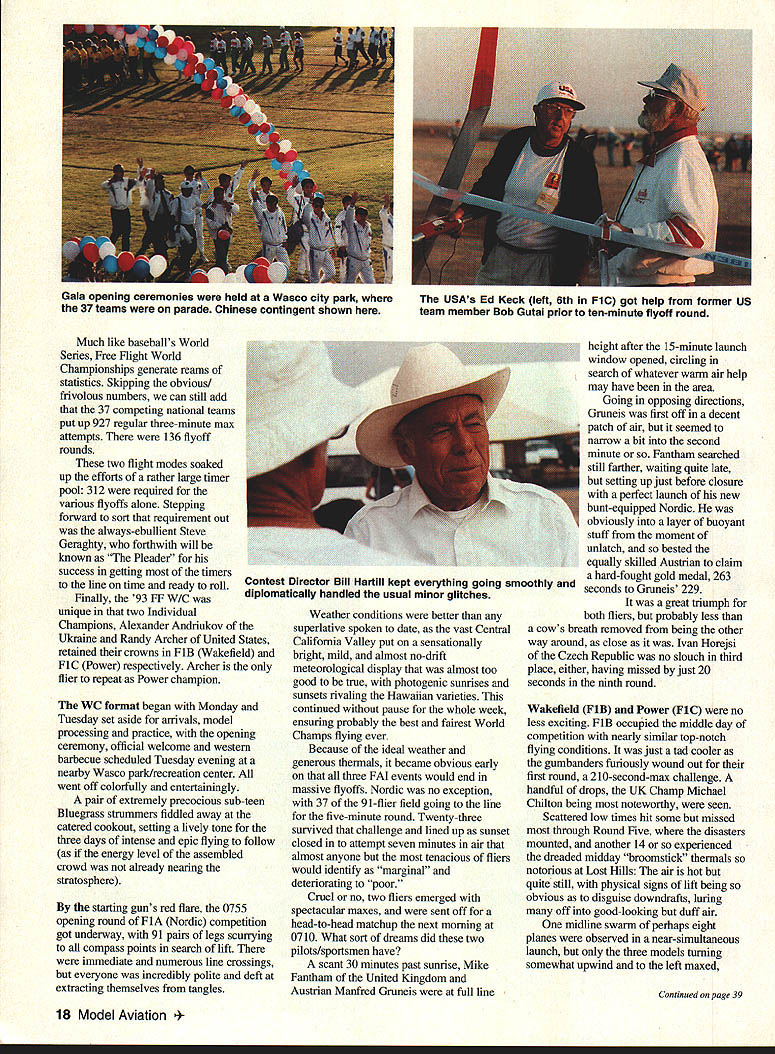
The meet format set Monday and Tuesday aside for arrivals, model processing, and practice, with the opening ceremony and western barbecue scheduled Tuesday evening at the Wasco park/recreation center. A pair of precocious sub‑teen bluegrass strummers enlivened the on‑site catered cookout and set a lively tone for the flying to follow.
By 07:55 the opening round of F1A (Nordic) competition began, with 91 competitors scurrying to all compass points in search of lift. There were numerous line crossings, but fliers were polite and deft at freeing themselves from tangles. The Central Valley produced sensationally bright, mild weather throughout the week, probably ensuring the fairest World Champs flying ever.
F1A (Nordic)
Because of ideal weather and generous thermals, all three FAI events ended in massive flyoffs. Nordic was no exception: 37 of the 91‑flier field advanced to a five‑minute flyoff. Twenty‑three survived that challenge and lined up at sunset for a seven‑minute attempt the next morning.
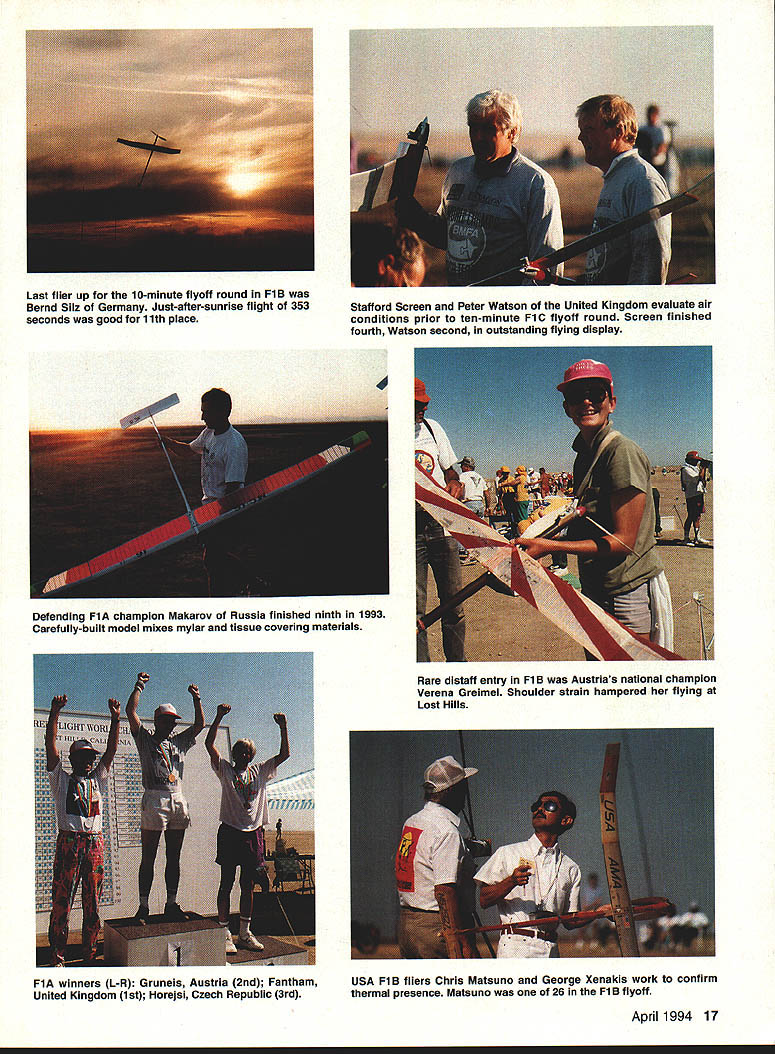
The head‑to‑head final featured Mike Fantham (United Kingdom) and Manfred Gruneis (Austria). At sunrise both were at full line height after the 15‑minute launch window opened. Gruneis launched into a decent patch that narrowed in the second minute; Fantham waited and then launched a near‑perfect flight, entering a buoyant layer from unlatch and posting a winning 263 seconds to Gruneis' 229. Ivan Horejsi (Czech Republic) finished third, narrowly missing a higher placing.
F1B (Wakefield)
F1B occupied the middle day of competition under similarly excellent conditions. Contestants began with a 210‑second max round; a few early drops occurred. Scattered thermals and deceptive midday "broomstick" lift at Lost Hills caused problems in Rounds Five and beyond, with several experienced fliers suffering disappointing flights. Rounds Six and Seven saw surprise disappointments as seemingly sure‑shot thermals failed to support models.
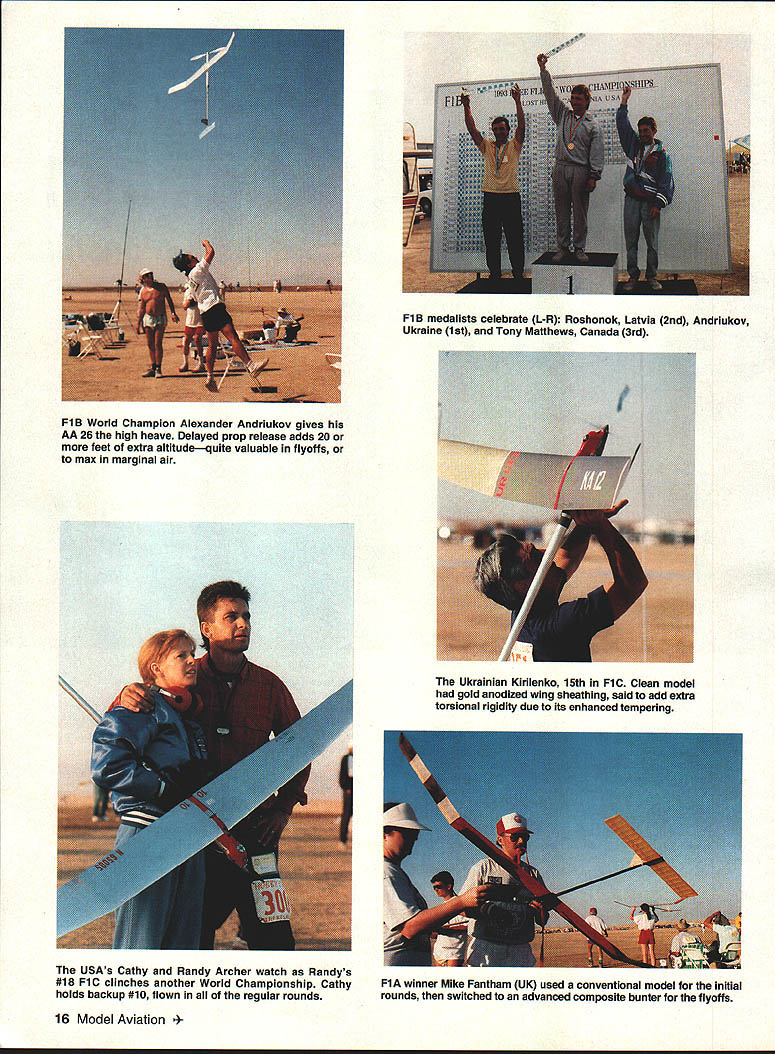
A large flyoff loomed. At sunset 26 hopefuls attempted a five‑minute Round Eight; 22 succeeded. Round Nine was deferred to the following morning as a ten‑minute‑max shootout at 07:10. Early‑morning flyoffs challenged competitors with colder air, numb fingers, and stretched nerves. A standout performance in the Wakefield final came from Alexander Andriukov (Ukraine), who produced a stunning 535‑second flight to claim gold.
F1B medalists:
- Alexander Andriukov (Ukraine) — 535 seconds (gold)
- Viktor Roshonok (Latvia) — 459 seconds (silver)
- Tony Matthews (Canada) — 434 seconds (bronze)
F1C (Power)
The Wakefields finished early enough for the meet's main attraction: the Power matches. Two reigning World Champions were present — Verbitski (Ukraine) and Randy Archer (USA) — along with strong teams from China, Russia, Italy, and the UK. Eighty‑five individuals from 23 nations contested F1C.
Given the performance of modern full‑auto, bunt, and programmed power models (roughly 8–8½ minutes in neutral air), the seven‑round program might have produced many maxes, but failed mechanicals, marginal picks, and lost or damaged planes decimated the field. In the first round 24 fliers missed the obligatory four‑minute max. A midday grass fire briefly halted flying for about an hour while the local fire department controlled a downwind blaze.
The delay eliminated same‑day flyoffs, so organizers scheduled a Saturday‑morning 10‑minute round followed by a 12‑minute round if needed, starting at 07:10. Timers and competitors assembled at 06:30. Nearly all 26 qualifiers launched nearly simultaneously after waiting out the 15‑minute window. It became clear at the 10‑minute mark that at least two had maxed: Randy Archer (reigning champion) and Peter Watson (UK).
A 12‑minute final was given the go‑ahead. Peter Watson landed at 408 seconds; Randy Archer's model stayed aloft for 567 seconds, securing the world title.
Archer's winning #18 model was built shortly after his 1991 WC triumph, crashed, then rebuilt in early 1993. After restringing it proved reliable and was groomed as a flyoff model. It featured a Russian Thermic .15 engine, gold‑anodized tempered aluminum covering (a gift in 1991 from F1B champ Andriukov), slightly longer dimensions and moments, and slightly different airfoils from his #10 used in the regular rounds.
Results and Closing
Champions:
- F1B (Wakefield): Alexander Andriukov (Ukraine)
- F1C (Power): Randy Archer (United States)
The 1993 World Championships were a howling success: outstanding flying on a relatively level playing surface, under conditions that will rank among the best and fairest. Good management, goodwill, and the opportunity to share techniques and camaraderie with international colleagues made this event one for the books.
Transcribed from original scans by AI. Minor OCR errors may remain.

