
Free Flight World Championships
Martin Dilly
Overview
In 1967 the grass airfield of Sazena, about 20 miles north of Prague, hosted 34 national teams for the World Free Flight Championships. Thirty years later, the same site staged one of the best Championships, with 37 nations competing and many fliers now representing their independent countries after the breakup of the USSR, Yugoslavia, and Czechoslovakia. New countries are now contesting the FAI classes F1A (A/2 glider), F1B (Wakefield rubber) and F1C (power).
Czech organizers, led by indoor flier Jiri Kalina and regular team member Ivan Horejsi, ran a three-class World Cup warmup on the same site that attracted 325 competitors. That event helped teams learn how treacherous the air could be—especially around midday. Rain limited flying during the two practice days, but the Championships enjoyed largely excellent weather.
F1A (Glider)
The first-round maximum for gliders was increased to 3½ minutes. Most competitors flew bunt-style models, and with light winds early on it was often more about a clean launch than finding lift. Eighty-four of 107 fliers made the first-round max, including the U.S. team:
- Randy Weiler (sixth team appearance)
- Martyn Cowley (ex-UK F1C team member)
- Don Zink (rookie)
Notable incidents and trends:
- Martyn Cowley, flying last in a round, collided with a towline five minutes before the end signal, then relaunched and salvaged the max.
- Wet grass from previous rain later “boiled off,” producing marked patches of lift and some holes. Several competitors were caught out by the variable conditions.
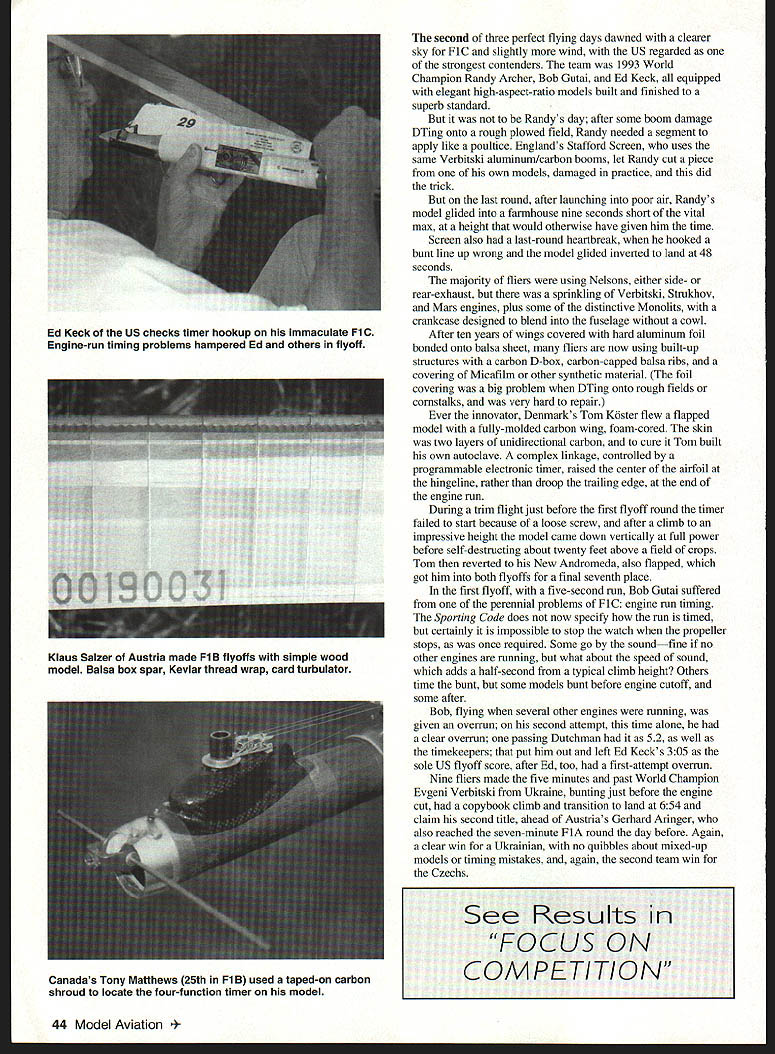
- Mikhail Kochkarev (Russia) and Sergei Makarov (Moscow) — pioneers of the bunting revolution — were among those using programmable electronic timers. Timers were often set from a notebook computer to modify delays between line release and the first “hunt” (about 0.7 seconds later), and to implement two-stage returns to glide as airspeed decayed, as well as to control DT (dethermalizer) timing. Delayed-prop-release (DPR) and other timer-driven experiments were common.
- Belgium’s Leo Reynders used a Kevlar-covered foam wing with a flapped rear half. The timer held the wing in a lower-drag, less-cambered shape during tow, requiring negative stab incidence and giving a nose-high tow; the flaps drooped after release to increase launch height. Reynders dropped one flight.
- Wing designs trended toward five-break wings to approximate elliptical dihedral, and more fliers used the Schuemann wing platform with a swept leading edge toward the tip.
- Radka Vojsepkova (Czech Republic), flying her husband Jan’s foam/glass/carbon Falcon 21, placed fifth in F1A.
- Croatia’s Robert Lesko flew a 108-inch-span, five-break model with a Makarov airfoil, winglets, and a 50-square-inch stab, but missed the last-round max.
- Dutch flier Allard van Wallene (third place) used 83 g/m² carbon over Roofmate foam on the center panels, a high-modulus carbon spar, and built-up tips joined via a short carbon stub.
After seven rounds five teams remained “clean,” including the U.S., and 48 fliers had seven maxes. A two-hour break preceded the flyoff to allow thermal activity to subside. In the first ten-minute slot competitors towed downwind to find clear air; Jiancheng Du of China released early into good air that others missed. Cowley stalled from a zoom launch; Don Zink missed the lift. Randy Weiler reached the second flyoff and ultimately placed eleventh, just ahead of 1995 World Champion Rudolf Holzleitner.
The final man-on-man flyoff for the title saw Ukraine’s Viktor Stamov and Hungary’s Jenö Vörös make seven minutes in the ten-minute slot and then tow for a head-to-head finish. Stamov, flying a lower-aspect-ratio CB60 with a preprogrammed two-stage bunt transition, landed 51 seconds ahead of Vörös to become the 1997 World Champion.
Team classification: the Czech Republic won, followed by Ukraine and the Netherlands. Tie-breaking was based on the lowest total of team members’ places (not flyoff aggregates), which dropped the United States from second to fourth.
Other notes: Australia’s Phil Mitchell covered a wing with Icarex polyester cloth (30 g/m²), a heat-shrinkable, contact-cement-stickable material used for boat sails and available in Day-Glo colors — durable and easy to repair.
F1C (Power)
The second of three fine days dawned clearer for F1C, with slightly more wind. The U.S. team was considered one of the strongest:
- Randy Archer (1993 World Champion)
- Bob Gutai
- Ed Keck
Highlights and technical trends:
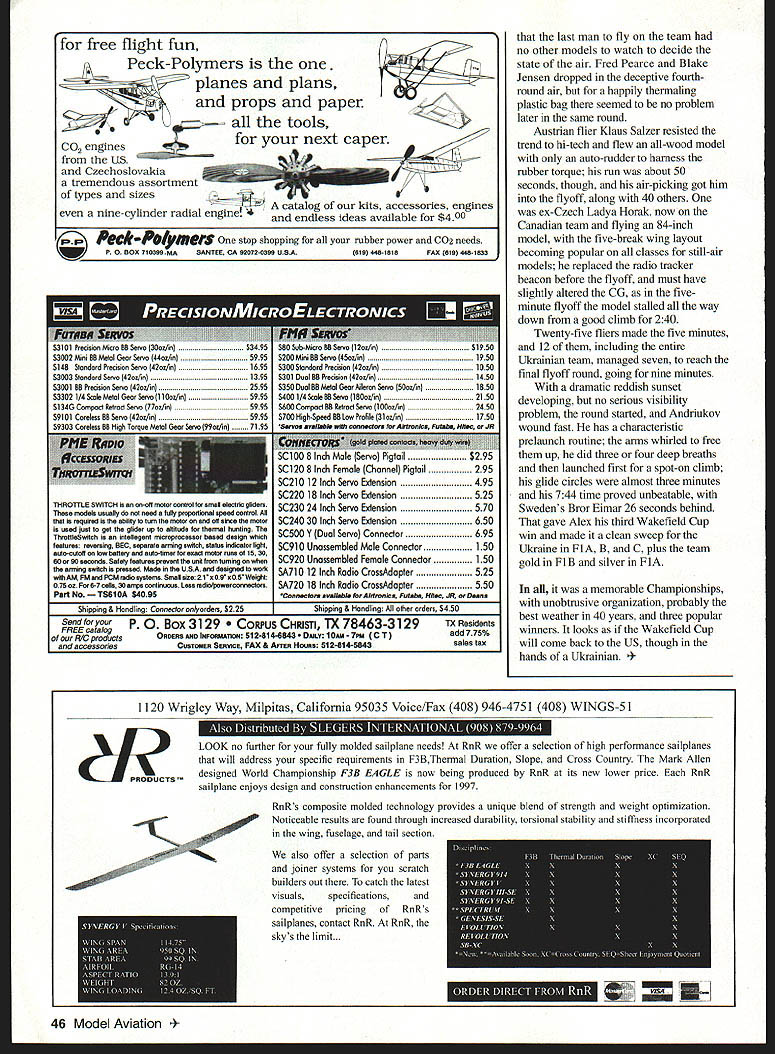
- Randy Archer suffered boom damage when dethermalizing onto rough plowed ground. Stafford Screen (England) lent a boom segment from a damaged practice model, which allowed Randy to continue; however, in the last round he launched into poor air and glided into a farmhouse nine seconds shy of the vital max.
- Stafford Screen also suffered a last-round mis-hooking of a bunt line and landed inverted at 48 seconds.
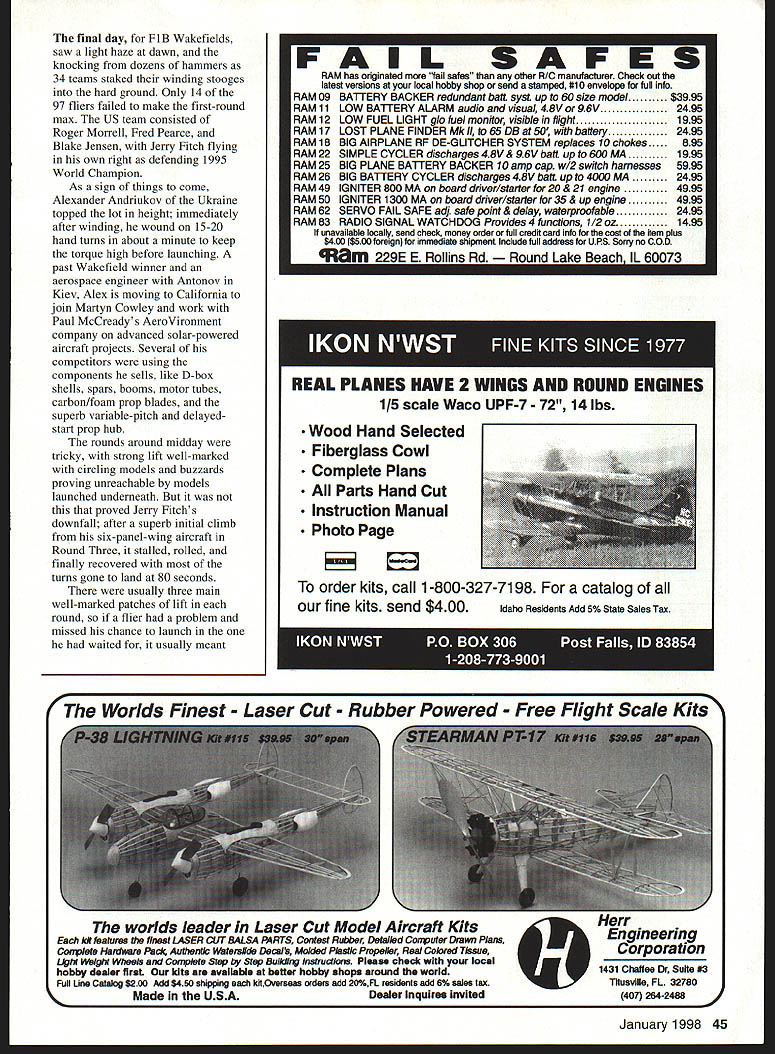
- Most fliers used Nelson engines (side- or rear-exhaust); there were also Verbitski, Strukhov, Mars, and Monolit engines.
- Construction moved away from hard aluminum-foil-covered wings toward built-up structures with carbon D-boxes, carbon-capped balsa ribs, and Micafilm or other synthetic coverings, which are easier to repair after DT incidents.
- Denmark’s Tom Koster pioneered a fully molded, foam-cored carbon wing with flaps. He built his own autoclave to cure the unidirectional-carbon skin. A complex linkage, controlled by a programmable timer, altered the airfoil at the hingeline. A timer failure (loose screw) caused a trim-flight crash when the model climbed, then came down vertically at full power and self-destructed about 20 feet above crops; Koster reverted to another flapped model and finished a solid seventh after getting into both flyoffs.
- Engine-run timing in flyoffs caused problems. The Sporting Code does not specify exactly how the run is timed, and with multiple engines running the timing method (by sound, bunt, or other cues) can be ambiguous. Bob Gutai suffered an overrun in the first flyoff attempt when other engines were running; on his second attempt, still judged to have an overrun (~5.2 s), he was out. That left Ed Keck’s 3:05 as the sole U.S. flyoff score after Ed had also initially suffered an overrun.
- Evgeni Verbitski (Ukraine) won F1C with a tidy climb, bunt and transition, landing at 6:54 to claim his second title, ahead of Austria’s Gerhard Aringer.
Team-wise, this gave the Czech organizers another successful event and reinforced strong Ukrainian performances in the Championships.
F1B (Wakefields)
The final day for F1B Wakefields began with a light haze and dozens of teams hammering winding stooges into the ground. Only 14 of 97 fliers failed to make the first-round max. The U.S. team:
- Roger Morrell
- Fred Pearce
- Blake Jensen
Jerry Fitch competed independently as defending 1995 World Champion.
Key points:
- Alexander Andriukov (Ukraine) topped the height charts. He wound quickly and kept torque high with 15–20 hand turns before launch. A past Wakefield winner and an Antonov aerospace engineer, Andriukov is moving to California to work with Martyn Cowley and Paul MacCready’s AeroVironment on advanced solar aircraft, and he sells high-quality components (D-box shells, spars, booms, motor tubes, carbon/foam prop blades, and variable-pitch/delayed-start prop hubs).
- Midday rounds were tricky, with strong, well-marked lift patches and buzzards in unreachable lift centers. Jerry Fitch experienced a stall after a superb climb in Round Three and landed at 80 seconds. Fred Pearce and Blake Jensen fell victim to deceptive fourth-round air.
- Austrian Klaus Salzer resisted hi-tech trends and flew an all-wood model with auto-rudder; his 50-second run and air sense still got him into the flyoff. Ex-Czech Ladva Horak, now on the Canadian team, flew an 84-inch model; five-break wing layouts were popular for still-air models. Horak replaced a radio tracker beacon before the flyoff and may have slightly altered the CG; in the five-minute flyoff his model stalled from a good climb, landing at 2:40.
- Twenty-five fliers made five minutes, and 12 (including the entire Ukrainian team) reached seven minutes to qualify for the final flyoff for nine minutes.
In the final flyoff with a dramatic reddish sunset, Andriukov launched first, climbed spot-on, and produced long glide circles for a 7:44 that proved unbeatable. Sweden’s Bror Elmar finished 26 seconds behind. Andriukov’s win gave the Ukraine the Wakefield Cup and completed a clean sweep of F1A, F1B and F1C, plus team gold in F1B and team silver in F1A.
Conclusion
The 1997 Free Flight World Championships at Sazena were memorable: unobtrusive organization, probably the best weather in 40 years, strong international entries, and three popular individual winners (Viktor Stamov in F1A, Evgeni Verbitski in F1C, and Alexander Andriukov in F1B). Technical innovation—programmable timers, DPR systems, flapped and molded carbon wings, five-break layouts, and new coverings—was evident across classes, alongside continued experimentation in construction and engine systems.
Transcribed from original scans by AI. Minor OCR errors may remain.

