


French TR260
A new French design showed up at the 1986 Aerobatics World Championships, and it did very well for its first outing. The lines are pleasing, and one of our contributors is already working on an RC version for a future issue. — Don Berliner
The French have broken out with a vengeance! Thanks to the long-overdue easing of government restrictions, the French Aerobatic Team is now able to compete on even terms with other countries that have long been free of artificial limitations on the design and power of competition airplanes.
While the full impact of this newfound freedom has yet to be felt, the French have already shown that they can create designs fully competitive with the established powers in the sport: the U.S.A., U.S.S.R., and Czechoslovakia. In 1986 the French teams (men's and women's) placed third; for the men this was the best result in the 25-year history of the World Aerobatics Championships. In the process, they ousted the Czechoslovakian team from the elite level where it had resided for 10 years.
The credit must go to those French designers and builders involved at the top, or international, level of competition—for that is where the freedom exists. Others are still stuck where they have been for many years—in a red-tape-wrapped cocoon.
There has never been a lack of flying talent in French aerobatic circles. The first person in history to fly inverted was Adolphe Pégoud, a Frenchman, who did it in 1913. The French also dominated the first important series of international competitions—the 1955–1965 Lockheed Trophy Contests in England—with their Leon Biancotto winning three times.
In more recent years the story wasn't filled with glorious achievements. From the start of the World Championships in 1960 through 1968, the French flew a collection of Belgian Stampe biplanes and their own big Nord 3202 military trainers, plus the occasional Czech Zlin. The results were far from satisfactory, both in terms of competitive success and national pride. The French needed their own airplanes, designed and built in France by Frenchmen.
In 1970, the first of a long series of limited-production CAP designs appeared in the form of a single-seat CAP-20 prototype, designed by Claude Piel, creator of the popular Emeraude two-seat homebuilt. Robert Baudoin flew it to an undistinguished 43rd place; combined with the scores of other team members, this produced a 9th place out of 11 teams. The CAP-20 was brand-new and needed refinement, as did the flying techniques.
For 1972, when the French hosted the World Championships at their Air Force Academy, they had a fleet of CAP-20s and managed to climb to 4th place in the team standings, though the top-placed individual was Louis Pena in 13th. The airplane had been improved, but so had the airplanes flown by most of the other teams. Progress was hardly rapid.
There was no Championship in 1974, and for 1976 the lightweight CAP-20L was flying, if not fully ready. Jean-Pierre Bourgeois flew it into 19th place, the best for any French pilot as their team finished 8th. It was the same old story; as the CAP-20 got better, the Pitts, Zlins, and Yaks got better, faster. The French were slipping backwards.
The final version of this series—the CAP-21—made its debut at the Oshkosh World Championships in 1980. The CAP-21's double-tapered, Laser-like wing, better at snap rolls than the old semi-elliptical planform wing, showed the French willingness to adapt to others' ideas. However, the wing was still mounted low, while the trend was very much toward mid-wing monoplanes. The CAP-21 breathed some life into the program, but the French team could do no better than 6th in 1982 in Austria, or 5th in 1984 in Hungary.
The problem was strict government control over experimental (generally homebuilt) airplanes. The idea that anyone should be allowed to build anything he wants was unknown in France. In the U.S.A., it is up to the individual builder to decide design, construction, and power, with very limited interference from the FAA. Moreover, the rules for international aerobatics competition recognize this, limiting nothing but the engines—and that restriction is not on horsepower but on the basic form, with only piston engines being allowed; no turbines. If you want to use a 3,000-hp Pratt & Whitney engine or a 63-hp snowmobile engine, there won't be anything standing in your way but common sense.
It must have annoyed the French mightily to be forced to sit and watch while others experimented with modified engines, composite materials, and new airplanes at each biennial World Championships. To all intents and purposes, they were stuck with factory-built airplanes, and that meant CAP-21s, since national pride and rising costs prevented them from buying Czech Zlin 50s or West German Extra 230s.
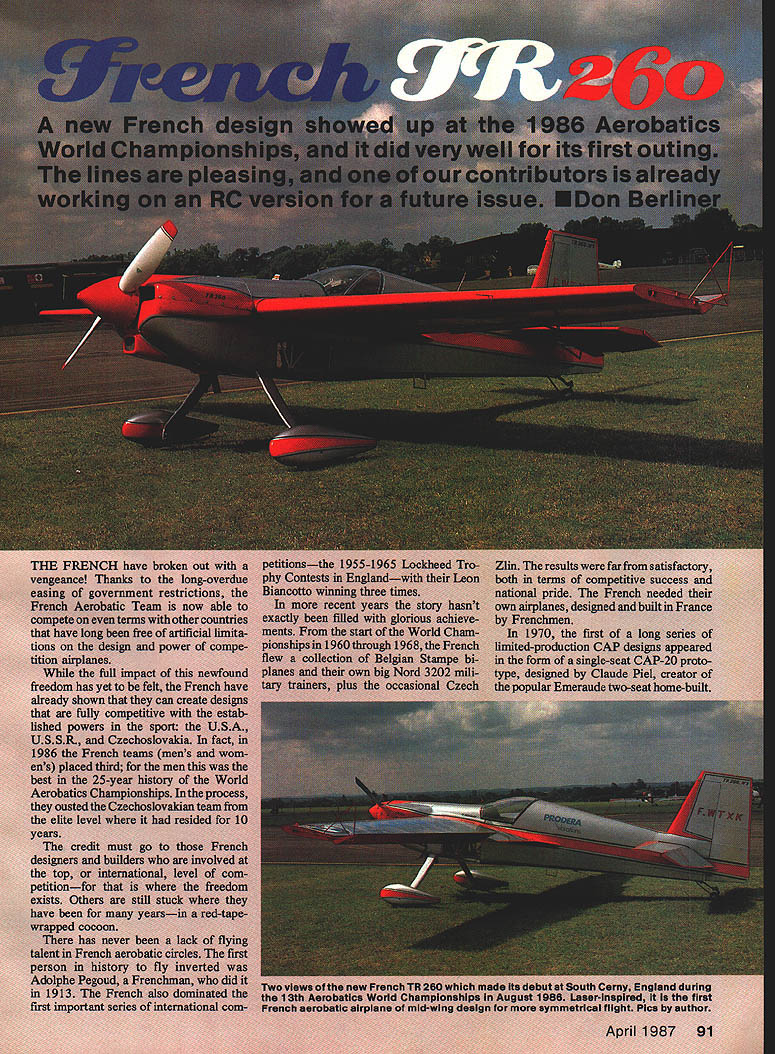
Until 1986! The French team that flew into South Cerney Aerodrome in the west of England for the 13th World Championships was completely different from any seen before. There wasn't a single factory-stock airplane in the bunch. There were several highly modified CAP-21s, along with the first of a new breed of French-developed airplanes: the TR 260.
It didn't even look like anything the French had built or flown before, nor did it look like a copy of any other country's design. Unlike the CAP-20s and -21s, which never looked quite up-to-date, it was obviously a mid-1980s airplane.
There wasn't anything radical or particularly novel about the TR 260, just an intelligent combination of proven elements. It was a mid-wing of the American Laser style which traces its origins back to the Stephens Akro of 1967. That design, in turn, owes its distinctive, trim shape to the Formula One racers of the era. The Akro was basically an enlarged version of a F-1 called Miss San Bernardino that was raced by one of America's great aerobatic pilots, the late Art Scholl.
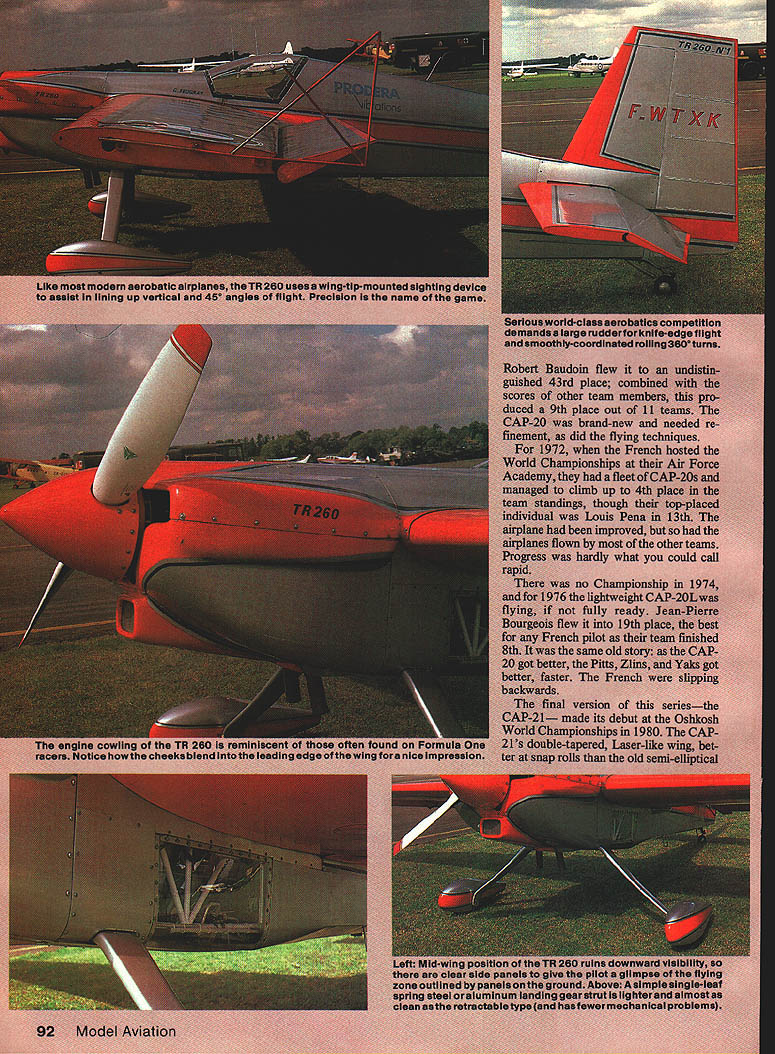
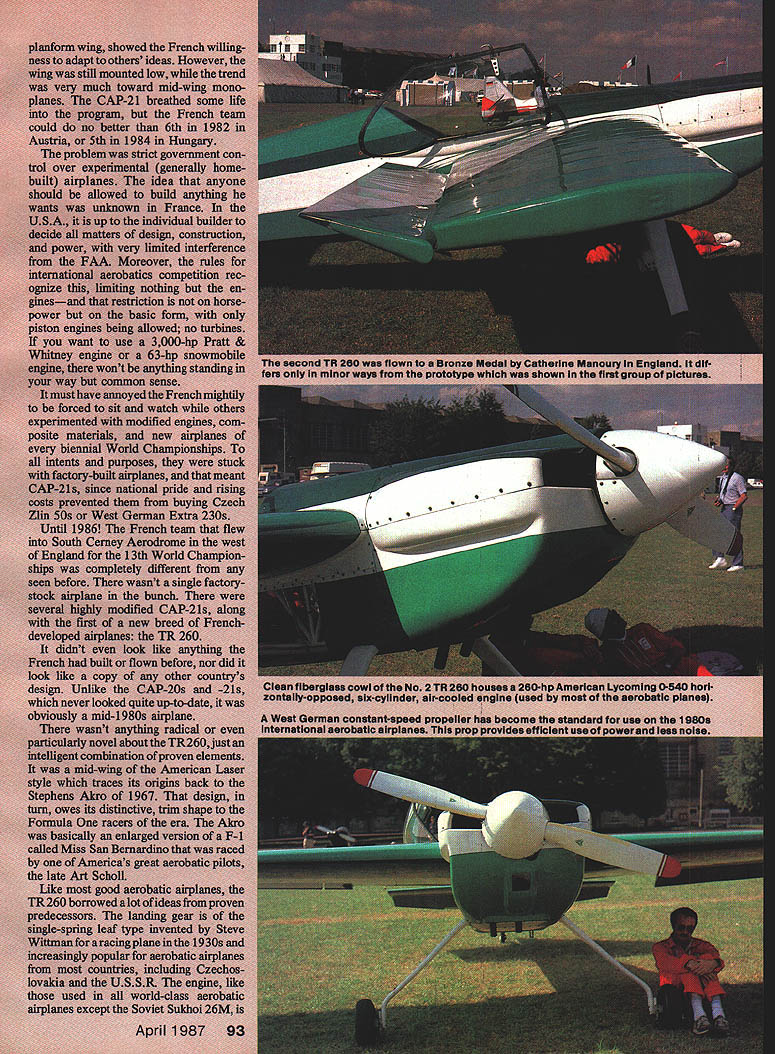
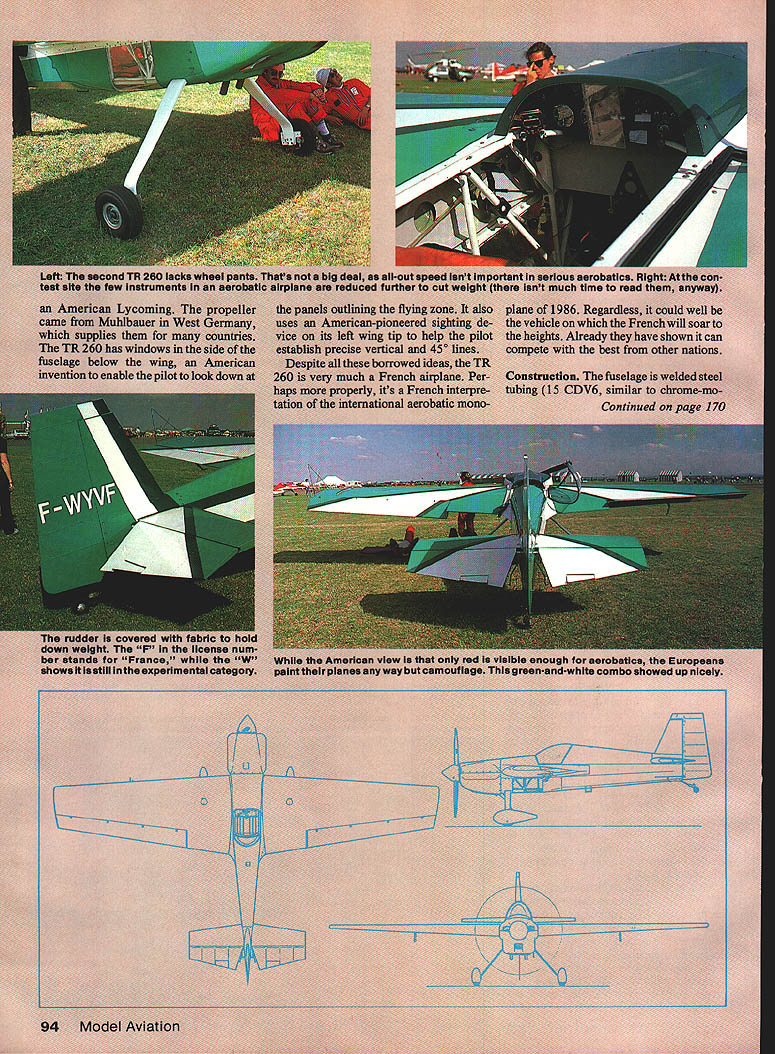
Like most good aerobatic airplanes, the TR 260 borrowed a lot of ideas from proven predecessors. The landing gear is of the single-spring leaf type invented by Steve Wittman for a racing plane in the 1930s and increasingly popular for aerobatic airplanes in most countries, including Czechoslovakia and the U.S.S.R. The engine, like those used in all world-class aerobatic airplanes except the Soviet Sukhoi 26M, is a 260-hp Lycoming O-540. The propeller came from Muhlbauer in West Germany, which supplies them for many countries. The TR 260 has windows in the sides of the fuselage below the wing—an American invention to enable the pilot to look down at the panels outlining the flying zone. It also uses an American-pioneered sighting device on its left wing tip to help the pilot establish precise vertical and 45° lines.
Despite all these borrowed ideas, the TR 260 is very much a French airplane. Perhaps more properly, it's a French interpretation of the international aerobatic monoplane of 1986. Regardless, it could well be the vehicle on which the French will soar to the heights. Already they have shown it can compete with the best from other nations.
Construction
The fuselage is welded steel tubing (15 CDV6, similar to chrome-moly) covered with unidirectional fiberglass. The wings are built up from hemlock pine and covered with 2½ mm, 45° mahogany plywood. The ribs are spaced 12 in. apart. The airfoil is a modified NACA 21000 series, with the symmetrical section tapering in thickness from 14% at the root to 10% at the tip. It is stressed to ±10 g, both positive and negative. The large, almost-full-span ailerons use small external counterbalances, rather than load-easing spades.
The engine on the prototype built for Georges Muzergues by Gerard Feugray (F-WTKX) is a 260-hp, six-cylinder, horizontally-opposed Lycoming AIO-540 which uses a Christen inverted fuel and oil system and turns a two-bladed Muhlbauer constant-speed propeller. Catherine Manoury's Sirius version, the second TR 260 (F-WYVF), has a Lycoming AIO-540 rated at no less than 330 hp.
Dimensions
- Wingspan: 27 ft. 4 in. (8.34 m)
- Length: 19 ft. 3½ in. (5.88 m)
- Wing Area: 118 sq. ft. (11 m²)
- Flying Weight: 1,320 lb. (600 kg)
- Wing Loading: 12.2 lb./sq. ft. (54.5 kg/m²)
Performance
- Maximum Level Speed: 235 mph (380 km/h)
- Maximum Diving Speed: 280 mph (450 km/h)
- Maximum Maneuvering Speed: 200 mph (320 km/h)
- Sea Level Rate of Climb: 4,000 ft./min. (20 m/sec)
- Roll Rate: 270 deg./sec.
The TR 260 has now had its first major international competition airing. No doubt many lessons were learned which are even now being incorporated into these first two airframes and, one hopes, into others to follow. How the French develop the TR 260 will depend on how they see its future—how they think it will stand up against the best of current airplanes and the new ones being readied, such as a couple of 300-hp Pitts Specials with retracting landing gear.
The next important test for the TR 260 and for Muzergues and Manoury will be Eurobatics '87 (the European Championships), scheduled for June 12–22, 1987, at Obernburg, West Germany, 40 miles northeast of Nürnberg. After that, it will be the World Championships from July 31 to August 12, 1988, at Red Deer, Alberta, Canada. By then the world will know just how good an airplane the TR 260 has become.
Transcribed from original scans by AI. Minor OCR errors may remain.

