
Frequently Asked Questions
Bob Aberle
E-mail: baberle@optonline.com
This is the third monthly column in which I try to give you the best answers to questions you have written or e-mailed to me. I give each question a sequential number for identification purposes. Because publication space is limited, part of this column will appear in print and spillover material will appear only on the AMA Web site. Stated another way, all questions and answers will be posted on the AMA Web site. Let's start!
Q25: "I just acquired a Global Hobbies ProMax Activator peak digital charger. I am just getting into electric power, but would like to use this charger on my regular RC transmitter and receiver batteries. It states in the instructions that you should set the charge current to two or three times the rated capacity of the battery pack. Is that okay?
You also said in your 'Battery Basics' article (October 2003 Model Aviation) that a battery pack is bad when it is depleted to 20% of its rated capacity. How do I know when I get there? Can you straighten me out?"
A25: Several answers are necessary, and this is an important subject. The ProMax charger the reader referenced works well, and I have no problem with it. The basic charging circuit was designed with the electric-power enthusiast in mind. You can charge one to eight cells (Ni-Cd or NiMH) at selectable charge currents ranging from 0.5 to 6.0 amps. It is essentially a fast charger with peak-detect cutoff. There is also a "Slow Peak Mode" that applies a fixed 0.2-amp (200 mA) charge current to the smaller battery packs. There are no discharge testing capabilities in this unit.
I do not recommend that you fast-charge your RC transmitter battery. Most of these cells are rated at 500–600 mAh. If you apply a 3C charge current (600 × 3 = 1,800 mA, or 1.8 A), you might blow out the internal charging circuit wiring inside your transmitter. I recommend that you charge your RC transmitter battery pack with the system charger that the manufacturer supplied. That will always be at the overnight rate (or for at least 10–12 hours). You can do this every other day and never overcharge the battery at that rate.
For the most part I also favor charging the RC airborne receiver/servo battery pack with the system manufacturer's charger at the same overnight rate. Unless you want to fly for more than two hours at a particular flying session, there is no need to fast-charge these batteries. Most RC-system batteries were never intended for fast charging in the first place. So I recommend that you save your ProMax charger for your electric-power battery packs. It will do a fine job.
In the next part of his question, the reader indicated that my article stated that a battery needs replacing when it falls to 20% of its originally rated capacity. He then wondered if he could interpret data from the ProMax charger that would allow him to derive battery capacity.
Here we go again with the fine print! In that article I wrote that I discard battery packs when they drop 20% from their original capacity rating. As an example, I wrote that a 600 mAh pack should be discarded when the capacity reaches 480 mAh (600 less 20%). I referred to when it goes down 20%—not when it goes down to 20%.
The peak voltage and time showing up on the ProMax display will not directly tell you anything about the battery's capacity. To find that out, you need a simple battery-discharge tester. This device applies a load to the battery, usually taking the voltage down to 1 volt per cell. The amount of the load and the time it took to get to the 1 volt per cell is integrated into a single capacity reading in mAh.
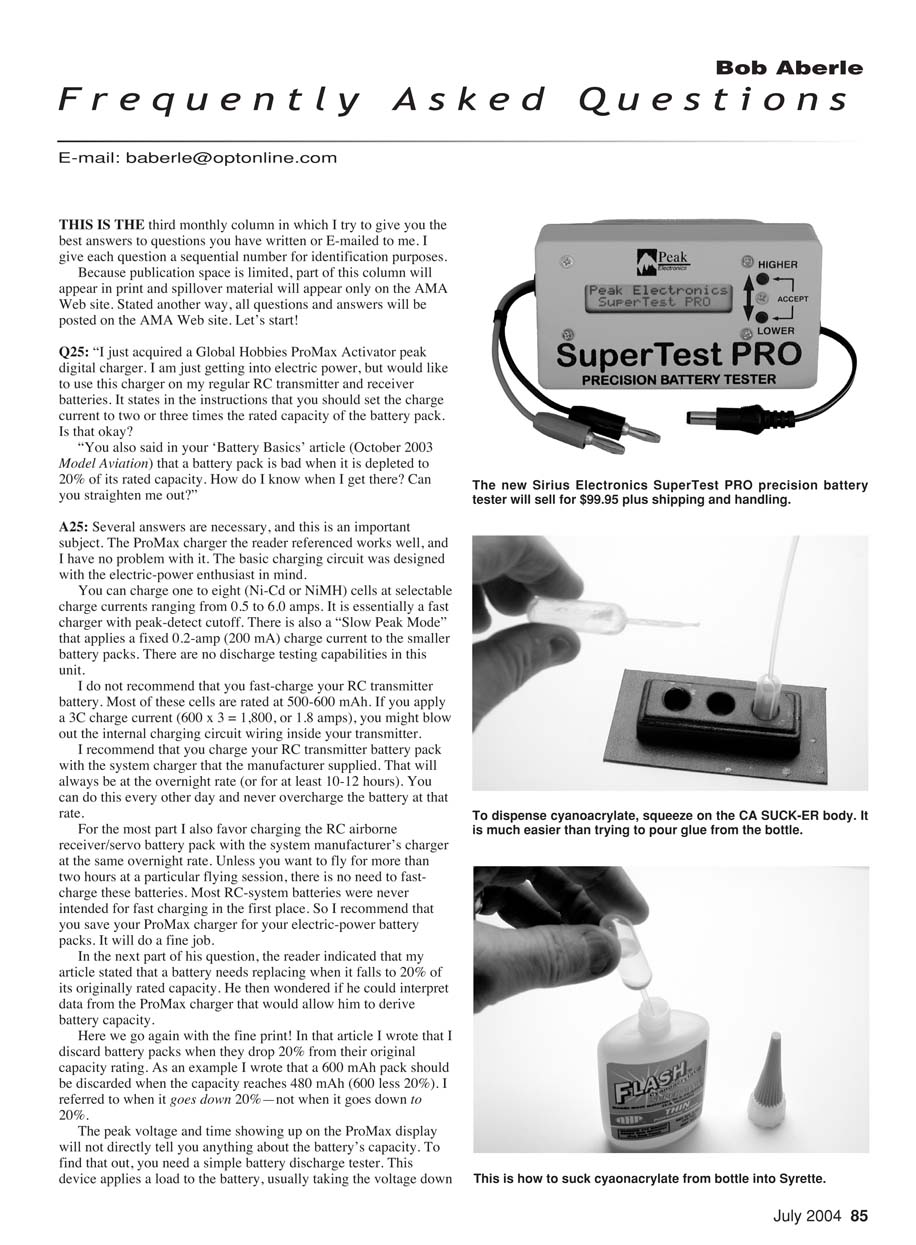
I've included a photo of the new Sirius Electronics (a division of Peak Electronics, Inc.) SuperTest PRO precision battery tester, which can handle as many as 14 battery cells. You can set the voltage cutoff point in 1-volt increments up to 14 volts. This enables you to test Ni-Cd, NiMH, and even Li-Poly batteries. To learn more about this battery tester, go to www.siriuselectronics.com/supr_tst.htm.
Q26: "I'm having a tough time using my thin CA cement because the nozzle on the top of the dispenser bottle keeps continuously clogging. This slows down my building process. Is there any possible solution to this problem?"
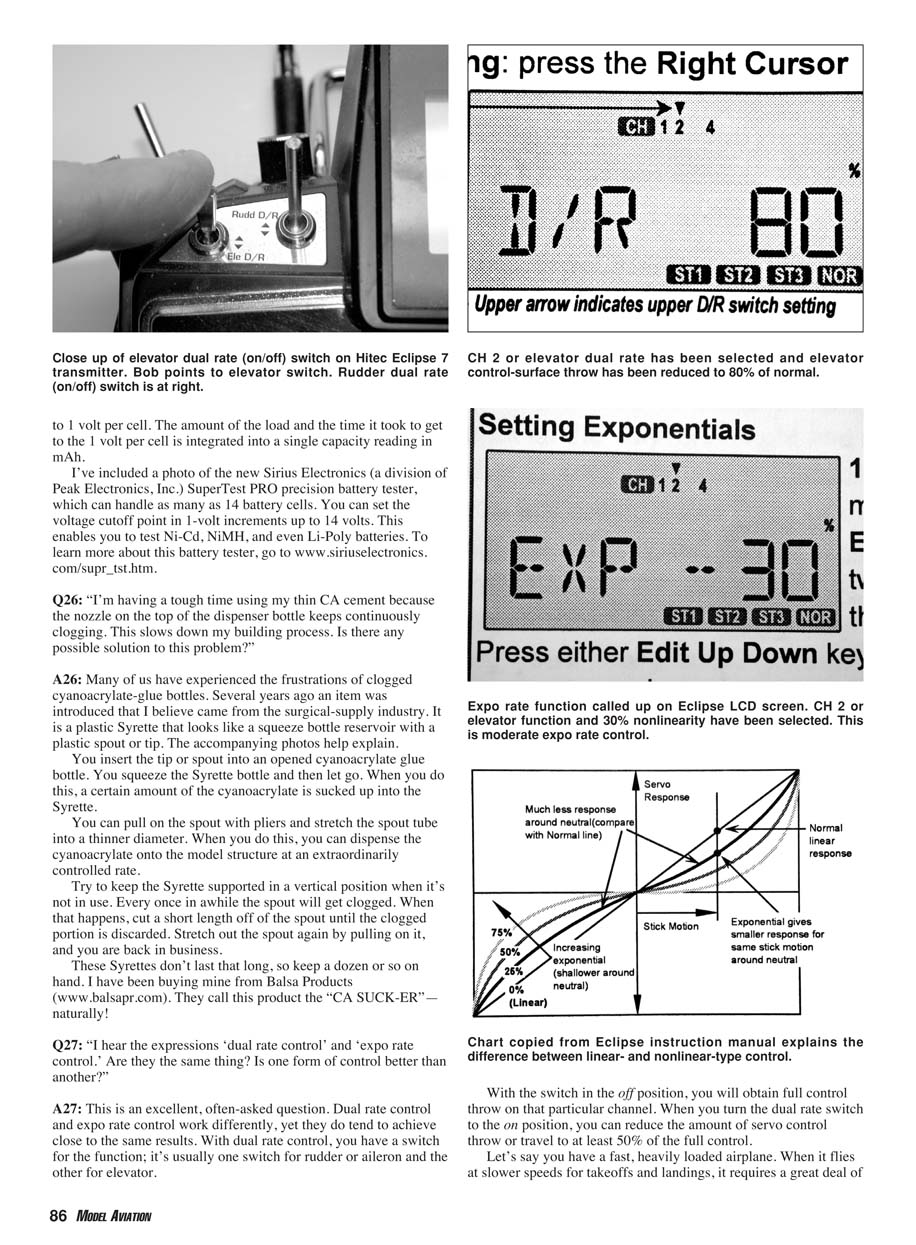
A26: Many of us have experienced the frustrations of clogged cyanoacrylate (CA) glue bottles. Several years ago an item was introduced that I believe came from the surgical-supply industry. It is a plastic Syrette that looks like a squeeze-bottle reservoir with a plastic spout or tip.
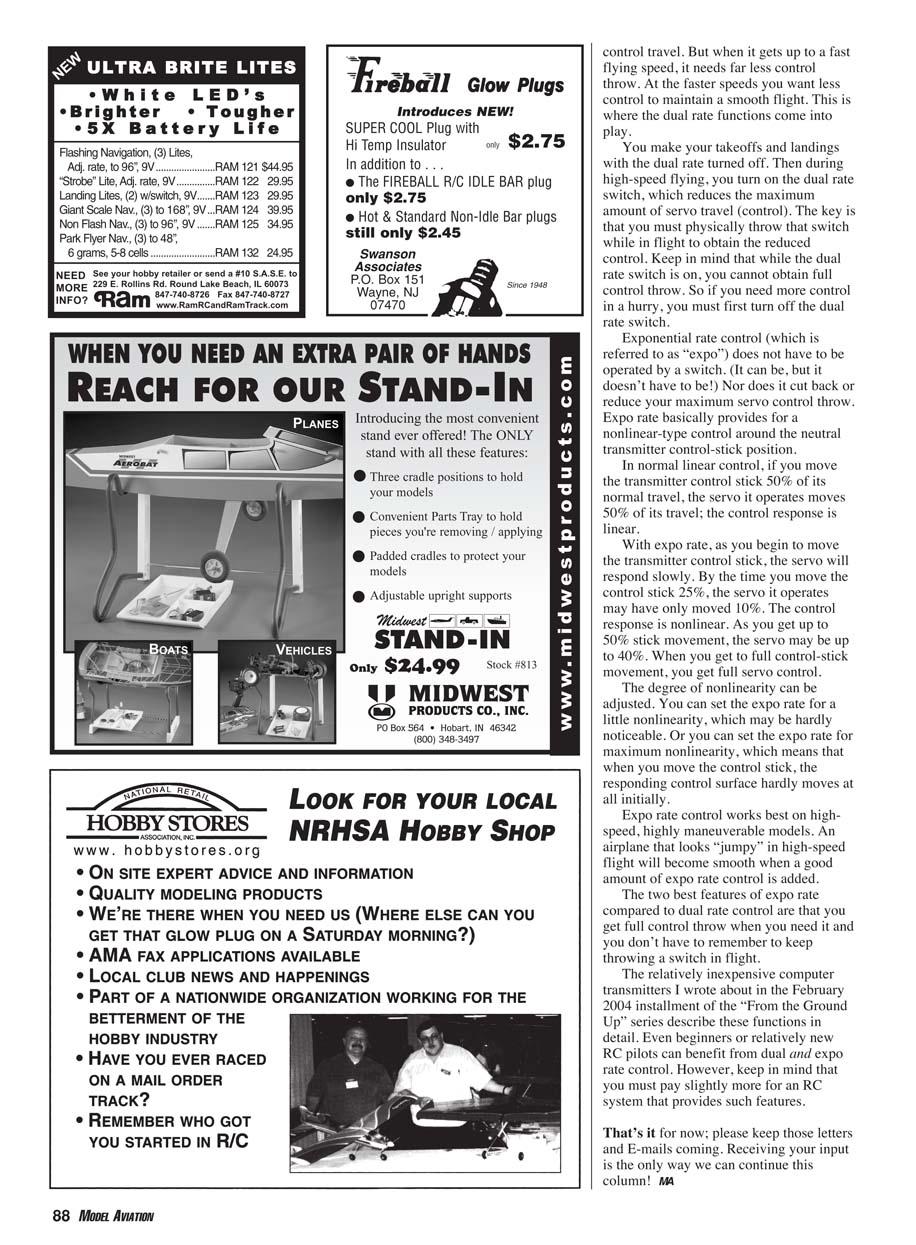
- You insert the tip or spout into an opened cyanoacrylate glue bottle. You squeeze the Syrette bottle and then let go. When you do this, a certain amount of the cyanoacrylate is sucked up into the Syrette.
- You can pull on the spout with pliers and stretch the spout tube into a thinner diameter. When you do this, you can dispense the cyanoacrylate onto the model structure at an extraordinarily controlled rate.
- Try to keep the Syrette supported in a vertical position when it's not in use. Every once in a while the spout will get clogged. When that happens, cut a short length off the spout until the clogged portion is discarded. Stretch out the spout again by pulling on it, and you are back in business.
These Syrettes don't last that long, so keep a dozen or so on hand. I have been buying mine from Balsa Products (www.balsapr.com). They call this product the "CA SUCK-ER"—naturally!
Q27: "I hear the expressions 'dual rate control' and 'expo rate control.' Are they the same thing? Is one form of control better than another?"
A27: This is an excellent, often-asked question. Dual rate control and expo rate control work differently, yet they do tend to achieve close to the same results.
Dual rate control:
- You have a switch for the function; it's usually one switch for rudder or aileron and another for elevator.
- With the switch in the off position, you will obtain full control throw for that channel.
- When you turn the dual rate switch on, you can reduce the amount of servo control throw or travel (commonly to 50% or less of full control).
- Use case: A fast, heavily loaded airplane needs more control travel at slow speeds (takeoff, landing) and less at high speeds. You make takeoffs and landings with dual rate turned off. During high-speed flight, you switch it on to reduce maximum servo travel.
- Note: You must physically flip the switch in flight to change the rate. While dual rate is on, you cannot obtain full control throw without first turning the switch off.
Exponential (expo) rate control:
- Expo does not have to be operated by a switch (though it can be).
- Expo does not reduce your maximum servo control throw.
- Expo provides a nonlinear-type response around the neutral transmitter stick position. In linear control, 50% stick movement produces 50% servo movement. With expo, initial stick movement produces much less servo response; as stick movement increases, servo response ramps up nonlinearly until full stick yields full servo travel.
- The degree of nonlinearity (expo amount) is adjustable from slight to strong.
- Use case: Expo works best on high-speed, highly maneuverable models. An airplane that seems "jumpy" at speed will become smoother with appropriate expo.
The two best features of expo compared to dual rate are that you get full control throw when you need it and you don't have to remember to throw a switch in flight.
The relatively inexpensive computer transmitters I described in the February 2004 installment of the "From the Ground Up" series cover these functions in detail. Even beginners or relatively new RC pilots can benefit from dual and expo rate control. However, keep in mind that you must pay slightly more for an RC system that provides such features.
That's it for now; please keep those letters and e-mails coming. Receiving your input is the only way we can continue this column! MA
Transcribed from original scans by AI. Minor OCR errors may remain.

