
Frequently Asked Questions - 2004/12
Bob Aberle
E-mail: baberle@optonline.com
This is the ninth monthly column in which I try to give the best possible answers to questions that you write in or e-mail to me. Each question is given a sequential number for identification purposes. Because space here is limited, part of this column will be published and spillover material will be posted on the AMA Web site at www.modelaircraft.org/mag/faq/index.asp. All questions and answers are posted on the Web site. Let's start!
Q72
"Last month in Q65 you talked about the fact that the popular AstroFlight Whattmeter would not operate below 4.0 volts. You referenced a modification that would permit such use. You also said the following: 'If enough people show an interest, Bob Boucher of AstroFlight might offer a meter specifically for this application in the future.' Well, I have good news: AstroFlight just announced a new version of their meter. Would you please verify that fact?"
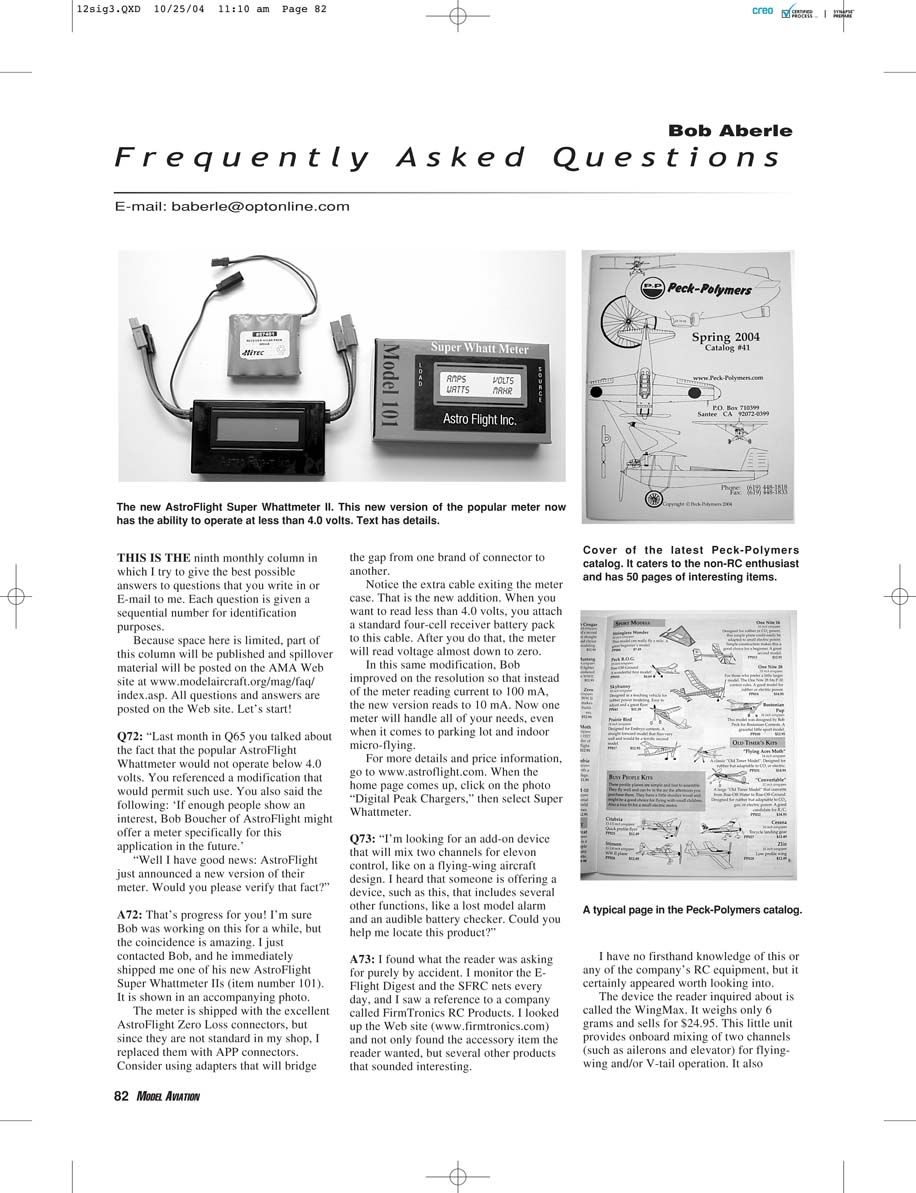
A72: That's progress for you! I contacted Bob Boucher, and he immediately shipped me one of his new AstroFlight Super Whattmeter II (item number 101). The meter is shipped with the AstroFlight Zero Loss connectors; since they are not standard in my shop, I replaced them with APP connectors. Consider using adapters that will bridge the gap from one brand of connector to another.
Notice the extra cable exiting the meter case. That is the new addition. When you want to read less than 4.0 volts, you attach a standard four-cell receiver battery pack to this cable. After you do that, the meter will read voltage almost down to zero. In this same revision, Bob improved the resolution so that instead of reading current to 100 mA, the new version reads to 10 mA. Now one meter will handle all of your needs, including parking-lot and indoor micro-flying.
For more details and price information, go to www.astroflight.com. When the home page comes up, click on the photo "Digital Peak Chargers," then select Super Whattmeter.
Q73
"I'm looking for an add-on device that will mix two channels for elevon control, like on a flying-wing aircraft design. I heard that someone is offering a device, such as this, that includes several other functions, like a lost model alarm and an audible battery checker. Could you help me locate this product?"
A73: I found what the reader was asking for purely by accident. I monitor the EFlight Digest and the SFRC nets every day, and I saw a reference to a company called FirmTronics RC Products. I looked up the Web site (www.firmtronics.com) and found the accessory the reader wanted, plus several other interesting products. I have no firsthand experience with the company's equipment, but it appeared worth looking into.
The device the reader inquired about is called the WingMax. Details:
- Weight: 6 grams
- Price: $24.95
- Functions: onboard mixing of two channels (such as ailerons and elevator) for flying-wing and/or V-tail operation; in-flight low-battery-warning alarm; lost-aircraft warning alarm if the transmitter signal is lost or turned off
Other FirmTronics products include:
- PathFinder LMA (airplane locator and low-battery alarm)
- Servo reverser (for use at your receiver)
- DigiFailSafe (program servo positions in the event of a lost signal or interference)
I hope to obtain several of these devices to review in the near future.
Q74
“I recently experienced a flying-site separation problem where two local clubs were operating from flying fields in very close proximity to one another. To help resolve this problem I was advised to look up AMA document 548 ‘Procedure for RF Interference Testing Between Model Sites’ (reference this specific AMA Web site: www.modelaircraft.org/templates/ama/PDF-files/548.pdf).
“Well, I did and it appears that this test procedure depends on a device referred to as a ‘Glitch Detector.’ The only problem is, there is no reference as to what this device is or even where one could buy it. Can you help me out?”
A74: I was aware this document was being prepared, but when I checked the released version I noticed the reference to the Glitch Detector was missing. Here are several ways to obtain or access a Glitch Detector:
- George Steiner originally designed the Glitch Detector about 10 years ago and published a construction article in the April 1994 Radio Control Modeler magazine. He offered assembly kits then; while kits are no longer available, George indicated he has some PC boards remaining and will give them away for the cost of postage. You must supply the parts. Contact George at GSPPRO@aol.com.
- Schulze Elektronik (Germany) makes a "glitch counter" called the blinki-mc4. Icare-Ikarus, Inc., of Canada (www.icare-rc.com) sells it for about $45 US. Details and photos are at www.schulze-elektronik-gmbh.de/.
- FMA Direct’s new Flight System Receivers (FS5 and FS8) include built-in glitch-counting capability. A detailed review of that product appeared in the November 2004 MA.
- Dan Williams, the AMA District II frequency coordinator, recently updated the Steiner Glitch Detector with a new microprocessor, making it easier to use and calibration-free. Dan is making several of these devices for the AMA districts.
When you have a flying-site separation problem, contact your district's Frequency Coordinator (listed at the top of the respective vice president’s column in the “AMA News” section each month). He or she should be able to loan you a Glitch Detector and coach you on how to use it effectively.
Q75
“Although I enjoy building and flying RC models, I still like to also try my hand at some ‘non-RC’ models, like Free Flights, rubber power, and Towline Gliders. Most of the magazine advertisements are RC oriented. Can you recommend any literature or catalogs that concentrate more on the ‘non-RC’ areas of our hobby?”
A75: I still fly a free-flight model or hand-launched glider on occasion. I started in the hobby in 1950 flying FF models and won many contests as a teenager before getting actively into RC. Although most modern hobby-magazine advertising concentrates on RC, many suppliers specialize in products for “non-RC” model aircraft.
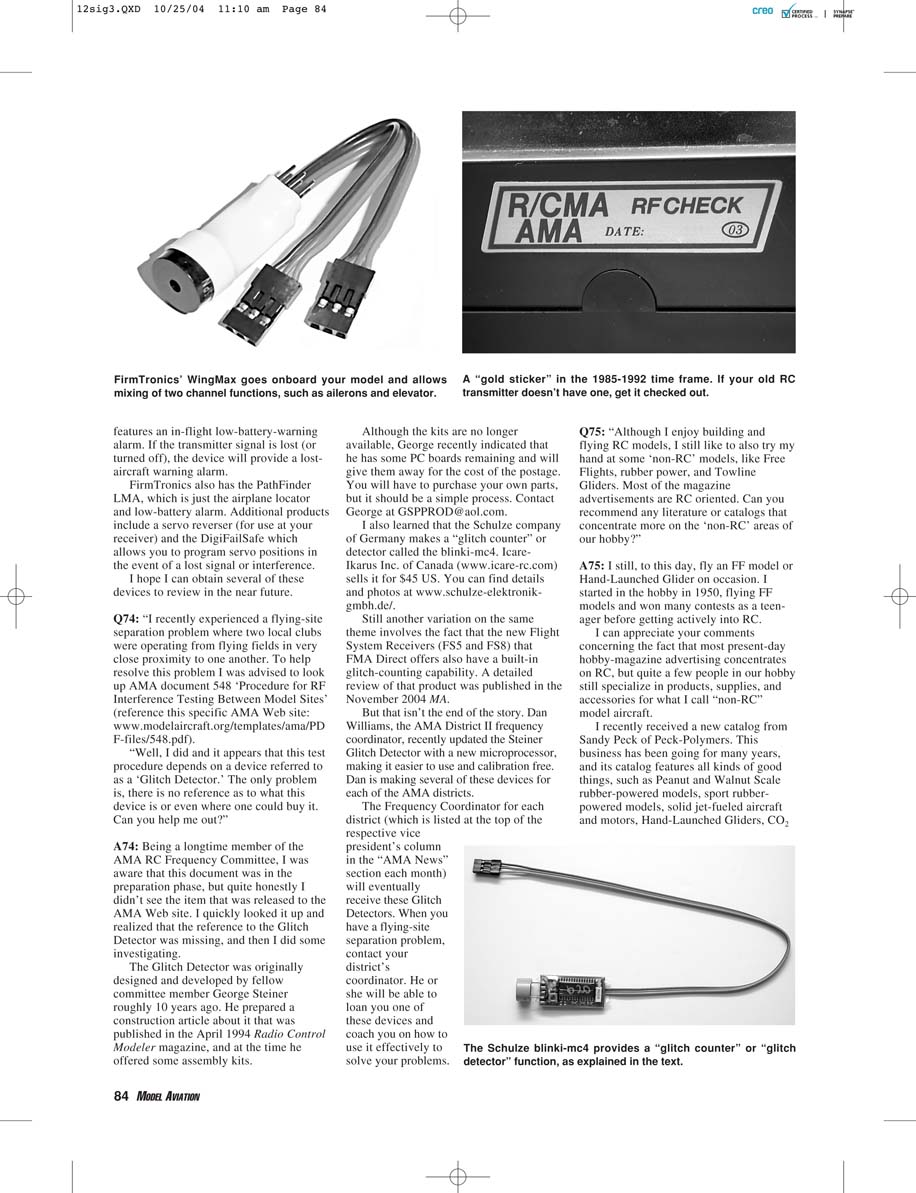
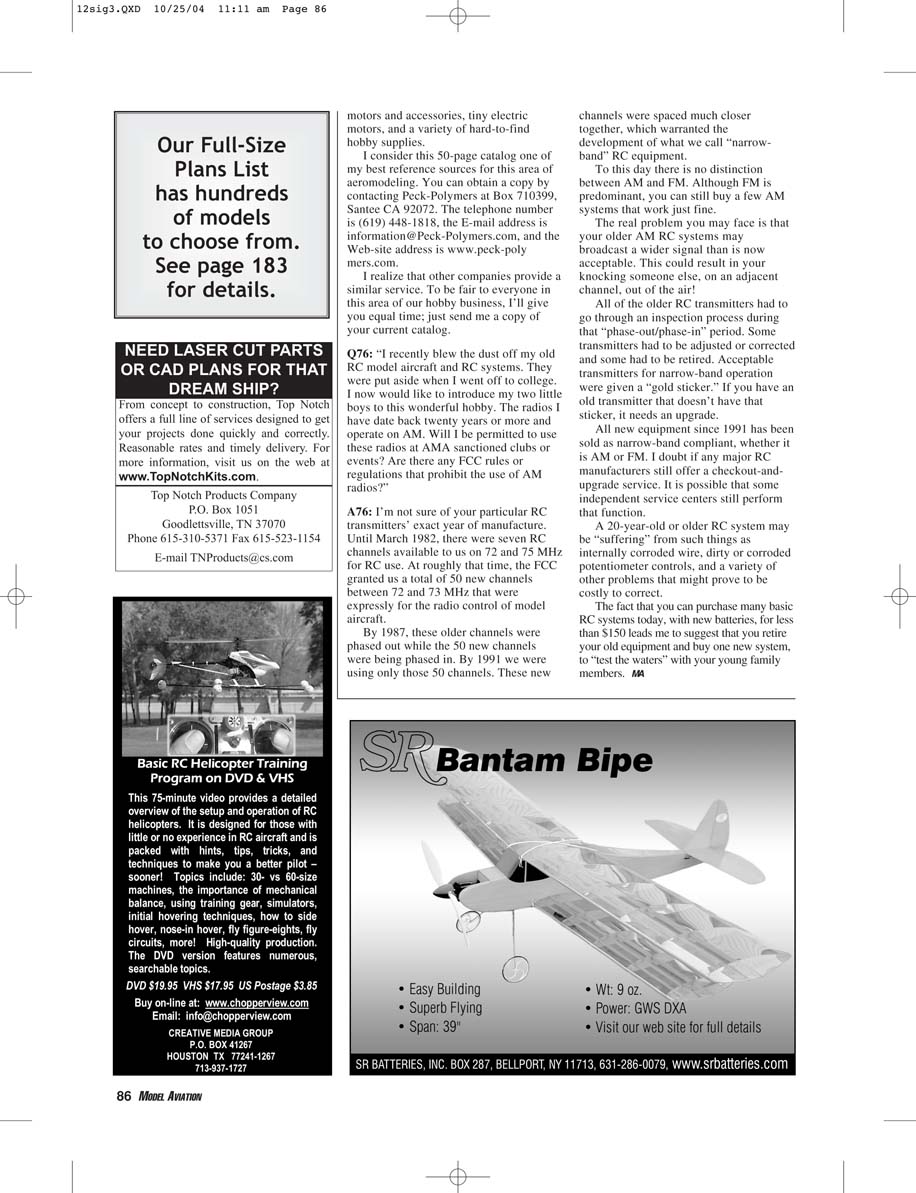
A good resource is Peck-Polymers. Their catalog features Peanut and Walnut Scale rubber-powered models, sport rubber-powered models, solid-jet-fueled aircraft and motors, hand-launched gliders, CO2 motors and accessories, tiny electric motors, and a variety of hard-to-find hobby supplies. I consider their 50-page catalog one of the best references for this area of aeromodeling.
Contact Peck-Polymers:
- Address: Box 710399, Santee, CA 92072
- Phone: (619) 448-1818
- E-mail: information@peck-polymers.com
- Web: www.peck-polymers.com
Other companies provide similar catalogs. To be fair to everyone in this area of the hobby business, send me a copy of your current catalog and I'll give equal coverage.
Q76
"I recently blew the dust off my old RC model aircraft and RC systems. They were put aside when I went off to college. I would like to introduce my two little boys to this wonderful hobby. The radios I have date back twenty years or more and operate on AM. Will I be permitted to use these radios at AMA sanctioned club events? Are there any FCC rules or regulations that prohibit the use of AM radios?"
A76: The brief history: until March 1982 there were seven RC channels available on 72 and 75 MHz. Around that time the FCC granted 50 new channels between 72 and 73 MHz for model aircraft. By 1987 the older channels were being phased out as the 50 new channels were phased in; by 1991 we were using only those 50 channels. These new channels are spaced more closely together and required development of narrow-band RC equipment.
There is no regulatory distinction today between AM and FM; although FM is predominant, some AM systems are still available and work fine. The issue with very old transmitters is that they may broadcast a wider signal than is acceptable for narrow-band operation and could cause interference on adjacent channels.
During the phase-out/phase-in period, acceptable transmitters were given a "gold sticker." If your old transmitter does not have that sticker, it needs upgrading. Many older units may also suffer from corroded wiring, dirty or corroded potentiometers, and other issues that can be costly to repair.
All new equipment sold since 1991 has been narrow-band-compliant, whether AM or FM. Given that many basic new systems (with batteries) can be purchased for less than $150, my recommendation is to retire very old gear and buy a new system to introduce your children to the hobby. This will be more reliable and simpler to maintain.
MA
Transcribed from original scans by AI. Minor OCR errors may remain.

