
Frequently Asked Questions
Bob Aberle E-mail: baberle@optonline.net
This is the 10th monthly column in which you write in or e-mail your questions, and I try to give you the best possible answers. Each question is given a sequential number for identification purposes. Because publication space is limited, part of each month’s installment will appear here, and the columns in their entirety are posted on the AMA web site at www.modelaircraft.org/mag/faq/index.asp.
Let’s start!
Q80: “I know years ago that you could purchase books containing coordinates for plotting most known wing airfoils. I’ve heard that information like this is now available on Web sites. If that is true, could you steer me to a particular Web site to get me started?”
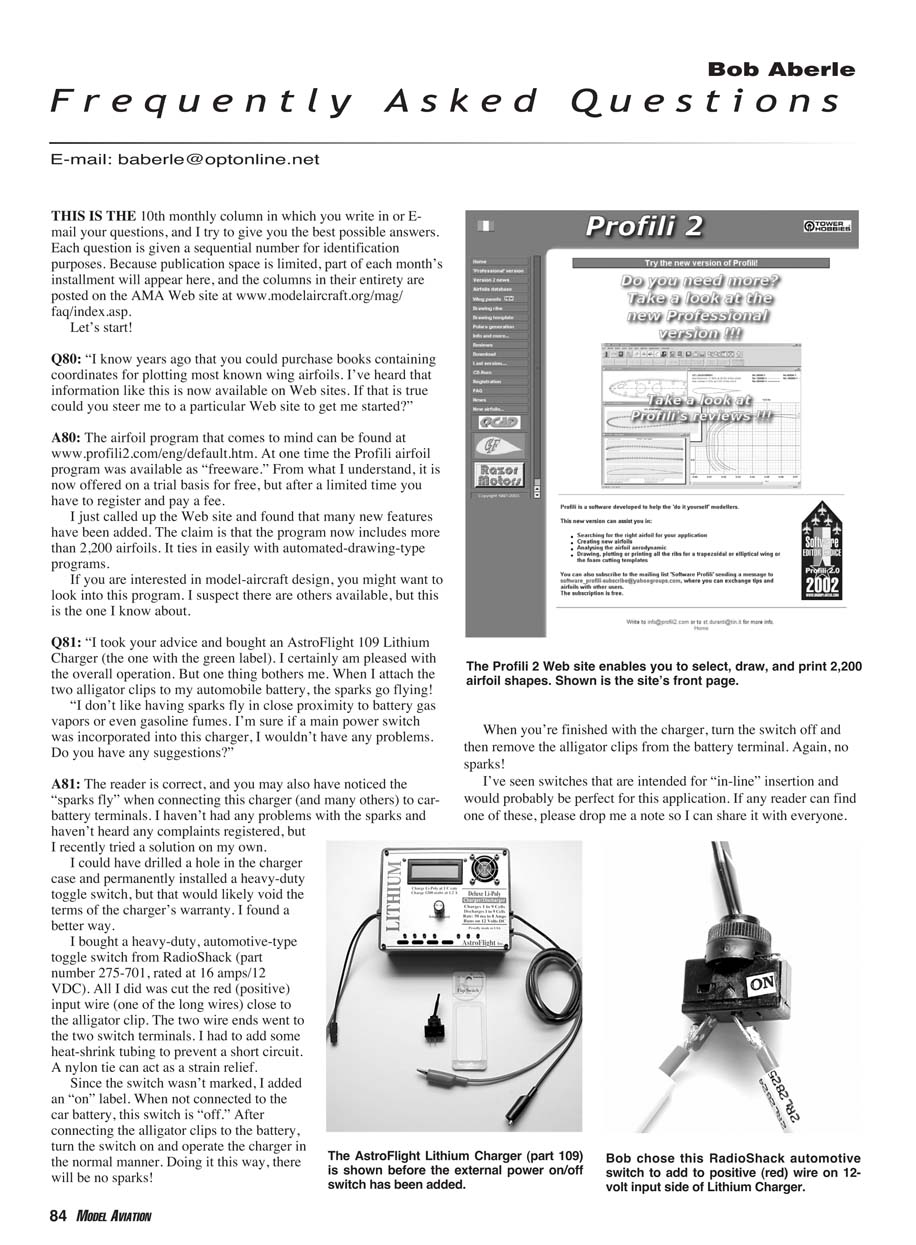
A80: The airfoil program that comes to mind can be found at www.profili2.com/eng/default.htm. At one time the Profili airfoil program was available as freeware. From what I understand, it is now offered on a trial basis for free, but after a limited time you have to register and pay a fee.
I checked the site and found that many new features have been added. The claim is that the program now includes more than 2,200 airfoils and ties in easily with automated-drawing-type programs.
If you are interested in model-aircraft design, you might want to look into this program. I suspect there are others available, but this is the one I know about.
Q81: “I took your advice and bought an AstroFlight 109 Lithium Charger (the one with the green label). I certainly am pleased with the overall operation. But one thing bothers me. When I attach the two alligator clips to my automobile battery, the sparks go flying! I don’t like having sparks fly in close proximity to battery gas vapors or even gasoline fumes. I’m sure if a main power switch was incorporated into this charger, I wouldn’t have any problems. Do you have any suggestions?”
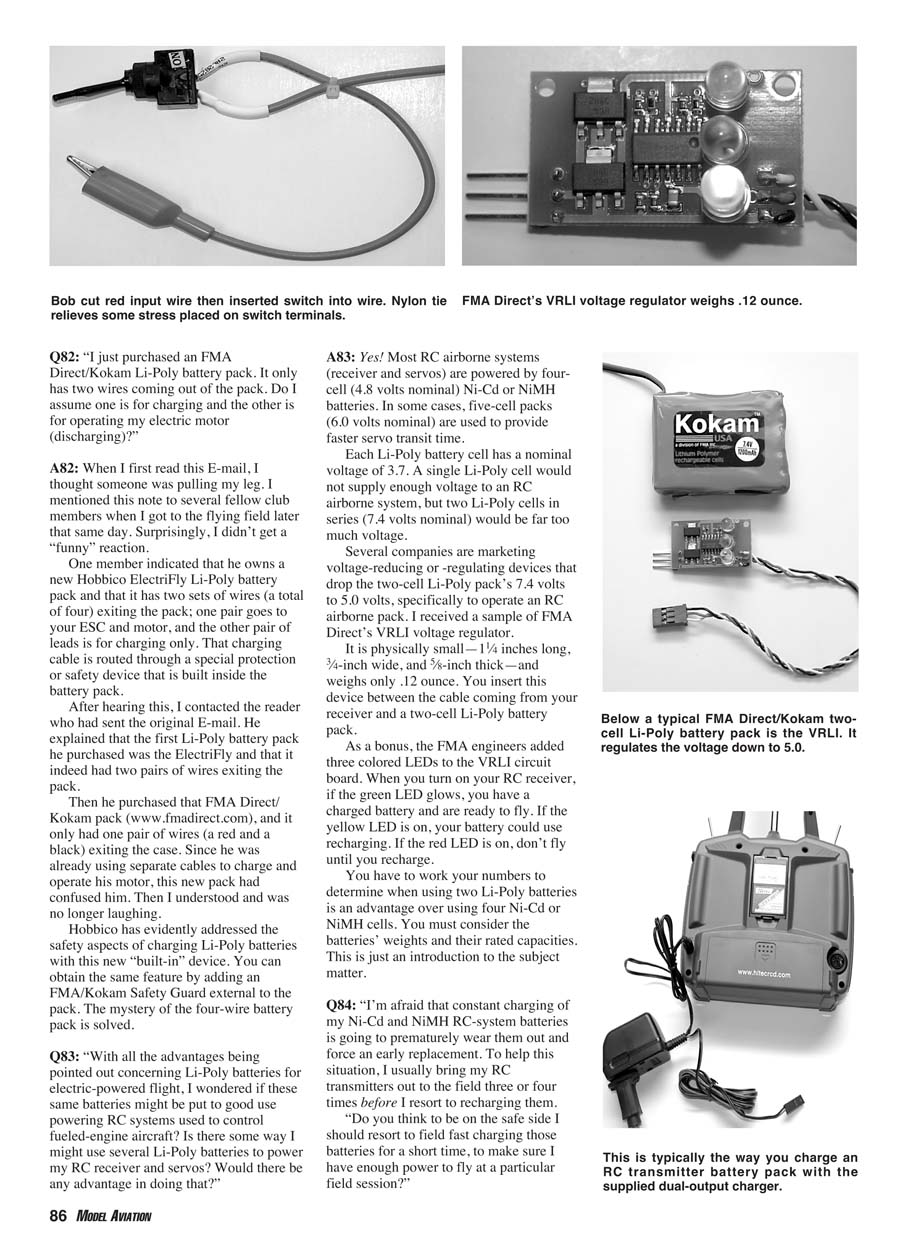
A81: The reader is correct — you may notice sparks when connecting this charger (and many others) to car-battery terminals. I haven’t had problems with the sparks nor heard many complaints, but I recently tried a simple, noninvasive solution.
Instead of drilling the charger case and installing a switch (which could void the warranty), I bought a heavy-duty automotive-type toggle switch from RadioShack (part number 275-701, rated at 16 A / 12 VDC) and wired it in-line on the positive lead. The procedure I used:
- Cut the red (positive) input wire (one of the long wires) close to the alligator clip.
- Attach the two resulting wire ends to the two switch terminals.
- Add heat-shrink tubing over the connections to prevent short circuits.
- Use a nylon tie for strain relief and add an “on” label if desired.
When the switch is off, you can clip the alligator leads to the battery with no sparks. After the clips are connected, turn the switch on and operate the charger normally. When finished, turn the switch off before removing the clips. No sparks.
I’ve also seen in-line switches specifically intended for this use, which would be ideal. If any reader finds one, please drop me a note so I can share it.
Q82: "I just purchased an FMA Direct/Kokam Li-Poly battery pack. It only has two wires coming out of the pack. Do I assume one is for charging and the other is for operating my electric motor (discharging)?"
A82: At first that sounded odd, but the explanation is straightforward. Some Li-Poly packs (for example, Hobbico ElectriFly packs) have two pairs of wires — four leads total: one pair for the ESC/motor, and a second pair routed through an internal protection/safety device used for charging.
The FMA Direct/Kokam pack you mentioned apparently only has one pair of leads (red and black). That is normal for packs that do not include an internal charging lead or safety circuit. Hobbico’s approach places the charging lead through an internal protection device; you can obtain equivalent protection for a single-lead pack by using an external safety guard such as the FMA/Kokam Safety Guard.
So, if your pack only has one pair of wires, both charging and discharging are handled through that pair (or charging is expected to be done through an external safety device). The two‑pair packs simply provide separate leads for convenience and built-in safety.
Q83: "With all the advantages being pointed out concerning Li-Poly batteries for electric-powered flight, I wondered if these same batteries might be put to good use powering RC systems used to control fueled-engine aircraft? Is there some way I might use several Li-Poly batteries to power my RC receiver and servos? Would there be any advantage in doing that?"
A83: Yes — you can use Li-Poly cells to power airborne RC systems, but you need a regulator. Typical RC airborne packs use four Ni-Cd or NiMH cells (about 4.8 V nominal) or sometimes five cells (6.0 V nominal) for faster servos. A single Li-Poly cell has a nominal voltage of 3.7 V (not enough), while two Li-Poly cells in series give about 7.4 V (too high for most receivers/servos).
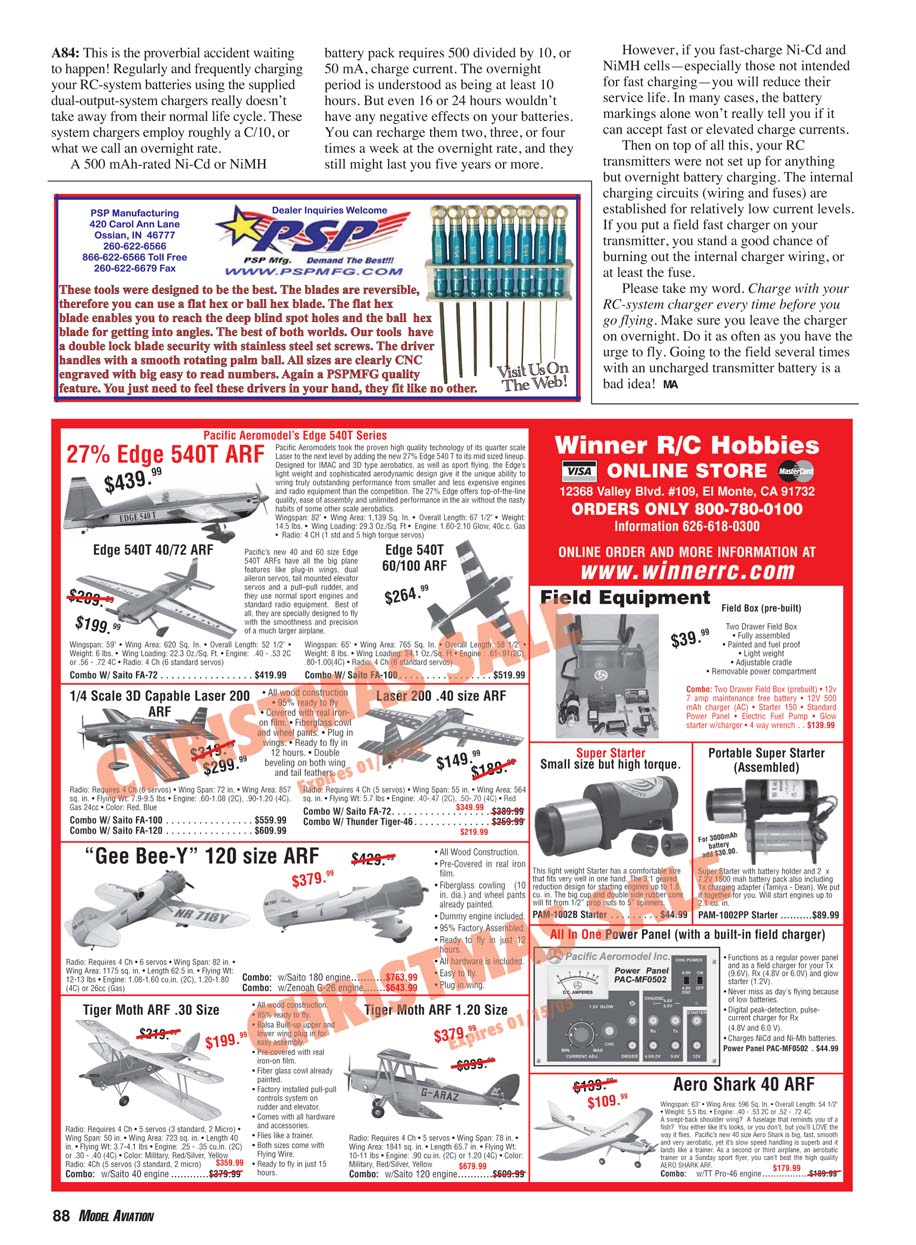
Several companies sell voltage-reducing/regulating devices that drop a two-cell Li-Poly pack’s 7.4 V down to 5.0 V suitable for RC airborne use. For example, FMA Direct’s VRLI regulator is a small device (about 1.25 in × 0.75 in × 0.625 in, weight ~0.12 oz) that is inserted between the receiver leads and a two-cell Li-Poly pack. It also includes three colored LEDs indicating charge state:
- Green: charged and ready to fly.
- Yellow: battery could use recharging.
- Red: do not fly until recharged.
Whether two Li-Poly cells plus a regulator are advantageous compared to four Ni-Cd/NiMH cells depends on weight, capacity, and your specific setup. Consider the batteries’ weights and rated capacities when doing the comparison.
Q84: "I'm afraid that constant charging of my Ni-Cd and NiMH RC-system batteries is going to prematurely wear them out and force an early replacement. To help this situation, I usually bring my RC transmitters out to the field three or four times before I resort to recharging them. Do you think to be on the safe side I should resort to field fast charging those batteries for a short time, to make sure I have enough power to fly at a particular field session?"
A84: That’s a risky approach. Regularly charging your RC-system batteries with the supplied dual-output/system charger at the recommended overnight rate (about C/10) does not shorten their normal life; in fact, it helps maintain them. For example, a 500 mAh pack charged at C/10 requires about 50 mA and an overnight period (at least 10 hours). Charging at this rate two to four times a week may still give you several years of service.
Fast-charging Ni-Cd and NiMH cells — especially those not specified for fast charge — will reduce their service life. Additionally, most transmitters are set up for overnight charging only: the internal charger wiring and fuses are sized for low currents. Using a field fast charger on your transmitter risks burning out the internal charger wiring or blowing fuses.
My recommendation: always charge your RC-system pack with the proper charger overnight before you go flying. Don’t take transmitters to the field with partially discharged batteries and don’t attempt to fast-charge them in the field.
— MA
Transcribed from original scans by AI. Minor OCR errors may remain.

