
Frequently Asked Questions Bob Aberle | baberle@optonline.net
A transmitter tray may make flying more enjoyable
Also included in this column:
- Hobby-oriented frequency scanners
- Neat and easy lightening holes
- Battery-mounting safety thoughts
- Model-article reference source
- Reading onboard RC-system voltage
THIS IS THE 34th monthly column in which I try to give you the best possible answers to questions you have written or E-mailed to me. Each new inquiry is given a sequential number for identification purposes.
A good many questions and answers have been posted to the AMA Web site at www.modelaircraft.org/mag/faq/index.asp. Unfortunately that posting stopped in August 2005 and will not continue until this section of the site is revamped. In the meantime, if you can't find the subject matter you are interested in, drop me an E-mail or letter and I will try to assist you.
Q269: "I seem to have problems holding onto my RC transmitter and moving the control sticks at the same time. I almost feel at times like I'm more worried about dropping the transmitter than flying my aircraft. I've seen these transmitter supporting trays and wonder if they are any good and where I might purchase one."
A269: Transmitter supporting trays have been around for many years. They have been, and are, more popular with European RC fliers than they are in the U.S.
Through the years many prominent RC-accessory manufacturers developed and marketed these trays, such as Du-Bro and Robart. However, they never achieved much popularity and were eventually discontinued.
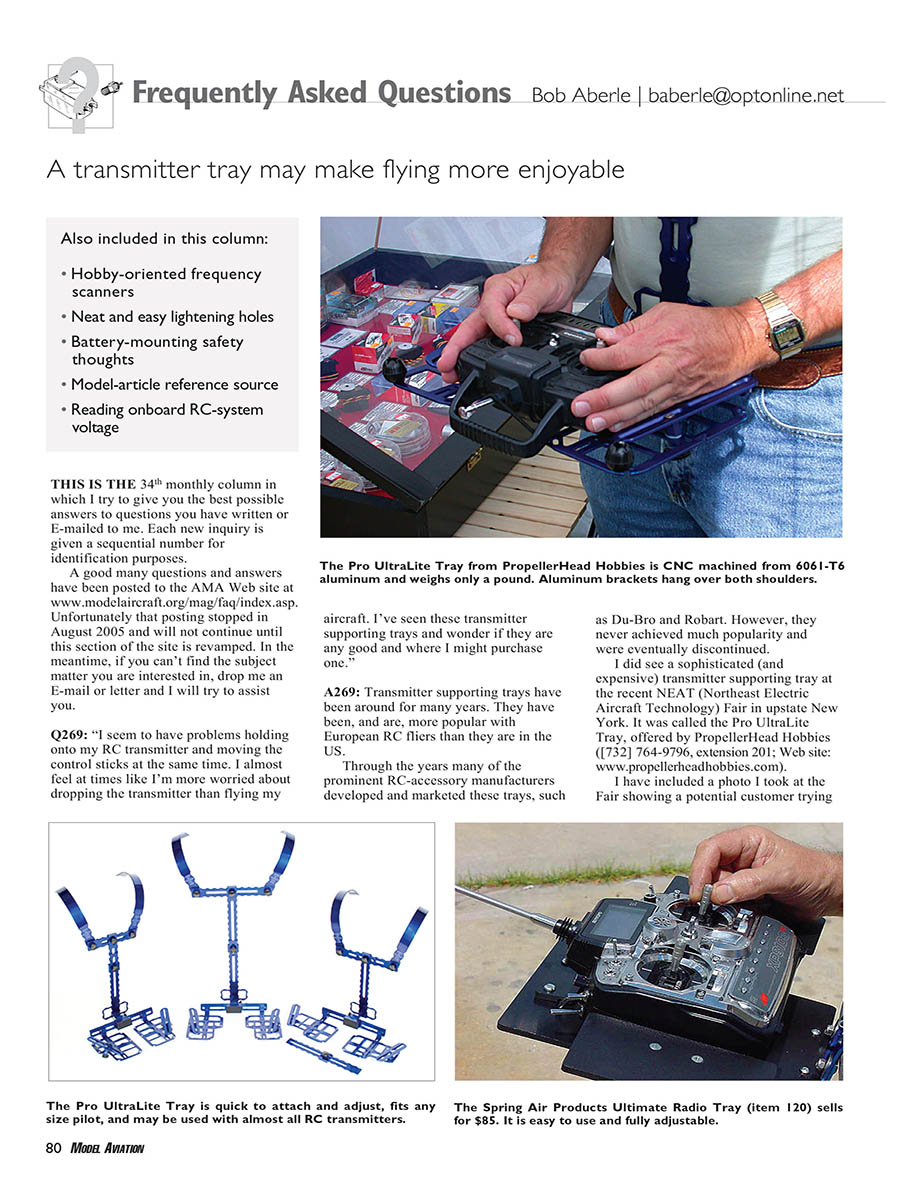
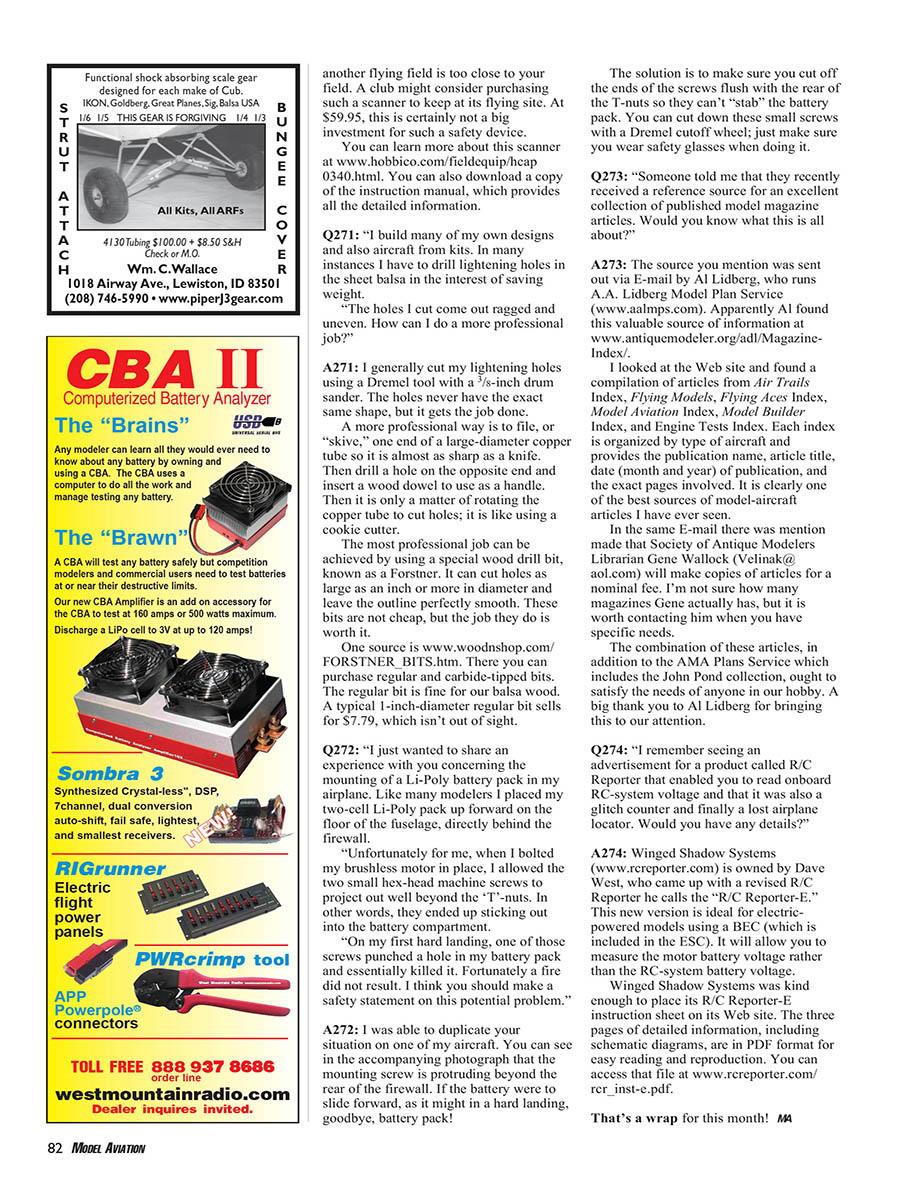
I did see a sophisticated (and expensive) transmitter supporting tray at the recent NEAT (Northeast Electric Aircraft Technology) Fair in upstate New York. It was called the Pro UltraLite Tray, offered by PropellerHead Hobbies (732-764-9796, ext. 201; Web site: www.propellerheadhobbies.com). The company's web site gives a clearer view of the product than my crowded show photo.
This is certainly a quality-built product, but it comes at a big price. When you use these trays it is suggested that you extend the length of your transmitter control sticks. Stick extensions are available and there are styles with a knob at the end of the stick for a better grip.
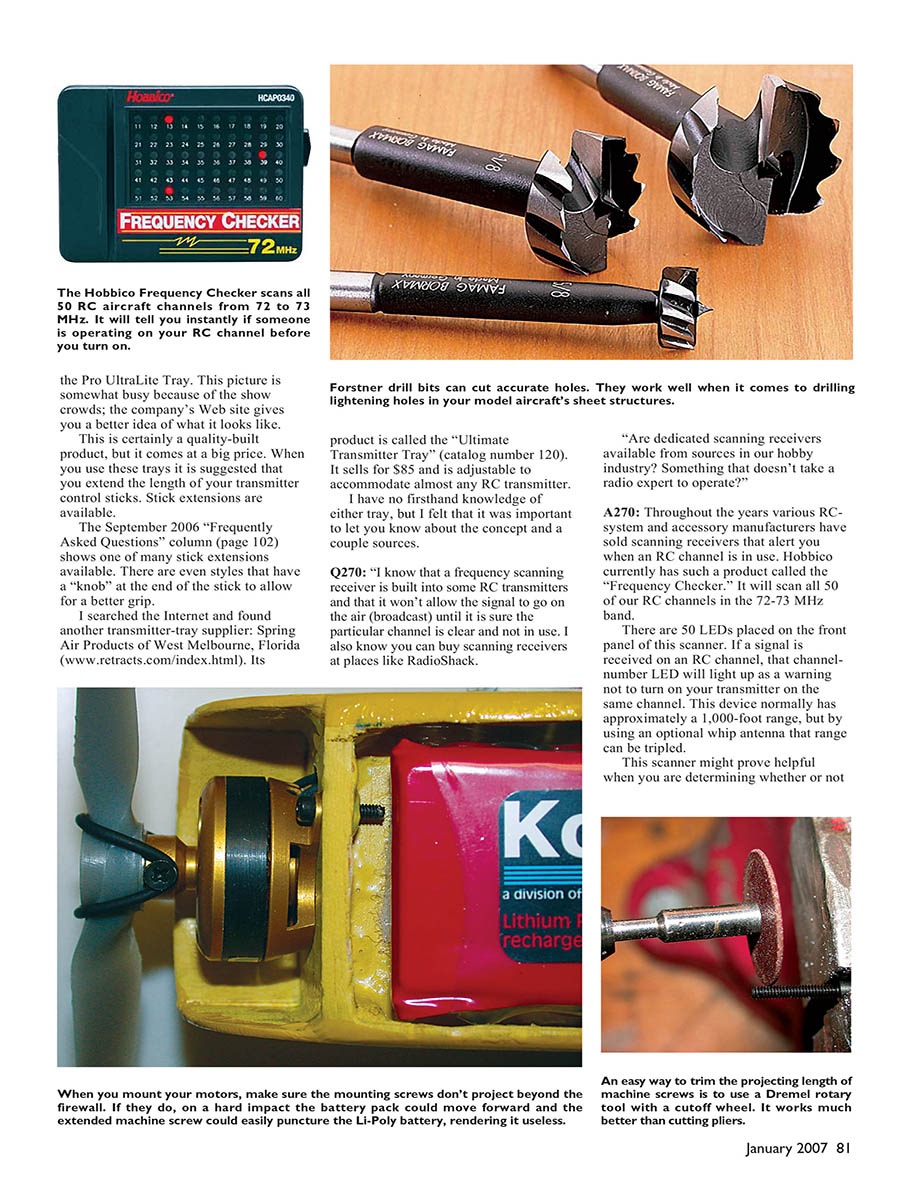
I also found another supplier: Spring Air Products of West Melbourne, Florida (www.retracts.com/index.html). Its product is called the "Ultimate Transmitter Tray" (catalog number 120). It sells for $85 and is adjustable to accommodate almost any RC transmitter. I have no firsthand knowledge of either tray, but I wanted to let you know about the concept and a couple sources.
Q270: "I know that a frequency scanning receiver is built into some RC transmitters and that it won't allow the signal to go on the air (broadcast) until it is sure the particular channel is clear and not in use. I also know you can buy scanning receivers at places like RadioShack. Are dedicated scanning receivers available from sources in our hobby industry? Something that doesn't take a radio expert to operate?"
A270: Various RC-system and accessory manufacturers have sold scanning receivers that alert you when an RC channel is in use. Hobbico currently has such a product called the "Frequency Checker." It will scan all 50 of the RC channels in the 72–73 MHz band. There are 50 LEDs on the front panel; if a signal is received on a channel, that channel-number LED lights up as a warning not to turn on your transmitter on the same channel.
This device normally has approximately a 1,000-foot range, but using an optional whip antenna can triple that range. It can be helpful when determining whether another flying field is too close to yours. A club might consider purchasing one to keep at its flying site. At $59.95, it is not a large investment for a safety device.
More information and the instruction manual are available at www.hobbico.com/fieldequip/hcap0340.html.
Q271: "I build many of my own designs and also aircraft from kits. In many instances I have to drill lightening holes in the sheet balsa in the interest of saving weight.
The holes I cut come out ragged and uneven. How can I do a more professional job?"
A271: For a quick job I use a Dremel tool with a 3/8-inch drum sander. The holes won't all be identical, but it gets the job done.
A neater, low-cost method is to file or "skive" one end of a large-diameter copper tube so it is almost as sharp as a knife. Drill a hole in the opposite end and insert a piece of hardwood as a handle. Rotating the tube cuts the hole much like a cookie cutter.
The most professional result comes from using a Forstner bit. It can cut holes as large as an inch or more and leaves a perfectly smooth outline. These bits are not cheap, but worth it for the quality. One source is www.woodshop.com/FORSTNER_BITS.htm. Regular (non-carbide) bits are fine for balsa wood; a typical 1-inch-diameter regular bit sells for about $7.79.
Q272: "I just wanted to share an experience with you concerning the mounting of a Li-Poly battery pack in my airplane. Like many modelers I put the two-cell Li-Poly pack up forward on the floor of the fuselage, directly behind the firewall.
Unfortunately for me, when I bolted my brushless motor in place, I allowed the two small hex-head machine screws to project out well beyond the T-nuts. In other words, they ended up sticking out into the battery compartment.
On my first short landing, one of those screws punched a hole in my battery pack and essentially killed it. Fortunately a fire did not result. I think you should make a safety statement on this potential problem!"
A272: I duplicated your situation on one of my aircraft. The mounting screw protruding beyond the rear of the firewall can indeed stab a forward-mounted battery if the pack shifts in a hard landing.
The solution is to cut the ends of the screws flush with the rear of the T-nuts so they can't puncture the battery pack. You can shorten these small screws with a Dremel cutoff wheel; be sure to wear safety glasses when doing it.
Q273: "Someone told me that they recently received a reference source for an excellent collection of published model magazine articles. Would you know what this is all about?"
A273: The source you mention was sent via E-mail by Al Lidberg of A.A. Lidberg Model Plan Service (www.aalplans.com). He found a valuable compilation at www.antiquemodeler.org/adm/Magazine-Index/.
The site includes indices of articles from Air Trails Index, Flying Models, Flying Aces Index, Model Aviation Index, Model Builder Index, and Engine Tests Index. Each index is organized by aircraft type and provides the publication name, article title, date (month and year), and exact pages. It's one of the best sources of model-aircraft articles I've seen.
The same E-mail mentioned that Society of Antique Modelers Librarian Gene Wallock (Velinak@...) will make copies of articles for a nominal fee. I'm not certain how many magazines Gene has, but it's worth contacting him for specific needs.
Between these indices and the AMA Plans Service (which includes the John Pond collection), hobbyists should find a wealth of material. Thanks to Al Lidberg for bringing this to our attention.
Q274: "I remember seeing an advertisement for a product called R/C Reporter that enabled you to read onboard RC-system voltage and that it was also a glitch counter and finally a lost airplane locator. Would you have any details?"
A274: Winged Shadow Systems (www.rcreporter.com), owned by Dave West, developed a revised R/C Reporter called the "R/C Reporter-E." This version is ideal for electric-powered models since it runs on the BEC (included in most ESCs) and allows monitoring of the motor battery voltage rather than the RC-system battery voltage.
Winged Shadow Systems has placed the R/C Reporter-E information on its web site. The three pages of detailed information, including schematic diagrams, are available in PDF format at www.rcreporter.com/rcr_inst-e.pdf.
That's a wrap for this month!
Transcribed from original scans by AI. Minor OCR errors may remain.

