
Frequently Asked Questions
Bob Aberle | baberle@optonline.net
Batteries and chargers for micro/indoor RC fliers
Please write in with your questions, since that is the only way we can keep this column format going. When referring to published Q-and-As (for follow-ups), provide the number as a reference.
References to addresses and Web sites are placed in a group, separate from the text, at the end of this column under "Sources."
Q404: "I've read a lot about Li-Poly batteries, on how to size them for a specific application and the best and safest way to charge them. But I see more and more concentration on 1000 to 5000 mAh cells and their companion high current chargers for medium to large aircraft.
"In my case I fly 15 gram on up to 2-ounce micro aircraft. As I see it the technology is a lot different. Can you set the stage for our micro world?"
A404: Most of the material you are looking for has been featured in John Worth's RC Micro World Webzine. When you subscribe, you gain access to all previous issues from the start (May 2005). Below I’ll steer you to the batteries and chargers that most micro fliers use.
- Bob Selman has emerged from years of micro-flying to become a primary source for micro aircraft, RC systems, motors, ESCs, batteries, chargers, and building supplies. He operates as Bob Selman Designs in Carthage, Missouri.
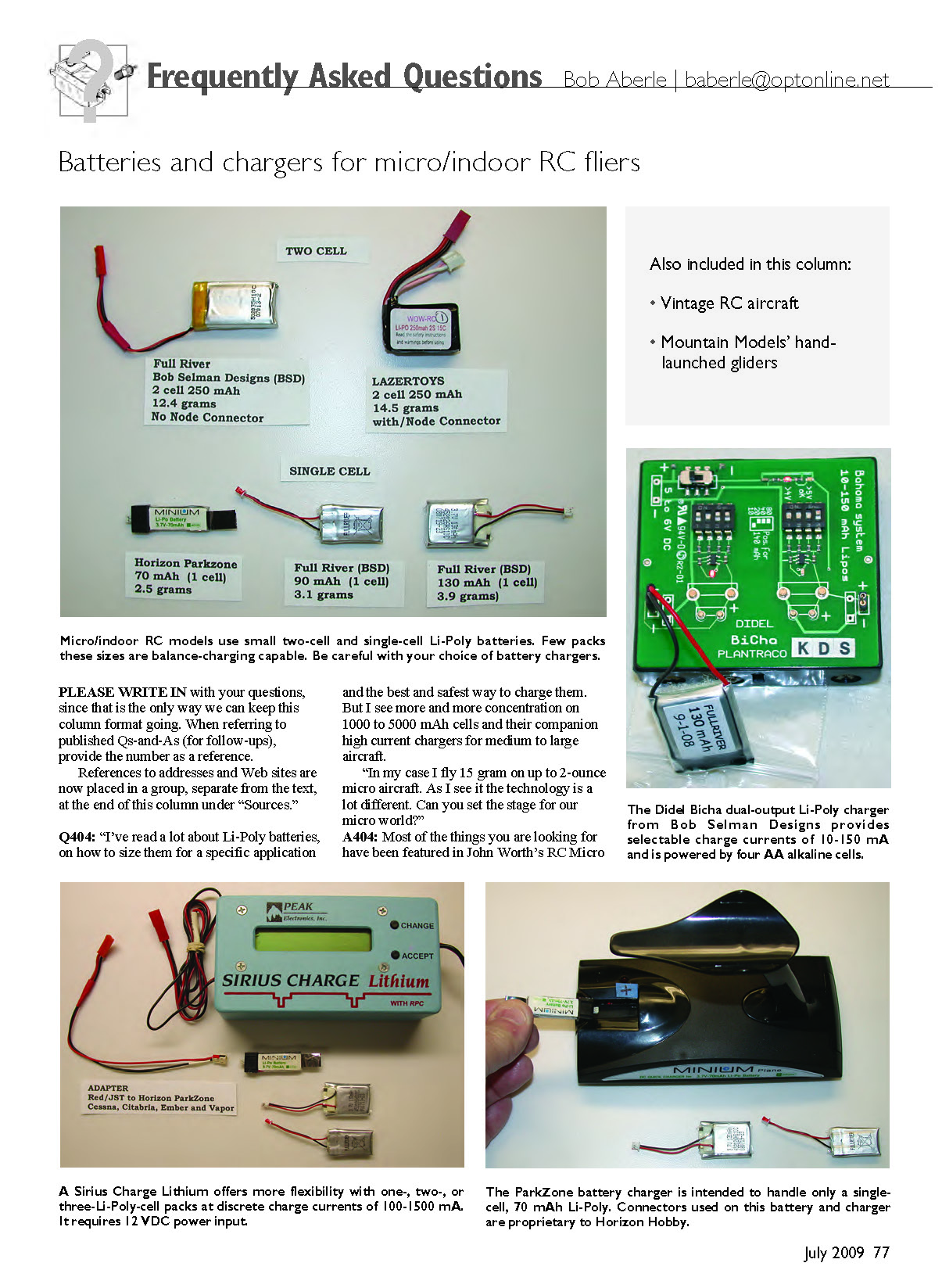
- Most traditional Li-Poly suppliers offer cells and packs starting at roughly 300 mAh rated capacity. The average micro-flier will use packs up to approximately 250 mAh, but might go down as low as 10 mAh for an aircraft weighing about 10 grams.
- I fly a 4.2-ounce model using a two-cell, 250 mAh Li-Poly battery purchased from Lazertoyz. It is one of the few batteries this size that comes with a node (balance) connector, which enables balanced charging of the two cells. Using an adapter cable, I can balance-charge this pack on my FMA Direct CellPro 4s charger.
- I’ve also used two-cell 250 mAh packs from Bob Selman Designs that do not have node connectors; in that case I cannot use the CellPro 4s.
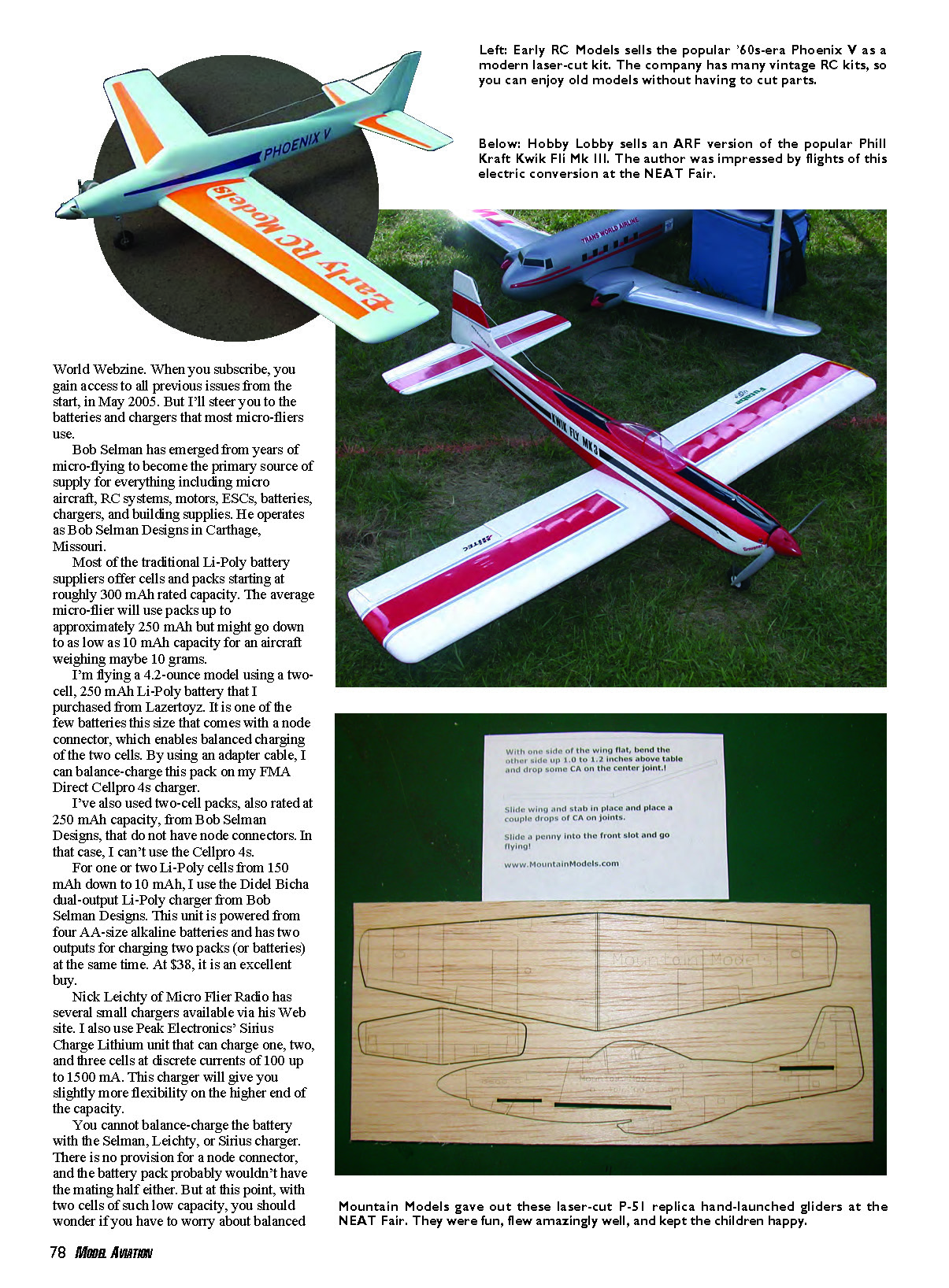
For one- or two-cell Li-Poly packs from 150 mAh down to 10 mAh, I use the Didel Bicha dual-output Li-Poly charger from Bob Selman Designs. This unit is powered from four AA alkaline batteries and has two outputs for charging two packs at the same time. At $38 it’s an excellent buy.
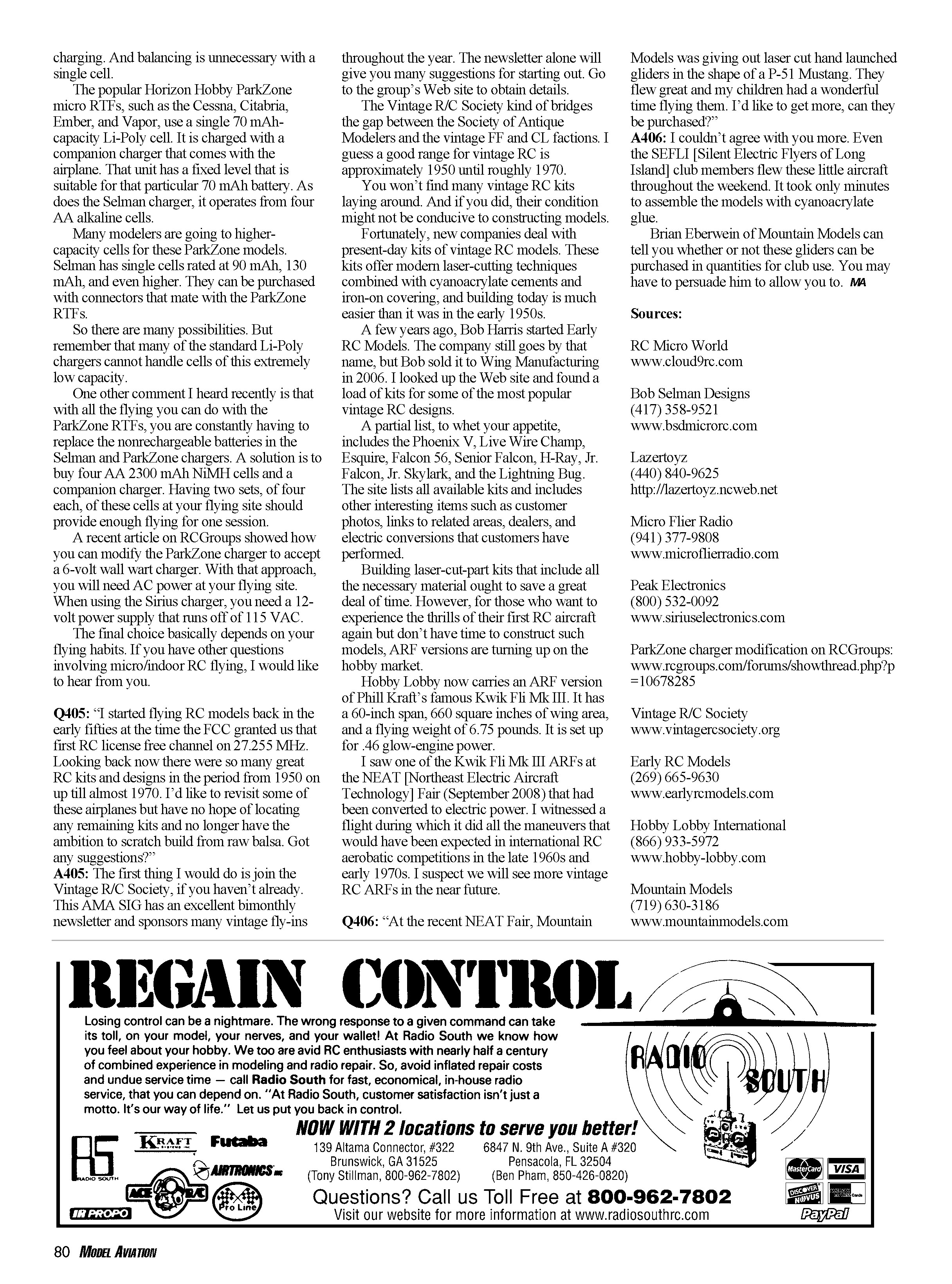
Nick Leichty of Micro Flier Radio has several small chargers available via his Web site. I also use Peak Electronics’ Sirius Charge Lithium unit, which can charge one, two, or three cells at discrete currents from 100 up to 1500 mA. The Sirius gives you more flexibility on the higher end of capacities.
Note on balance charging:
- You cannot balance-charge the battery with the Selman, Leichty, or Sirius chargers if the pack lacks a node connector. There is no provision for a node connector on those chargers, and the pack may not have the mating connector either.
- With two very low-capacity cells you should consider whether balanced charging is necessary. Balancing is unnecessary with a single cell.
ParkZone micro RTFs (Cessna, Citabria, Ember, Vapor) use a single 70 mAh Li-Poly cell charged with a companion charger that comes with the airplane. That charger has a fixed level suitable for that specific 70 mAh battery and, like the Selman charger, operates from four AA alkaline cells.
Many modelers use higher-capacity cells for ParkZone models. Selman offers single cells rated at 90 mAh, 130 mAh, and higher, and they can be purchased with connectors that mate with the ParkZone RTFs.
A few additional practical notes:
- Many standard Li-Poly chargers cannot handle extremely low-capacity cells.
- With frequent flying, you may constantly replace the nonrechargeable AA cells in the Selman and ParkZone chargers. A solution is to buy four AA 2300 mAh NiMH cells and a companion charger; having two sets of four AA NiMH cells at the flying site should cover a session.
- A recent RCGroups article shows how to modify the ParkZone charger to accept a 6 V wall-wart adapter (requires AC power at the field).
- The Sirius charger requires a 12 V power supply that runs off 115 VAC.
The final choice depends on your flying habits. If you have other questions involving micro/indoor RC flying, I would like to hear from you.
Q405: "I started flying RC models back in the early fifties at the time the FCC granted us that first RC license-free channel on 27.255 MHz. Looking back now there were so many great RC kits and designs in the period from 1950 on up till almost 1970. I'd like to revisit some of these airplanes but have no hope of locating any remaining kits and no longer have the ambition to scratch-build from raw balsa. Got any suggestions?"
A405: First, join the Vintage R/C Society if you haven't already. This AMA SIG has an excellent bimonthly newsletter and sponsors many vintage fly-ins throughout the year. The newsletter alone will give you many suggestions for starting out. Go to the group's Web site for details.
The Vintage R/C Society bridges the gap between the Society of Antique Modelers and the vintage free-flight and control-line factions. A reasonable range for vintage RC is approximately 1950 through about 1970.
You won't find many vintage RC kits available in good condition. Fortunately, companies now produce modern kits of vintage RC models, using laser-cut parts, CA cements, and iron-on coverings, which make building much easier than in the early 1950s.
A few years ago Bob Harris started Early RC Models; he later sold it to Wing Manufacturing in 2006. The website lists many kits for popular vintage RC designs. A partial list includes Phoenix V, Live Wire Champ, Esquire, Falcon 56, Senior Falcon, H-Ray, Jr. Falcon, Jr. Skylark, and Lightning Bug. The site also includes customer photos, links to related areas, dealers, and electric conversion examples.
Laser-cut kits that include all necessary materials save a great deal of time. For those who want the vintage experience without building, ARF versions are appearing in the hobby market. For example, Hobby Lobby carries an ARF version of Phil Kraft's Kwik Fli Mk III: 60-inch span, 660 sq in wing area, flying weight 6.75 lb, set up for .46 glow-engine power. I saw a Kwik Fli Mk III ARF at the NEAT Fair (Sept 2008) converted to electric; it performed classic aerobatic maneuvers from the late 1960s and early 1970s. Expect to see more vintage RC ARFs.
Q406: "At the recent NEAT Fair, Mountain Models was giving out laser-cut hand launched gliders in the shape of a P-51 Mustang. They flew great and my children had a wonderful time flying them. I'd like to get more, can they be purchased?"
A406: I couldn't agree more — these gliders were popular. They were quick to assemble with cyanoacrylate glue and flew well. Brian Eberwein of Mountain Models can tell you whether these gliders can be purchased in quantities for club use; you may need to persuade him to supply larger quantities.
Sources:
- RC Micro World
- Bob Selman Designs
(417) 358-9521 www.bsdmicrorc.com
- Lazertoyz
(440) 840-9625 http://lazertoyz.ncweb.net
- Micro Flier Radio
(941) 377-9808 www.microflieradio.com
- Peak Electronics (Sirius Charge)
(800) 532-0092 www.siriuselectronics.com
- ParkZone charger modification on RCGroups
www.rcgroups.com/forums/showthread.php?p=10678285
- Vintage R/C Society
- Early RC Models
(269) 665-9630 www.earlyrcmodels.com
- Hobby Lobby International
(866) 933-5972 www.hobby-lobby.com
- Mountain Models
(719) 630-3186 www.mountainmodels.com
Transcribed from original scans by AI. Minor OCR errors may remain.

