
Frequently Asked Questions
Bob Aberle | baberle@optonline.net
Please write in with your questions; that is the only way we can keep this column format going. When referring to published questions and answers (for follow-ups), provide the number as a reference.
Also note that references to addresses and web sites are placed in a group, separate from the text, at the end of this column under "Sources."
A new feature, "Tips," is provided in addition to Qs and As. These hints are numbered in the same sequence as the questions and answers.
Steerable PVC aircraft dolly
Q483: "I heard that one of the Model Aviation columns last year showed a neat take-off dolly for model aircraft that was constructed from common PVC pipe and fittings. Can you locate this reference for me and elaborate on it?"
A483: The dolly you are referring to was featured in Red Scholefield's battery column, on page 104 of the November 2009 issue. Red used the device to support his electric-powered sailplane, enabling it to take off from the ground even though it had no landing gear or even wheels.
Many sailplanes are simply hand-launched, but Red preferred a ground launch. A detailed photo published in that column shows the basic construction of the dolly, from common PVC pipe and fittings.
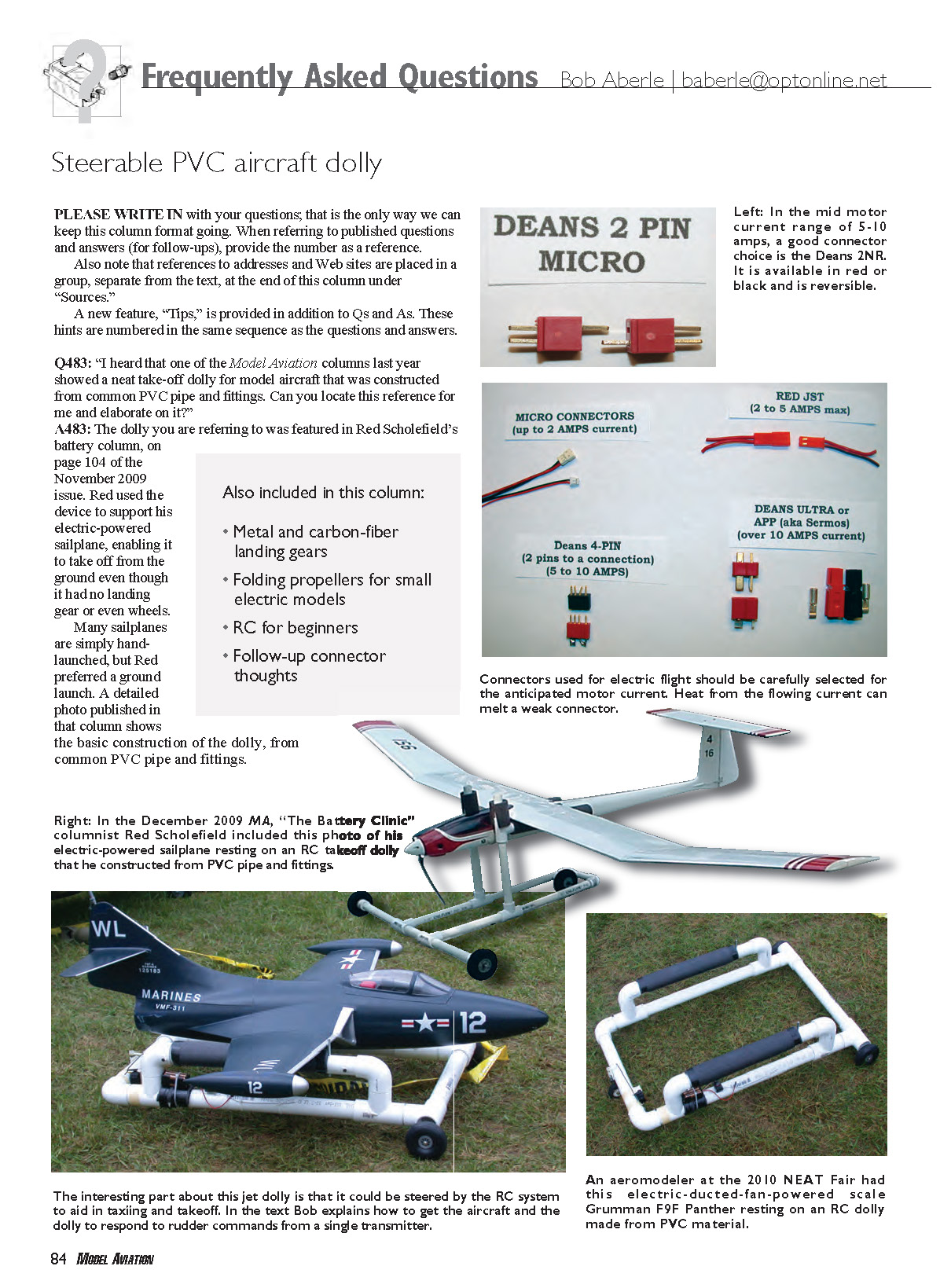
That would have been the end of this question, except that I found an alternative to the idea at the recent NEAT (Northeast Electric Aircraft Technology) Fair in upstate New York. A modeler (whose name I never learned) had a stand-off-scale, electric-ducted-fan (EDF)-powered Grumman F9F Panther that had no landing gear. The jet is shown resting on a dolly that was constructed from PVC pipe. As I looked closer I saw that the structure had an RC receiver, servo, and battery pack attached to it. The servo actually steers the dolly, which means that it also steers the airplane while it is on the ground. The servo output arm is connected to a single wheel located at the rear of the dolly.
The modeler employed two RC systems—one in the F9F and the other on the dolly—that were operated by separate transmitters. A friend performed the ground steering with one system while he flew the jet with the other.
I asked why he didn't simply have two receivers working off of one transmitter. His reply was that he thought you couldn't bind two receivers to one 2.4 GHz spread-spectrum transmitter. I couldn't wait to get home to try an experiment.
I quickly set up two Spektrum AR6110 2.4 GHz receivers and bound both to my Spektrum DX7 transmitter. To my total delight, both receivers responded to the rudder command from the transmitter. So now my modeler friend can taxi, take off, and fly his Panther all by himself.
The only thing I caution you about is that this scheme might not work with every RC spread-spectrum system. You will have to run tests with your particular system to verify that two receivers can be bound to one transmitter. But this is an interesting concept. It will also save you from a bungee-cord launch, which sometimes can prove quite difficult.
Q484: "I'm looking for small-size metal or carbon-fiber strap-type main landing gears for use on my original-design park flyer and E3D aircraft.
"I remember years ago a product line under the company name, Hallco, that offered a full line of aluminum landing gears that many referred to as 'Cessna type' gears. These gears were simply bolted to the bottom of the fuselage. Integral axles came already attached to accept the wheels.
"I've tried to locate this company but suspect they are long out of business. How can I obtain similar type gears?"
A484: I thought this answer was going to be easy, but it proved me wrong. The Internet search approach did not yield the Hallco company name. But, surprisingly, several modelers had used Hallco gears that they were selling on eBay and some of the model forums.
One of the nice things about Hallco gears was that the company supplied their tread and height, so you could judge propeller-to-ground clearance, and a guide to the estimated model weight that the specific gear could support.
When I attempted to locate current suppliers for these gears, in many cases little dimensional or model-weight data was provided. But I eventually located a few supply sources.
Several of the gears were the metal type fabricated from hard (resilient) aluminum and dural, while others were molded from woven carbon fiber and resin (or epoxy). Esprit Model has an excellent selection of carbon-fiber landing gears and provides all necessary data, including saddle width, height, and tread for the entire series.
The basic strap-type landing gear is one piece and usually bolts to the bottom of the fuselage. Two-piece landing-gear assemblies are intended to be mounted to the sides of a profile fuselage. Du-Bro item 943 is a good example of that type. Axle shafts are used on many of these gears for wheel attachment.
A good way to locate landing gears is to visit the web site of a major mail-order house, such as Tower Hobbies, Horizon Hobby, Hobby Lobby International, or Sig Manufacturing. When you get to the home page, type "landing gear" into the search box.
You might be surprised by what comes up. Be patient, because there are many landing gears out there.
Another long-trusted source for landing gear is TnT Landing Gear Products. Tom Kroggel has been custom-making support products for models for years, and the company is worth a try, although I don't think it has parts for foamies yet.
I've listed a few web site addresses in the "Sources" section to get you started. If you find other worthwhile sources for these gears for small aircraft, please share that info; I would be happy to write a follow-up on this subject.
Q485: "I'm looking for a small-diameter folding prop for use with my indoor, electric-powered, endurance aircraft. I want the prop to fold back against the fuselage sides after I shut down the motor. This will tend to reduce drag when not under power and give me the cleanest possible glide.
"I've tried several commercially available folding props and found them so stiff that the blades refuse to fold back in the wind stream. Have you come across any props that fold freely?"
A485: Many indoor and micromodel fliers have been on the lookout for such a propeller. As you point out, some are so stiff that they won't fold, while others are too heavy for micro applications.
Having propeller blades that fold easily will definitely reduce drag after the motor is shut down. Bob Selman of BSD Micro RC has found an interesting new folding propeller assembly that he is now importing from the Far East.
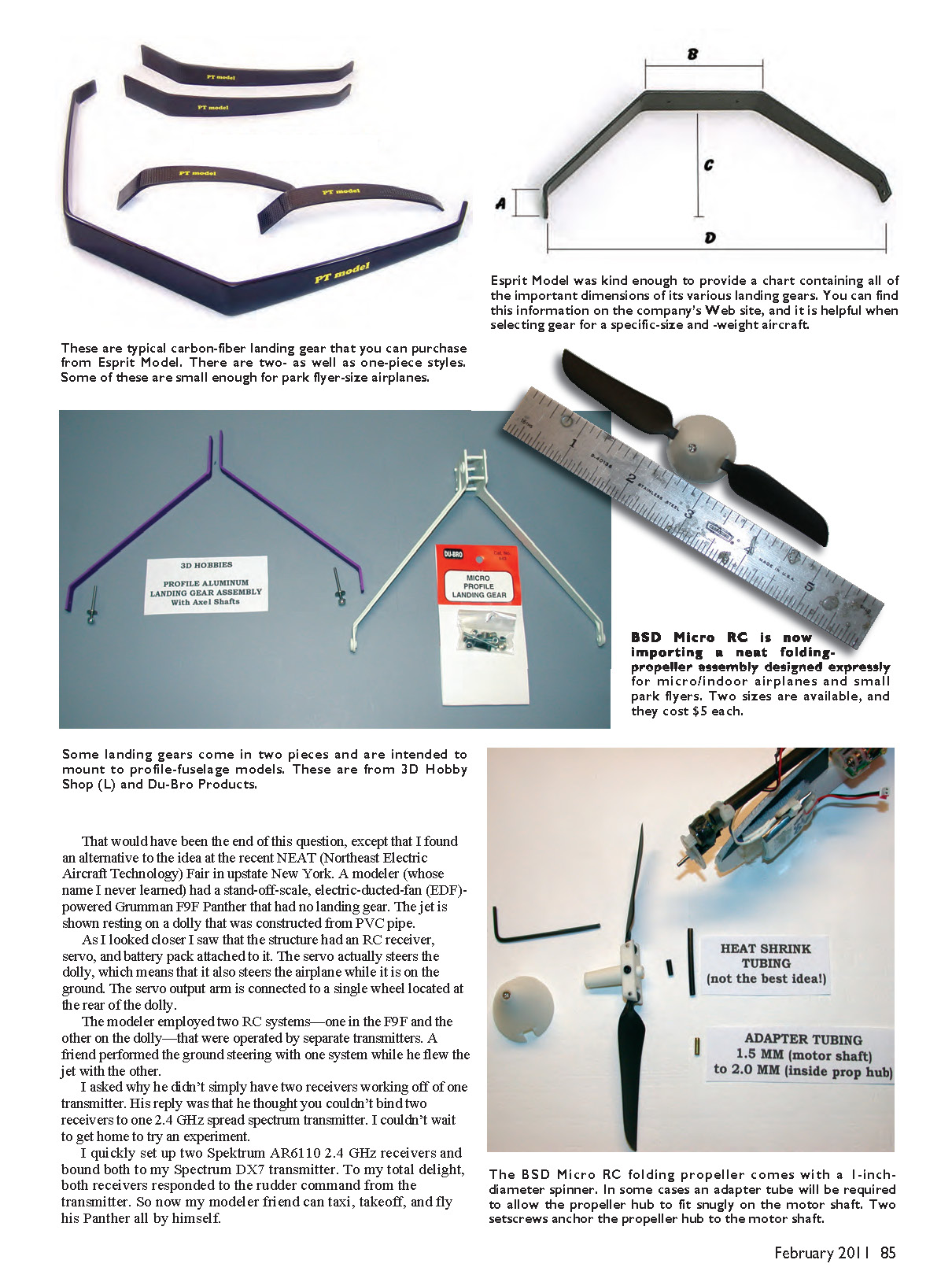
He has two sizes available, although the sizes are similar. They measure 4.5 inches in diameter by 3 inches in pitch and 5.1 inches in diameter by 3.1 inches in pitch. These assemblies come with a 1-inch-diameter spinner, and the entire assembly (blades, hub, and spinner) weighs only 4.3 grams (0.15 ounce).
This type of assembly is intended exclusively for electric power applications and primarily for small micro/indoor aircraft. These propeller blades fold freely and smoothly, to the point where they stay folded until power is applied.
The propeller hub has a 1.5 mm hole and employs two setscrews. If your motor shaft is anything but that 1.5 mm diameter, you will need to use some sort of adapter.
My motor shaft on a 7 mm geared pager motor had a 2 mm-diameter shaft. Luckily this is a popular-size motor, and Bob provides a small machined length of tubing that allows the 1.5 mm propeller to slide onto the 2 mm motor shaft.
These folding propeller assemblies sell for $5. They are perfect for my pager motor and several ParkZone RTF motors, such as those used in the Sukhoi and P-51 Mustang. I've listed the BSD Micro RC contact info under "Sources."
T486: I do a lot of web-site "surfing" to get ideas and answers for this column, and something interesting often pops up. By accident I found a web site that modeler Gary Dyrkacz created, called Radio Control for Beginners.
In his relatively brief text, Gary covers such subjects as who can fly RC, whether or not you need to be an engineer to fly RC, what kinds of RC aircraft are available, and what you need for RC flight. It's down-to-earth and basic writing, but it is exactly what you would want to show a person who asks, "What's this model airplane stuff all about?"
I was impressed enough with Gary's writing to place several copies in the glove compartment of my car. Along with that I have a brief information sheet about the AMA, including the Academy's web site address and a membership application.
When an interested spectator approaches me at the flying field, he or she gets a copy of this material—as an introduction—and an invitation to attend our next regular club meeting.
Follow-Up From MA
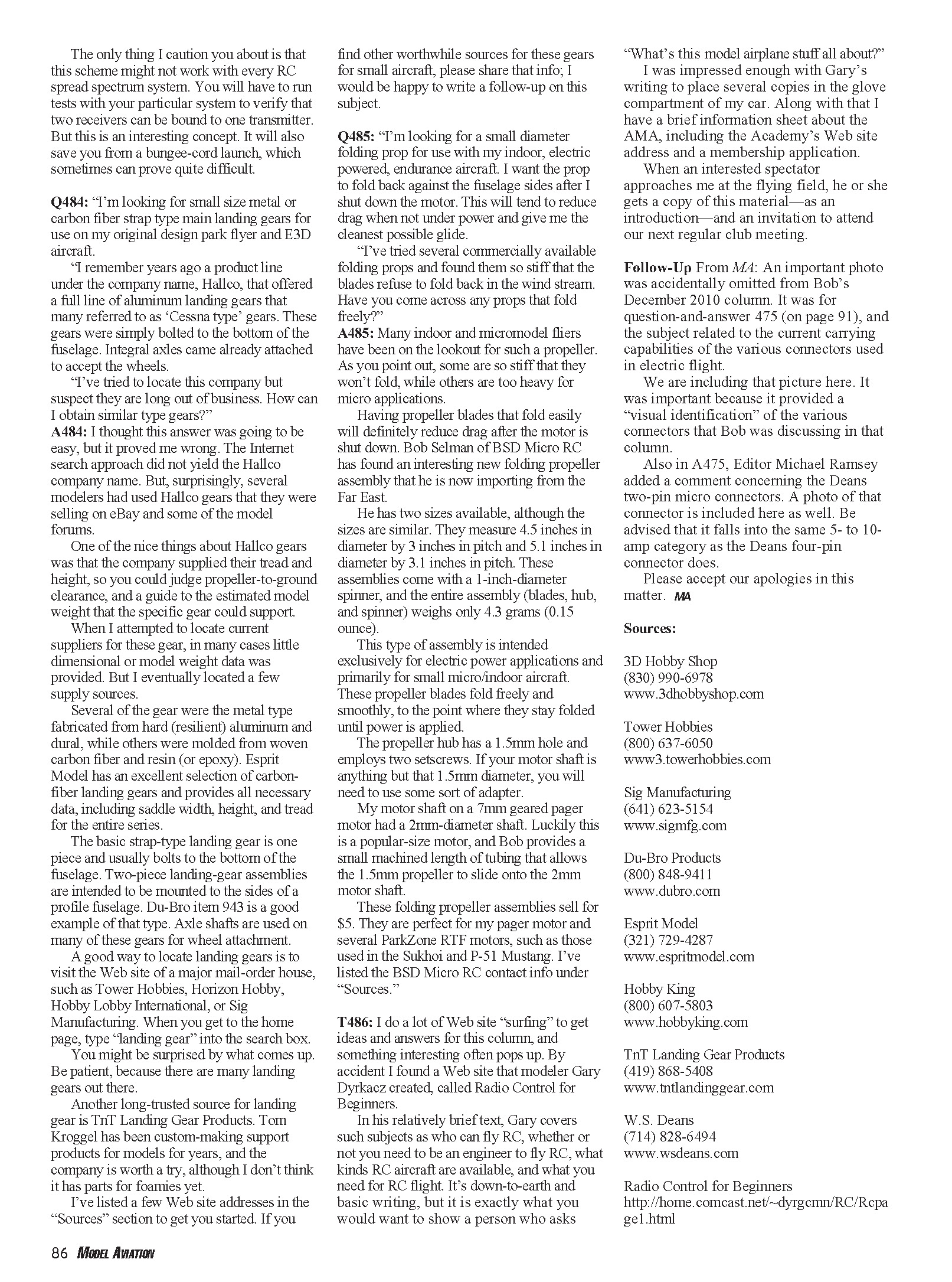
An important photo was accidentally omitted from Bob's December 2010 column. It was for question-and-answer 475 (on page 91), and the subject related to the current-carrying capabilities of the various connectors used in electric flight.
We are including that picture here. It was important because it provided a "visual identification" of the various connectors that Bob was discussing in that column.
Also in A475, Editor Michael Ramsey added a comment concerning the Deans two-pin micro connectors. A photo of that connector is included here as well. Be advised that it falls into the same 5- to 10-amp category as the Deans four-pin connector does.
Please accept our apologies in this matter. MA
Sources:
- 3D Hobby Shop
(830) 990-6978 www.3dhobbyshop.com
- Tower Hobbies
(800) 637-6050 www3.towerhobbies.com
- Sig Manufacturing
(641) 623-5154 www.sigmfg.com
- Du-Bro Products
(800) 848-9411 www.dubro.com
- Esprit Model
(321) 729-4287 www.espritmodel.com
- Hobby King
(800) 607-5803 www.hobbyking.com
- TnT Landing Gear Products
(419) 868-5408 www.tntlandinggear.com
- W.S. Deans
(714) 828-6494 www.wsdeans.com
- Radio Control for Beginners
http://home.comcast.net/~dyrgcmn/RC/Rcpagel.html
Transcribed from original scans by AI. Minor OCR errors may remain.

