
Fun on Floats: Control Line Row
By Fred Cronenwett
At the 1998 Northwest Control Line Regionals, a Control Line ROW (Rise Off Water) pond was constructed and used. In 1997 the pond was an above-ground structure that was barely larger than a CL Navy Carrier deck.
Pond construction
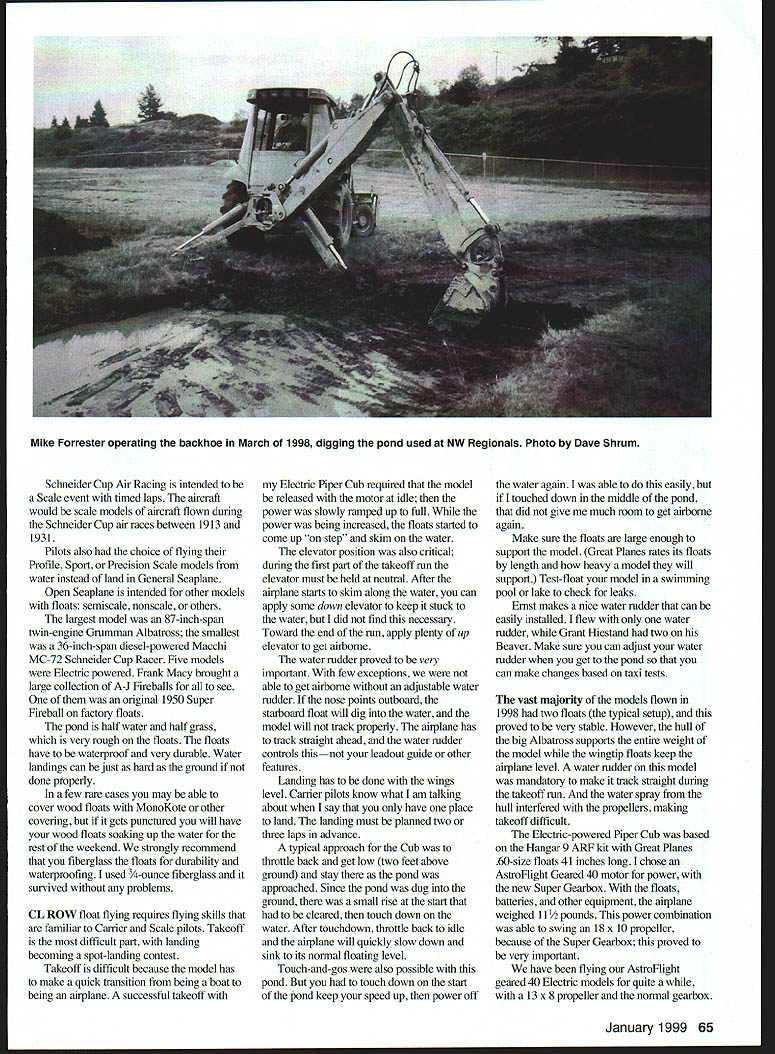
A new pond was created by digging a moat 17 feet wide and 220 feet long. Gordon Deedon, Dave Shrum, and Mike Forrester spent many hours with a backhoe to create the pond. Drop in a plastic liner, fill the pond, and you are ready to go.
The pond is half water and half grass, which is very rough on floats. The floats have to be waterproof and very durable. Water landings can be just as hard as ground landings.
Events
Three demo events were held at the Regionals:
- Schneider Cup Air Racing: intended to be a scale event with timed laps. Aircraft are scale models of those flown during the Schneider Cup air races between 1913 and 1931.
- General Seaplane: pilots can fly their Profile, Sport, or Precision Scale models from water instead of land.
- Open Seaplane: for other models with floats — semiscale, nonscale, or others.
Aircraft and participation
A total of 12 aircraft and seven pilots showed up with floats attached to CL models. Many pilots had built models with floats but had never flown them from water. Several models were untested at the beginning of the contest but survived many flights by the end of the weekend.
Highlights:
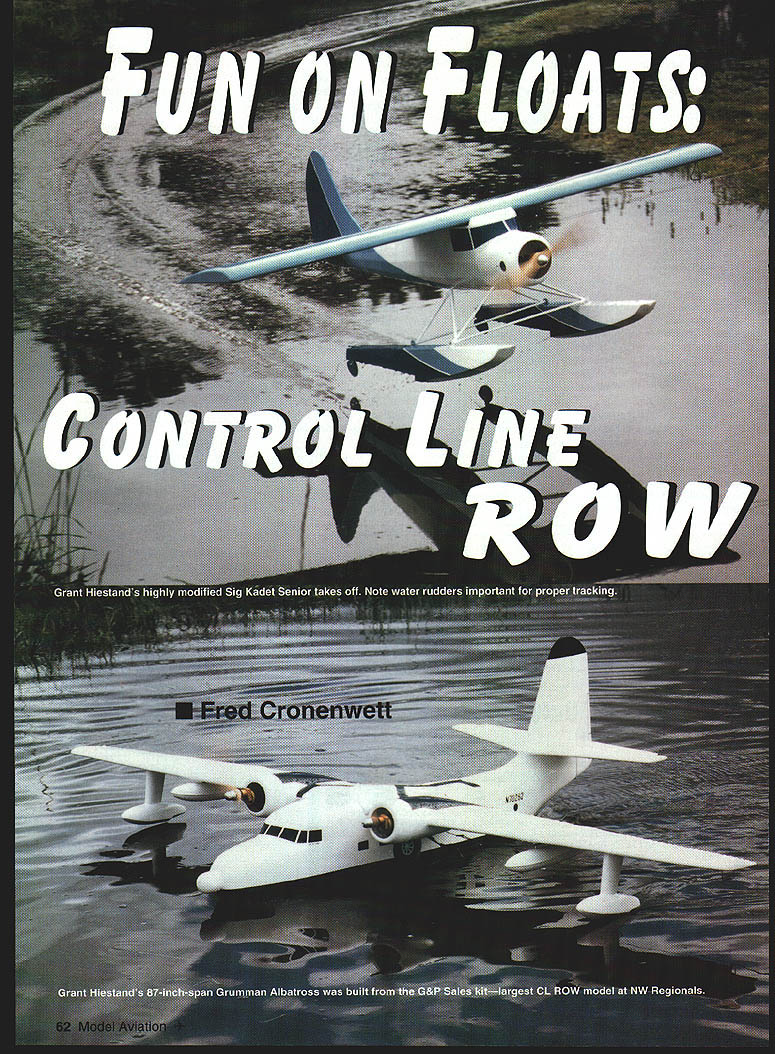
- Largest model: 87-inch-span twin-engine Grumman Albatross (hull supports weight; wingtip floats keep level).
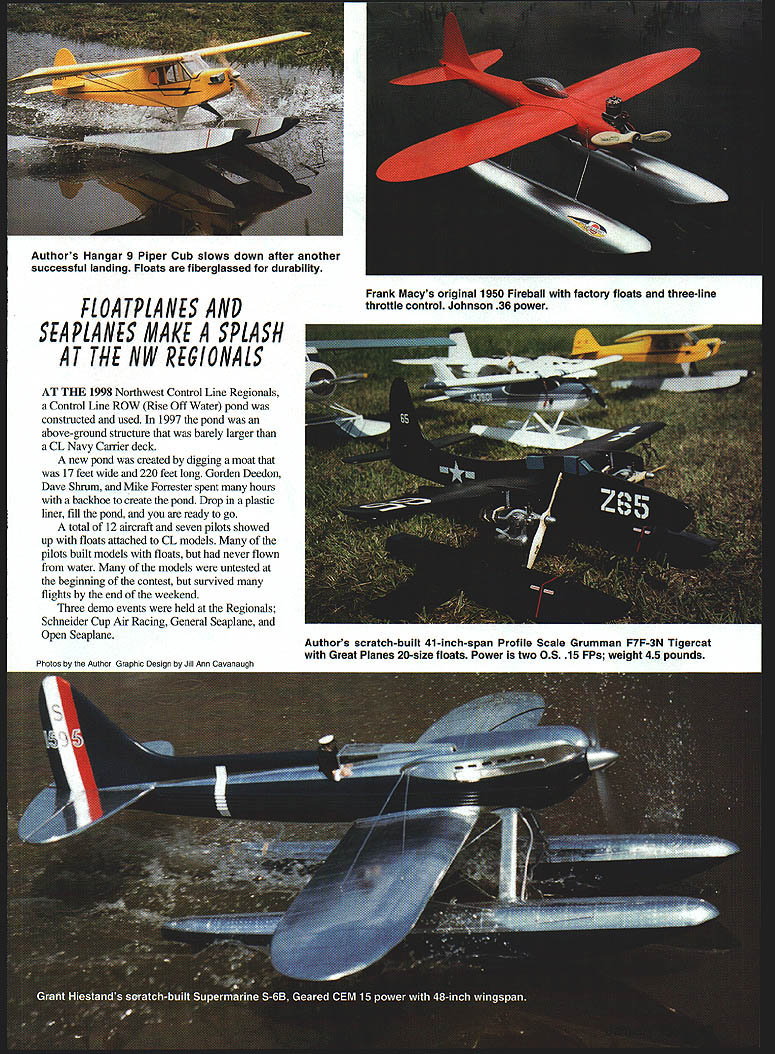
- Smallest model: 36-inch-span diesel-powered Macchi MC-72 Schneider Cup racer.
- Five models were electric powered.
- Frank Macy brought a large collection of A-J Fireballs, including an original 1950 Super Fireball on factory floats.
- Grant Hiestand flew his Supermarine S-6B from the pond for its official flights and won Precision Scale.
Floats and waterproofing
If you plan to fly from water:
- Test-float your model in a swimming pool or lake to check for leaks.
- Although you may be able to cover wood floats with MonoKote, a puncture can let the wood soak up water for the rest of the weekend. Fiberglassing is strongly recommended for durability and waterproofing (3/4-ounce fiberglass was used successfully).
- Make sure floats are large enough to support the model. (Great Planes rates its floats by length and the weight they will support.)
The pond’s grass edge and mud make getting into the water necessary for launches; waterproof rubber fishing boots are recommended.
Water rudder and tracking
The water rudder proved to be very important. With few exceptions, models could not get airborne without an adjustable water rudder. If the nose points outboard, the starboard float will dig into the water and the model will not track properly. The airplane must track straight ahead, and the water rudder controls this — not your leadout guide or other features.
Recommended:
- Use an adjustable water rudder so you can fine-tune alignment based on taxi tests.
- Ernst makes a nice water rudder that can be easily installed.
- Some models used one water rudder; others (like Grant Hiestand’s Beaver) used two.
Takeoff technique
Takeoff is the most difficult part; landing becomes a spot-landing contest. ROW float flying requires flying skills familiar to Carrier and Scale pilots.
Key points:
- Transition quickly from boat to airplane.
- For the Electric Piper Cub: release the model with the motor at idle, then slowly ramp power to full. As power increases the floats come up "on step" and begin to skim the water.
- Elevator position is critical:
- Hold elevator neutral during the first part of the takeoff run.
- After the model starts to skim, some down elevator can help keep it on the water (not always necessary).
- Toward the end of the run, apply plenty of up elevator to get airborne.
- The water rudder keeps the model tracking straight during the takeoff run.
A typical Cub approach: throttle back and get low (about two feet above ground), clear the small rise at the start of the dug pond, then touch down on the water. After touchdown, throttle back to idle and the model will slow and settle to its normal floating level.
Touch-and-gos are possible if you touch down near the start of the pond, keep speed up, and power off again. Touching down in the middle of the pond leaves little room to get airborne.
Landing technique
- Land with the wings level — you only have one place to land, so plan your landing two or three laps in advance.
- Approach planning and precise throttle control are important; throttle control is not required but makes water flying easier.
Power, gearboxes, and propellers
Because the pond is only 220 feet long, set up your model for maximum takeoff performance:
- Test takeoff performance at your local field, simulating floats with wheels and ballast if needed.
- As a rule of thumb, takeoff from water will be about 50% longer than from land.
- Example performance with the Cub:
- With wheels and ballast, airborne in 1/4 lap using 16 x 8 props.
- From water, approximately 1/3 lap with 16 x 8 and 1/4 lap with 18 x 10.
Electric setup used on the Cub:
- Hangar 9 ARF kit with Great Planes 60-size floats (41 inches long).
- AstroFlight Geared 40 motor with the Super Gearbox (allowed use of an 18 x 10 prop).
- With floats, batteries, and equipment, the Cub weighed 11-1/2 pounds.
- The Super Gearbox made it possible to swing larger props (15- to 18 x 10) compared to the normal gearbox (13 x 8). Larger props provide the thrust needed to get larger models off the water quickly.
Steve Davis’ Hangar 9 Piper Cub (OS 52 four-stroke with 11-inch prop) flew similar to the electric Cub but required a longer run.
Other models and handling
- Mike Conner flew a Precision Aerobatics model with Top Flite Elder floats (antique-style: two mains and a tail float). Powered with an OS .40FP, the model performed the Classic pattern including inverted flight and loops. Floats softened the corners; added weight and aerodynamic effects were present but relatively small.
- The Grumman Albatross (hull + wingtip floats) required a water rudder and had spray from the hull interfering with the props, making takeoff difficult.
Practical tips and rules
- Make sure you can adjust your water rudder at the pond after taxi testing.
- Leave good shoes in the car — the pond edge is muddy.
- The pond has a radius of 56 feet, so cut your lines accordingly.
- If you have a Scale model, you can fly it from water in lieu of concrete.
- Even non-Scale models (Stunt, non-scale) can be fitted with floats and entered in Open Seaplane.
Interested in participating in the 1999 ROW event? Dave Shrum has already made plans. Contact Dave directly for a set of detailed rules for all three ROW events:
Dave Shrum 68 Danita Lane Roseburg, OR 97470
Take those wheels off and get your feet wet during the Memorial Day weekend at the NW Control Line Regionals. Hope to see you there!
Fred Cronenwett 21320 Parthenia St. #101 Canoga Park, CA 91304
Transcribed from original scans by AI. Minor OCR errors may remain.

