
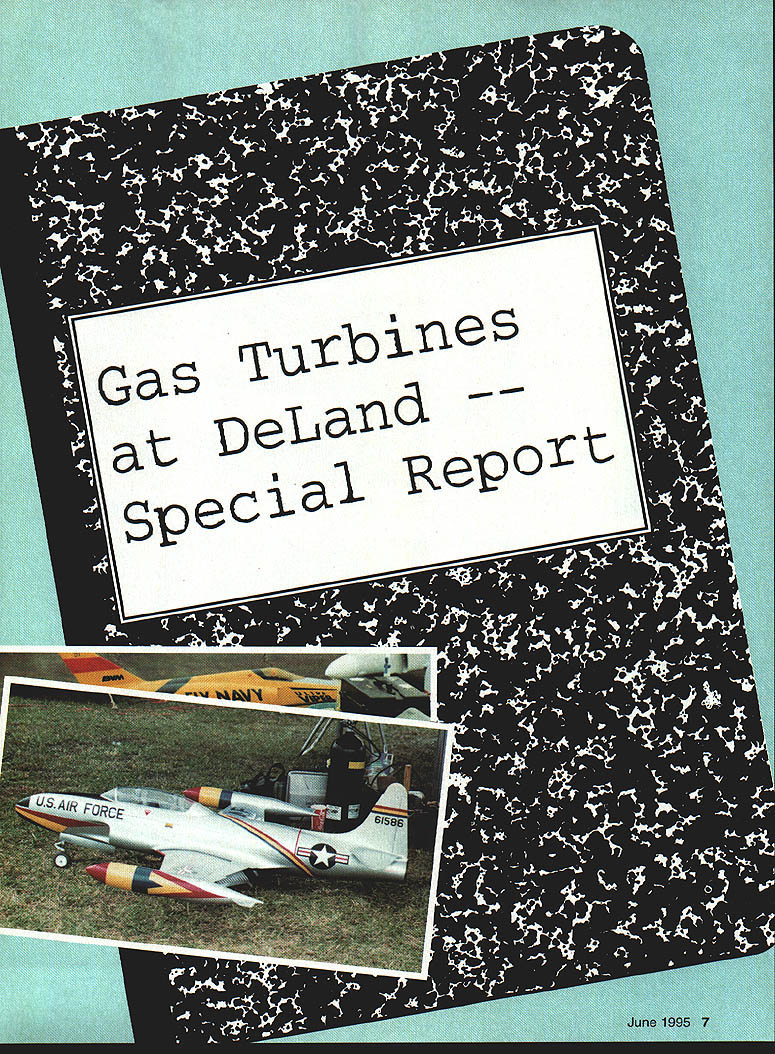

Gas Turbines at DeLand -- Special Report
For one week in January, jet enthusiasts migrate to DeLand, Florida for Jets Over DeLand, the world's largest jet meet. It has become an international event, with nearly a third of this year's 179 entrants from Europe and other countries. The meet offers an opportunity to sample all aspects of jet modeling and to fly in a delightful summertime climate.
For the last two years DeLand has showcased the coming of gas turbines. European modelers already incorporate gas-turbine power in radio-controlled jets, and U.S. manufacturers are applying their ingenuity and gearing up. The results seen at DeLand were exciting: turbine-powered and ducted-fan jets flew together without incident, and demonstrations included treetop landings and flameouts for both engine types. Safety control was emphasized by DeLand officials, everyone cooperated, and the event was free of major problems.
The competitive attitudes of demonstration manufacturers were a hot topic. The turbines were so realistic that it was often difficult to separate full-scale business jets from turbine-powered models overhead. Many attending pilots began calculating how to afford the hardware. DeLand ’95 will be long remembered by now-committed enthusiasts.
Highlights and demonstrations
- Bob Violett demonstrated excellent control, having perfected turbine power-lag timing. One flight ended in a positive-control, carrier-type landing with no bounce; another concluded with a feather-light touchdown.
- Demonstrations showed the speed and power potential of turbines — high-rate climbouts, strong acceleration, sustained inverted flight, and very high level-flight speeds in radar traps.
- The manufacturers’ turbine entries generally did not participate in the formal speed competitions, but turbine-equipped sport and scale jets showcased power and realism.
What may be in our futures
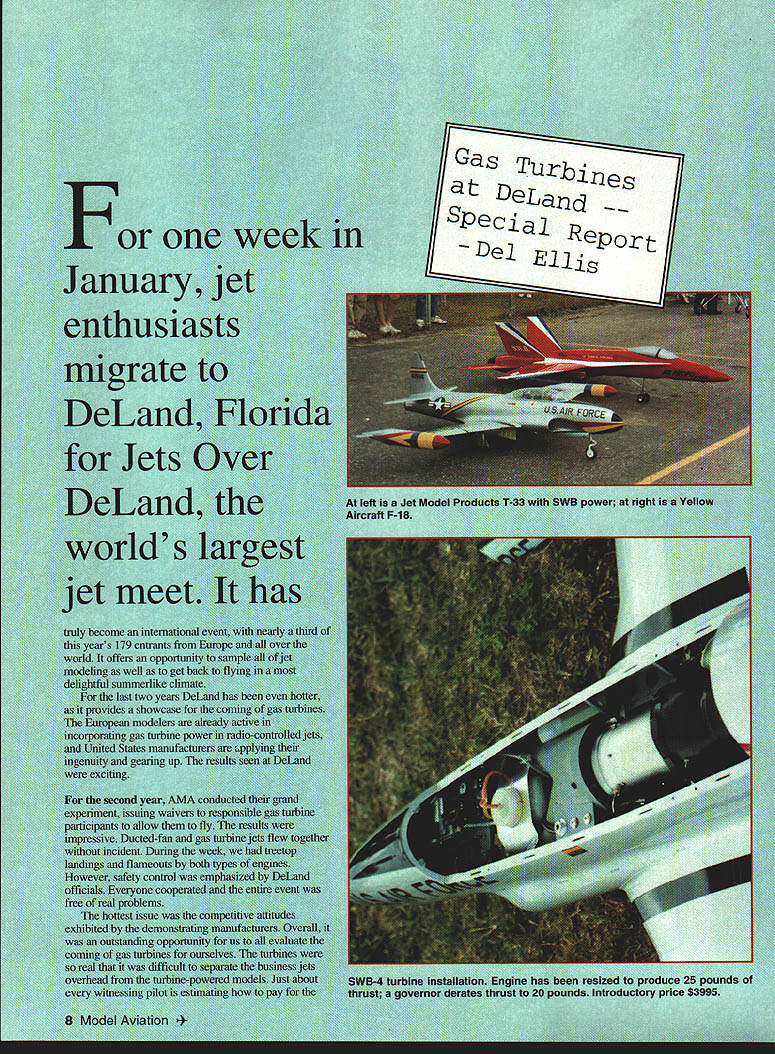
Jeff Seymour’s SWB-4 gas-turbine prototype, demonstrated in a modified IMP T-33, was resized to produce 25 pounds of thrust and governed to 20 pounds for design margin. During demonstrations, the heavy T-33 (about 31 lb dry, with tip tanks) reached 162 mph in level flight at roughly half throttle. Unfortunately, one aircraft suffered a mishap when the engine stopped during setup for landing; inadvertent fuel shutoff is suspected. The model had a treetop snag and entered a flat spin before reaching the runway. Post-crash inspection found the engine undamaged, fuel tanks about half full, fuel lines intact, and no heat damage to inlets or tailpipe; the airframe was repairable.
JPX
The most prominently displayed engine was the French JPX T240, in production for some time with more than 200 engines sold. The JPX produces more than 10 pounds of static thrust and is fueled by propane, which caused initial resistance in the United States but enjoys favorable status in Europe. At DeLand it proved trouble-free and manageable.
Speed highlights with JPX-powered models:
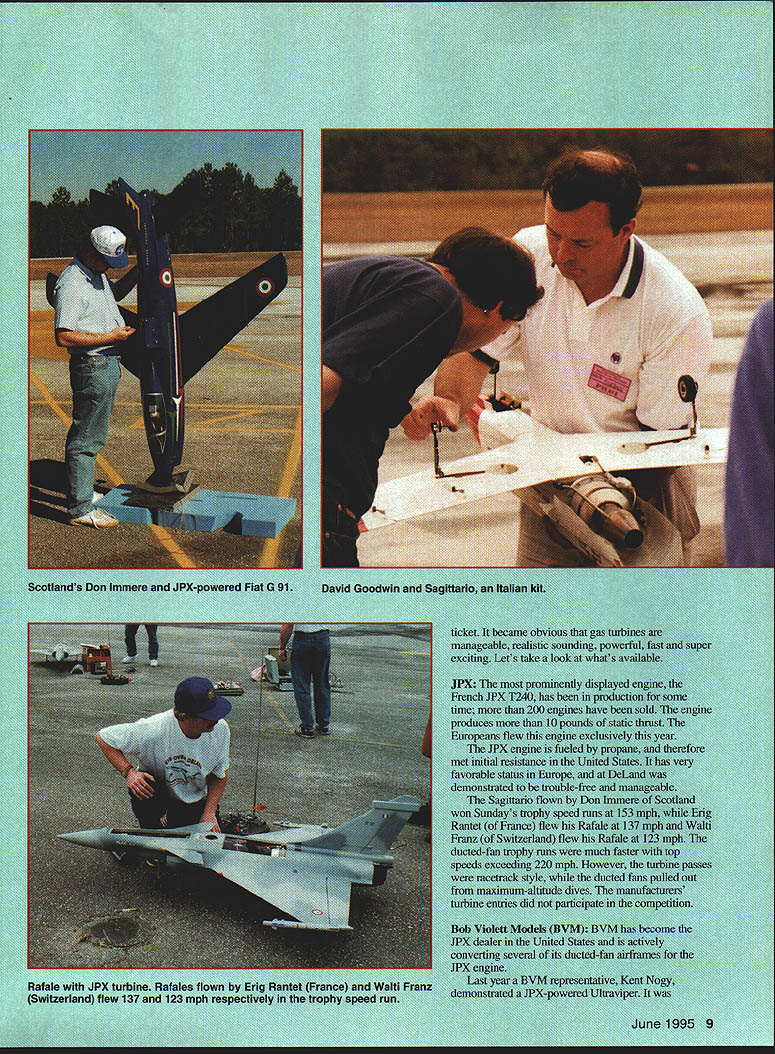
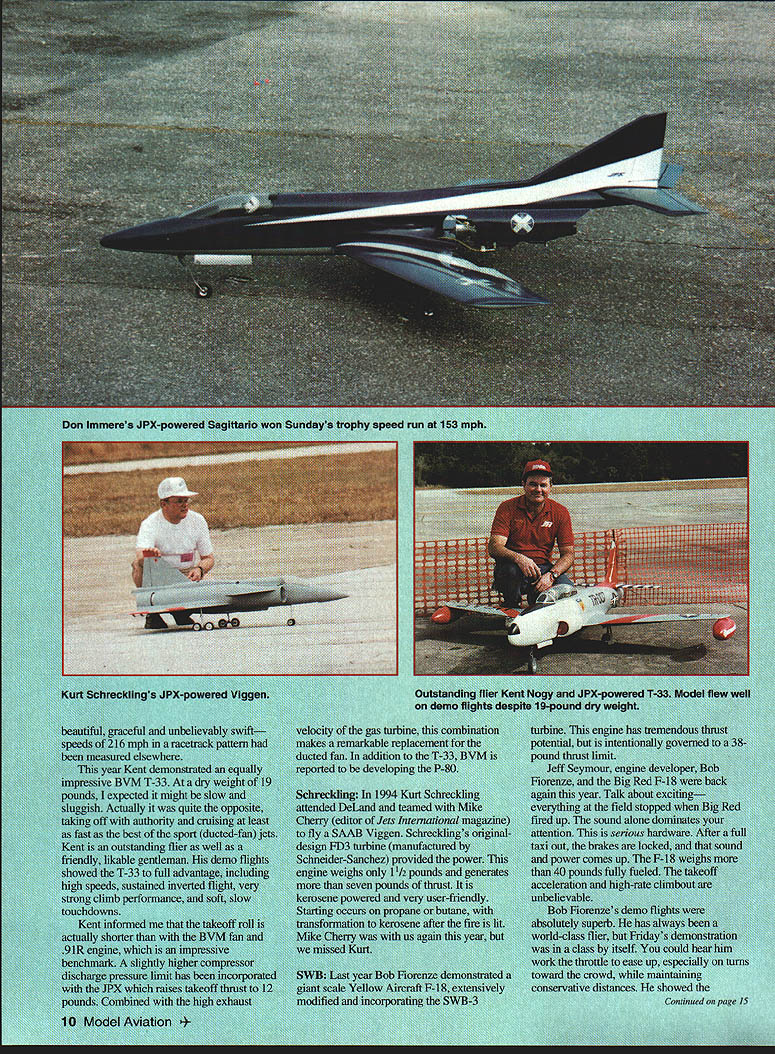
- Don Immere (Scotland) flew a Sagittario to win Sunday’s trophy speed run at 153 mph.
- Eric Rantet (France) flew a Rafale at 137 mph.
- Walti Franz (Switzerland) flew a Rafale at 123 mph.
Note: ducted-fan trophy runs recorded higher peak speeds (over 220 mph) due to different flight profiles (max-altitude dives versus racetrack-style turbine passes).
Bob Violett Models (BVM)
BVM became the JPX dealer in the United States and is converting several ducted-fan airframes for JPX installation. Last year BVM’s Kent Nogy demonstrated a JPX-powered Ultraviper, reportedly reaching speeds of 216 mph in a racetrack pattern. This year Kent flew a BVM T-33 (dry weight ~19 lb) that took off with authority, cruised as fast as top sport ducted-fan jets, sustained inverted flight, climbed strongly, and landed softly.
Kent reported that takeoff roll with the JPX is actually shorter than with the BVM fan and 9IR engine. A slightly higher compressor discharge pressure limit raises takeoff thrust to about 12 pounds, and the high exhaust velocity of the turbine makes it a remarkable replacement for a ducted fan. BVM is also reported to be developing a P-80 model.
Schreckling
Kurt Schreckling attended DeLand in 1994 and flew a SAAB Viggen powered by his original FD3 turbine (manufactured by Schneider-Sanchez). The FD3 weighs about 1.5 pounds and generates over seven pounds of thrust. It is kerosene-powered and designed to be user-friendly: starting occurs on propane or butane, with transition to kerosene after ignition.
Kurt’s book Gas Turbine Engines for Model Aircraft has recently been released in English (see references).
SWB
SWB demonstrated serious hardware and has become a major U.S. player in small gas turbines.
- SWB-3: Last year Bob Fiorenze demonstrated a giant-scale Yellow Aircraft F-18 extensively modified with an SWB-3 turbine governed to a 38-pound thrust limit. The sound and power dominated attention; the full-scale demonstrations showed strong takeoff acceleration and high-rate climb.
- SWB-4 prototype: Jeff Seymour demonstrated the SWB-4 in a modified IMP T-33, resized for 25 lb thrust but governed to 20 lb. The prototype demonstrated extraordinary speed and presence in the air. Tom Cook served as demo/test pilot and reported an unexpected burst of speed on one checkout flight. On subsequent flights, level speeds of 162 mph were recorded at half throttle in a large, heavy T-33.
- Mishap: On Saturday the T-33 experienced an in-flight engine stoppage during landing setup. Inadvertent fuel shutoff is suspected. The aircraft snagged a treetop and entered a flat spin to the ground; the engine was undamaged and the airframe repairable.
Production plans and projects:
- The SWB-4 will be produced with an introductory price of $3,995. Several $1,000 advance deposits were taken at DeLand for 1995 delivery.
- SWB has obtained military contracts for turbine engines and has several production projects underway.
- Seymour displayed a giant-scale F-16 fuselage (98 inches long) estimated at 20–22 pounds ready to fly with the SWB-4.
- Other planned products include:
- 13–14 pound-thrust gas turbines
- Turboprop gas-turbine engines for propeller-powered models
- Turboshaft gas-turbine engines for helicopter models
- Jet Model Products (JMP) demonstrated a prototype T-33 using the SWB-4.
- Further development aims for at least a four-pound weight reduction in the production SWB-4. The prototype latest version and the Starfire sport jet already incorporate an all-graphite, high-strength molded wing. Modifications are underway for gas turbines in the 10–14 pound thrust range, including installations with the JPX.
Available reference data
- Radio Control Jets International, January 1995 issue — detailed rundown of gas turbines in development. Available through Traplet Publications, BVM Models and local hobby shops.
- Kurt Schreckling, Gas Turbine Engines for Model Aircraft — newly released in English, available through Traplet Publications.
- Videotapes "1994–1995 International Jets Over DeLand" — available from SKS Video Productions and Telstar Productions.
AMA response activities
The Academy of Model Aeronautics (AMA) has actively assessed gas-turbine growth in model aircraft. AMA acquired two JPX turbines to evaluate safety and flight procedures. An AMA Gas Turbine Committee recently submitted recommendations and evaluations outlining safety standards and procedures. The consensus at DeLand was that gas turbines are manageable, realistic-sounding, powerful, fast and extremely exciting, provided proper safety controls and procedures are followed.
Transcribed from original scans by AI. Minor OCR errors may remain.

