
Geared Motors for Rubber Models
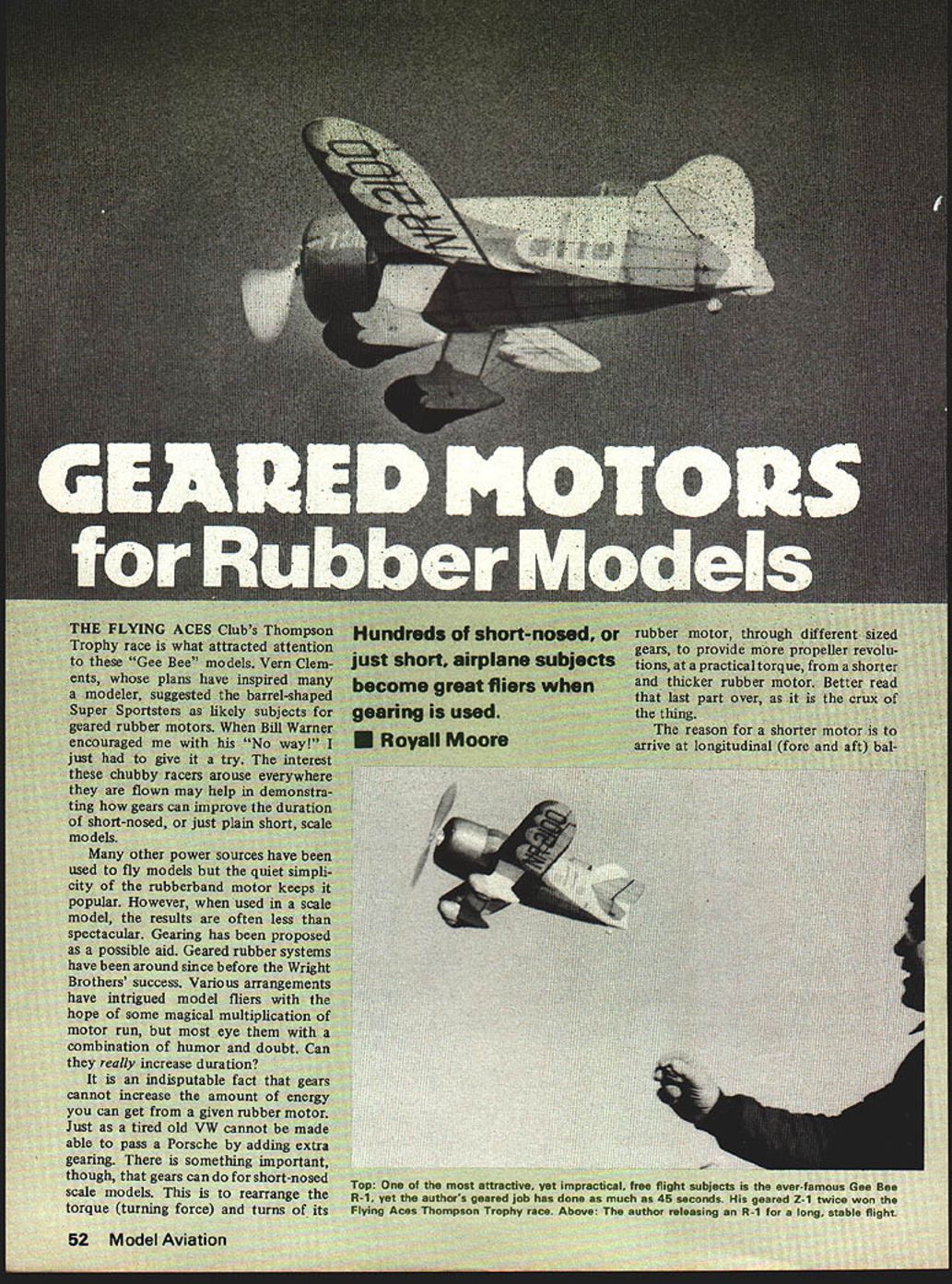
THE FLYING ACES Club's Thompson Trophy race is what attracted attention to these "Gee Bee" models. Vern Clements, whose plans have inspired many a modeler, suggested the barrel-shaped Super Sportsters as likely subjects for geared rubber motors. When Bill Warner encouraged me with his "No way!" I just had to give it a try. The interest these chubby racers arouse everywhere they are flown may help in demonstrating how gears can improve the duration of short-nosed, or just plain short, scale models.
Many other power sources have been used to fly models but the quiet simplicity of the rubberband motor keeps it popular. However, when used in a scale model, the results are often less than spectacular. Gearing has been proposed as a possible aid. Geared rubber systems have been around since before the Wright Brothers' success. Various arrangements have intrigued model fliers with the hope of some magical multiplication of motor run, but most eye them with a combination of humor and doubt. Can they really increase duration?
It is an indisputable fact that gears cannot increase the amount of energy you can get from a given rubber motor. Just as a tired old VW cannot be made able to pass a Porsche by adding extra gearing. There is something important, though, that gears can do for short-nosed scale models. This is to rearrange the torque (turning force) and turns of its
Hundreds of short-nosed, or just short, airplane subjects become great fliers when gearing is used.
- Royall Moore
rubber motor, through different sized gears, to provide more propeller revolutions, at a practical torque, from a shorter and thicker rubber motor. Better read that last part over, as it is the crux of the thing.
The reason for a shorter motor is to arrive at longitudinal (fore and aft) bal- ance, without having to add excessive ballast. Longitudinal balance is perhaps more critical than some of us realize. It can be upset, in a full-scale light plane by simply leaning forward or back. When Alphonse Penaud invented the twisted rubberband model airplane motor over 100 years ago, he demonstrated the importance of balance by extending the rubber about equally, ahead of and behind, his "planophore's" center of gravity. Because the rubber motor, in a good flying model, is a large proportion of its total weight, it is wise to follow what Penaud showed would work.
Looking more deeply into this balance problem, as it relates to ungeared rubber powered scale, we find that due to lack of engine weight, almost every lightly built model comes out tail heavy. In the quest for more turns, the builder often increases the balance upset by putting the tail hook (or peg) too far back.
The reason for a thicker motor is to carry more rubber. Carrying more rubber is like carrying more fuel; it is where the "go" for our machine is. No model can fly very long with only a tiny morsel of Pirelli. There is a limit, though, to the amount that can be used when it is hooked directly to the prop shaft. If it is made too thick, the prop will turn too fast, which defeats duration and has other bad effects. Making it too long (this means beyond the slack that's practical) can cause bunching, vibration, stalls and dives. Added to the above quantity limitations, there is a rearmost location of the rear hook, beyond which the weight of the extra rubber plus the ballast up front to balance it, will reduce flight duration rather than increase it. A thicker motor can be made of any
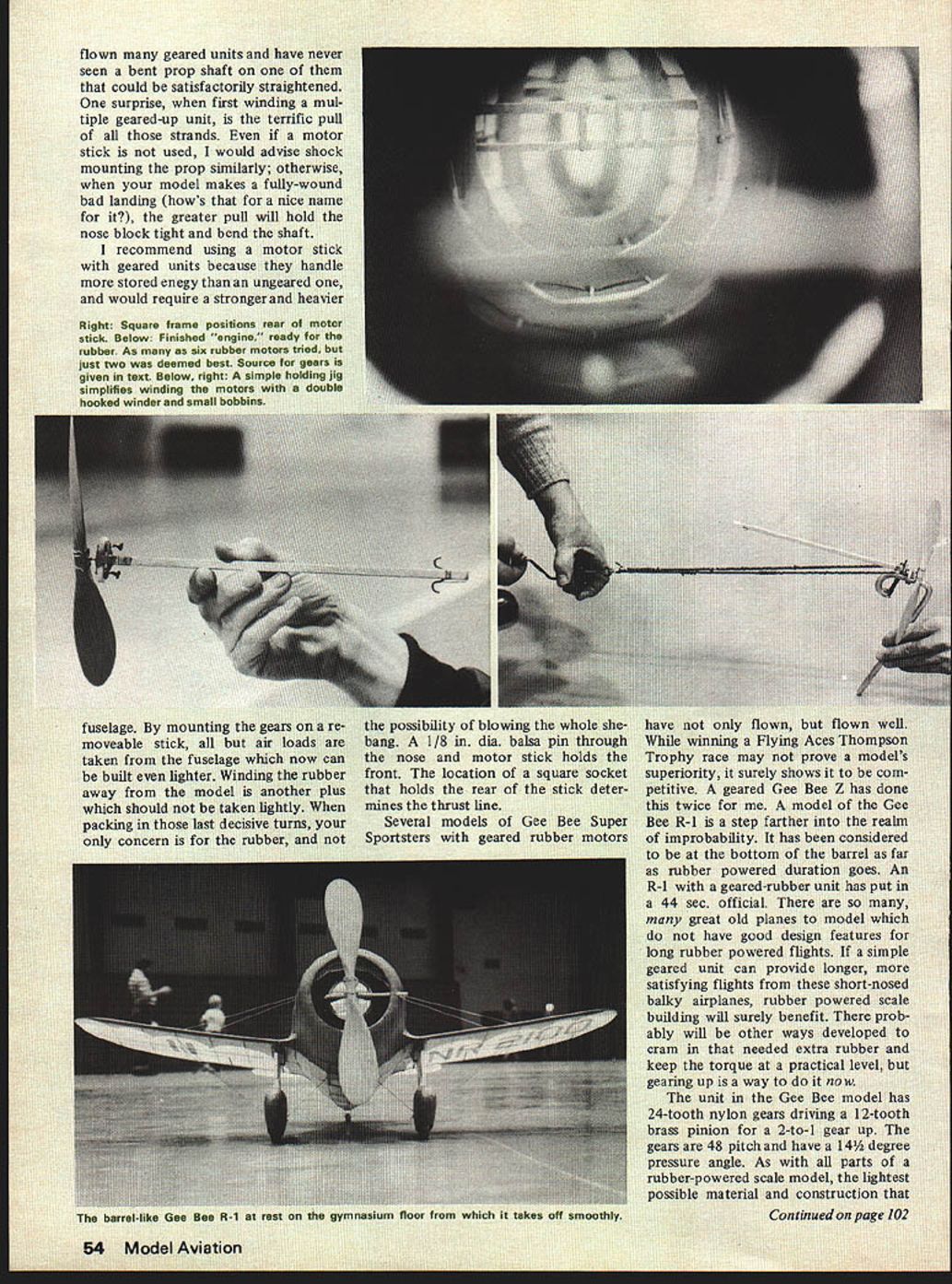
number of motors geared to the prop shaft. After using as many as six, I've decided two is best.
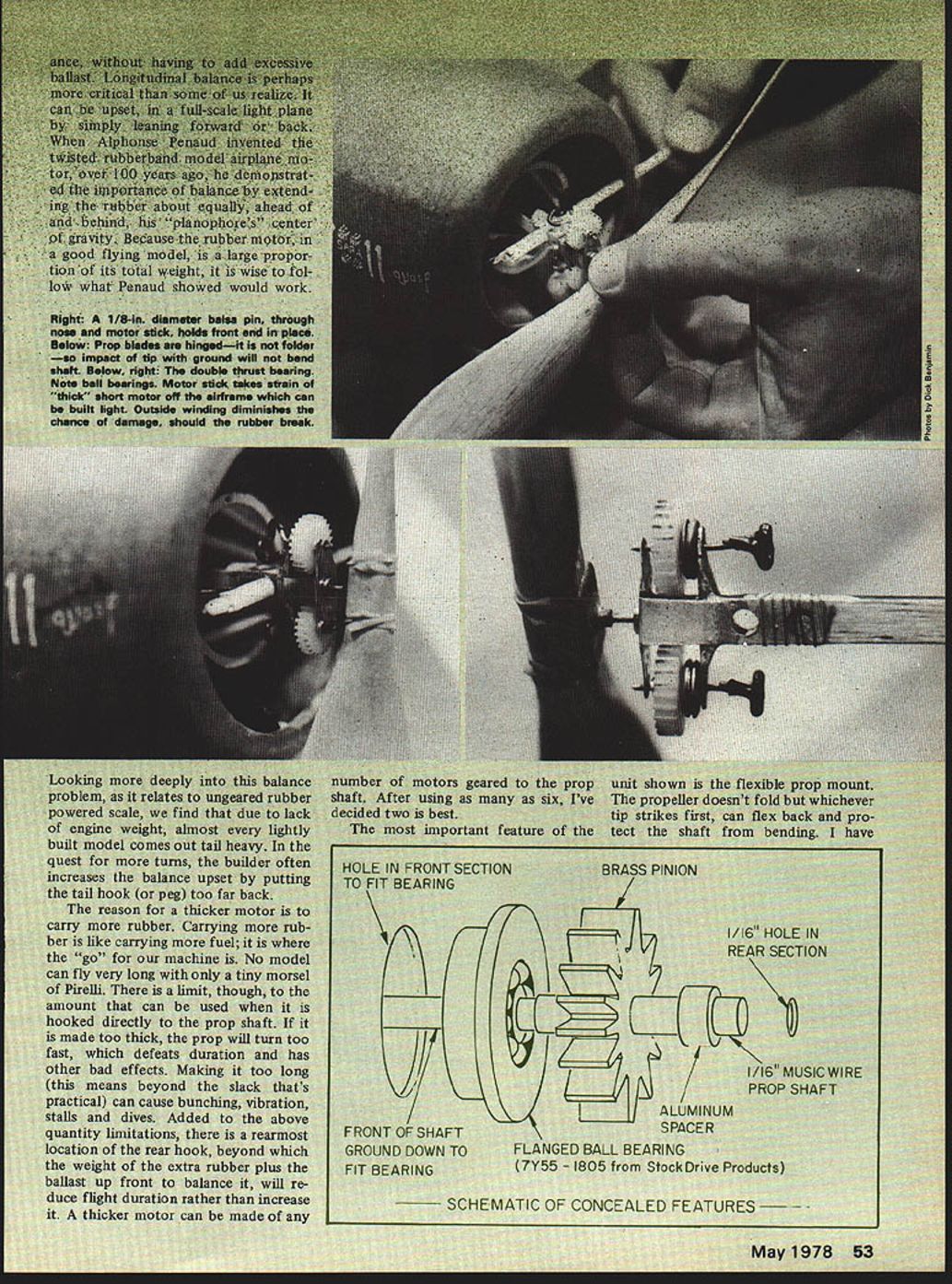
The most important feature of the unit shown is the flexible prop mount. The propeller doesn't fold but whichever tip strikes first, can flex back and protect the shaft from bending. I have flown many geared units and have never seen a bent prop shaft on one of them that could be satisfactorily straightened.
One surprise, when first winding a multiple geared-up unit, is the terrific pull of all those strands. Even if a motor stick is not used, I would advise shock mounting the prop similarly; otherwise, when your model makes a fully-wound bad landing (how's that for a nice name for it?), the greater pull will hold the nose block tight and bend the shaft.
I recommend using a motor stick with geared units because they handle more stored energy than an ungeared one, and would require a stronger and heavier fuselage. By mounting the gears on a removable stick, all but air loads are taken from the fuselage which now can be built even lighter. Winding the rubber away from the model is another plus which should not be taken lightly. When packing in those last decisive turns, your only concern is for the rubber, and not the possibility of blowing the whole shebang. A 1/8 in. dia. balsa pin through the nose and motor stick holds the front. The location of a square socket that holds the rear of the stick determines the thrust line.
Several models of Gee Bee Super Sportsters with geared rubber motors have not only flown, but flown well. While winning a Flying Aces Thompson Trophy race may not prove a model's superiority, it surely shows it to be competitive. A geared Gee Bee Z has done this twice for me. A model of the Gee Bee R-1 is a step farther into the realm of improbability. It has been considered to be at the bottom of the barrel as far as rubber powered duration goes. An R-1 with a geared-rubber unit has put in a 44 sec. official. There are so many, many great old planes to model which do not have good design features for long rubber powered flights. If a simple geared unit can provide longer, more satisfying flights from these short-nosed balky airplanes, rubber powered scale building will surely benefit. There probably will be other ways developed to cram in that needed extra rubber and keep the torque at a practical level, but gearing up is a way to do it now.
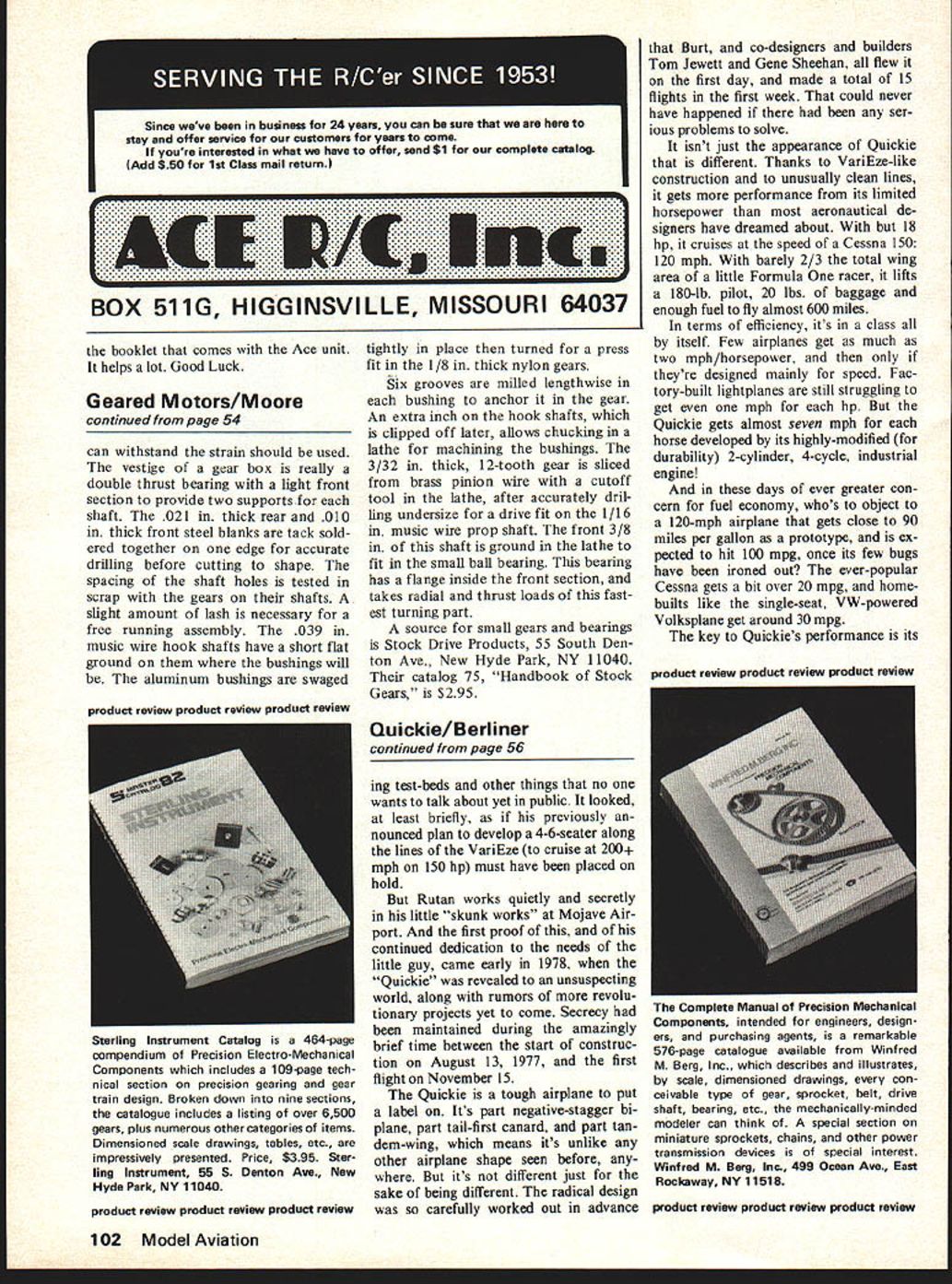
The unit in the Gee Bee model has 24-tooth nylon gears driving a 12-tooth brass pinion for a 2-to-1 gear up. The gears are 48 pitch and have a 14-1/2 degree pressure angle. As with all parts of a rubber-powered scale model, the lightest possible material and construction that can withstand the strain should be used. The vestige of a gear box is really a double thrust bearing with a light front section to provide two supports for each shaft. The .021 in. thick rear and .010 in. thick front steel blanks are tack soldered together on one edge for accurate drilling before cutting to shape. The spacing of the shaft holes is tested in scrap with the gears on their shafts. A slight amount of lash is necessary for a free running assembly. The .039 in. music wire hook shafts have a short flat ground on them where the bushings will be. The aluminum bushings are swaged tightly in place then turned for a press fit in the 1/8 in. thick nylon gears.
Six grooves are milled lengthwise in each bushing to anchor it in the gear. An extra inch on the hook shafts, which is clipped off later, allows chucking in a lathe for machining the bushings. The 3/32 in. thick, 12-tooth gear is sliced from brass pinion wire with a cutoff tool in the lathe, after accurately drilling undersize for a drive fit on the 1/16 in. music wire prop shaft. The front 3/8 in. of this shaft is ground in the lathe to fit in the small ball bearing. This bearing has a flange inside the front section, and takes radial and thrust loads of this fastest turning part.
A source for small gears and bearings is Stock Drive Products, 55 South Denton Ave., New Hyde Park, NY 11040. Their catalog 75, "Handbook of Stock Gears," is $2.95.
Transcribed from original scans by AI. Minor OCR errors may remain.

