
GEE BEE Flight Box: An easy-to-build flight box from the "Golden Age"
TOM CHIPLEY
Concept
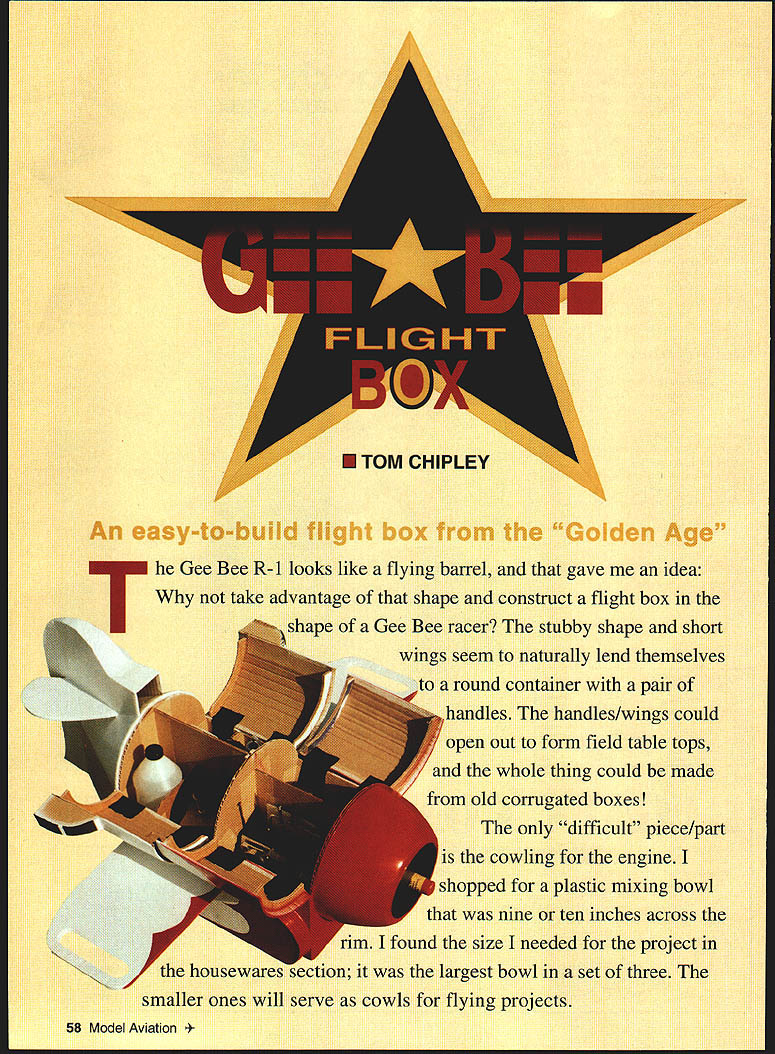
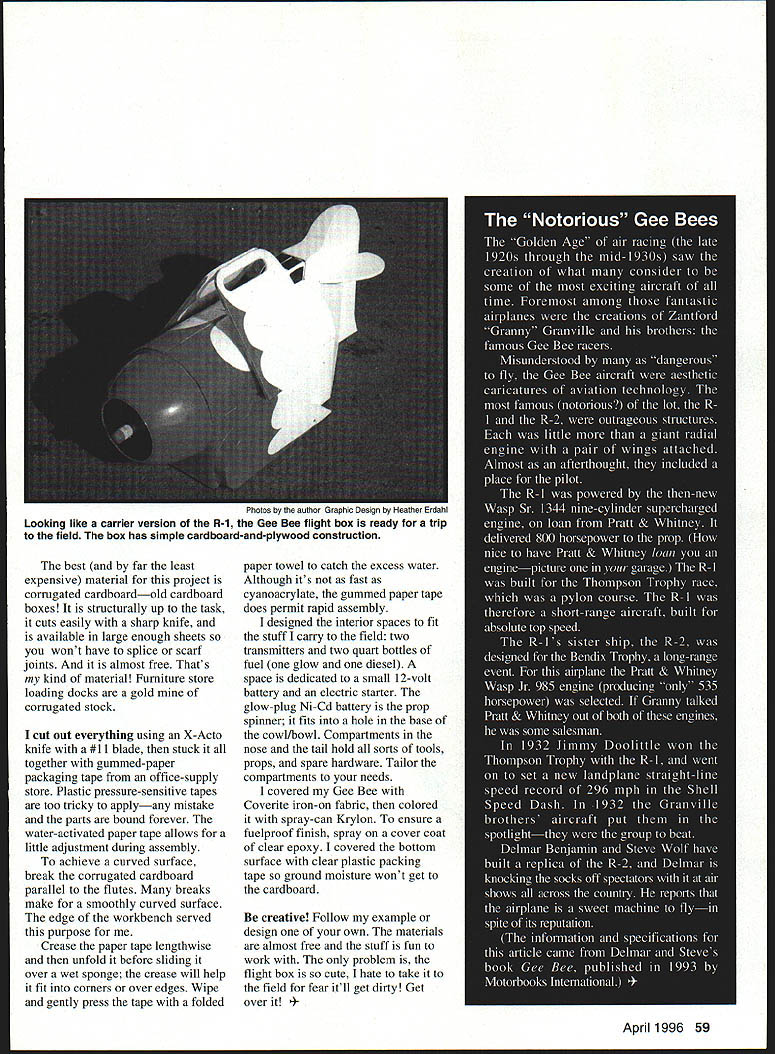
The Gee Bee R-1 looks like a flying barrel, and that gave me an idea: why not take advantage of that shape and construct a flight box in the shape of a Gee Bee racer? The stubby fuselage and short wings naturally lend themselves to a round container with a pair of handles. The handles/wings can open out to form field tabletops, and the whole thing can be made from old corrugated boxes.
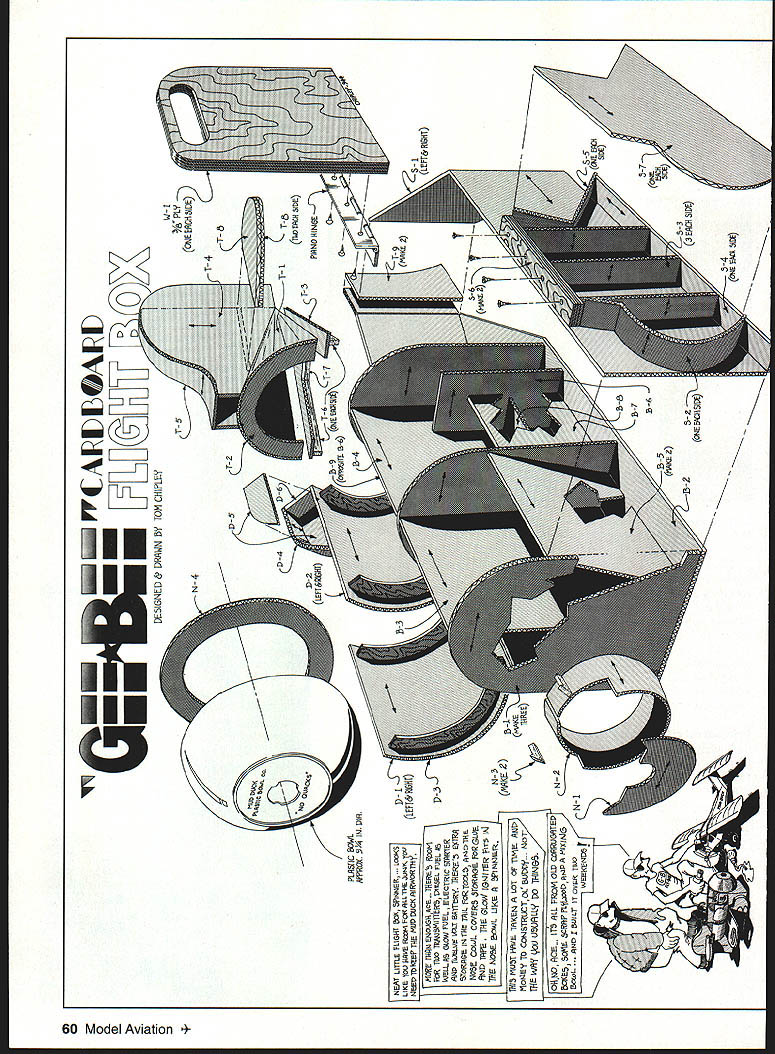
The only “difficult” piece is the cowling for the engine. I shopped for a plastic mixing bowl that was nine or ten inches across the rim. I found the size I needed in the housewares section; it was the largest bowl in a set of three. The smaller ones will serve as cowls for flying projects.
Materials and tools
- Corrugated cardboard (old boxes) — structurally up to the task, easy to cut, and available in large sheets
- Plastic mixing bowl (9–10 inches across the rim) for the cowling
- X-Acto knife with a #11 blade
- Gummed-paper (water-activated) packaging tape
- Sponge and folded paper towel for wetting and wiping tape
- Coverite iron-on fabric
- Spray-can Krylon (for coloring)
- Clear epoxy for a fuelproof finish
- Clear plastic packing tape (to protect bottom from ground moisture)
- 12-volt battery and electric starter (if you carry them)
- Glow-plug Ni-Cd battery (prop spinner)
Construction tips
- Cut all parts with an X-Acto knife and a #11 blade.
- Stick parts together with gummed-paper packaging tape. Plastic pressure-sensitive tape is harder to apply because mistakes cannot be adjusted. The water-activated tape allows a little adjustment during assembly.
- To achieve a curved surface, break the corrugated cardboard parallel to the flutes. Make many small breaks for a smoothly curved surface — the edge of a workbench works well for this.
- Crease the paper tape lengthwise and then unfold it before sliding it over a wet sponge; the crease helps it fit into corners or over edges. Wipe and gently press the tape with a folded paper towel to catch excess water.
- Although gummed paper tape is not as fast as cyanoacrylate, it permits rapid assembly and is forgiving.
Interior layout
I designed the interior spaces to fit what I normally carry to the field:
- Two transmitters
- Two quart bottles of fuel (one glow and one diesel)
- Space dedicated to a small 12-volt battery and an electric starter
- A hole in the base of the cowl/bowl for the glow-plug Ni-Cd battery that serves as the prop spinner
- Compartments in the nose and tail for tools, props, and spare hardware
Tailor the compartments to your needs.
Finishing
- Cover the Gee Bee with Coverite iron-on fabric, then color it with spray-can Krylon.
- To ensure a fuelproof finish, spray on a cover coat of clear epoxy.
- Cover the bottom surface with clear plastic packing tape so ground moisture won't reach the cardboard.
Final thoughts
Be creative! Follow my example or design your own. The materials are almost free, and the stuff is fun to work with. The only problem is this flight box is so cute I hate to take it to the field for fear it'll get dirty — get over it!
DESIGNED & DRAWN BY TOM CHIPLEY
Transcribed from original scans by AI. Minor OCR errors may remain.

