
Gee Bee: Model Y
Henry Haffke
IN THE LATE 1920's and early 30's, the Granville Brothers of Springfield, Mass., built a series of aircraft that were destined to become the most famous racing aircraft of all times. The well known R-1 and R-2 Super Sportsters racing craft have probably received more coverage in aviation publications than any other single aircraft.
The Super Sportsters came about as a result of success attained with earlier aircraft built by the company which were raced in various racing events. The first Gee Bee aircraft to enter in a race was the model "X" Sportster powered with a Cirrus engine. Its success prompted a series of single-place sport planes powered with various engines including the Cirrus, Menasco and Warner powerplants. Eight of these Model "D" Sportsters, as they were called, were built. A larger two-place version of these was built and was designated the Model "Y" Senior Sportster. Two of the Model "Y" Sportsters were built and both were very successful as racers even though they were not designed as such.
They were excellent flying craft and Tom Granville states that the Model "Y" Sportsters were the best ever built by the company. They won more money than any other planes and had plenty of power, landed nicely, and flew beautifully. One of the Model "Y" Sportsters was flown to victory in the National Acrobatic event as Russell Boardman won the Speed Holman Trophy.
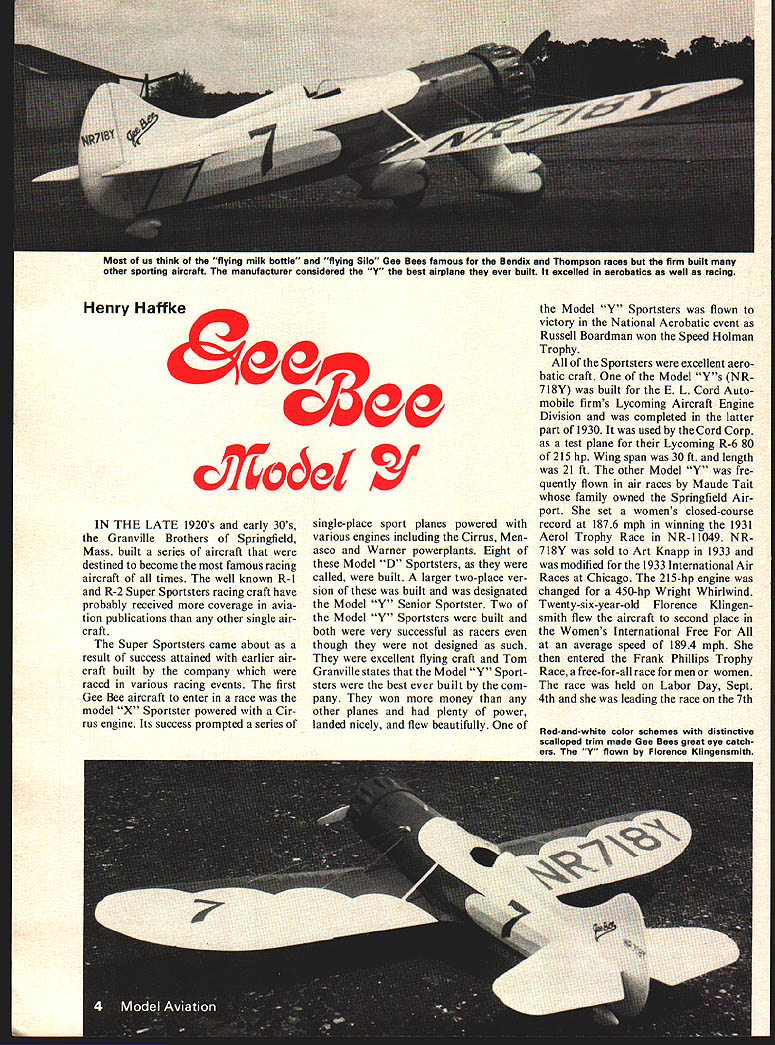
All of the Sportsters were excellent aerobatic craft. One of the Model "Y"'s (NR-718Y) was built for the E. L. Cord Automobile firm's Lycoming Aircraft Engine Division and was completed in the latter part of 1930. It was used by the Cord Corp. as a test plane for their Lycoming R-680 of 215 hp. Wing span was 30 ft. and length was 21 ft. The other Model "Y" was frequently flown in air races by Maude Tait whose family owned the Springfield Airport. She set a women's closed-course record at 187.6 mph in winning the 1931 Aerol Trophy Race in NR-11049. NR-718Y was sold to Art Knapp in 1933 and was modified for the 1933 International Air Races at Chicago. The 215-hp engine was changed to a 450-hp Wright Whirlwind. Twenty-six-year-old Florence Klingensmith flew the aircraft to second place in the Women's International Free For All at an average speed of 189.4 mph. She then entered the Frank Phillips Trophy Race, a free-for-all race for men and women. The race was held on Labor Day, Sept. 4th and she was leading the race on the 7th
- Model Y Senior Sportsters include:
- 1931 4th Thompson Trophy — Pilot Bob Hall
- 1931 1st Aerol Trophy Race — Pilot Maude Tait
- 1932 1st Omaha Air Races — Pilot Russell Boardman
- 1932 1st Niagara Falls International Air Races — Pilot Russell Boardman
- 1932 1st Omaha Air Races — Pilot Maude Tait
- 1932 1st Niagara Falls International Air Races — Pilot Maude Tait
- 1933 2nd Aerol Trophy Race — Pilot Marty Bowman
- 1933 5th Thompson Trophy Race — Pilot Zantford Granville
- 1933 2nd Women's International Free — Pilot Florence Klingensmith
lap at over 200 mph when fabric peeled from the right wing causing a fatal crash. Soon after this, a pilot flying Maude Tait's Model "Y" took off from the North Beach Airport (LaGuardia Field) on Long Island and spun into the ocean. A few months later, Zantford (Granny) Granville was killed Feb. 12, 1934 in a Gee Bee Model A Trainer avoiding two airport workers on a runway and the Gee Bee Company ceased operations.
As a young boy, I lived about a mile from the Springfield Airport and my father frequently took us over to the airport on a summer evening to watch the planes fly. I was too young at the time to appreciate what was going on, other than I enjoyed watching the take-offs and landings on the busy field. I undoubtedly saw several of the Sportsters during these visits and, while at home, never missed the chance to stare skyward whenever an engine was heard above. In my many years of modeling, I have become very interested in racing aircraft and the aircraft of the Golden Era are my favorite subjects. The Gee Bee Model "Y" flown by Florence Klingensmith has always had a special appeal to me as the ultimate of classic aircraft with its cowl bumps and faired landing gear.
From the golden age of air racing, sporty looking, smooth flying RC for .40 engines.
I work for a company that produces craft items and when my boss suggested that I design a model for him to produce, I decided on a .40 powered sport scale model of this beautiful plane of the past. A kit of this model is planned for this year.
Construction
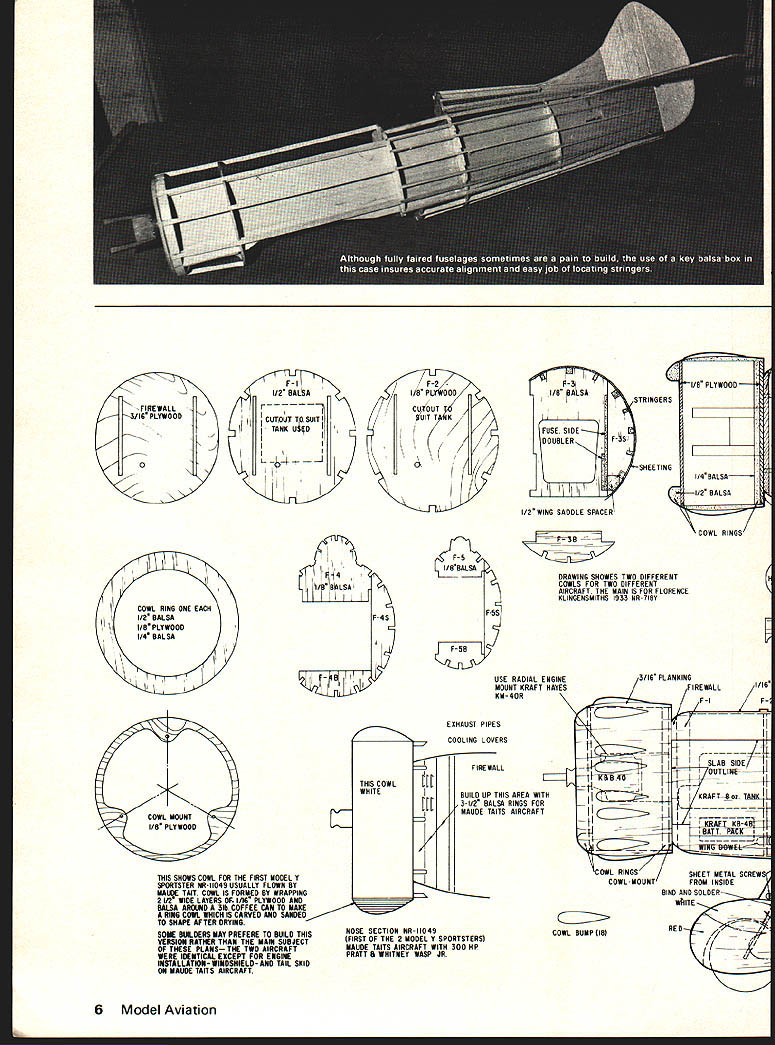
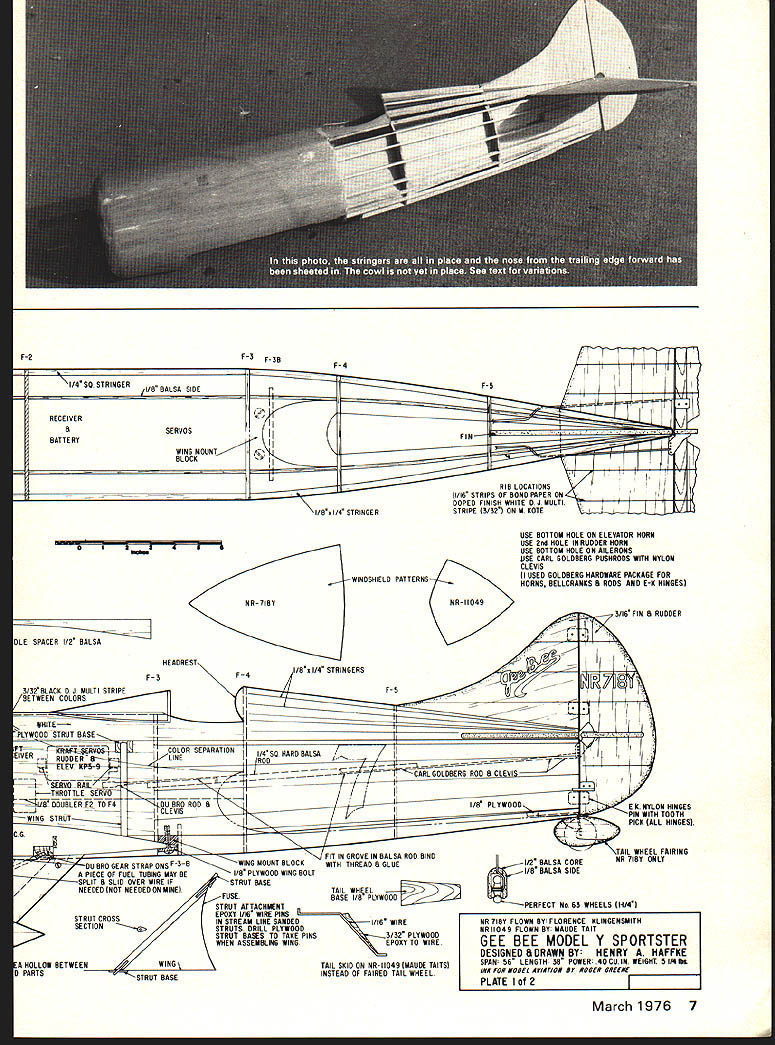
Drawings basically are for the final modification to NR-718Y as flown by Florence Klingensmith in the 1933 Chicago International Air Races. I have included details of the nose section of Maude Tait's aircraft which was identical except for the engine installation and smaller windshield, and also a plain tail skid. Either of these aircraft may be built from the drawings. Also, the two-seat version could be made. A list of reference material may be found at the end of this article. Although fully faired fuselages sometimes are a pain to build, the use of a key balsa box in this case insures accurate alignment and easy job of locating stringers.
FIREWALL 3/16" PLYWOOD
1/2" BALSA CUTOUT TO SUIT TANK USED
5/32" 1/8" PLYWOOD CUTOUT TO SUIT TANK
FUSE. SIDE DOUBLER 1/8" BALSA STRINGERS SHEETING
1/8" PLYWOOD 1/8" BALSA 1/2" BALSA COWL RINGS
COWL RING ONE EACH 1/2" BALSA 1/8" PLYWOOD 1/4" BALSA
F-48 1/8" BALSA
F-45
F-58
F-55
THIS COWL (WHITE)
EXHAUST PIPES COOLING LOUVERS
FIREWALL
BUILD UP THIS AREA WITH 3/32" BALSA RINGS FOR MAUDE TAIT'S AIRCRAFT
NOSE SECTION NR-1049 (FIRST OF THE 2 MODEL Y SPORTSTERS) MAUDE TAIT'S AIRCRAFT WITH 300 HP PRATT & WHITNEY WASP JR.
THIS SHOWS COWL FOR THE FIRST MODEL Y SPORTSTER NR-1049 USUALLY FLOWN BY MAUDE TAIT. COWL IS FORMED BY WRAPPING 1/2" WIDE STRIPS OF 1/16" PLYWOOD AND BALSA AROUND A 3/8" DIAMETER FORM TO MAKE A RING. THE RING IS CARRIED AND SANDED TO SHAPE AFTER DRYING.
COWL MOUNT 1/8" PLYWOOD
USE RADIAL ENGINE MOUNT KRAFT HAYES KM-60R
3/16" PLANKING FIREWALL
SLAB SIDE OUTLINE
KRAFT 8-oz. TANK
COWL RINGS COWL MOUNT
SHEET METAL SCREWS FROM INSIDE BIND AND SOLDER WIRE
COWL BUMP (3/8") 1/4" SQ. STRINGER 1/8" BALSA SIDE
RECEIVER & BATTERY
SERVOS
WING MOUNT BLOCK
1/8" x 1/4" STRINGER
F-2 F-3 F-3B F-4 F-5
FIN
RIB LOCATIONS 1/16" STRIPS OF BONO PAPER ON DOPED FINISH. WHITE & D-J MULTI STRIPE (3/32") ON RIB TOP.
USE BOTTOM HOLE ON ELEVATOR HORN USE 2ND HOLE IN RUDDER HORN USE BOTTOM HOLE ON AILERONS USE CARL GOLDBERG PUSHRODS WITH NYLON CLEVIS I USED GOLDBERG HARDWARE PACKAGE FOR HORNS, BELLCRANKS & RODS AND E-Z HINGES
WINDSHIELD PATTERNS NR-718Y NR-1049
3/16" FIN & RUDDER
HEADREST
1/8" x 1/4" STRINGERS
PLYWOOD STRUT BASE
COLOR SEPARATION LINE
1/4" SQ. HARD BALSA
CARL GOLDBERG ROD & CLEVIS
1/8" PLYWOOD
TAIL WHEEL BASE 1/8" PLYWOOD
1/8" BALSA CORE 1/8" BALSA SIDE
TAIL WHEEL FAIRING NR 718Y ONLY
PERFECT NO. 55 WHEELS (1/4")
NR 718Y FLOWN BY: FLORENCE KLINGENSMITH NR1049 FLOWN BY: MAUDE TAIT
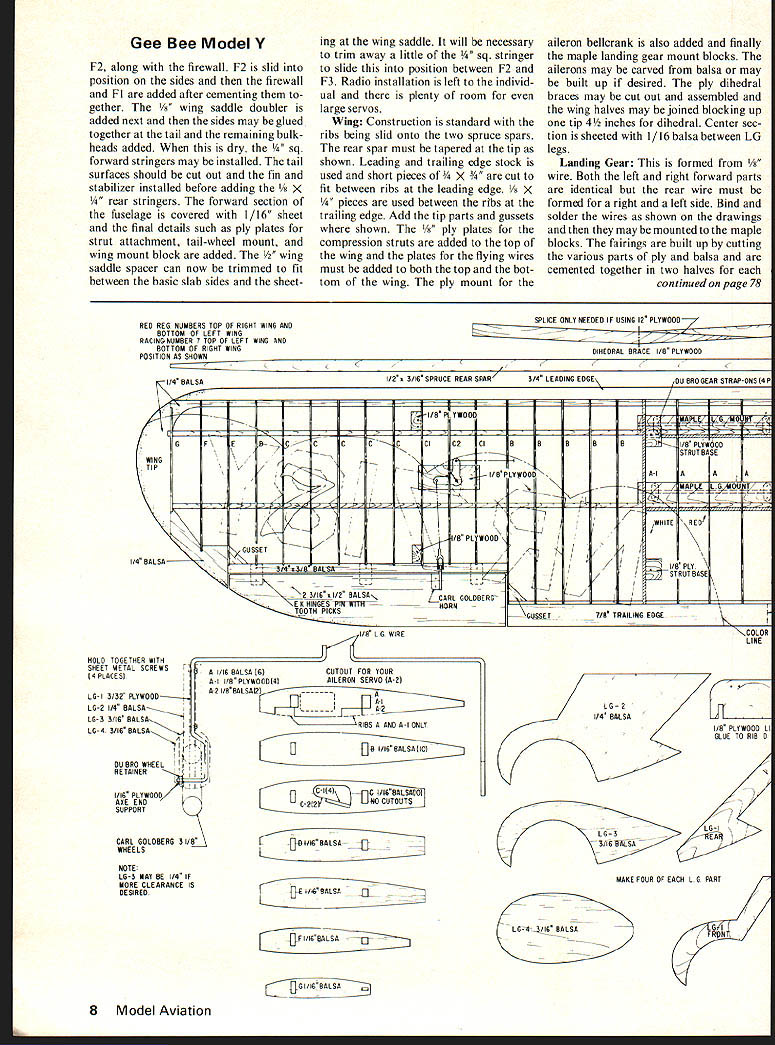
GEE BEE MODEL Y SPORTSTER DESIGNED & DRAWN BY: HENRY A. HAFFKE SPAN: 56" LENGTH: 38" POWER: .40 CU. IN. WEIGHT: 5-1/2 LBS. FOR MODEL ILLUSTRATION BY ROGER CREECH PLATE 1 of 2 F2, along with the firewall. F2 is slid into position on the sides and then the firewall and F1 are added after cementing them together. The 1/8" wing saddle doubler is added next and then the sides may be glued together at the tail and the remaining bulkheads added. When this is dry, the 1/4" x 3/8" forward stringers may be installed. The tail surfaces should be cut out and the fin and stabilizer installed before adding the 1/8" x 1/4" rear stringers. The forward section of the fuselage is covered with 1/16" sheet and the final details such as ply plates for strut attachment, tail-wheel mount, and wing mount block are added. The 1/2" wing saddle spacer can now be trimmed to fit between the basic slab sides and the sheeting at the wing saddle. It will be necessary to trim away a little of the 1/4" sq. stringer to slide this into position between F2 and F3. Radio installation is left to the individual and there is plenty of room for even large servos.
Wing: Construction is standard with the ribs being slid onto the two spruce spars. The rear spar must be tapered at the tip as shown. Leading and trailing edge stock is used and short pieces of 1/4" x 3/4" are cut to fit between ribs at the leading edge. 1/8" x 1/4" pieces are used between the ribs at the trailing edge. Add the tip parts and gussets where shown. The 1/8" ply plates for the compression struts are added to the top of the wing and the plates for the flying wires must be added to both the top and the bottom of the wing. The ply mount for the aileron bellcrank is also added and finally the maple landing gear mount blocks. The ailerons may be carved from balsa or may be built up if desired. The ply dihedral braces may be cut out and assembled and the wing halves may be joined blocking up one tip 1/2" for dihedral. Center section is sheeted with 1/16" balsa between LG legs.
Landing Gear: This is formed from 1/8" music wire. Both the left and right forward parts are identical and the rear wire must be formed for a right and a left side. Bind and solder the wires as shown on the drawings and then they may be mounted to the maple blocks. The fairings are built up by cutting the various parts of ply and balsa and are cemented together in two halves for each
Gee Bee: Model Y
Most of us think flying miniature and flying full-scale Gee Bees ruinous ventures, but in the Bendix and Thompson races and in many other sporting events the manufacturer considered the Y the best airplane ever built. It excelled in aerobatics as well as racing.
In the late 1920s and early '30s the Granville Brothers of Springfield, Mass., built a series of aircraft destined to become famous racing machines of the times. The well-known R-1, R-2 and Super Sportsters have probably received coverage in aviation publications. Another single aircraft, the Super Sportster, came about as a result of the success attained by earlier aircraft built by the company. The company produced a series of single-place sport planes powered by various engines including Cirrus, Menasco and Warner powerplants. Eight Model D Sportsters were built. A larger two-place version was built and designated Model Y Senior Sportster.
Two Model Y Sportsters were built; both were very successful racers though not expressly designed as such. Tom Granville states the Model Y Sportsters were the best ever built by the company. They won money, had plenty of power, landed nicely and flew beautifully. Model Y Sportsters were flown to victory in national aerobatic events. Russell Boardman won the Speed Holman Trophy and the Sportsters proved to be excellent aerobatic craft.
NR718Y was built for E. L. Cord. The Cord Automobile firm's Lycoming Aircraft Engine Division completed the latter part of 1930 and used the plane as a Cord Corporation test ship, powered by a Lycoming R-680 of about 215 hp. Another Model Y was frequently flown in air races. Maude Tait, of the family that owned Springfield Airport, set a women's closed-course record of 187.6 mph, winning the 1931 Aerol Trophy Race in NR11049.
NR718Y was sold to Art Knapp in 1933 and was modified for the 1933 International Air Races in Chicago: the 215-hp engine was replaced with a 450-hp Wright Whirlwind. Twenty-six-year-old Florence Klingensmith flew the aircraft to second place in the Women's International Free-for-all with an average speed of 189.4 mph. She also entered the Frank Phillips Trophy Race, a free-for-all in which men and women competed; on Labor Day, Sept. 4th, she was leading the race when she was forced out of it.
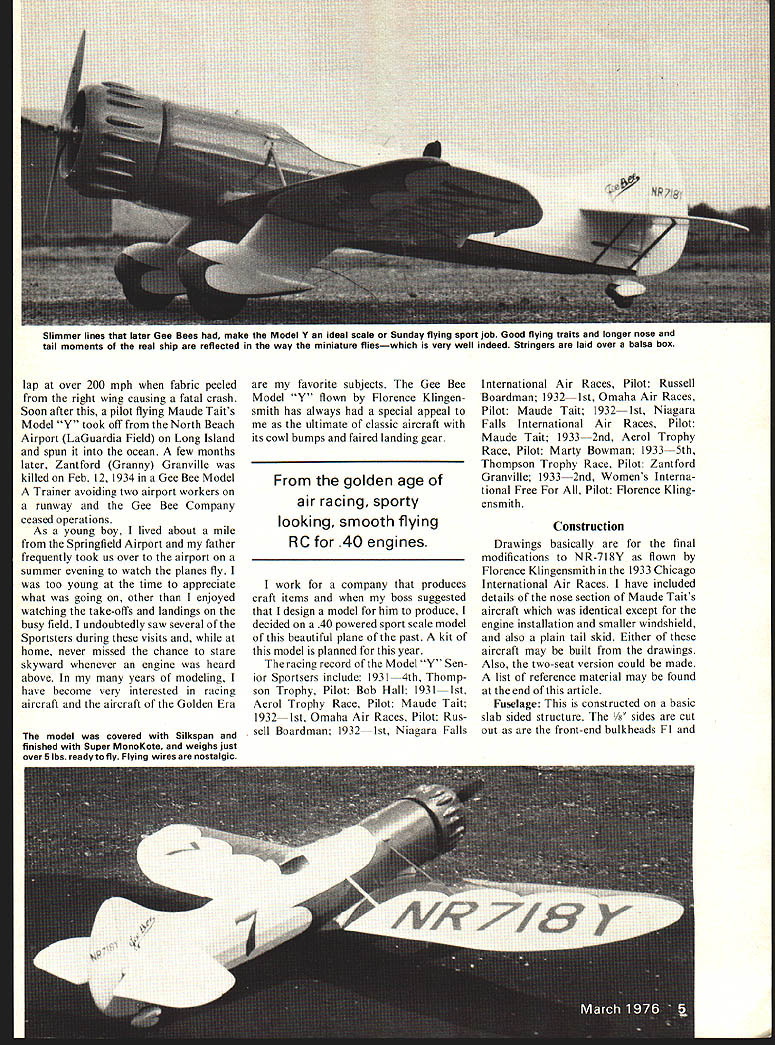
The red-and-white color scheme and distinctive scalloped trim made the Gee Bees great eye-catchers. The slimmer lines of the later Gee Bees made the Model Y an ideal scale Sunday-flying sport job. Its good flying traits — longer nose and tail moments than the real ship — were reflected in the way the miniature flies, which is very well indeed.
While flying at speeds in excess of 200 mph, fabric peeled from the right wing of one Model Y, causing a fatal crash. Soon after, while Maude Tait was piloting a Model Y taking off from North Beach Airport (LaGuardia Field), Long Island, the airplane spun into the ocean. A few months later Zantford "Granny" Granville was killed (Feb. 12, 1934) while flying a Gee Bee Model Trainer in an attempt to avoid two airport workers on the runway. The Gee Bee Company ceased operations thereafter.
As a young boy I lived about a mile from Springfield Airport and my father frequently took us out to the field on summer evenings to watch the planes fly. Too young at the time to appreciate what was going on, I nevertheless enjoyed watching the take-offs and landings at the busy field and undoubtedly saw several Sportsters during those visits. I never missed a chance to stare skyward whenever an engine was heard overhead. Over the years of modeling I have become very interested in racing aircraft of the Golden Era; they have become favorite subjects. The Gee Bee Model Y flown by Florence Klingensmith has always had special appeal. It is the ultimate classic aircraft with its cowl bumps, faired landing gear and the look of the golden age of air racing — sporty looking and smooth flying.
RC .40 engines work well in the model. The company that produces the craft items for the model suggested the design and I decided to produce a .40-powered sport-scale model of this beautiful plane. The kit model was planned with the racing record in mind.
Model Y Senior Sportsters include:
- 1931 — 4th, Thompson Trophy; Pilot: Bob Hall
- 1931 — 1st, Aerol Trophy Race; Pilot: Maude Tait
- 1932 — 1st, Omaha Air Races; Pilot: Russell Boardman
- 1932 — 1st, Niagara Falls International Air Races; Pilot: Russell Boardman
- 1932 — 1st, Omaha Air Races; Pilot: Maude Tait
- 1932 — 1st, Niagara Falls International Air Races; Pilot: Maude Tait
- 1933 — 2nd, Aerol Trophy Race; Pilot: Marty Bowman
- 1933 — 5th, Thompson Trophy Race; Pilot: Zantford Granville
- 1933 — 2nd, Women's International Free; Pilot: Florence Klingensmith
Construction drawings are basically final; modifications and detailing are shown on the plates. fairing. The stacked parts should be weighted while the glue dries. When thoroughly dry, the halves may be doweled for alignment and may be tack glued for carving to shape. When finished, the two halves are sandwiched over the wire and secured together with short sheet-metal screws.
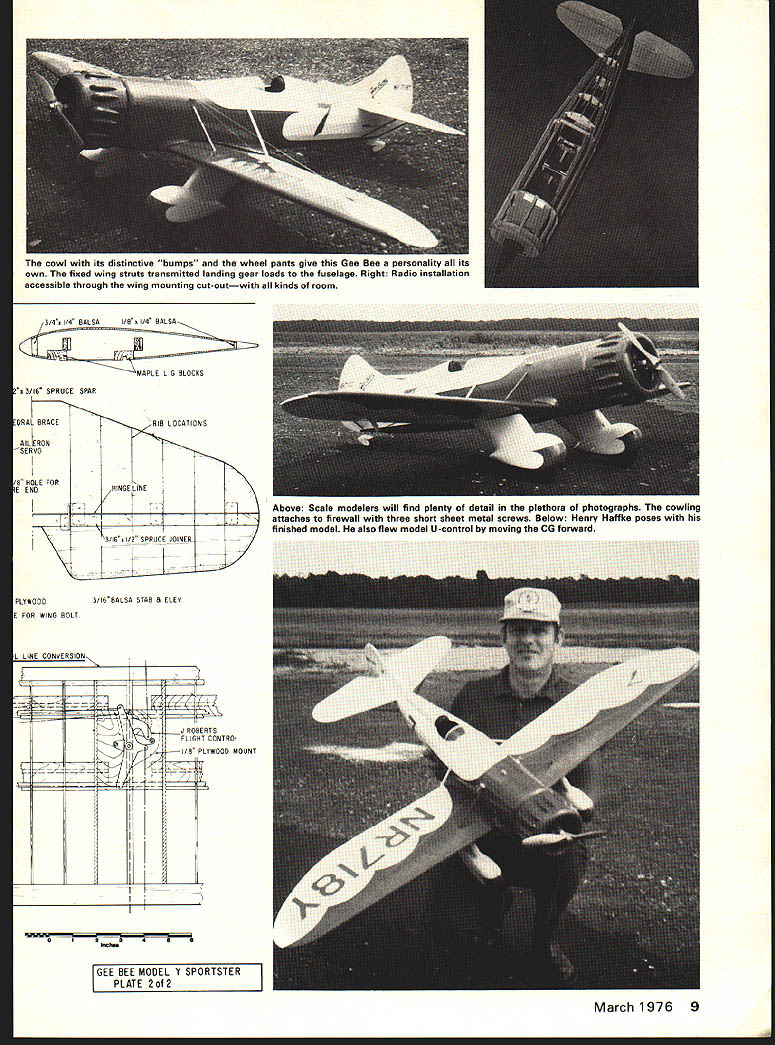
Engine Cowl: Cowl rings and cowl mount are cut from the various sizes shown on the plans. The 1/8" balsa and 1/8" ply rings are glued together as are the 1/4" balsa ring and 1/8" ply mount. Space these 3 in. apart and plank with 3/16" strips; or sheet may be used, wetting it to help curvature, if you prefer. Cowl is carved and sanded to shape then thoroughly dry. The 1/8" cowl bumps are carved from scrap balsa and are cemented in place. After cowl is finished, it may be fitted to firewall and retained with three short sheet-metal screws. Mine needed only a small hole for the glow plug and I used an exhaust extension out the bottom of the cowl. We can make available a molded plastic cowl and wheel fairings for anyone wishing to avoid building these parts. You may inquire about these parts by writing to Aero Classics, P.O. Box 2156, S. Vineland, N.J. 08360.
If you desire to build the model as Maude Tait's NR-11049, the cowling may be formed by using a large coffee can or other appropriate size cylinder and wrap around the can a 2 1/2" strip of 1/16" ply. A second layer of 1/16" ply is wrapped over the first with the joints staggered, and then layers of balsa may be added to build up the proper thickness. When dry, it is carved and sanded to shape. Maude Tait's aircraft had the standard windshield of the two-seat version and used a simple tail skid in place of the faired tail wheel.
Finishing the model is up to the individual and much has been written on this. I covered my structure with Silkspan and then finished it with Super Monokote. The model is very strong and light. Mine weighed just over 5 lbs. ready to fly. You may add whatever small details you wish such as wing and tail struts and flying wires. These give real character to the model.
My first model flew beautifully on its very first flight. Right rudder was needed but once in the air, it flew hands off with just a little trim adjustment. It proved very stable and gentle and was very positive to the controls. The model is not difficult to build and the structure is very strong and light. When finished with the external bracing and wires, it is a very attractive ship.
Data Sources: Racing Planes Guide, Joe Christy; 62 Rare Racing Planes, Maj. Truman Weaver; They Call Me Mr. Airshow, Bill Sweet; The National Air Racers in 3 Views, Charles Mendelhall; The Gee Bee Racers Profile Publication #51, Pete Bowers; Model Aircraft, Aug., 1957; American Modeler, July, 1958.
Transcribed from original scans by AI. Minor OCR errors may remain.

