
Gee Bee R-1 Super Sportster
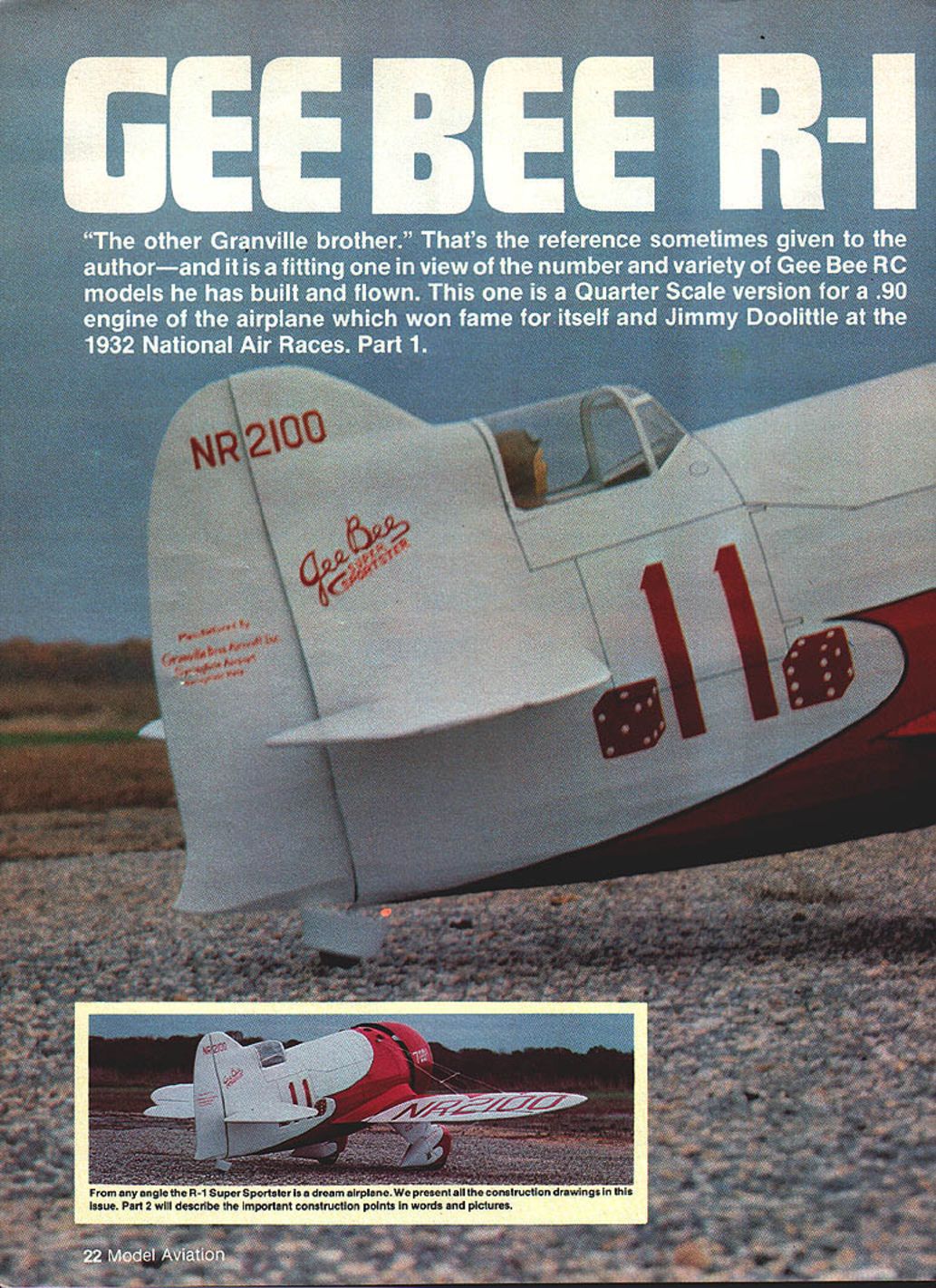
"The other Granville brother." That's the reference sometimes given to the author — and it is a fitting one in view of the number and variety of Gee Bee RC models he has built and flown. This one is a Quarter Scale version for a .90 engine of the airplane which won fame for itself and Jimmy Doolittle at the 1932 National Air Races. Part 1.
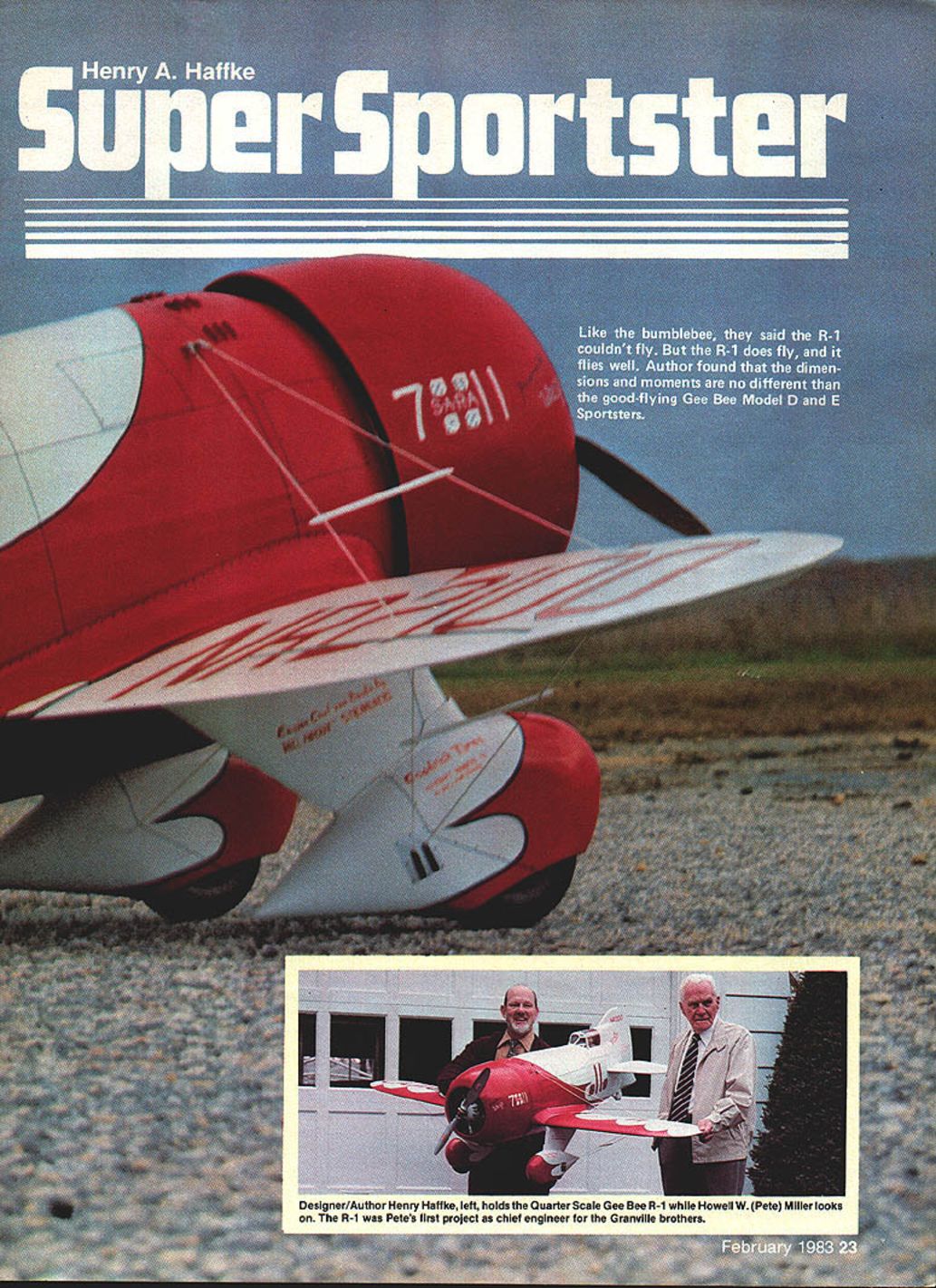
Like the bumblebee, they said the R-1 couldn't fly. But the R-1 does fly, and it flies well. The author found that the dimensions and moments are no different than the good-flying Gee Bee Model D and E Sportsters.
Background
Fifty years ago, at the 1932 National Air Races, a unique aircraft appeared which amazed all who saw it. It looked so different from other flying machines that most everyone decided it wouldn't fly. It was called the Bumble Bee, the Flying Milk Bottle, and other such uncomplimentary nicknames (my model has been called "the flying pickle barrel," and one of my friends calls it "Fat Albert"). It not only flew, but it made aviation history by winning the prestigious Thompson Trophy and setting a new world speed record for land planes of just under 300 mph.
The Gee Bee R-1 Super Sportster caught everyone's fancy. It has probably become the single most written-about aircraft in air racing history. Unfortunately, the many stories about the R-1 and the other craft built by the Granville brothers are filled with inaccuracies, misconceptions, and sensationalistic nonsense. Thus the Gee Bees have a poor reputation with aircraft buffs, and it is considered an accomplishment when a model Gee Bee flies well.
The men and the shop
The Gee Bee R-1 was the masterpiece of a small, dedicated group of men who were desperately trying to make a go of their aircraft business during the hard times of the 1930s. The five Granville brothers were from the farm lands of upper New Hampshire. All were mechanically inclined, and each was a master at his particular craft. The young man they had hired as their chief engineer was Howell W. "Pete" Miller, fresh from New York University's School of Aeronautics. Bob Hall, a former Gee Bee engineer, left the year before to form his own company and proved the team would establish aviation records and rock the aeronautical world with the planes they produced in their tiny shop, a former dance hall on the edge of Springfield Airport in Springfield, MA.
Design and development
The R-1 was Pete Miller's first project. The team wanted a plane capable of winning racing's biggest prize, the Thompson Trophy Pylon Race. The other big event at the National Air Races was the Bendix Cross-Country Race, so two ships were built, nearly identical in appearance, but each aimed for one event. The R-1 had the bigger engine of the two, for polishing the pylons in the Thompson; the R-2 had more fuel capacity and a smaller engine for the California-to-Cleveland Bendix Race.
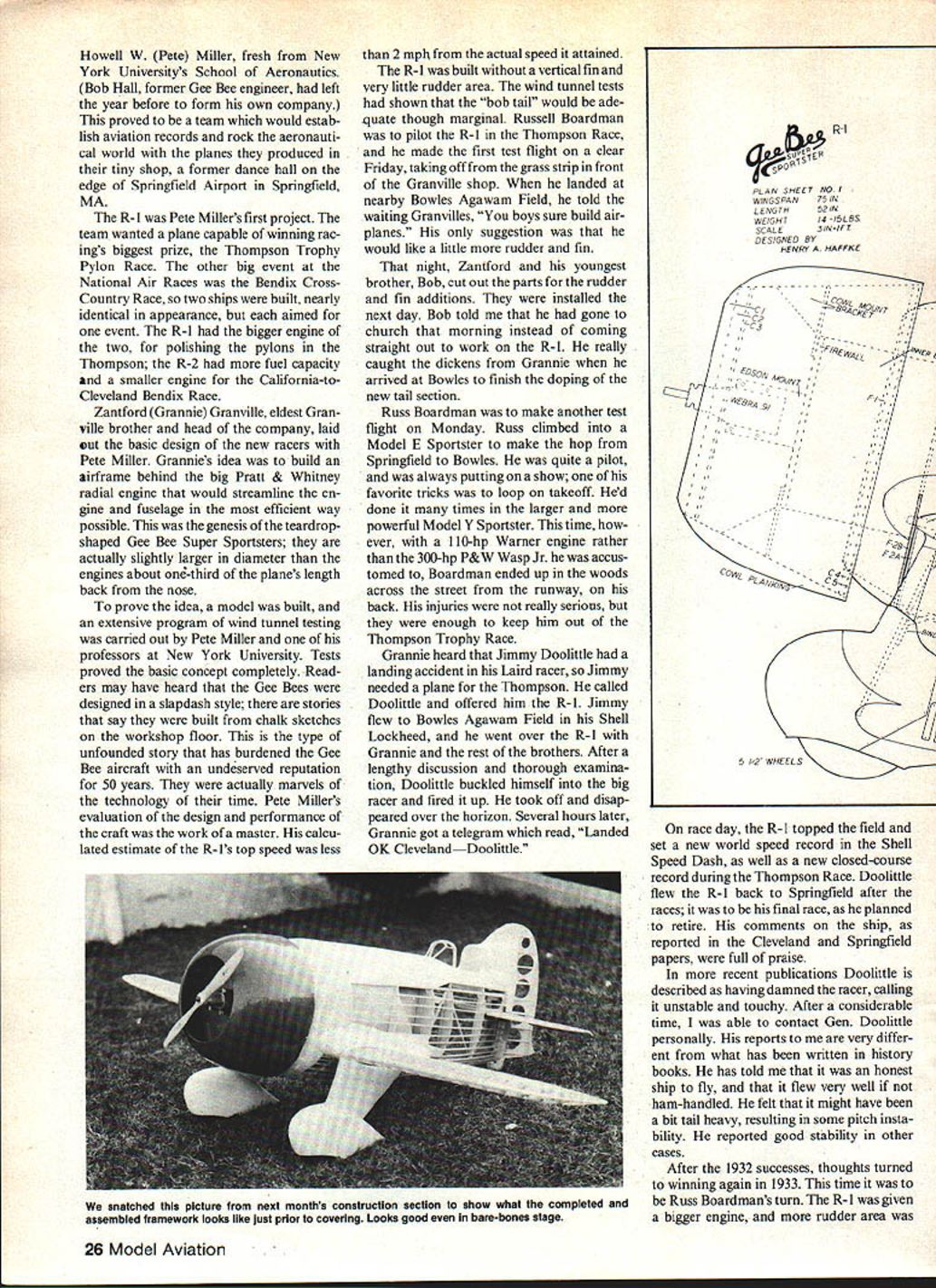
Zantford (Grannie) Granville, eldest Granville brother and head of the company, laid out the basic design of the new racers with Pete Miller. Grannie's idea was to build an airframe behind the big Pratt & Whitney radial engine that would streamline the engine and fuselage in the most efficient way possible. This was the genesis of the teardrop-shaped Gee Bee Super Sportsters; they are actually slightly larger in diameter than the engines about one-third of the plane's length back from the nose.
To prove the idea, a model was built, and an extensive program of wind tunnel testing was carried out by Pete Miller and one of his professors at New York University. Tests proved the basic concept completely. Readers may have heard that the Gee Bees were designed in a slapdash style; there are stories that say they were built from chalk sketches on the workshop floor. This is the type of unfounded story that has burdened the Gee Bee aircraft with an undeserved reputation for 50 years. They were actually marvels of the technology of their time. Pete Miller's evaluation of the design and performance of the craft was the work of a master. His calculated estimate of the R-1's top speed was less than 2 mph from the actual speed it attained.
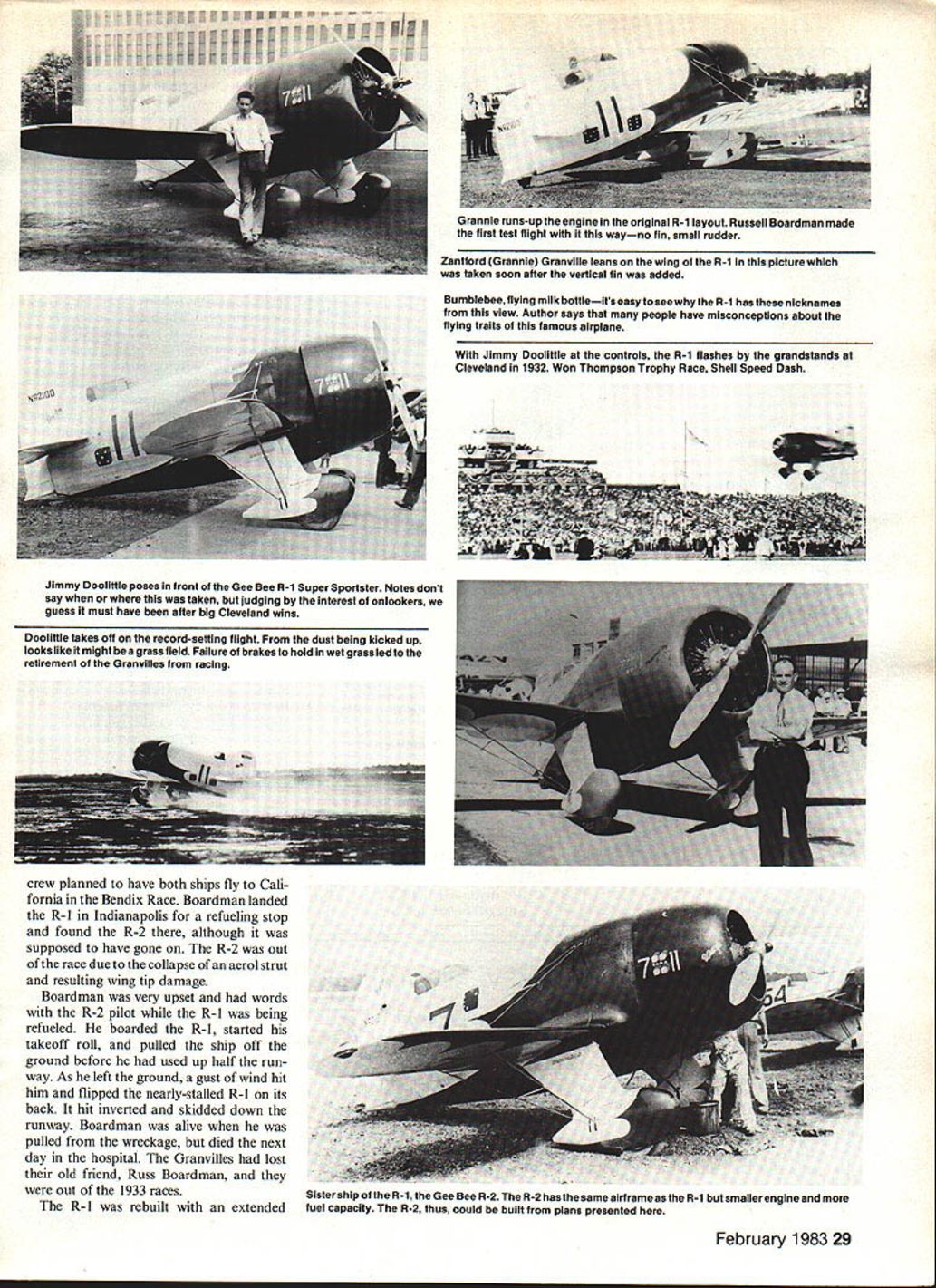
The R-1 was built without a vertical fin and with very little rudder area. The wind tunnel tests had shown that the "bob tail" would be adequate though marginal. Russell Boardman was to pilot the R-1 in the Thompson Race, and he made the first test flight on a clear Friday, taking off from the grass strip in front of the Granville shop. When he landed at nearby Bowles Agawam Field, he told the waiting Granvilles, "You boys sure build airplanes." His only suggestion was that he would like a little more rudder and fin.
That night, Zantford and his youngest brother, Bob, cut out the parts for the rudder and fin additions. They were installed the next day. Bob told me that he had gone to church that morning instead of coming straight out to work on the R-1. He really caught the dickens from Grannie when he arrived at Bowles to finish the doping of the new tail section.
Early testing and Jimmy Doolittle
Russ Boardman was to make another test flight on Monday. Russ climbed into a Model E Sportster to make the hop from Springfield to Bowles. He was quite a pilot, and was always putting on a show; one of his favorite tricks was to loop on takeoff. He'd done it many times in the larger and more powerful Model Y Sportster. This time, however, with a 110-hp Warner engine rather than the 300-hp P&W Wasp Jr. he was accustomed to, Boardman ended up in the woods across the street from the runway, on his back. His injuries were not really serious, but they were enough to keep him out of the Thompson Trophy Race.
Grannie heard that Jimmy Doolittle had a landing accident in his Laird racer, so Jimmy needed a plane for the Thompson. He called Doolittle and offered him the R-1. Jimmy flew to Bowles Agawam Field in his Shell Lockheed, and he went over the R-1 with Grannie and the rest of the brothers. After a lengthy discussion and thorough examination, Doolittle buckled himself into the big racer and fired it up. He took off and disappeared over the horizon. Several hours later, Grannie got a telegram which read, "Landed OK Cleveland—Doolittle."
On race day, the R-1 topped the field and set a new world speed record in the Shell Speed Dash, as well as a new closed-course record during the Thompson Race. Doolittle flew the R-1 back to Springfield after the races; it was to be his final race, as he planned to retire. His comments on the ship, as reported in the Cleveland and Springfield papers, were full of praise.
In more recent publications Doolittle is described as having damned the racer, calling it unstable and touchy. After a considerable time, I was able to contact Gen. Doolittle personally. His reports to me are very different from what has been written in history books. He has told me that it was an honest ship to fly, and that it flew very well if not ham-handed. He felt that it might have been a bit tail heavy, resulting in some pitch instability. He reported good stability in other cases.
1933 modifications and accidents
After the 1932 successes, thoughts turned to winning again in 1933. This time it was to be Russ Boardman's turn. The R-1 was given a bigger engine, and more rudder area was added. Boardman flew the re-engined R-1 as well as the R-2 (now equipped with the R-1's old engine) many times during the summer of 1933. He flew them into and out of tiny Springfield Airport and had no trouble at any time with either craft.
Since the 1933 races were to be held in California rather than Cleveland, the Gee Bee crew planned to have both ships fly to California in the Bendix Race. Boardman landed the R-1 in Indianapolis for a refueling stop and found the R-2 there, although it was supposed to have gone on. The R-2 was out of the race due to the collapse of an aero strut and resulting wing-tip damage.
Boardman was very upset and had words with the R-2 pilot while the R-1 was being refueled. He boarded the R-1, started his takeoff roll, and pulled the ship off the ground before he had used up half the runway. As he left the ground, a gust of wind hit him and flipped the nearly-stalled R-1 on its back. It hit inverted and skidded down the runway. Boardman was alive when he was pulled from the wreckage, but died the next day in the hospital. The Granvilles had lost their old friend, Russ Boardman, and they were out of the 1933 races.
The R-1 was rebuilt with an extended fuselage and was mated with the old R-2 wing, still in storage in Springfield since the R-2 was reworked in 1933. This final Gee Bee racer was known as the R-1/R-2 Long Tail Racer. It was readied for the 1933 Chicago International Races, and a pilot from the West Coast was engaged to fly it. Test flights showed good handling and very good speed.
Pete Miller felt that this was the fastest racer they had ever built. It's a shame it never really had a chance to show its stuff. During the second flight, the ground was very wet from a recent storm. The pilot was having some difficulty getting the ship on the ground, since it floated at low speeds. He made several passes. Finally he touched down, but he had too much speed. The brakes were useless in the wet grass. The R-1/R-2 skidded into the ditch at the end of the field and tipped up on its nose. The big Hornet engine was still ticking over, and as the ship nosed up, the prop hit the ground and flipped the entire plane over the ditch. It came to rest on its "feet," but damage to the wings and prop made it impossible to race at Chicago. This ended the racing of the Granville organization; there was no money left.
Other products of the Granville and Miller imaginations were to fly, most notably the Q.E.D. that Jackie Cochran flew in the MacRobertson Race, and the fabulous Time Flies built for Frank Hawks. But the end of the Long Tail Racer ended the days of Springfield, MA as the home of the fastest land planes in the world.
Personal recollections
I was born in Springfield, and spent many evenings as a young boy watching the activity at Springfield Airport. It was big entertainment in those days, when 10c for a movie was hard to come by. We lived less than a mile from the airport. My father would load us all into the car after supper and drive us to the airport for an evening of plane watching. There was a parking area with benches next to the Granville shop where we could sit and watch. I can still remember those evening trips, but I can't say that I remember the specific aircraft. They were all just airplanes to me then. I'm sure, however, that I saw many of the different Gee Bees fly.
Building the Quarter Scale model
After getting involved in RC many years ago, I decided to build a model of one of the Gee Bee planes. There were no plans or kits. I finally decided to design one of my own, and I selected the Model Y Sportster, a red-and-white beauty with two seats and a ringed radial engine. Material on it was very sketchy, but I finally got a set of none-too-accurate three-views and drew the model. It flew so well that I was attracted to the other Gee Bee designs. I made a layout analysis chart of the various Gee Bee aircraft and discovered that their proportions are not nearly as bad as everyone seems to think. Their shape gives the illusion that they are very short.
I have designed, built, and flown models of all of the Gee Bee Sportsters over the past eight years: two Model Y's, a Model D, and the R-1/R-2 in 56-in.-wingspan size; and a Model Y, a Model D and Model E in Quarter Scale. The Model Y Quarter Scale (Model Aviation, May 1981) was the best flying RC ship I have ever flown.
When it came time to do the most famous of them all, the R-1, I felt that I knew something that few other people did. The layout chart had shown me that the dimensions and moments of the R-1 were no different from the Model D and E Sportsters, and they were exceptionally good-flying planes. My smaller model of the R-1/R-2 had a wing loading of over 60 oz., and it still flew great. Pete Miller had told me that the fuselage created some lift, which helped explain what seemed like an impossibly high loading. Some figuring showed me that if I could build a Quarter Scale R-1 at under 15 lb., the wing loading would be a respectable 35 oz. or so. I felt that I could hit this weight easily, since my 90-in. span Model Y weighed just under 15 lb., and the Quarter Scale Model D and E Sportsters had weighed around 11 lb.
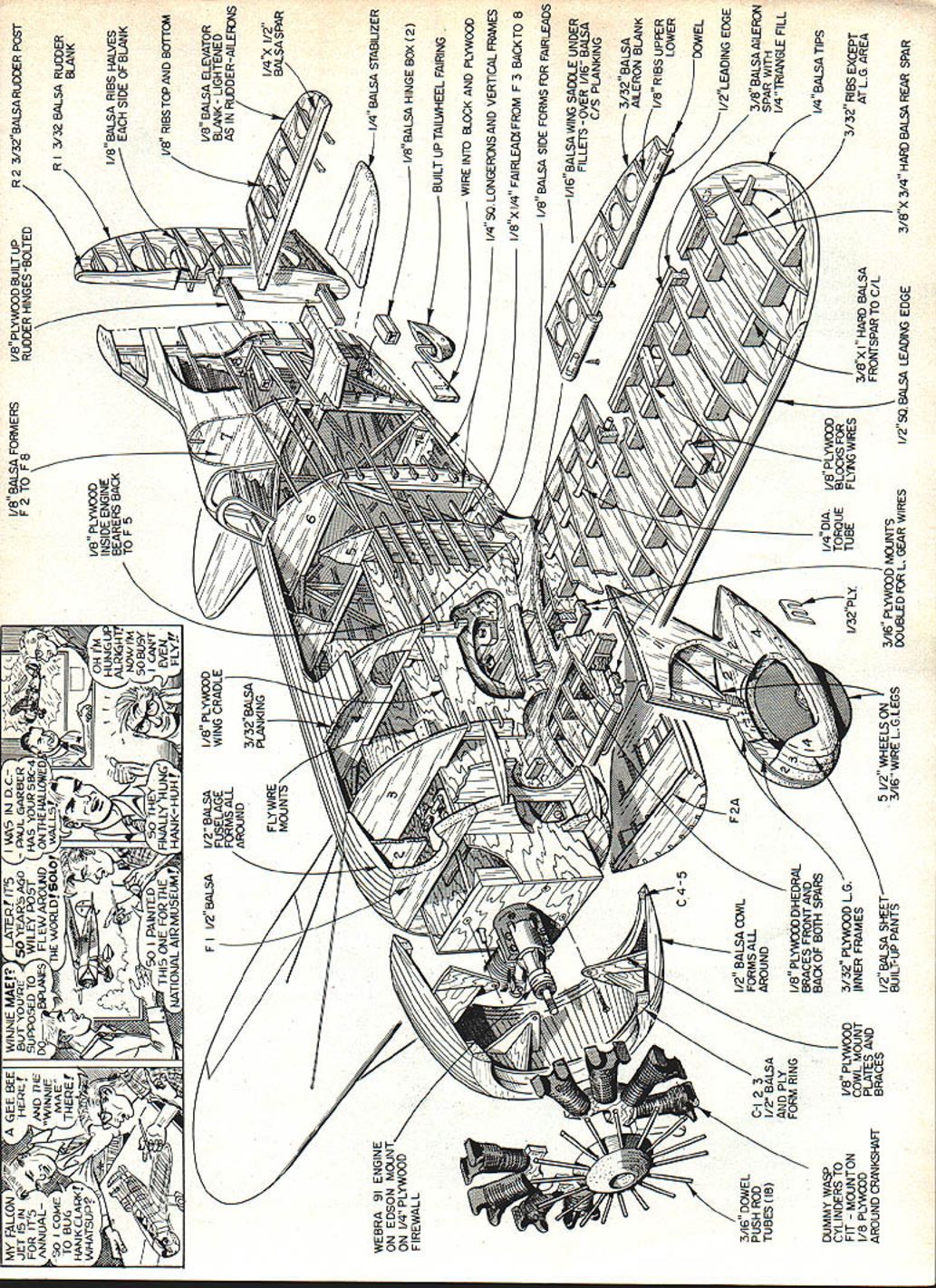
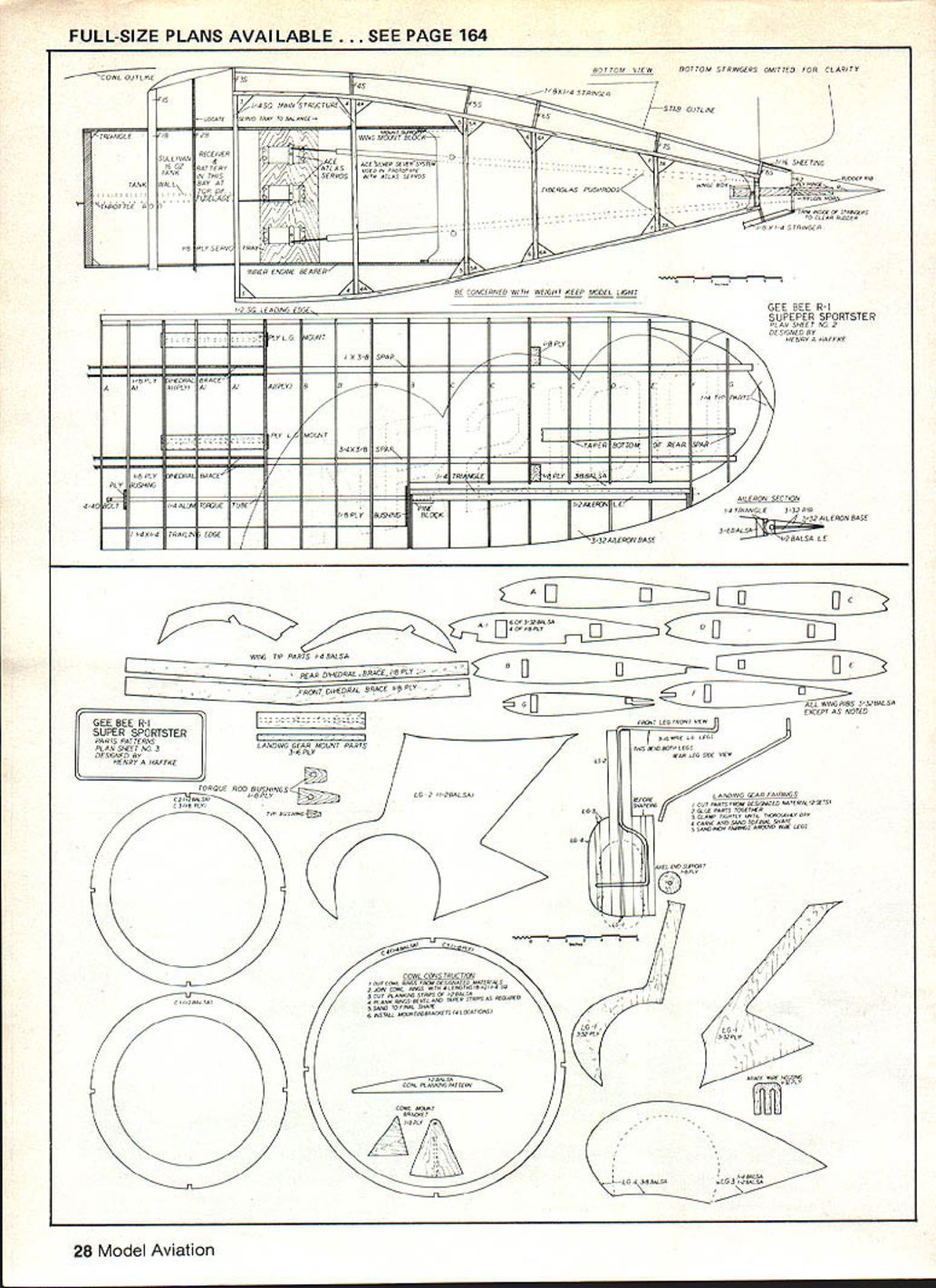
I felt that the best three-views of the R-1 were those done by Harry Robinson of England, so the plans were scaled from them. I did everything I could to keep the weight down; in fact, I went too far. More about that later.
Test flying the model
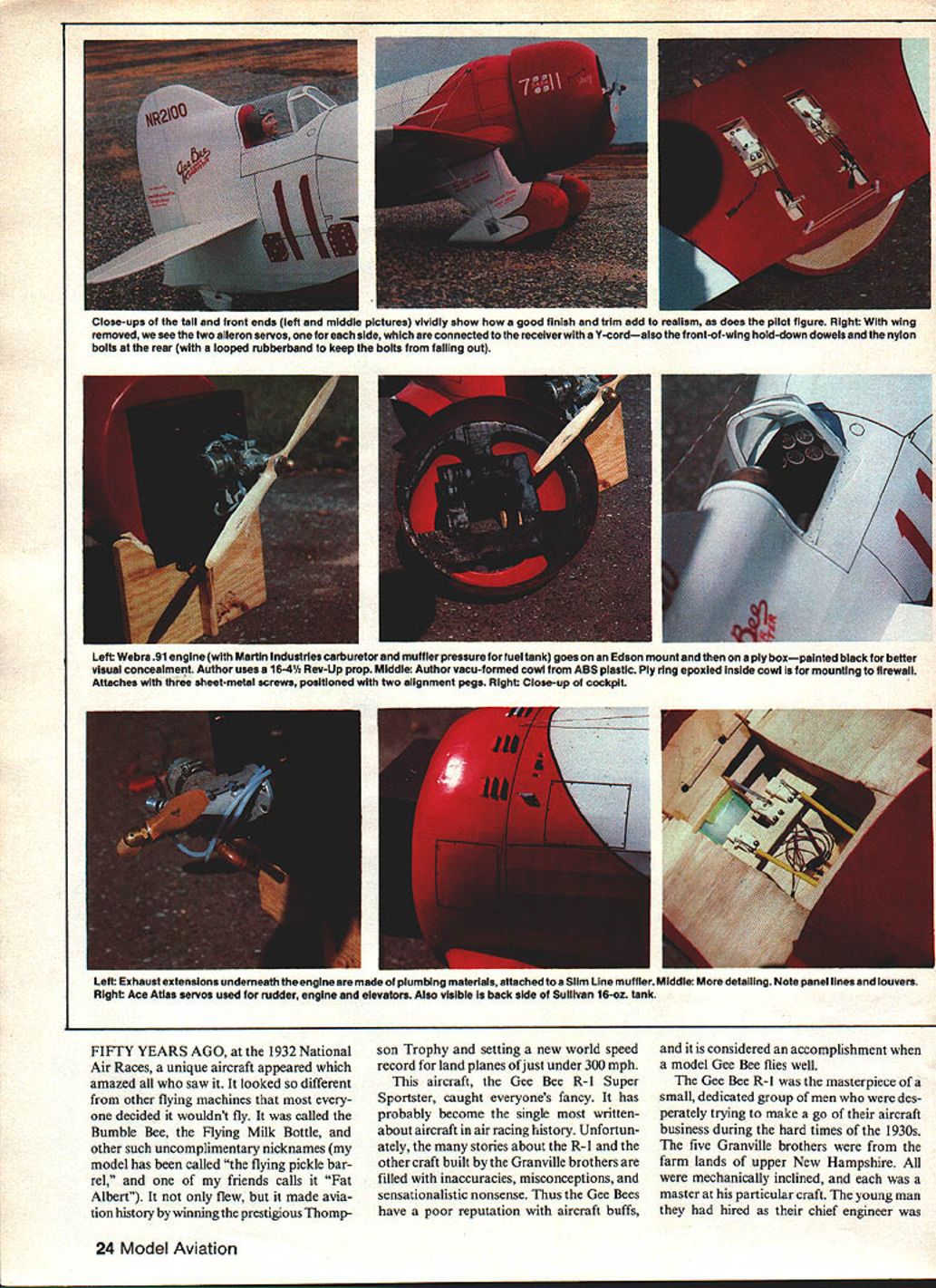
The model was built and readied for test flying. Once again I called on Test Pilot Supreme Sid Clements to take the bird upon its first flights. I used the Ace Silver Seven radio I had won at the Bealeton (VA) Scale Meet, and Ace kindly replaced the small servos with their heavy-duty Atlas models. (Editor: Never fly a Quarter Scale model with standard servos.) On test day a large group of club members from the South Jersey and Clayton clubs showed up to watch the flight (ever notice how this always happens on the first flight of a new model?)
Sid checked the engine and looked over all the controls. The tank was topped off, the engine restarted, and the bird placed in position at the end of the runway. When Sid opened the throttle, the R-1 leaped forward, and the tail came up right away. After a much shorter roll than we expected, it was in the air. After a short run upwind, Sid put the bird into a gentle 90-degree left turn.
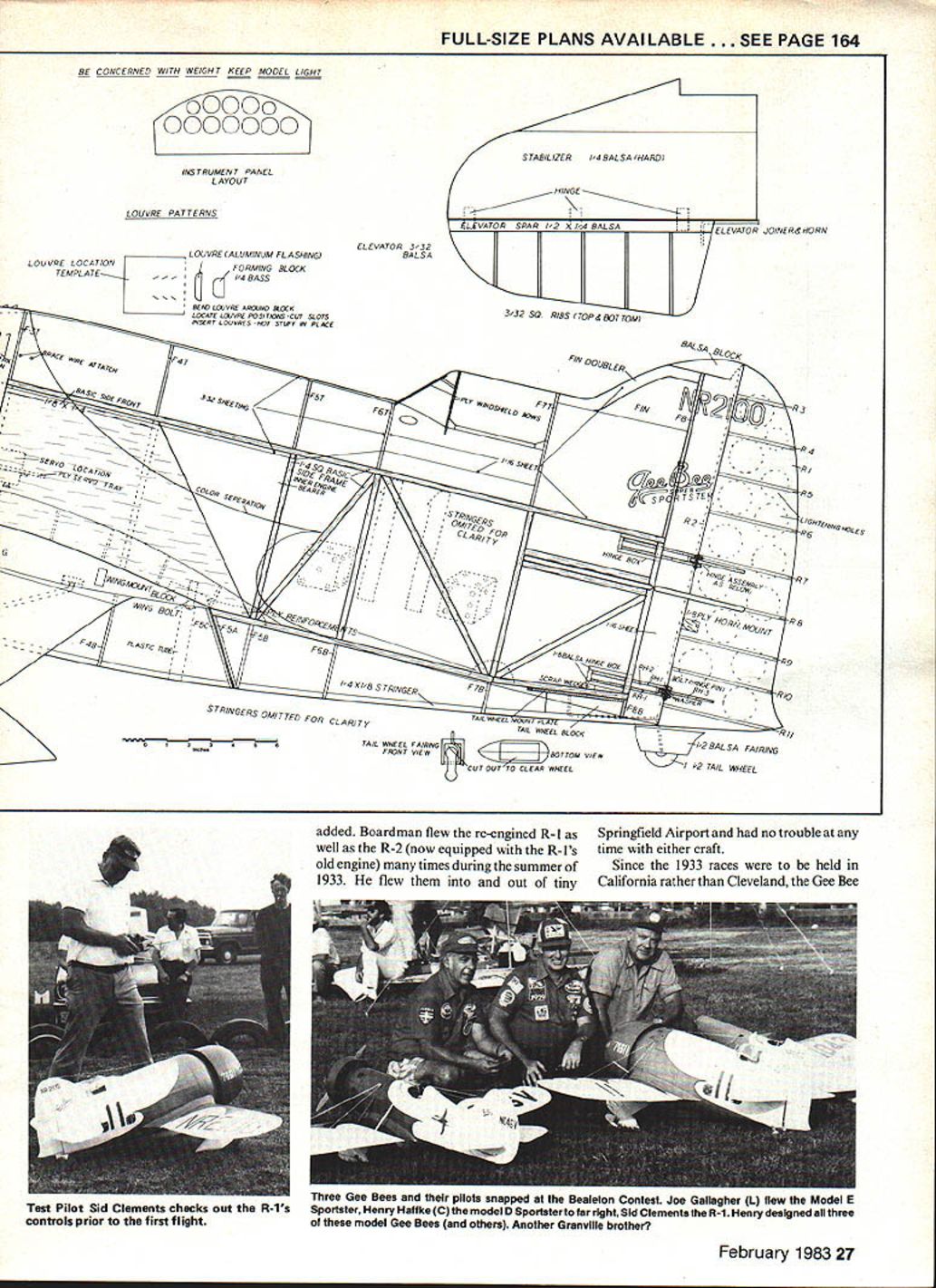
As he flew downwind, the tail began to flutter alarmingly. Sid immediately cut the throttle and lined up with the runway. He made a good approach, but the wounded bird couldn't flare completely, and it nosed over and broke the prop. The stab had broken on both sides of the fuselage, but the Coverite had held it together long enough to get back on the ground. The original built-up stab was replaced with a piece of solid 1/4-in. hard balsa.
Flight number two began with a beautiful takeoff, just like the first one. Sid climbed up to about 300 feet to feel it out, and after four or five minutes reported that he had no aileron response. He throttled back, and the ailerons came back. Every time he went to high speed he would lose ailerons. Finally, as he made a turn down to our left, the left wing folded, and the bird spiraled down to the ground.
This disaster turned out to be caused by using wood that was too weak for the wing spars. The wing structure is plenty strong, but I used a soft piece of wood to make the spars. Both spars had broken just outside the center section; the same had happened in the other wing. It was easy to see what had caused the loss of aileron at high speed: the wing would be forced upward, causing the torque tubes to bind. At a lower speed the wing would flex downward, and the ailerons would be freed. Fortunately, it was not a major repair job, but I was a little discouraged.
The big Bealeton Scale Meet was not far off, and I decided to get the R-1 back together. I started burning the midnight oil. The fuselage repairs were polished off in two evenings, but I decided I needed a complete new wing. This time I picked out the hardest spar material I could find. In another week I had the R-1 ready to fly again, although much of the detail work wasn't done. After working on it until 4 a.m., I went to bed and got up at six to install the radio. I had arranged to meet Sid at nine that morning for the flight.
This time the R-1 was not to be denied. The flight was beautiful from takeoff to landing roll. Everything was perfect. After making some camera passes, Sid took it up higher for some stalls, a loop, and stall turns. He then put in another flight in the same pattern they would use at Bealeton. Sid and I had won the event for three years in Team Scale with my Howard Ike. We decided we were ready to try for another year. As I cleaned up the big bird to take home, Sid kept saying, "Don't change anything."
At Bealeton, the big Gee Bee drew a crowd even before I got it put together. No one seemed to believe that we would really try to fly it. We heard all sorts of skeptical comments right through the static judging. When flying time came, everything stopped and all eyes were on us. We really were going to try to fly that "dangerous" airplane. Well, Sid put in a flight just as perfect as he had before, to loud ovations on both takeoff and landing. The R-1 had placed second in static with an 89 (the model ahead had a 90), but the flight score put us solidly in first. For the fourth year in a row, we took the Team Scale honors home with us. The R-1 was really the star of the show.
The R-1 is really a joy to fly. Both Sid and I have flown it a great deal, and are now looking forward to this year. (Editor: At the September 1982 Bealeton meet, Henry, Sid and the R-1 took first in Team Scale again.) If I have whetted your appetite, get started on a Gee Bee of your own. It's a bird with a rich and exciting history—one you'll be proud to own.
(To be continued.)
Transcribed from original scans by AI. Minor OCR errors may remain.

