
Gee Bee Senior Sportster Model Y: Part 1
Henry A. Haffke
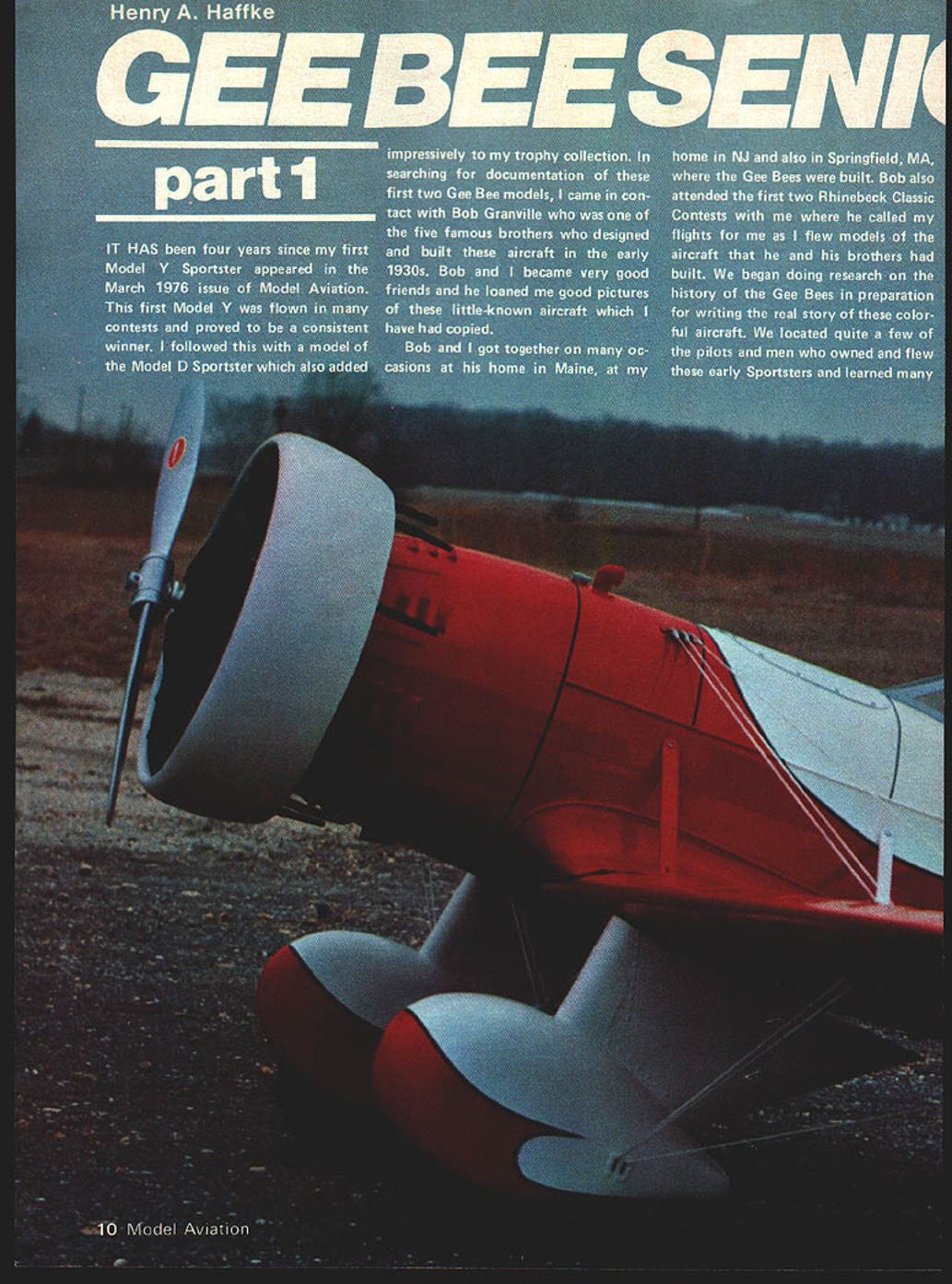
It has been four years since my first Model Y Sportster appeared in the March 1976 issue of Model Aviation. This first Model Y was flown in many contests and proved to be a consistent winner. I followed this with a model of the Model D Sportster which also added impressively to my trophy collection. In searching for documentation of these first two Gee Bee models, I came in contact with Bob Granville who was one of the five famous brothers who designed and built these aircraft in the early 1930s. Bob and I became very good friends and he loaned me good pictures of these little-known aircraft which I have had copied.
Bob and I got together on many occasions at his home in Maine, at my home in New Jersey and also in Springfield, Massachusetts, where the Gee Bees were built. Bob also attended the first two Rhinebeck Classic Contests with me where he called my flights for me as I flew models of the aircraft that he and his brothers had built. We began doing research on the history of the Gee Bees in preparation for writing the real story of these colorful aircraft. We located quite a few of the pilots and men who owned and flew these early Sportsters and learned many previously unknown facts.
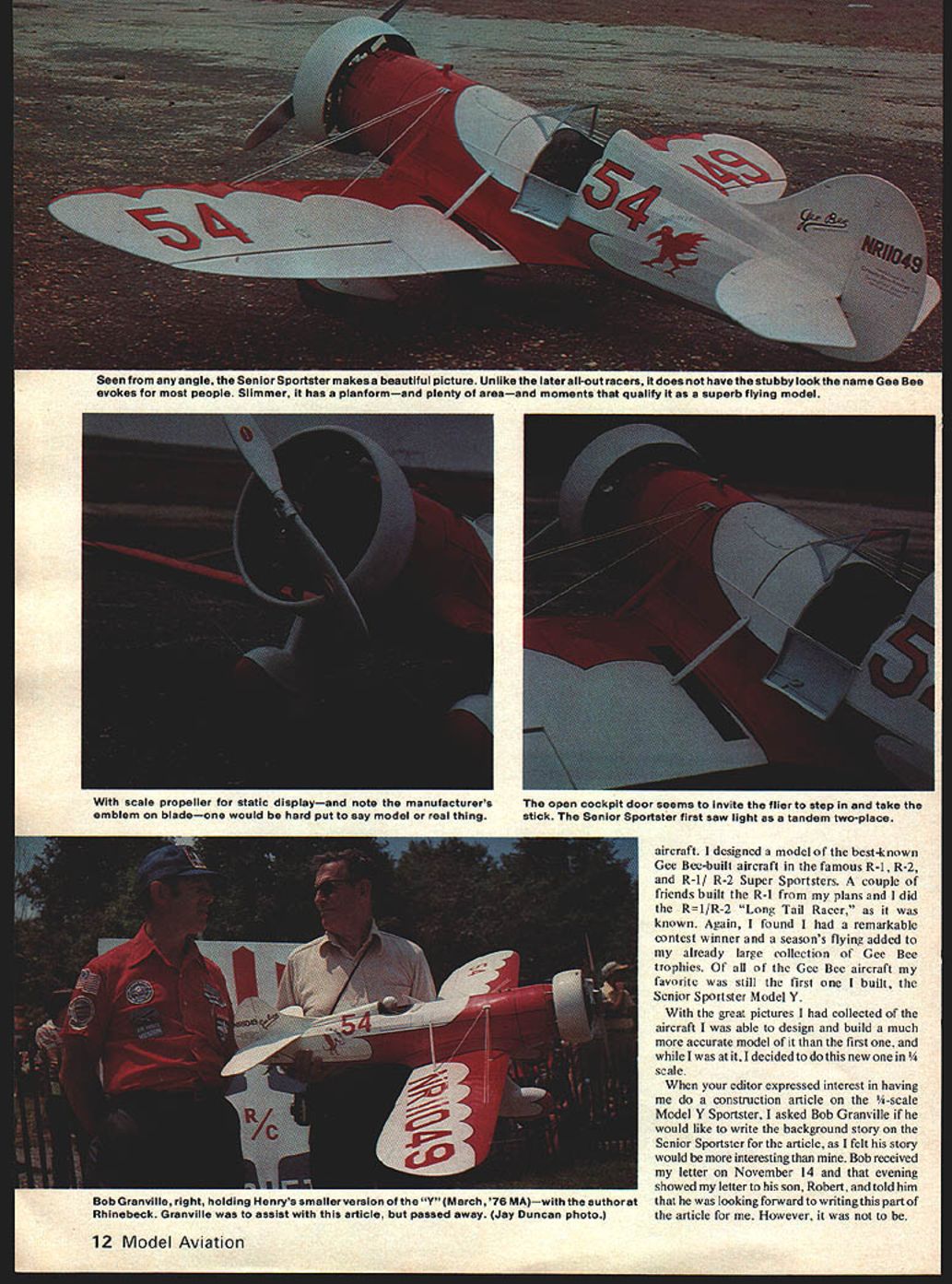
With the pictures obtained from Bob's collection I became even more interested in doing models of these great aircraft. I designed a model of the best-known Gee Bee-built aircraft in the famous R-1, R-2, and R-1/R-2 Super Sportsters. A couple of friends built the R-1 from my plans and I did the R-1/R-2 "Long Tail Racer," as it was known. Again, I found I had a remarkable contest winner and a season's flying added to my already large collection of Gee Bee trophies. Of all of the Gee Bee aircraft my favorite was still the first one I built, the Senior Sportster Model Y.
With the great pictures I had collected of the aircraft I was able to design and build a much more accurate model of it than the first one, and while I was at it, I decided to do this new one in 1/4 scale.
When your editor expressed interest in having me do a construction article on the 1/4-scale Model Y Sportster, I asked Bob Granville if he would like to write the background story on the Senior Sportster for the article, as I felt his story would be more interesting than mine. Bob received my letter on November 14 and that evening showed my letter to his son, Robert, and told him that he was looking forward to writing this part of the article for me. However, it was not to be.
The next night I got a call from Beverly Granville, Bob's daughter-in-law, telling me that Bob had passed away earlier that evening. The aviation world had lost the last of the famous Granville brothers and I had lost a very dear friend. Also, readers missed out on the chance to read about the Senior Sportster in the words of one of the men who built the ship.
Because of the wealth of material, we will run the subject over two issues. Complete plans are given this month; wings, finishing, detailing and flight will be covered next month. A picture collection of historic variants and their famous pilots is included in the final installment.
Bob had planned on putting this material together in a book that would tell, for the first time, the real story of the Gee Bees and the men who built them. Bob's family has promised that they will finish the project he started and that someone will get to writing the book as soon as the family can gather the final facts. I am seeking whatever help I can to best tell the story of the Senior Sportster as best I can, using Bob's words and articles on the Gee Bee whenever possible.
The Gee Bee Model Y Senior Sportster
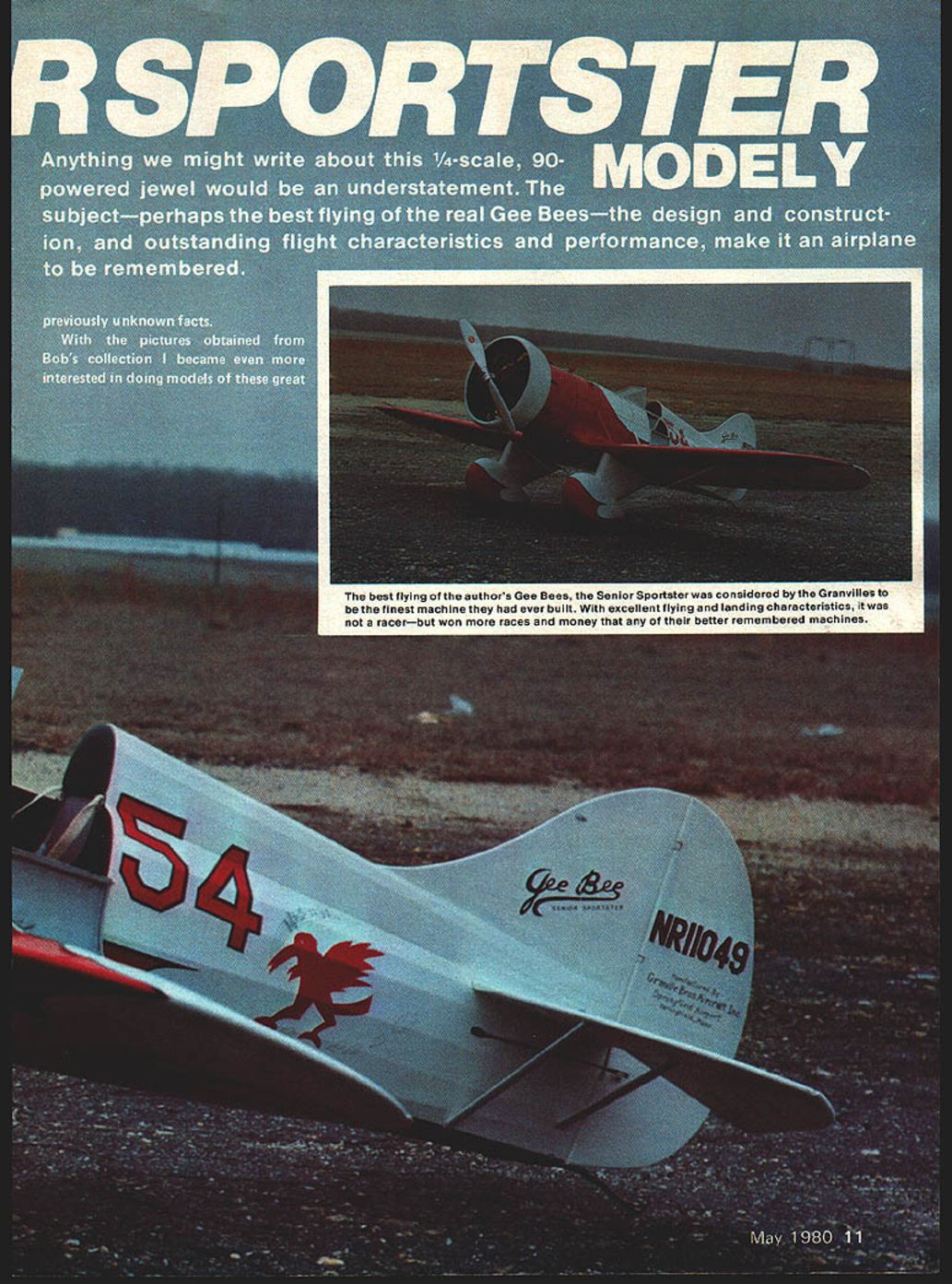
The Gee Bee Model Y Senior Sportster was a fabulous machine; the Granvilles felt it was the best aircraft they built. It flew and landed beautifully and won races and prize money, although it was designed as a sport plane.
Let's go back a few years and find out how the Model Y Sportster came about. Zantford Granville, still about 20 but oldest of the five New Hampshire-born brothers, left home and opened a garage and Chevrolet dealership in Arlington, Massachusetts, near Boston. Tom joined him around 1920 and later took over the garage. This gave Zantford the opportunity to become a mechanic at the Boston Airport Corporation (what is now Logan International). He took part pay in flying time and got his private license. Soon after he quit the big company and started his own aircraft repair business, setting up a portable repair shop built over the chassis of a large truck so he could go to the site of a downed plane and make necessary repairs. The business flourished and eventually all five brothers were working together.
I remember Bob telling of joining his brothers in 1928 and being thrilled at the prospect of making 50 cents an hour. Zantford offered him a job shortly after. Grannie, as he was known, designed an airplane that they would build. They built the two-place biplane in about three months and Grannie test-flew it on May 2, 1929, on a terrible stormy night. It was shortly after midnight when the storm seemed to let up a little and he decided to do it right then. Bob told of his disappearing into the murky sky and they all thought they wouldn't see him again as the weather was so bad. However, Grannie somehow brought the new biplane back and there was jubilation among the brothers. The craft was a success and Grannie decided they would go into production—building airplanes.
They needed a place to build, and money for backing. Grannie wrote letters to various places trying to interest someone in their venture. Around the first week of July 1929, the four Tait brothers of Springfield, Massachusetts, took them in, and they set up shop in what had previously been a dance hall on the edge of the Springfield Airport. They built a number of their biplanes, but things were not the best for any business in 1929.
In 1930, Grannie and Bob Hall, who was their first engineer, decided to design and build an aircraft around the Cirrus engine to compete for some of the prize money offered by the Cirrus company in their Cirrus Derby. This was a 5,541-mile race which started in Detroit, the motor capital of the world, and went as far west as Los Angeles and back to Detroit. Grannie and Hall designed the ship; it was built and given the designation Model X Sportster. This was a low-wing, single-cockpit sport plane and proved to be a very beautiful flying craft. Its big problem was in landing as it had no shock absorbing gear and depended on a new air wheel to absorb the jolts of landing. It took a good pilot to get it on the ground without bouncing like a jackrabbit.
The little black-and-white sportster was flown by Lowell Bayles in the derby and placed second, which netted the young company a nice piece of change. Several wealthy sportsman pilots wanted one of the little 25-foot-span sportsters and a total of eight were built. Some had the Cirrus, some Menasco, and some the Warner radial engines. Various versions were known as Model B, C, D, and E Sportsters. All were very aerobatic and extremely fast for their power, and in various racing events of the day, nothing in their class could stay with them. They were not built as racing planes, but soon proved to be unbeatable in their class.
Bill Sloan, who owned two of the Model E Sportsters, tells me that racing with them was "like taking candy from a baby." In trying to find something that would make money for the company, Grannie thought that a two-seat version of the Sportster might be the answer and here is where the Senior Sportster Model Y was born.
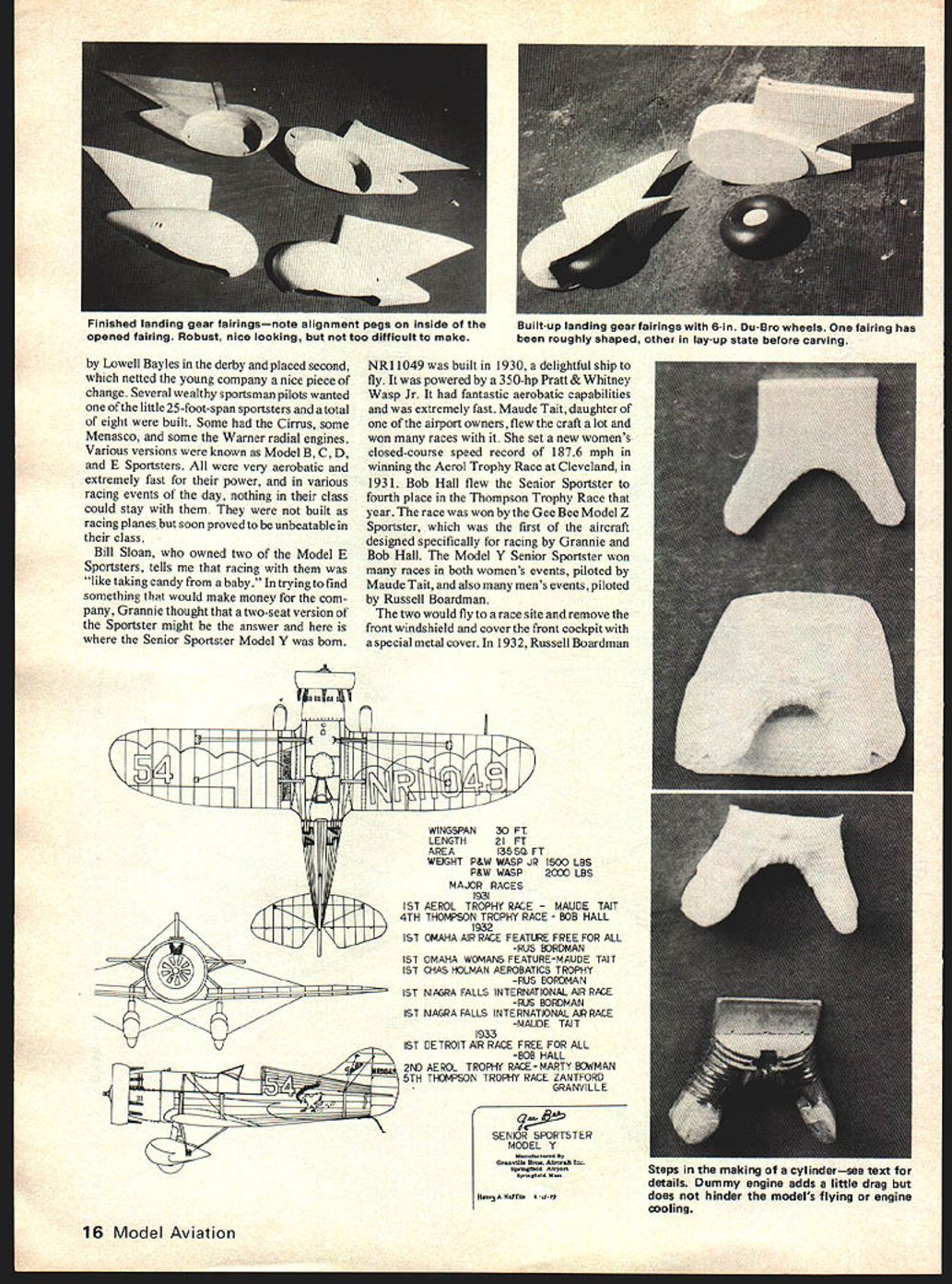
NR11049 was built in 1930, a delightful ship to fly. It was powered by a 350-hp Pratt & Whitney Wasp Jr. It had fantastic aerobatic capabilities and was extremely fast. Maude Tait, daughter of one of the airport owners, flew the craft a lot and won many races with it. She set a new women's closed-course speed record of 187.6 mph in winning the Aero Trophy Race at Cleveland in 1931. Bob Hall flew the Senior Sportster to fourth place in the Thompson Trophy Race that year. The race was won by the Gee Bee Model Z Sportster, which was the first of the aircraft designed specifically for racing by Grannie and Bob Hall. The Model Y Senior Sportster won many races in both women's events, piloted by Maude Tait, and also many men's events, piloted by Russell Boardman.
The two would fly to a race site and remove the front windshield and cover the front cockpit with a special metal cover. In 1932, Russell Boardman and Maude Tait swept the men's and women's events as they won the Omaha Air Races. Then Boardman strapped himself into the Y again and won the Speed Holman Trophy as he won the National Aerobatic Championship. He also made a fast, record-breaking flight, after midnight, from Chicago to Newark, to bring east the newsreels of the Democratic national convention. His time was a record 3 hrs. 38 min.
The Senior Sportster was truly a remarkable aircraft. It was just plain fun to fly and in a race the other competitors had to watch its tail end. It was flown all over the country, as it served as the support aircraft to the racers in 1931, '32, and '33. Unbeatable in its class, it could more than hold its own against the bigger, more powerful Thompson Trophy racers. It was flown in the Thompson twice and finished in the money both times, being piloted to fourth place by Bob Hall in 1931, and to fifth place by Zantford Granville in 1933.
After the R-1 and R-2 racers suffered misfortunes in the 1933 Bendix race at Indianapolis, Zantford Granville, who was in Los Angeles with the Y waiting for the racers to arrive, flew to Indianapolis, where he met a contingent of irate National Aeronautics officials who were investigating the accident that took the life of Russell Boardman. These officials grounded the Y when they saw fit to condemn the three-year-old fabric on the aircraft. Zantford finally made arrangements with them to be able to fly the ship home to Springfield.
In February of 1934, Zantford Granville was killed in a landing crash while en route to deliver one of the single-seat sportsters. Things went bad for the Granville Aircraft Company and everything was sold at the sheriff's block. Bandleader Harry Richmond of New York acquired the Senior Sportster and completely reconditioned and installed a new engine. Shortly after its overhaul was complete, the craft took off from the North Island Airport (LaGuardia Field) and soon thereafter its propeller came loose. Vibration tore the engine from its mounts. It is not known who the pilot was. Even though he was wearing a parachute, he rode the aircraft down safely as it flat-spun into Flushing Meadow with little damage to the aircraft. Before it could be removed, it was destroyed by vandals. A very sad way for such a great aircraft to end.
A second Model Y Sportster was built on special order for the Cord Automobile Co., to be used as a test bed for the Cord-produced 215-hp Lycoming R-680 engine. The Granvilles were never paid, another example of the financial difficulties that plagued the small company. In 1933 this second Y (NR718Y) was re-engined with a 450-hp Wright Whirlwind and modified by Art Knapp and Bob Hall for the 1933 Chicago International Air Races. After placing second in the women's Free-For-All race at 189.4 mph, Florence Klingensmith entered the "big race," the Frank Phillips Trophy Race, the men's Free-For-All. Many erroneous stories have been told of the aircraft shedding fabric and breaking up in the air. I was given an eye-witness account of what actually happened. She was traveling in excess of 200 mph as she led the race on the seventh lap. Each time around, as she banked around the near pylon, the fabric could be seen bulging out between the ribs. Rounding the pylon on that lap, the fabric was seen to pop open between the first and second inboard ribs with a loud noise. It is suspected that she could have been frightened terribly by the noise, fainted, etc., and apparently she froze at the controls. Not out of control, the plane simply flew off the course into a shallow descent into the side of a knoll quite some distance from the course, killing the pilot. Bob Hall has told me that during a race in the other Model Y he clipped a pylon, shearing over three feet from the left wing tip and had no trouble continuing on and making an uneventful landing.
The Senior Sportsters were truly remarkable aircraft and it is hoped that we have not seen the last of them. I know of at least two men who are contemplating building a Model Y Senior Sportster and, hopefully, we will again see this great aircraft take to the sky along with the Model Z, which has been recreated and flown by Bill Turner in California.
Construction
The drawings basically are for the first Model Y Senior Sportster NR11049 as flown by Maude Tait in winning the 1931 Aero Trophy Race. However, the plans can be used to do a model of the other Model Y, NR718Y. Two versions of NR718Y could be built, as it looked quite different with the 1933 engine change. The factory version of NR718Y had a smooth cowl and the landing gear fairings were open, while the 1933 modification had rocker housings on the cowl and also had the landing gear fully faired. This version also had a long gentle sloping windshield. Basic structure was the same for all versions. Engine installation was the main difference. Color of the NR718Y was cream and red, while NR11049 was white and red. Exact colors as picked out for me from color charts by Bob Granville were Randolph Tucson Cream and Sunset Red for NR718Y, and Juneau White and Sunset Red for NR11049.
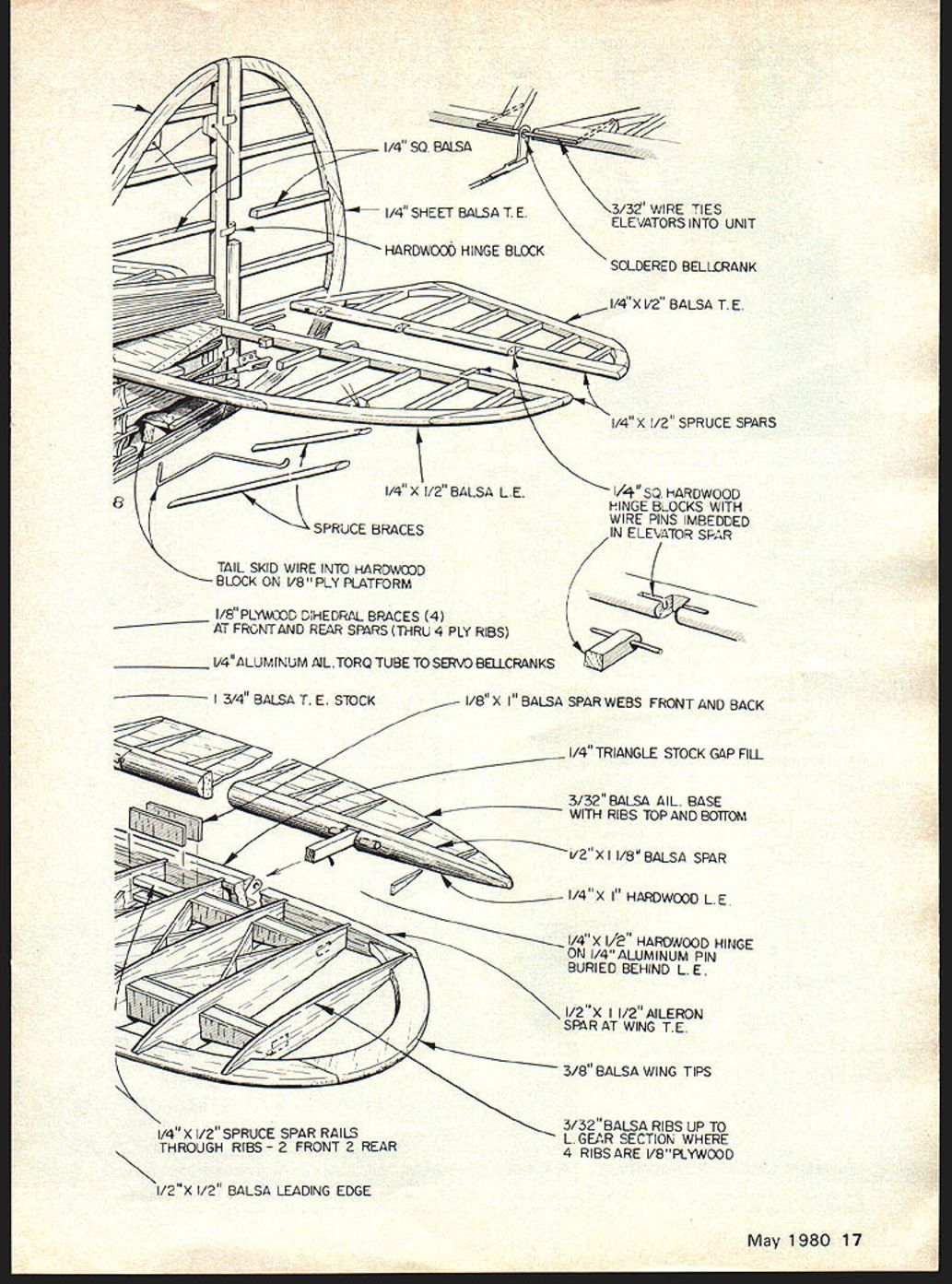
Parts and materials (reference items)
- 1/4" sq. balsa
- 1/4" sheet balsa T.E.
- Hardwood hinge block
- 3/32" wire ties elevators into unit
- Soldered bellcrank
- 1/4" x 1/2" balsa T.E.
- 1/4" x 1/2" spruce spars
- 1/4" x 1/2" balsa L.E.
- 1/4" sq. hardwood hinge blocks with wire pins embedded in elevator spar
- Spruce braces
- Tail skid wire into hardwood block on 1/8" ply platform
- 1/8" plywood dihedral braces (4) at front and rear spars (thru 4 ply ribs)
- 1/4" aluminum aileron torque tube to servo bellcranks
- 1 3/4" balsa T.E. stock
- 1/8" x 1" balsa spar webs front and back
- 1/4" triangle stock gap fill
- 3/32" balsa aileron base with ribs top and bottom
- 1/2" x 1 1/8" balsa spar
- 1/4" x 1" hardwood L.E.
- 1/4" x 1/2" hardwood hinge on 1/4" aluminum pin buried behind L.E.
- 1/2" x 1 1/2" aileron spar at wing T.E.
- 3/8" balsa wing tips
- 3/32" balsa ribs up to landing gear section where 4 ribs are 1/8" plywood
- 1/4" x 1/2" spruce spar rails through ribs - 2 front 2 rear
- 1/2" x 1/2" balsa leading edge
Fuselage
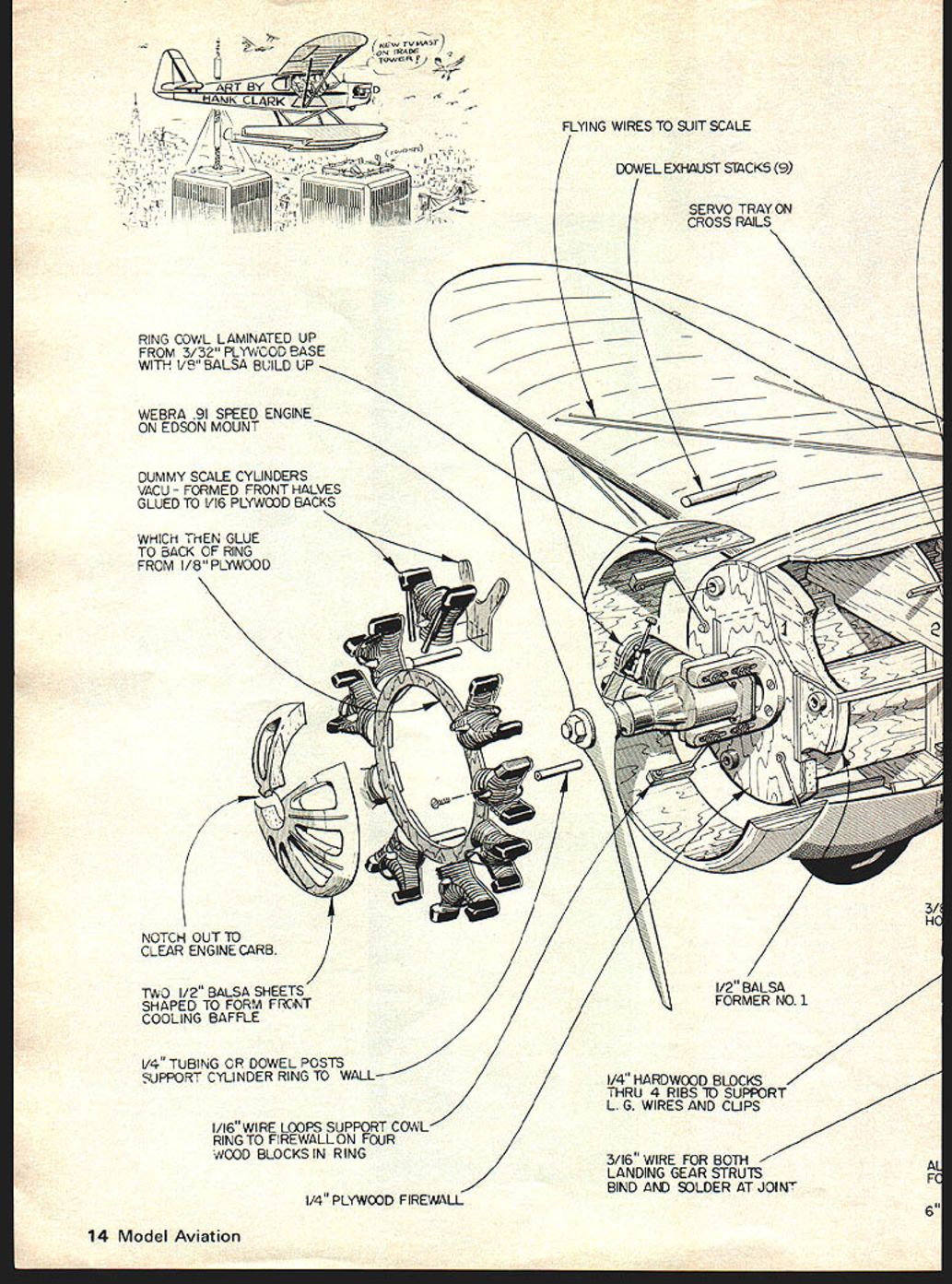
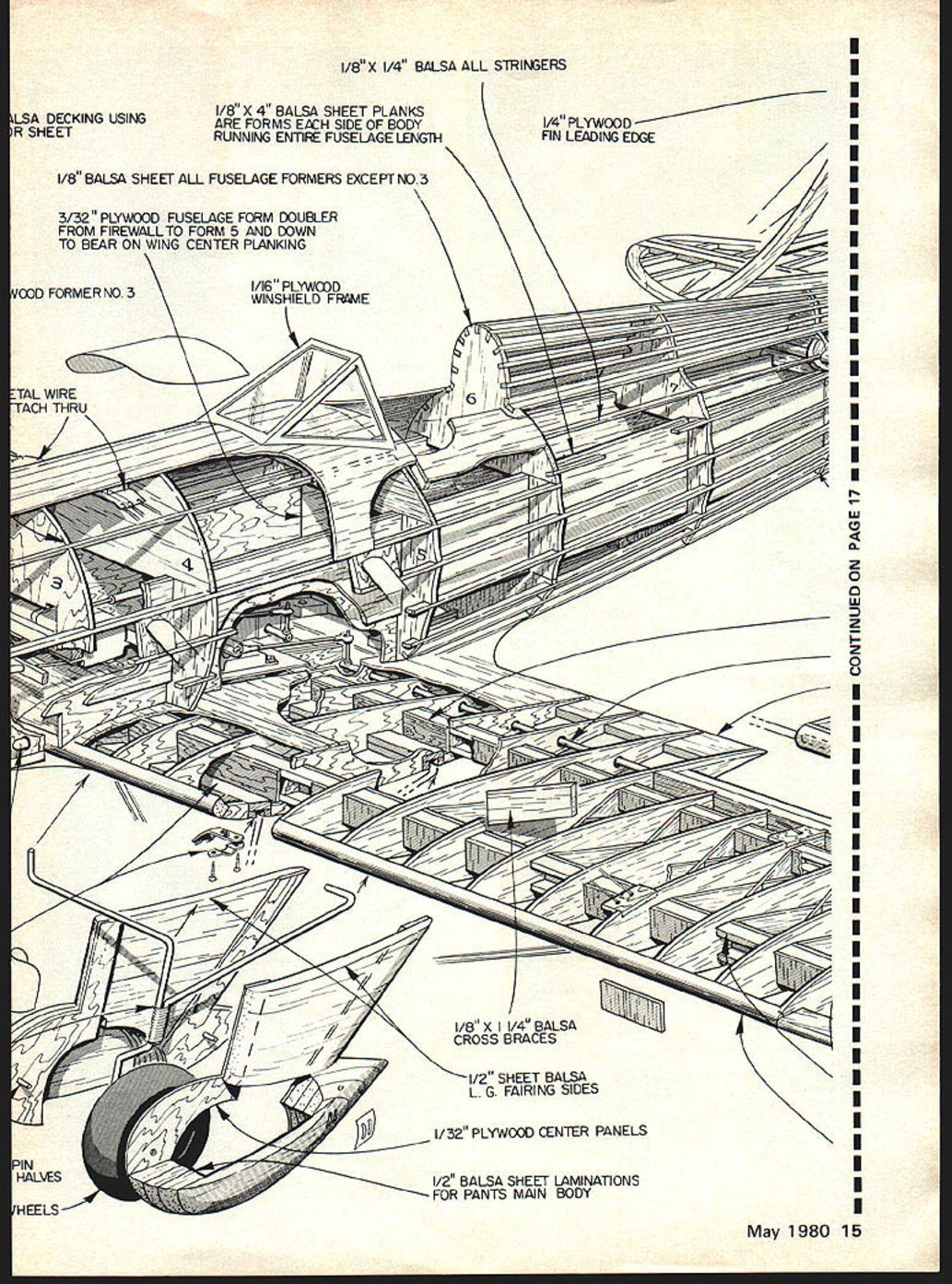
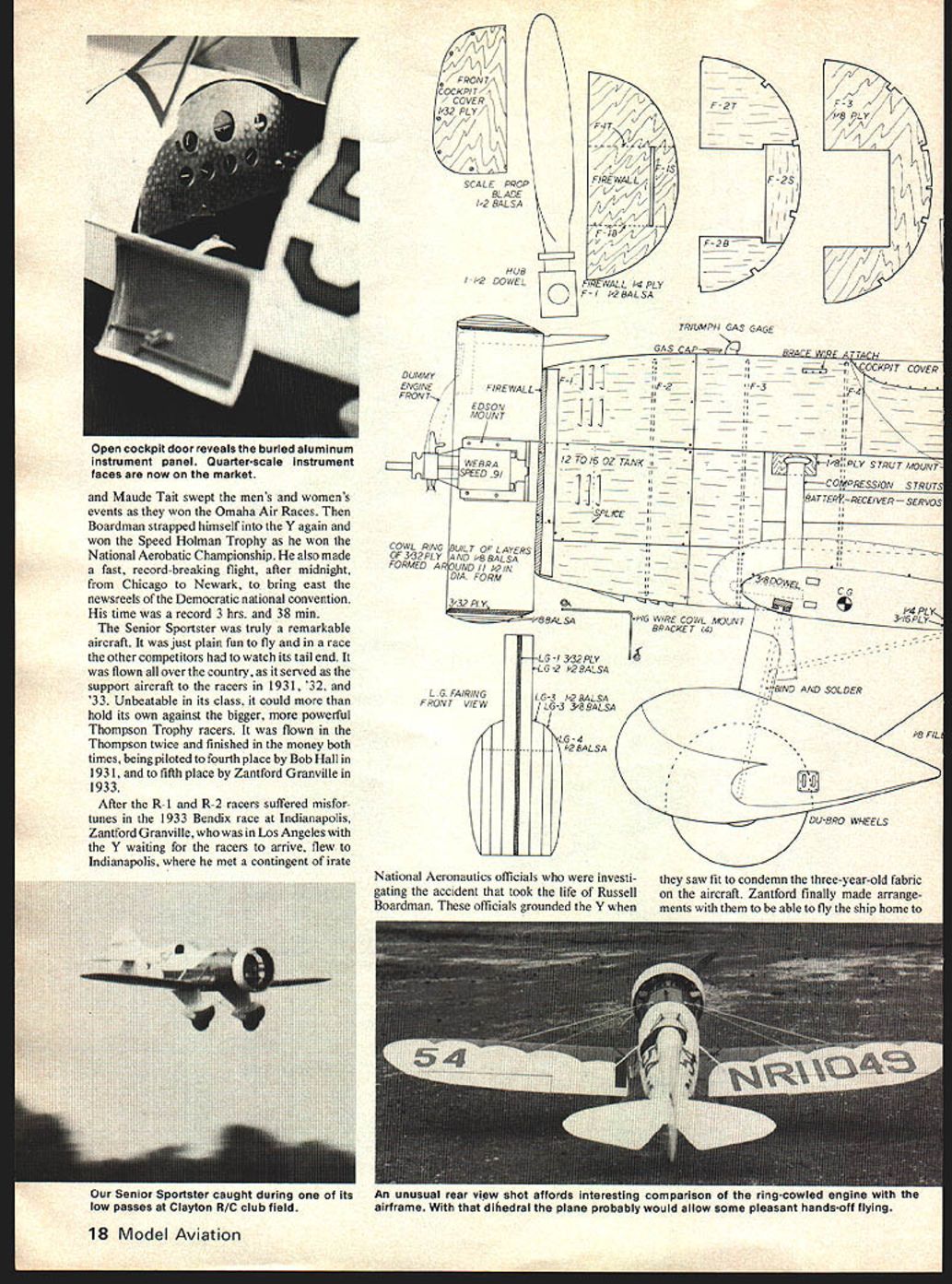
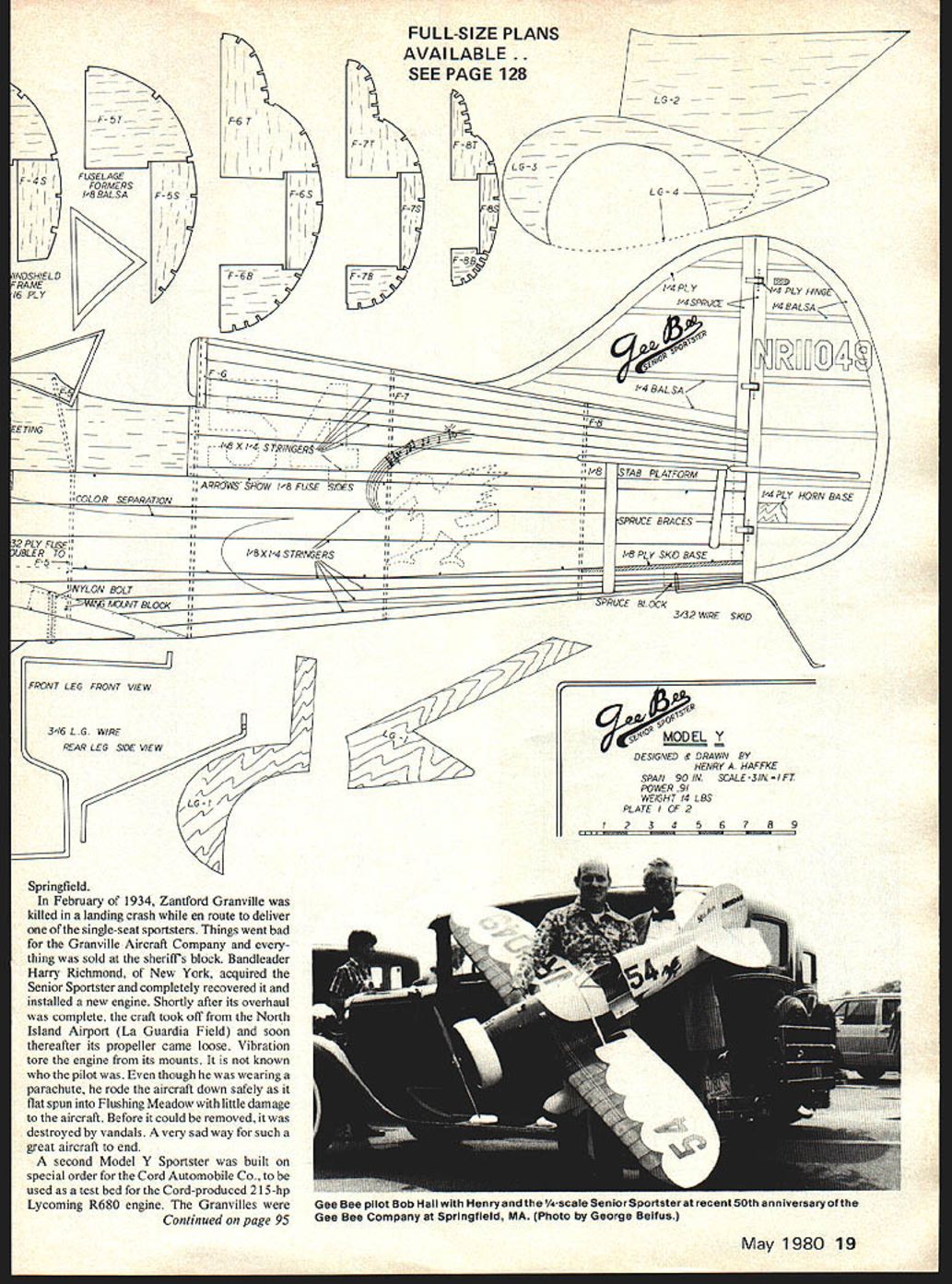
The basic sides were prepared from 1/8" x 4" x 48" balsa. It will be necessary to add a short piece at the front, where splice is shown on the plans, to make fuselage sides long enough. I used the wing saddle location and an additional section is added below the main side sheet. The one-piece 3/32" ply forward fuselage doubler is added from the front to F-5 location. After the basic sides have been laminated, slide F-3, of 1/8" ply, into position and then locate the one-piece firewall on the sides. Epoxy these parts and line up everything by weighing the structure upside down on a flat level surface.
Reinforce the firewall with triangle stock inside the fuselage sides. When this structure is completely cured, remaining fuselage formers are added, then the main stringers along the sides. Leave off the rear top stringers until the tail surfaces are installed. Omit the bottom rear stringers until the wing is fitted to the fuselage later on. The top forward section and lower forward section are sheeted with 3/32", or can be planked, using 3/32" strips.
Add the 1/16" ply plates for mounting the compression struts and the 1/8" ply skid base. A spruce block, cut to support the tail skid, is added. The engine installation is now completed. I used the Webra .9 on an Edson adjustable mount, with one of the Edson thrust wedges to give right-thrust offset.
After the wings and tail surfaces have been built and installed, the fuselage is finished by adding the rear stringers on the top and bottom sections.
Wing fillet
After the wing has been installed, a 1/16" ply base is glued to the wing saddle, extending 3 inches out from the fuselage sides. The wing is assembled to the fuselage so that the base will fit properly to the dihedral angle. The forward section of the fillet is built up of 1/8" balsa blocks cut to fit the curve of the fuselage and airfoil. Fill in behind the wing to bulkhead #6 with 1/8" soft balsa block to form the aft end of the fillet. Cut the fillet bulkheads of 1/8" balsa and install. The fillet is planked with 1/16" x 1/4" strips. A little final carving and sanding completes the fillet.
Engine cowl
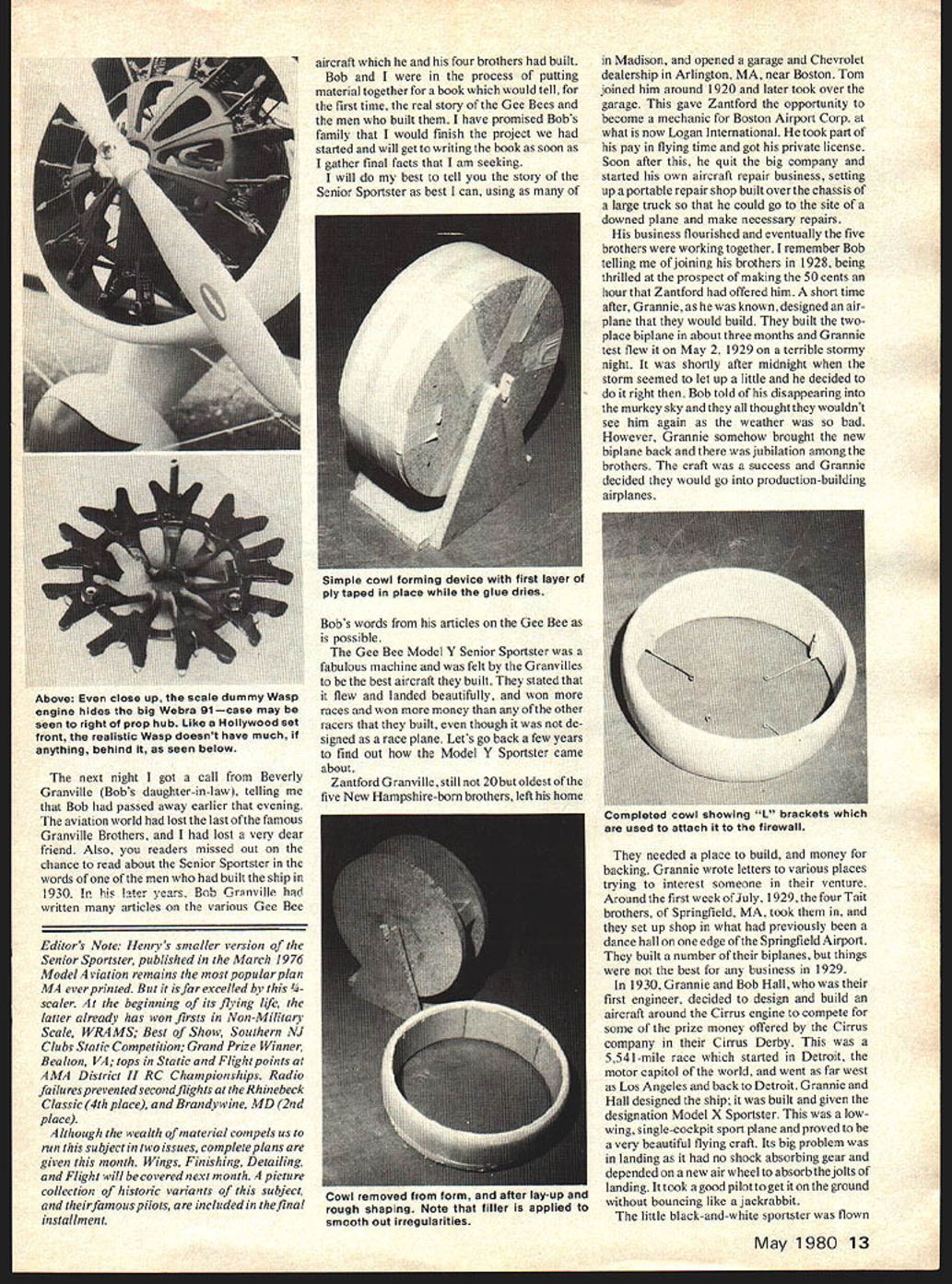
A form is necessary to build the cowl. It is easily made around an 11-1/2" form. I could not find anything that size so I cut two ply discs, spaced to give a 4" inside form. When mounted on a stand it is easy to work on. A layer of 3/32" ply is wrapped tightly around the form and a second layer is added over the first with the joints staggered. Use masking tape to hold the ply in place while the glue dries. Layers of 1/8" balsa are added (4) to the ply. After each layer is added, a couple of large rubber bands around the structure will keep them pressed together until dry. The completed cowl structure is slid off the form, then carved and sanded to final shape. Cowl is attached to firewall with four L-shaped music wire brackets. These are permanently mounted to the inside of the cowl and fastened to the firewall with sheet-metal screws. Exhaust stacks are formed from aluminum tube and mounted to the inside of the cowl with spruce blocks.
Wheel fairings
These are built up of laminations of ply and balsa. When the layers have been glued together, weight or clamp heavily, and allow to dry completely before carving to shape. Also before shaping, align the two halves of each fairing with dowels at front and rear of the fairings. Spot-glue the halves together and carve and sand to final shape.
Landing gear
Landing gear legs are formed from 3/16" music wire. Both forward legs are identical, but the rear leg must be formed for a right and left part. Drawings show side view of rear leg. From the front it will have the same upper bends as the front leg, except that one side will bend right and the other side will bend to the left. The front and rear legs are mounted to the wing mount blocks with straps and screws. Bind the two legs together with copper wire and solder. It is preferable to use silver solder for this joint. Du-Bro 6" dia. wheels are retained on the axles by a wheel collar on each side of the wheel to assure proper centering. The wheel fairings are fastened together over the wheel and axle and held together by spot-gluing, or can be screwed together with short screws if you prefer.
Fin and rudder
These vertical surfaces are built up from 1/8" sq. balsa and 1/8" ply fin leading edge, with 1/8" spruce for the fin trailing and rudder leading edge. Rudder trailing edge is cut from 1/8" balsa. Scale hinges are installed as shown on the drawings. These are made of 1/32" ply and are epoxied into the trailing edge of the fin, and one into the lower aft end of the fuselage. You can use your favorite commercial hinges in place of the scale hinges shown. A 1/4" ply insert is built into the rudder as a base for the rudder horn.
The tail surfaces have no airfoil and are simply rounded all the way around. The fin and rudder may also be built of solid 1/4" sheet balsa if a simpler structure is preferred. Weight is no problem. The model will probably come out a little nose-heavy as was the case with the real aircraft. The real aircraft had a 50 lb. anvil mounted under the stab to bring the CG where it belonged.
To be continued.
Transcribed from original scans by AI. Minor OCR errors may remain.

