
Gee Bee Senior Sportster Model Z
Part 1 — Henry A. Haffke
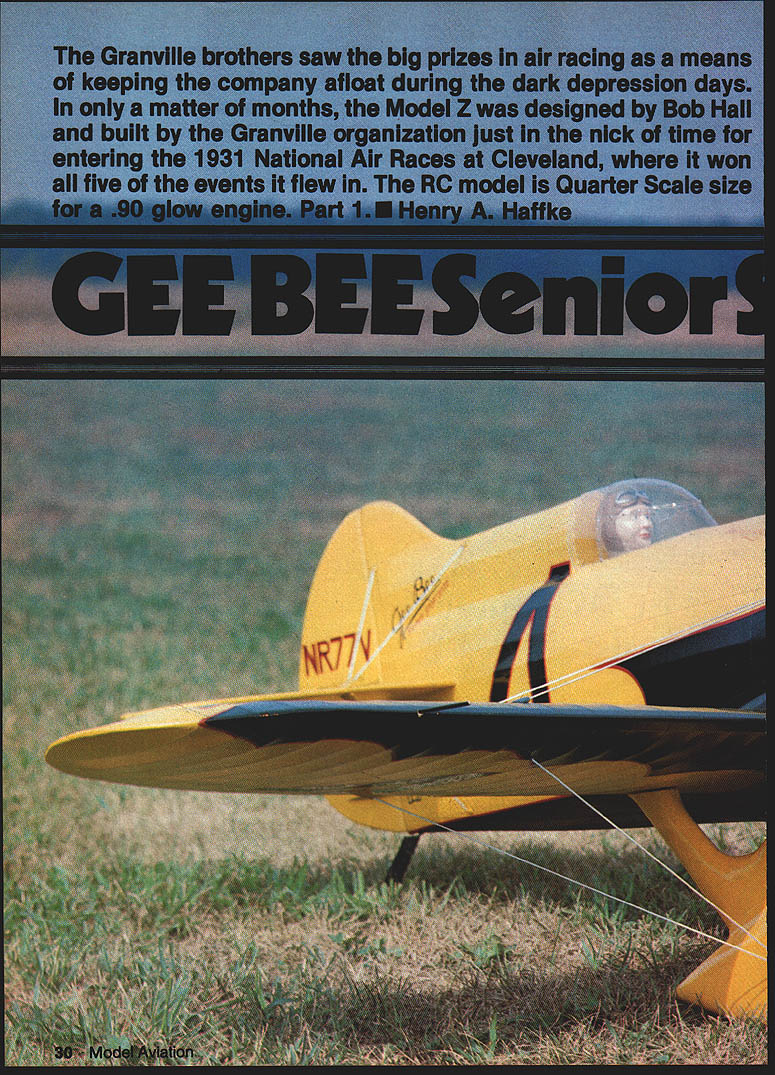
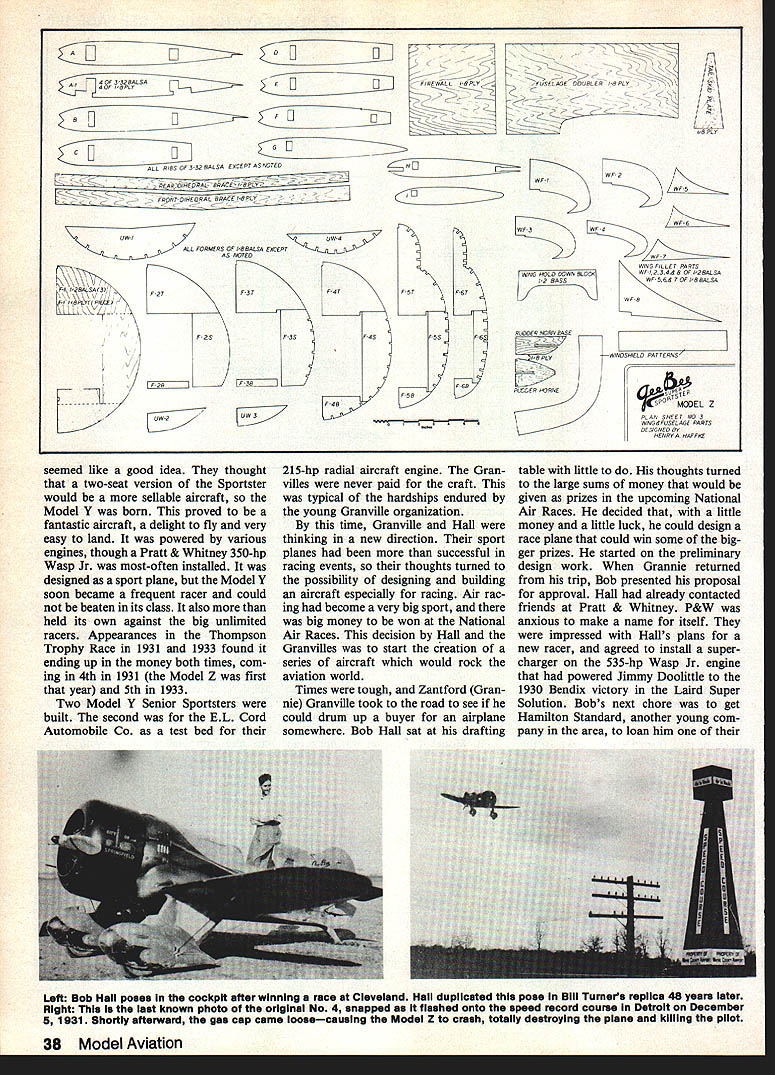
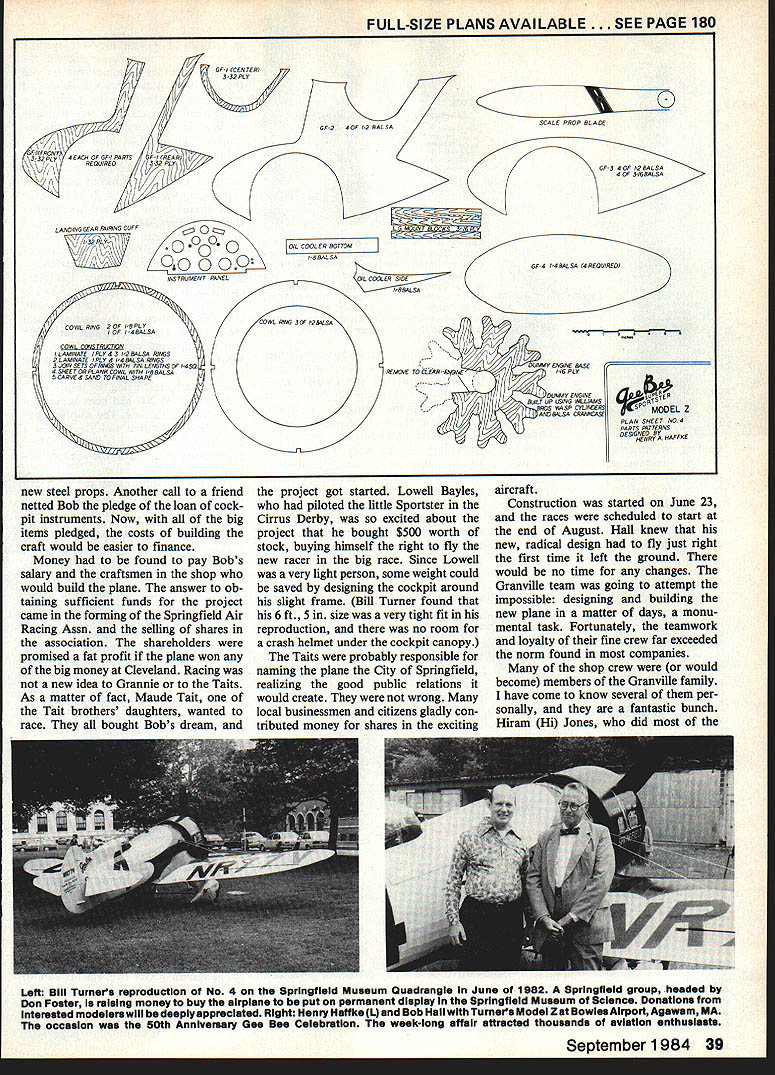
The Granville brothers saw big prizes in air racing as a way to keep the company afloat during the Depression. In a matter of months the Model Z was designed by Bob Hall and built by the Granville organization just in time for the 1931 National Air Races at Cleveland, where it won all five events it entered. The RC model described here is quarter-scale, sized for a .90/.91 glow engine.
Introduction / Personal Background
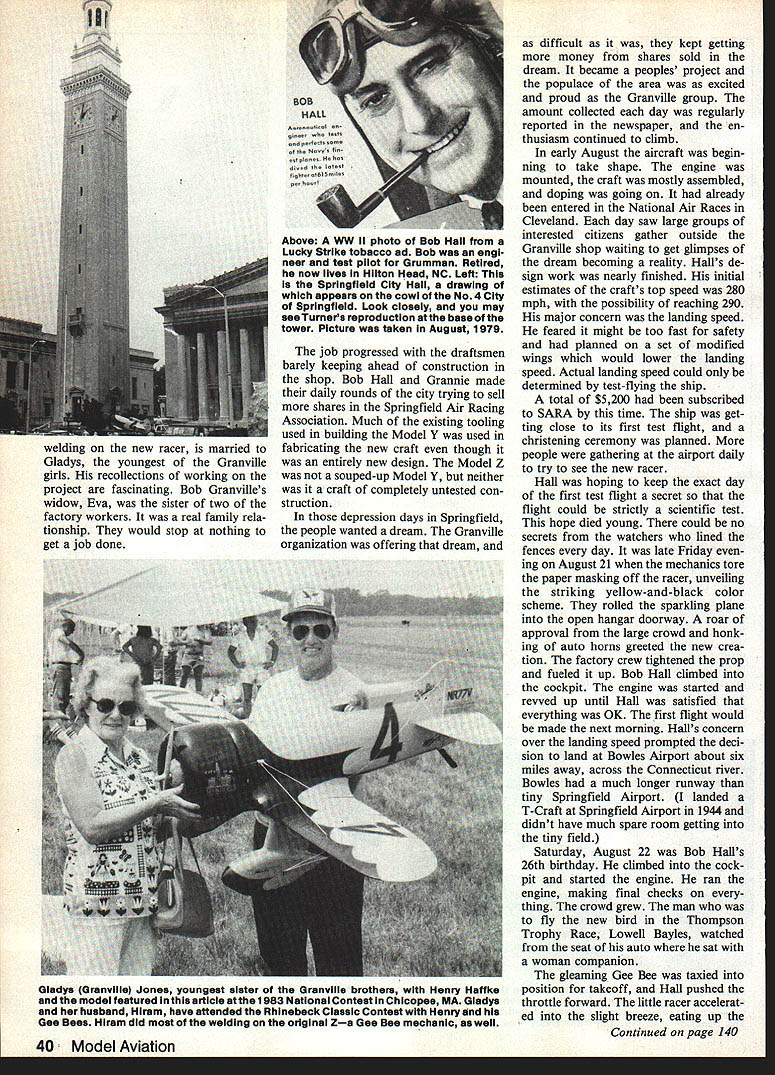
I began building Gee Bee models in 1975, starting with .40-size versions and later moving to quarter-scale. My quarter-scale Gee Bees have included the Model Y, Model D, Model E and the R-1 — all excellent flying models. For the 1983 Nationals, held at Westover AFB in Chicopee, MA (just outside Springfield), I decided to build a quarter-scale model of the City of Springfield (the full-size Model Z). The project developed more slowly than planned and required long nights to finish; the model was only flyable (not fully finished) the weekend before the Nats.
Test Flying the Model
- First flights were made by my good friend Sid Clements, who has test-flown many of my designs over the years and whose hands are steadier than mine for maiden flights.
- After a careful preflight and engine tuning, Sid flew the model first. The first flight was very smooth; only a little aileron trim was required. He landed flawlessly.
- We made a minor aileron change to return the trim lever to neutral and tried a bit of engine offset (one washer under the front engine bolt on an Edson side-mount; a regular Edson thrust wedge behind).
- On the second flight Sid was satisfied and handed me the transmitter. I flew the scale flight sequence, leaving the low flyby for last. During the flyby the engine quit; Sid took over and landed it beautifully.
- After wiping the model off, I found fuel on the bottom. Removing the wing revealed a ruptured fuel tank and raw fuel inside. Fortunately, foam rubber around the radio absorbed much of it and protected the gear.
- Later flights with the completed dummy Pratt & Whitney engine in place were uneventful. On one takeoff I held down too long to avoid lifting off early and later made a mistake with throttle trim while reaching for the trim lever; the model pitched up suddenly but I corrected and made a smooth landing. The model proved well-behaved.
Model Construction — Airframe & Finish
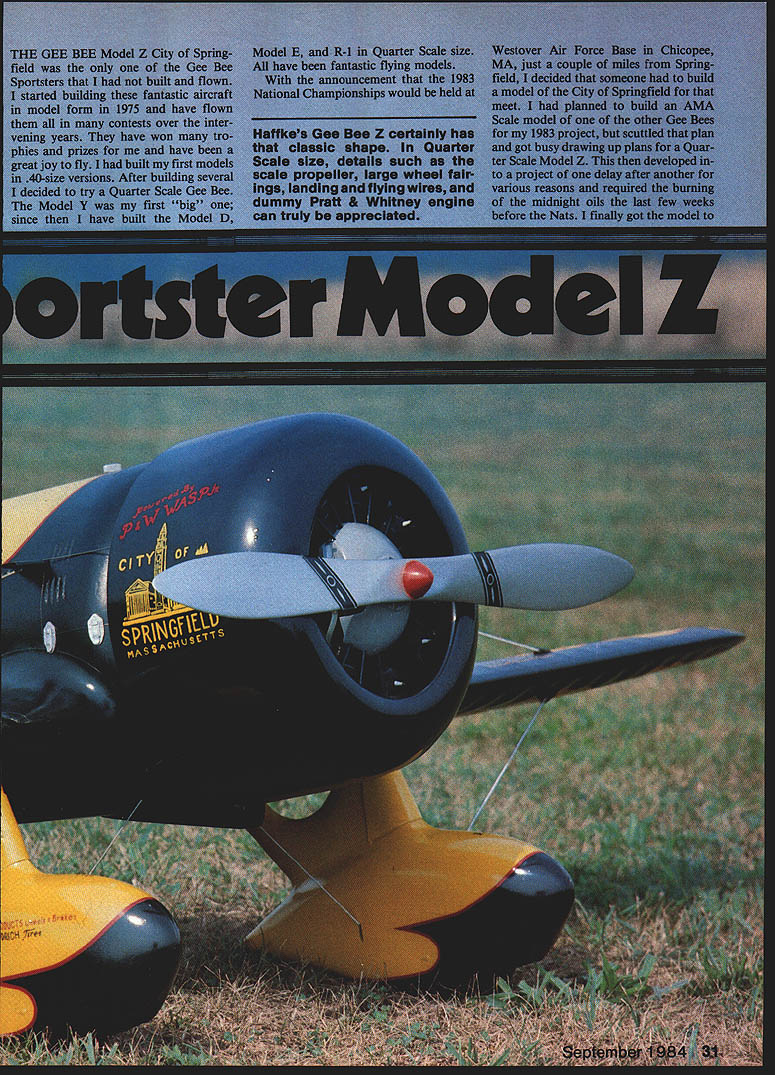
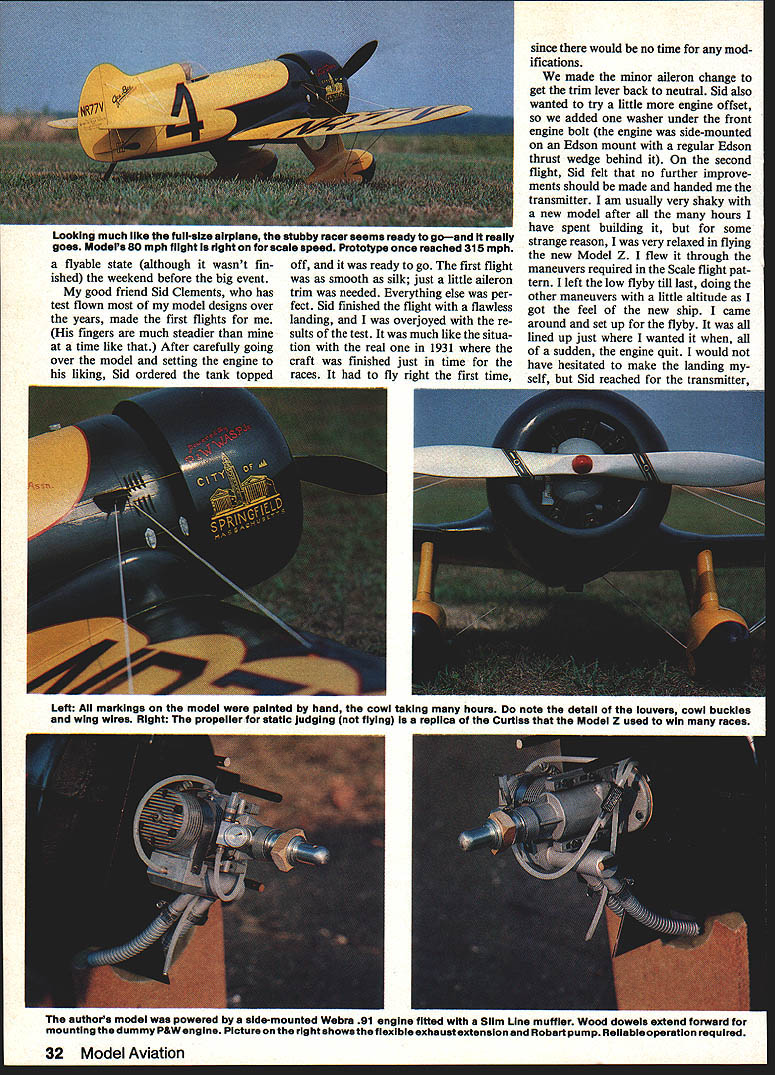
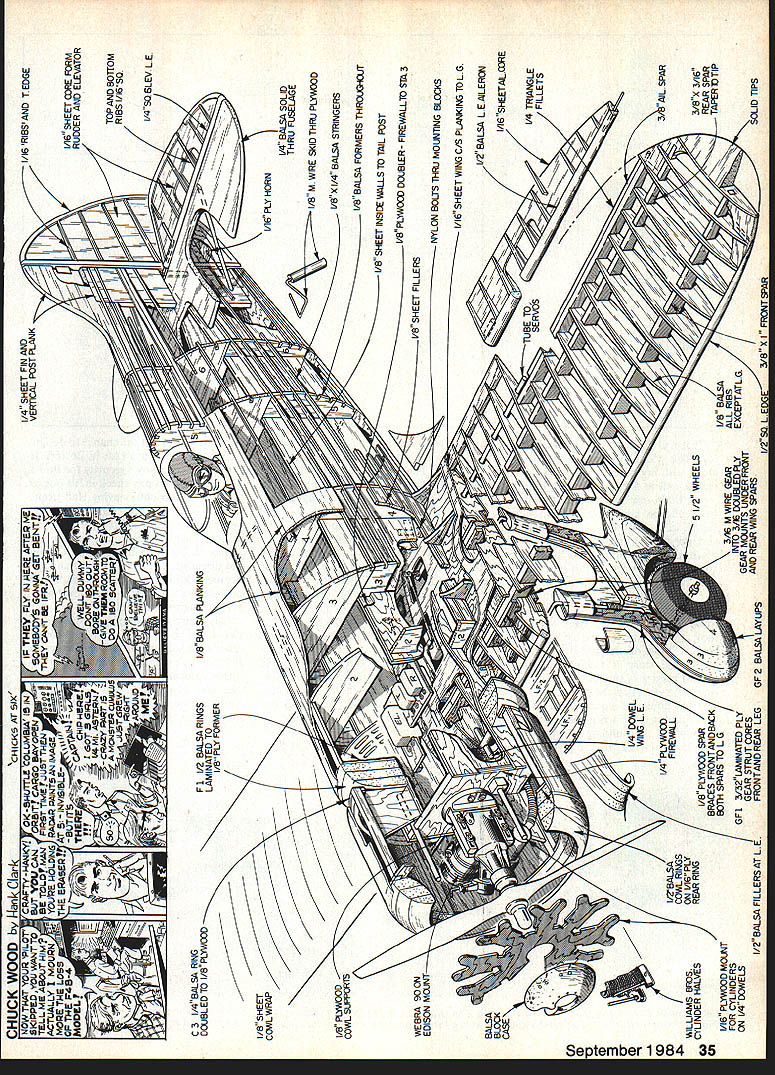
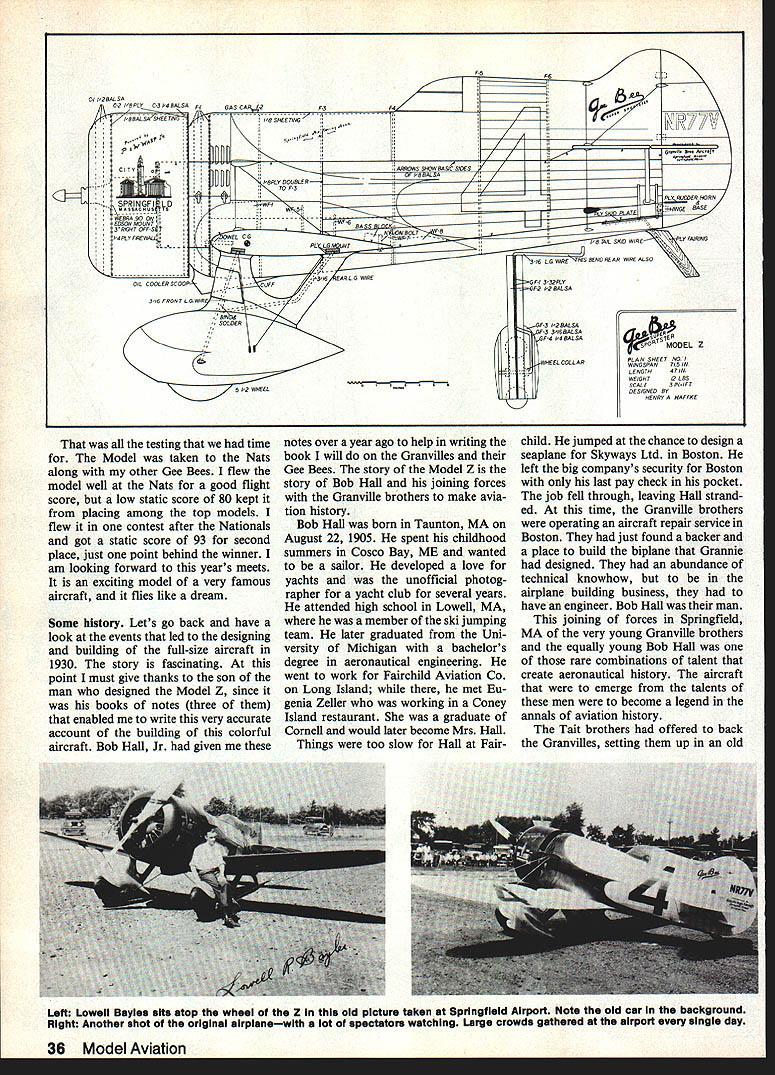
- Quarter-scale to suit a .90/.91 glow engine (my model used a side-mounted Webra .91 on an Edson mount).
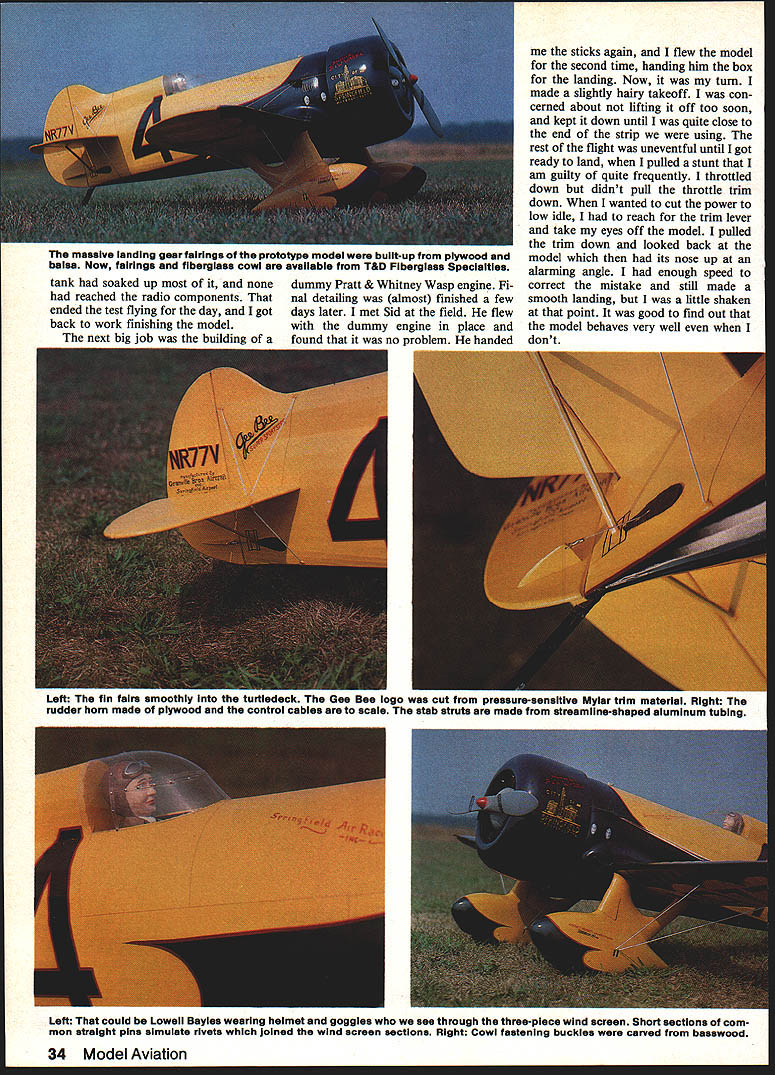
- Hand-painted markings; detailed cowl louvers, cowl buckles and wing wires required many hours.
- Wood dowels extend forward to mount the dummy Pratt & Whitney engine.
- Flexible exhaust extension used; a Robart pump provided reliable fuel pressurization.
- Gee Bee logo cut from pressure-sensitive Mylar trim material.
- Three-piece windscreen is transparent; short sections of straight pins simulate rivet joints.
- Cowl fastening buckles carved from basswood.
- Stab struts made from streamlined aluminum tubing.
- Right rudder horn made of plywood; control cables used in scale fashion.
- Large tail skid consistent with the prototype.
Radio, Servos & Control Systems
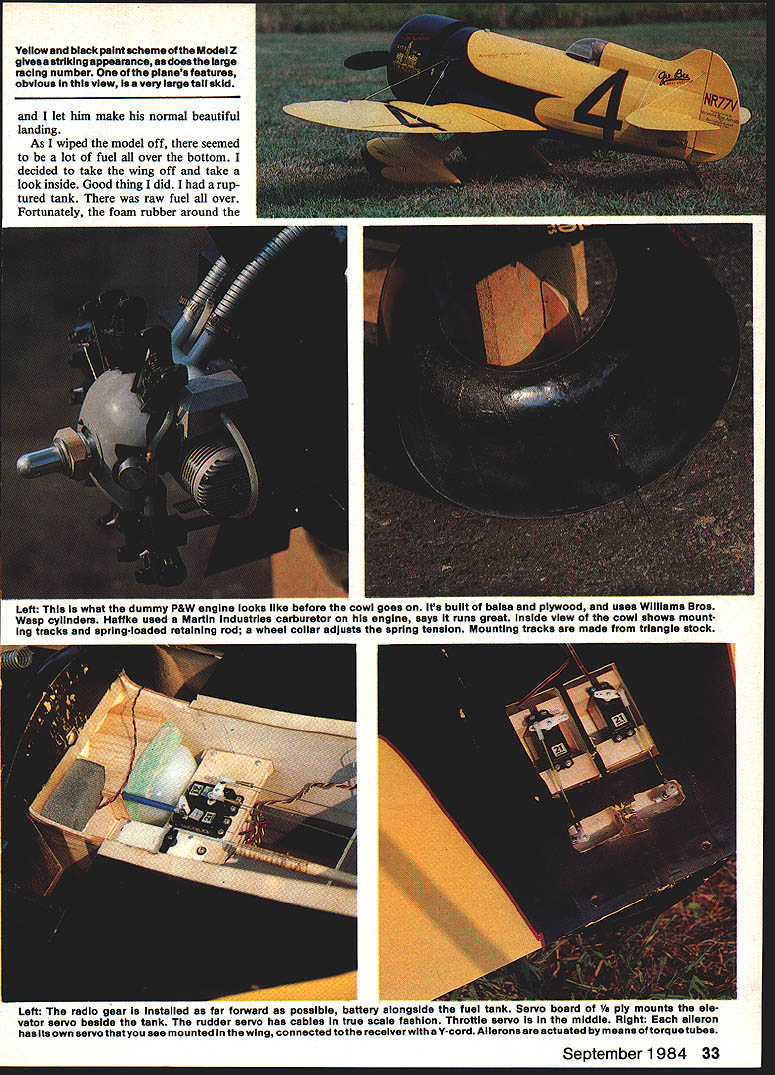
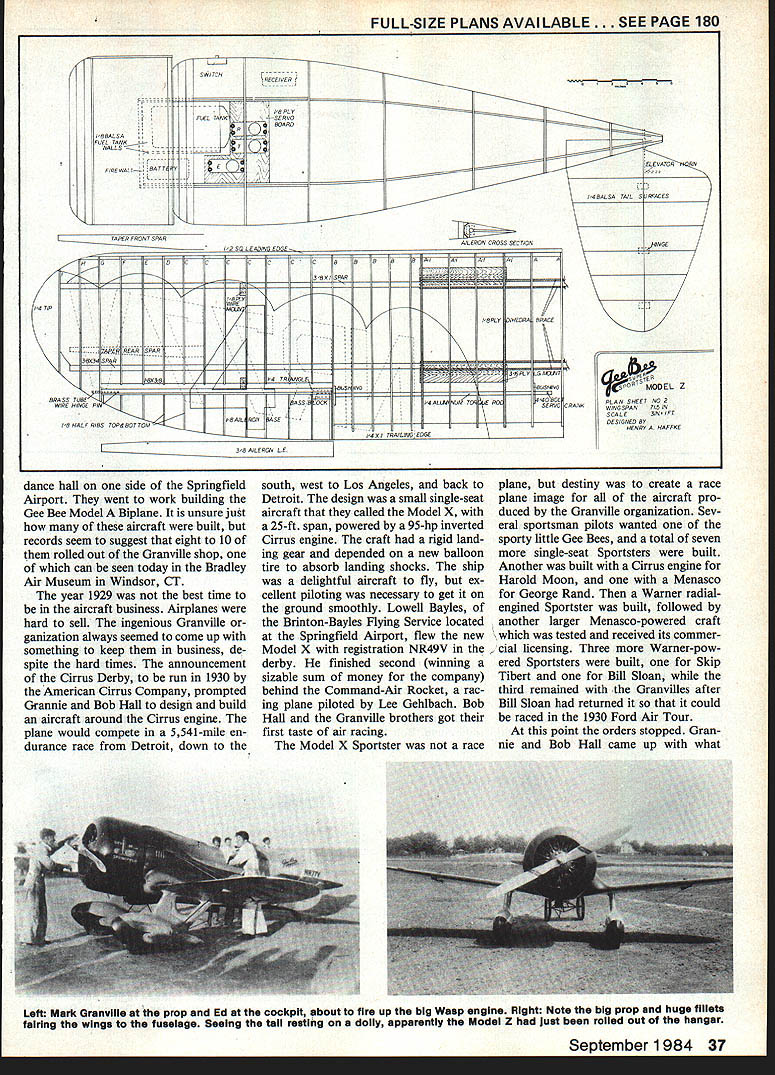
- Radio gear installed as far forward as practical; battery and switch toward the nose alongside the fuel tank.
- Elevator servo located beside the tank.
- Rudder servo uses scale-style cables.
- Throttle servo mounted mid-fuselage.
- Right aileron has its own servo mounted in the wing; connected to the receiver with a servo cord/Y‑lead as needed.
- Ailerons actuated via torque tubes.
Dummy Pratt & Whitney Wasp (Model Detail)
- Built of balsa and plywood; uses Williams Bros. Wasp cylinders.
- Martin Industries carburetor used on Haffke’s dummy engine; reported to run great.
- Inside view of the cowl shows mounting tracks (made from triangle stock) and a spring-loaded retaining rod; a wheel collar adjusts spring tension.
Model Competition Results
- At the 1983 Nationals I flew the model for a good flight score, but a relatively low static score of 80 kept it from placing among the top models.
- In a later contest I earned a static score of 93 for second place (one point behind first).
- The model captures the look and handling characteristics of the original and is a pleasure to fly.
History of the Full-Size Gee Bee Model Z
Bob Hall and the Granville Organization
- Bob Hall: born Taunton, MA, August 22, 1905. Spent summers in Casco Bay, ME; graduated from the University of Michigan with a B.S. in aeronautical engineering. Worked briefly for Fairchild, later joined the Granville brothers in Springfield when they needed an engineer.
- The Granvilles (including Zantford Granville) were operating an aircraft repair service and then moved into manufacturing sport planes. Their partnership with Hall produced a series of distinctive racing aircraft.
Early Gee Bee Sportsters
- The Model A biplane, Model X Sportster (designed for the Cirrus Derby), and several single-seat Sportsters established the company’s reputation.
- The Model X (25-ft span powered by a 95-hp inverted Cirrus) finished second in the 1930 Cirrus Derby flown by Lowell Bayles, providing valuable prize money and experience.
- The two-seat Model Y Senior Sportster followed and proved a delight to fly; it often raced successfully in its class and in larger events (e.g., Thompson Trophy appearances).
Development of the Model Z (City of Springfield)
- With air racing and big prize money in mind, Hall designed a purpose-built racer around a supercharged Pratt & Whitney Wasp Jr. (approx. 535 hp with supercharger). Hamilton Standard agreed to loan a propeller; Pratt & Whitney agreed to a supercharger; other instruments and equipment were obtained by contacts.
- Funding: the Springfield Air Racing Association (SARA) was formed and shares were sold locally; many citizens invested and followed progress with civic pride. Lowell Bayles bought $500 of stock and earned the right to fly the racer.
- Construction began June 23 (races in late August). Hall’s target top speed was approximately 280–290 mph; landing speed was a major concern and led to plans for modified wings to lower touchdown speed.
- By early August the ship was nearly assembled and painting (yellow-and-black scheme) was revealed to a large public crowd.
First Flights, Adjustments, and Preparation
- First flight: August 22 (Bob Hall’s 26th birthday). Hall taxied, took off, corrected an abrupt left torque on liftoff and settled into cruising speed (~200 mph) without pressing for top speed. Landing speed on that flight was about 80 mph.
- Cowl and wing adjustments were required after initial flights. A trip to Buffalo was planned to repitch the prop; on that ferry Hall suffered carbon monoxide fumes in the cockpit due to exhaust burning through the inner cowling, became drowsy, and made a straight-in approach and landing. He recovered after being helped on the ground.
- The crew in Springfield fabricated a heavier cowl overnight and transported it to Buffalo; Bayles then flew the Model Z on to Cleveland.
National Air Races, 1931 — Cleveland Success
- The Model Z at Cleveland was sensational. Entered in five races, it won all of them:
- Shell Speed Dash: Lowell Bayles set a new record of 267.342 mph; one pass reached ~286 mph (fastest speed recorded by a landplane at the time).
- Goodyear Trophy Race: Bayles won at 206.001 mph.
- Mixed Free For All: Bob Hall won at 222.623 mph.
- General Tire and Rubber Trophy: Hall won at 189.545 mph (with the engine not fully delivering).
- Thompson Trophy: Bayles won with a record speed of 236.239 mph after the crew reworked the engine overnight.
- The success electrified public interest; thousands greeted the returning victors in Springfield.
Later Speed Attempts and Crash
- A later World Speed Record attempt at Wayne Airport (near Detroit) involved a Model Z fitted with a larger supercharged Wasp (reported to boost power significantly). On December 5 a crash occurred during a high-speed attempt: the right wing panel was shed, the plane rolled in and crashed; Lowell Bayles was killed.
- The exact cause was never conclusively determined. A leading hypothesis is that a loose gas cap struck the windshield and tore a hole in the upper left wing panel, which then caused catastrophic failure. Film of the crash has been widely used in motion pictures.
Finishing Details & Scale Items (Model Notes)
- Cowling: detailed louvers and buckles; mounting tracks from triangle stock; spring-loaded retaining rod with wheel collar to set spring tension.
- Windscreen: three-piece; pins simulate rivets.
- Trim and markings: hand-painted; Mylar trim material used for logos.
- Landing gear fairings: large wheel pants replicated in quarter scale.
- Control detail: torque-tube aileron actuation; true-scale rudder cables; plywood rudder horn.
- Miscellaneous: tin trim fits into the turtledeck; flexible exhaust extension; careful alignment of wings and secure cowling fastening are essential for both scale appearance and safe flight.
The Gee Bee Senior Sportster Model Z is an exciting scale subject — rich in history and challenging to build and fly. The quarter-scale replica captures both the striking look and the lively handling of the original.
Transcribed from original scans by AI. Minor OCR errors may remain.

