
GEEBEE Y Replica
Henry Haffke
Background
The birthplace of Gee Bee aircraft, Springfield, MA, is also my birthplace. I built my first model of a Gee Bee in 1975 — a Sport Scale Model Y Senior Sportster (MA Plan #131). That model started me on my way researching the fabulous Gee Bee airplanes and the men who built them.
As I learned more about the Gee Bees, my interest intensified. I located Bob Granville, one of the original five brothers, and he put me in touch with his brother, Ed. Both supplied photos of the Model Y and helped me assemble a documentation package that contributed to several trophies. Ed Granville passed away before I had the opportunity to meet him in person, but Bob and I became very good friends and spent a lot of time together. Bob introduced me to many Gee Bee people — owners, pilots (including two famous women), and local craftsmen who had worked for Granville Brothers Aircraft.
My research showed that much of what had been published about Gee Bee aircraft was terribly inaccurate. I decided to write a book to tell the true story of these famous craft and the men behind them. Bob and I planned to write it together, but he passed away before we had gotten very far. My research is now complete, and soon the full story will be told.
Replicas and the Model Z
When planning the book I intended to include a chapter on replica Gee Bees. I found several people considering building one and a few actually involved in construction. So far I have learned of at least:
- a half dozen Model Y Senior Sportsters,
- an R-1,
- an R-1/R-2 hybrid, and
- a Model Z.
The Model Z is Bill Turner’s famous replica that now stands in the Smithsonian Institution — the first replica airplane ever exhibited there. Bill was the first to get his replica Gee Bee flying, and he flew it enough to disprove myths about how dangerously the little racer handled.
Discovery of Ken Flaglor’s Project
Two years ago I received an envelope containing half a dozen photos of a Model Y bare frame ready for covering. A short note said, "Henry, I thought you might be interested in my project," signed by Ken Flaglor. I had no idea anyone had a Model Y so close to completion. I knew Ken as the designer of the Flaglor Skooter ultralight (for which he sells plans), but I didn’t know he was building a Gee Bee. I arranged to visit him, and we spent a fascinating evening going over every nut and bolt. He promised me a ride when it was finished.
Two years later the great day came. My old friend Syd Clements (who flies Gee Bees) and I arrived at Ken’s hangar on a cloudy, drizzly afternoon. When Ken rolled back the hangar door I couldn’t believe my eyes — it looked so much bigger with the covering on. It was the most beautiful thing I had ever seen. We rolled it out, Ken started the big Lycoming, and although the clouds were too low to fly, I shot seven rolls of film while we listened to that engine making music.
Construction and Finish
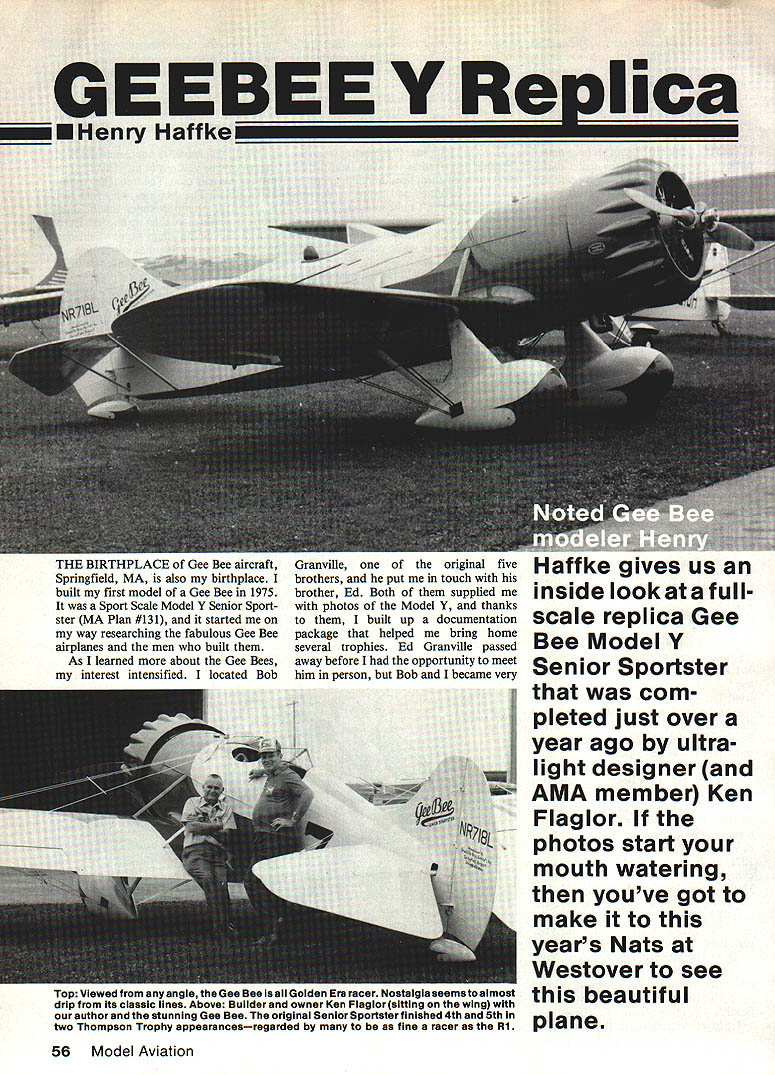
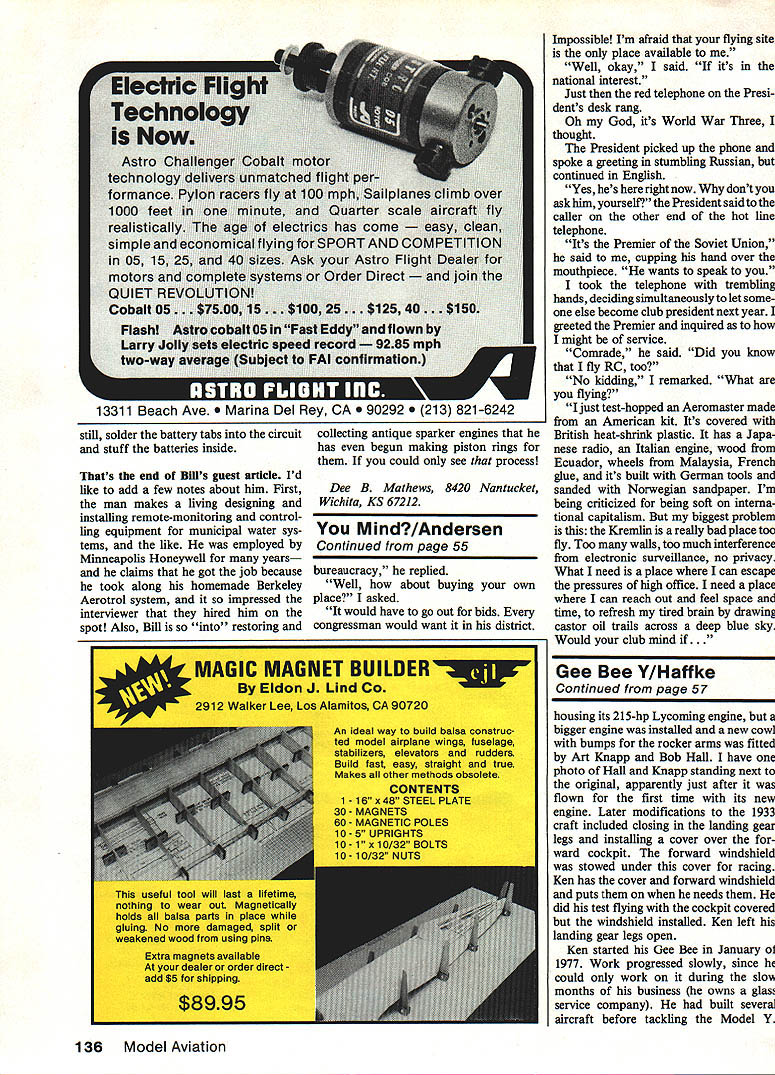
Ken’s Senior Sportster is finished like the second copy the Granvilles built, the one modified for the 1933 Chicago International Air Races. The original aircraft had a smooth cowl housing its 215-hp Lycoming engine, but a bigger engine was later installed and a new cowl with bumps for the rocker arms was fitted by Art Knapp and Bob Hall. I have a photo of Hall and Knapp standing next to the original, apparently just after it flew with its new engine.
Later modifications to the 1933 racer included closing in the landing-gear legs and installing a cover over the forward cockpit; the forward windshield was stowed under this cover for racing. Ken has that cover and the forward windshield and uses them when needed. He conducted his test flying with the cockpit covered but the windshield installed, while leaving the landing-gear legs open.
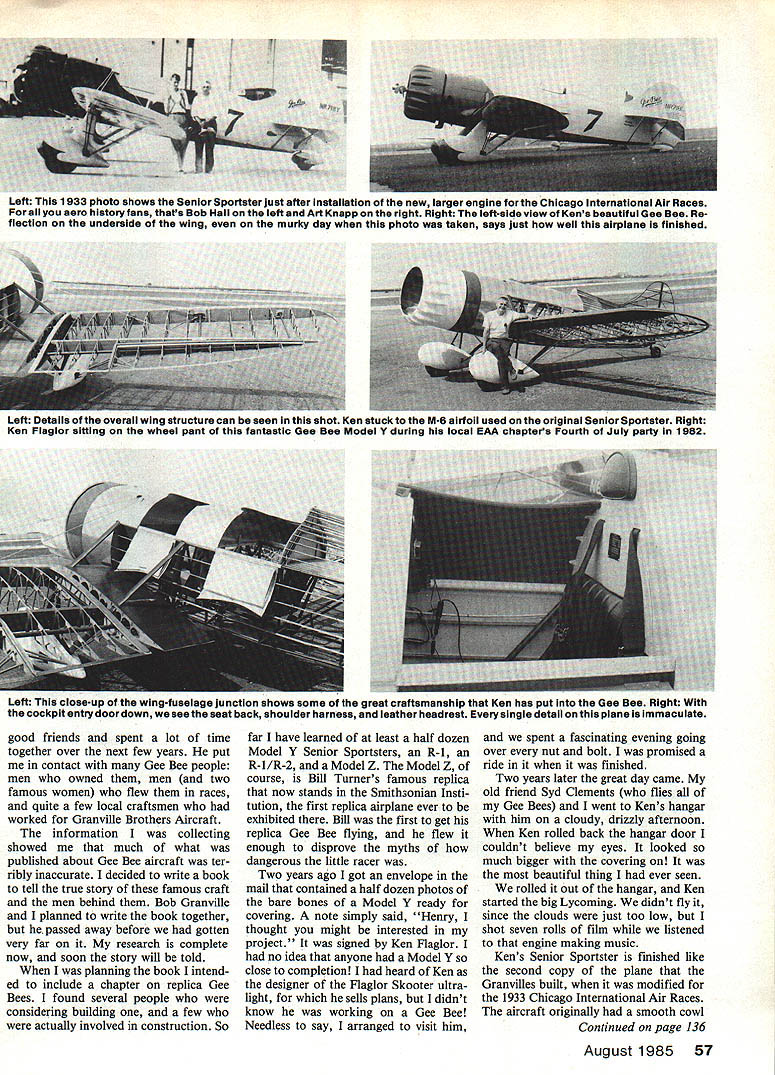
Ken started his Gee Bee in January 1977. Work progressed slowly because he could only work on it during his business’s slow months. He had built several aircraft before tackling the Model Y. When I first met him he insisted he wasn’t the greatest craftsman, but wanted to do all the work himself. Two years later I couldn’t find anything on his 1933 aircraft that was less than perfect.
Flight Testing, Awards, and Appearances
Ken made the first flight in his pride and joy on July 4, 1984. It flew beautifully, requiring only a minor adjustment in the brace wires to trim it out. He spent some time refining landing-gear damping, and after flying the required hours to qualify it for cross-country flight he headed to Oshkosh. Ken returned from Oshkosh with the Grand Champion Replica award.
Shortly thereafter he flew the Gee Bee to the Blakesburg EAA event and came home with four trophies, including:
- Best Replica,
- Most Unique Monoplane, and
- Best Workmanship by an Owner.
When I complimented him on his winning ways, he simply smiled and said the plane had come out better than he thought it would.
Specifications
- Registration: NR718L (original Model Y was NR718Y; Ken tried to obtain this number)
- Engine: Lycoming R-680-13, 300 hp
- Propeller: Constant-speed
- Cruise speed: 140 mph
- Rate of climb: 2,500 feet per minute
- Empty weight: 1,792 lb
- Gross weight: 2,500 lb
- Notes: Ken’s Model Y is a little heavier than the original due to an electric starter and radio equipment.
Closing
Ken will be flying his magnificent Model Y to the 1985 Nats at Westover Air Force Base in early August. He’s a longtime modeler and AMA member. I’ll be able to show Ken the area where the Gee Bees came from and finally get my ride. All of our AMA friends will get a close look at this magnificent airplane.
Can any of you guess what I’m building for Scale competition this year?
Transcribed from original scans by AI. Minor OCR errors may remain.

