
General
John Worth
Behind the Scenes
This was the year of the 63rd National Model Airplane Championships. The first Nationals was held in St. Louis in 1923. Except for three years during World War II, the Nationals have been held annually ever since. In 63 years it has been located in a large variety of places in the U.S.A., but not until 1989 was there a Nationals in the Pacific Northwest.
That wasn't for lack of modelers in this part of the country. Quite the contrary—the Northwest is a hotbed of model aviation. It wasn't until this year that the right combination of ingredients came together: a specific proposal involving sites suitable for the various forms of competition that take place at the National Championships, backed by area modelers ready and willing to provide the physical effort and technical expertise necessary to staff most of the events.
The most demanding aspect of a Nats in the 1980s has been the combination of sites required to produce what has become the world's largest model meet. The scope is enormous. A huge area—over a thousand acres—is needed for Free Flight events. An enormous building is needed for Indoor events. A very large (preferably grass) area is required for RC Soaring events, and another for RC Helicopter. RC Pylon Racing and RC Pattern (Aerobatics) events need large, smooth, hard surfaces for takeoffs and landings. Additional smooth, hard surfaces are needed for the various Control Line events, including a quality grass area for the CL Combat events.
All of this, plus a good situation for a large administrative headquarters operation, adds up to a tremendous physical facility and logistics requirement. Additionally, a couple hundred volunteer workers are needed to complement the nucleus of about a dozen AMA HQ staff members, adding up to an overwhelming picture.
The states of Washington and Oregon joined forces to make the Nats happen. The Nationals is often very locally oriented, but this year it involved people from a broad region. Credit AMA District XI Vice President Ed McCollough for bringing together people from far away to the Tri-Cities of Pasco, Kennewick, and Richland. No one of the cities could have hosted the Nationals by itself, but all three working together succeeded in a unique spirit of collaboration for the common good.
Pasco provided the RC Soaring site; Kennewick the RC Pattern and Scale site; Richland the RC Pylon, RC Helicopter, and Control Line sites. Outdoor Free Flight was southwest of the Tri-Cities in the desert country known as Badger Mountain. Only Indoor was very remote, across the eastern border of Washington in Moscow, Idaho. Though far away, it was a world-class location compared to any fair Tri-Cities site.
Schedule and Site Separation
A novel twist to the 1989 Nationals was the new schedule made possible by the nature and location of the various RC sites, permitting a nine-to-five workday for all activities except Indoor. As a result, it was a much easier than usual pace for most participants. The RC Pylon people didn't have to start at dawn and the RC Pattern people didn't have to stay on the field until dark, because they weren't sharing the same site. Evening activities, except for model processing in some events, were mostly social. The nine-to-five schedule was fairly popular and has been recommended for future Nationals when possible.
The key to nine-to-five was separating, rather than sharing, RC Pylon and Pattern sites. With RC Soaring and Helicopter also separated, each of the four RC groups could operate without compromise. This experience suggests that when each group operates with its own set of RC frequencies (as anticipated in 1991), the nine-to-five schedule will be practical even when all four RC groups share the same field, provided a large enough piece of real estate is available.
While the various Nats sites may have been separate, the distances between them (except for Indoor) were not great—typically about 15 to 20 minutes driving time from one site to another.
Headquarters and Facilities
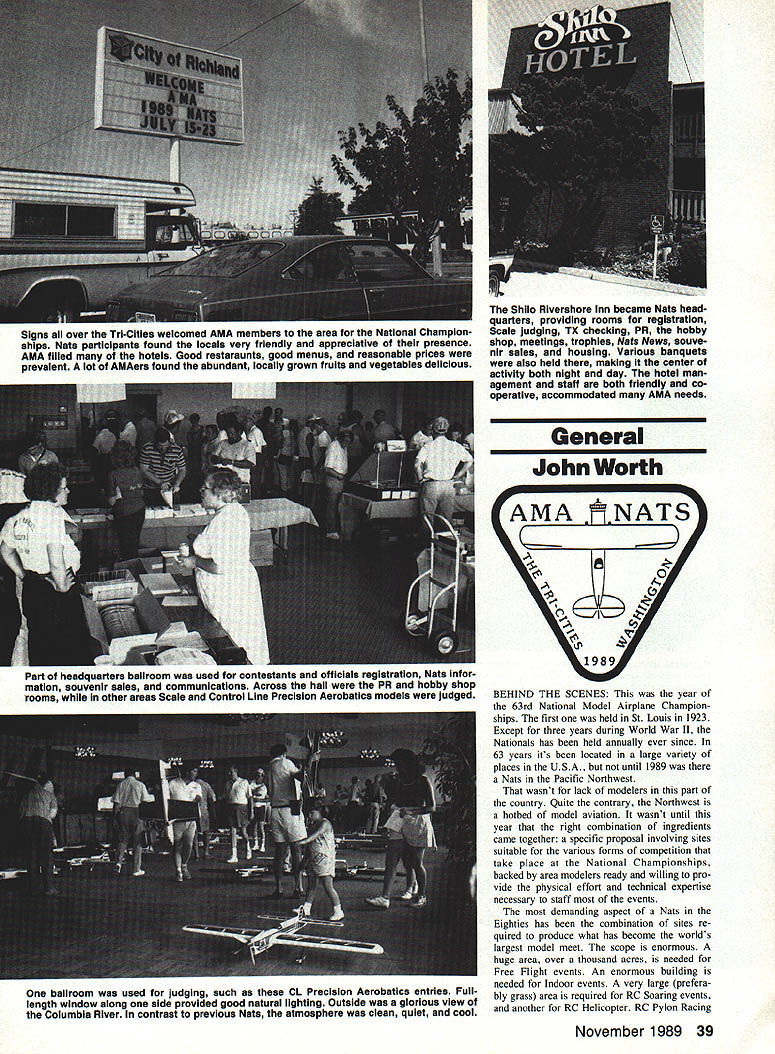
At the hub was the headquarters hotel, the Shilo Rivershore Inn, reminiscent of the Nats setup in Chicopee, MA. Most of the lodging for the officials was in rooms surrounding the large swimming pool area. Large ballrooms provided space for model judging and processing, registration for contestants and officials, information services, and souvenir sales. Other rooms were used for PR, the Nats Hobby Shop, Trophies, Nats News, and Nats communications.
RC Scale models enjoyed a spectacular setting after being judged. They were put on display in a beautifully landscaped grass area outside the Shilo Inn, along the Columbia River. The scenery made for many great color photos, movies, and videos. The riverside atmosphere was enjoyed by numerous attendees, poolside and riverside. Seldom has a Nats had such a pretty backdrop for model aircraft activities.
Besides the Shilo, lots of other fine area hotel facilities were relished. In contrast to years past when military barracks or college dormitories were needed to accommodate all the participants, this Nats had numerous hotel rooms in all price ranges, and good campsites. Good food at reasonable prices also prevailed in the many excellent area restaurants. Particularly enjoyable were the myriad locally grown fruits and vegetables that dominated the menus.
Participation and Entries
This was a good-size Nats. It was bigger than many previous West Coast Nationals. The official registration topped 1,000, with 862 contestants and 152 mechanics. The Radio Control events had the most individual entries at 531. Control Line had 193. Free Flight Outdoor had 129, and there were 65 for Indoor. Of the RC event entries, totaling 848, there were:
- 74 in Scale
- 387 in Soaring
- 39 in Helicopters
- 150 in Pylon
- 208 in Pattern
Among the 390 Control Line event entries:
- 119 in Speed
- 68 in Racing
- 43 in Carrier
- 52 in Precision Aerobatics
- 86 in Combat
- 22 in Scale
In Free Flight (377 total):
- 47 in P-30
- 46 in A/GA Gas
- 45 in Hand-Launched Glider
- 43 in A Gas
- 31 in Coupe d'Hiver
Indoor (217 total):
- 35 in Novice Penneyplane
- 31 in Easy B
- 25 in Hand-Launched Stick
- 23 in Hand-Launched Glider
- 21 in FAI
- 20 in Indoor FAI
In Scale, there were 170 total for Indoor Peanut and Rubber Scale.
Some other interesting numbers:
- Washington had 223 individual entries.
- The state with the highest number was California—388.
- Oregon had 82, Texas 48.
- Canada probably had its largest Nats entry ever with 77.
- There were also two from Japan and four from Mexico.
- Most interesting of all were seven entries from the U.S.S.R.
International Visitors
This was the first time that visitors from the U.S.S.R. attended a Nationals—three were nominated altogether. The Russians flew in Control Line events and one Free Flight (Nordic Glider) event, and everyone did well. They were warmly received, enjoying American hospitality, especially from Washington-area residents who provided housing, good food, and transportation.
Weather and Conditions
Weather-wise, this was a pretty good Nats, although there were problems in the beginning. The first two days brought rains and/or high winds, but the third day was basically good for most events. High winds on opening Sunday badly hurt the A-I Gliders, C Gas, and Payload Outdoor events. Outdoor Free Flight Scale suffered misfortune, being almost completely blown out by high winds on Thursday. The next day would have been perfect for the event, but time did not permit rescheduling. The rest of Nats week was quite good; there were several instances of models flying out of sight and returning near the launch point (including a couple of Combat Control Line models that broke loose from their lines!).
Temperatures were mostly high, but low humidity made them much more tolerable than they would have been otherwise. A universal problem, however, was a superabundance of dust. Most events (CL Combat and RC Helicopter, for one) were affected. The dust also made hands and models dirty and meant more work and frustration for many competitors. Once in the air, the planes flew fine.
Overall Impression
Aside from the varying weather situations which hindered some events more than others, this seemed to be a happy Nats, with fewer complaints than in years past. Most sites were good and most officiating was good, so the level of competition appeared to be high. As a sidelight, there may have been more first-time Nats contestants in 1989 than in many years past. Most of the over 300 contestants from the states of Washington and Oregon seemed to be first-timers. It was obvious from the happy comments from many of them that they were delighted to be part of the Nats scene.
On balance, this must be recorded as a good Nats. Most people were happy. It wasn't the biggest—nor were the facilities the best—but everything was generally adequate. This first Northwest Nats left many participants feeling that they would gladly return.
Transcribed from original scans by AI. Minor OCR errors may remain.

