
General
Vince Mankowski
Behind the scenes — when the Nats really begins
When does the Nats start? The competition results of the 1990 Mid‑American National Model Airplane Championships and coverage for all the events are reported elsewhere in this issue, but to share a behind‑the‑scenes perspective you must first be aware that Nats efforts began not on July 14, 1990, but back in October of 1989.
Following Executive Council approval to hold the 1990 National Championships in Lawrenceville‑Vincennes, a Nats planning meeting was scheduled for November 17–19 at the site. The Nats Management Committee for the 1990 event included:
- Chuck Foreman — Communications
- John Guenther — Scale Category Manager
- Bob Landry — Facilities Manager
- Betty Stream — Radio Control Category Manager
- Bev Wisniewski — Control Line Category Manager
- Al Williamson — Radio Control Category Director
- Dr. Sandy Frank — Free Flight Category Manager
Special Interest Groups concerned with competition events were invited to send a representative to the planning meeting, and there was an open invitation to AMA members in the local area to attend, since the Nats has a significant impact on the local modeling scene.
The meeting process began with a tour of all known potential contest sites, because site layout has a dramatic effect on the Nats event schedule. The planning meeting itself was held in the Lawrenceville Community Center and typified other 10‑ to 14‑hour planning sessions. The goal was to arrive at the necessary definition and detail to produce a 1990 National Championships entry form.
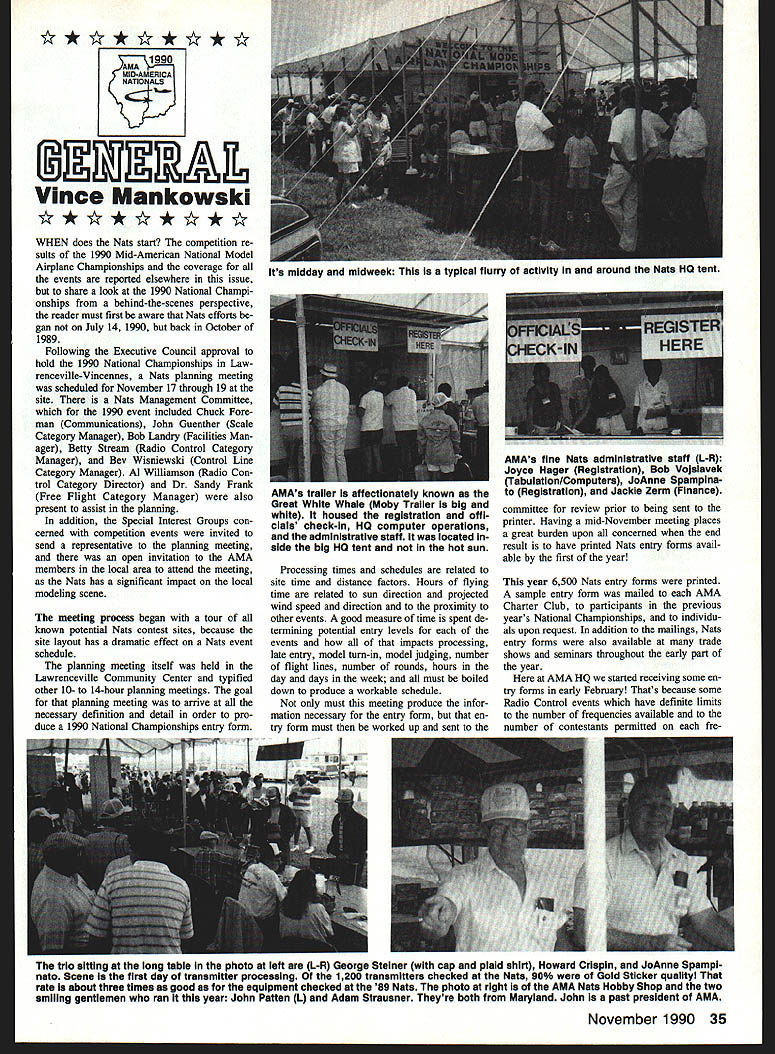
AMA's trailer, affectionately known as the Great White Whale (Moby Trailer), housed registration and officials' check‑in, HQ computer operations, and the administrative staff. It was located inside the big HQ tent, out of the hot sun.
Processing times and schedules are related to site time and distance factors. Hours of flying time are related to sun direction, projected wind speed and direction, and proximity to other events. A good measure of time is spent determining potential entry levels for each event and how that impacts processing, late entry, model turn‑in, model judging, number of flight lines, number of rounds, hours in the day and days in the week; all must be boiled down to produce a workable schedule.
Not only must the meeting produce the information necessary for the entry form, but that form must then be reviewed by the committee prior to being sent to the printer. Having a mid‑November meeting places a great burden upon staff and all concerned when printed Nats entry forms must be available by the first of the year.
This year, 6,500 Nats entry forms were printed. A sample entry form was mailed to each AMA charter club, to participants in the previous year's National Championships, and to individuals upon request. Entry forms were also available at many trade shows and seminars early in the year.
Entry processing and early planning
AMA HQ began receiving some entry forms in early February. Some Radio Control events have definite limits on the number of frequencies available and the number of contestants permitted on each frequency, necessitating very early responses to ensure a contestant's desired frequency can be reserved. Headquarters responds to early entries with a postcard acknowledging both receipt of the entry and the frequency slot reservation. Between early response and mid‑May, relatively low entry activity is the reason HQ defers concentrated effort processing Nats entries until mid‑May.
From the November planning meeting until early February, Category Managers recruit Nats Event Directors. Event Directors are then busy from December through April recruiting officials for their events. From February through May, HQ is busy putting in place the necessary contracts to support a Nats.
Equipment and contracts arranged include:
- Chemical toilets
- Telephone service
- Electrical power
- Table and chair rentals
- Tents
- Refuse disposal
- Dormitory and hotel accommodations
- Food concessionaires and vendors
As you can see, months before the first airplane is flown a lot of behind‑the‑scenes work has already been done.
From mid‑May through June there is a frenzy of Nats entry receipts at AMA HQ. Those entries must be processed and responded to, and the various Category Managers and Event Directors are kept apprised of entry totals. During this period there is also substantial communication between Event Directors, Category Managers, and Headquarters regarding necessary event supplies — everything from walkie‑talkies and stopwatch batteries to the number of score sheets to be printed.
On‑site preparation and media
Representatives from AMA's Marketing Division arrive on location a full week in advance to begin work with local TV, radio, and press. On‑site radio broadcasts are arranged for and followed up; press kits and information are distributed; and TV crews are advised as to the best locations for good model‑airplane shots.
The media coverage this year was perhaps the best we have ever had. On July 15, five different television crews were at the Nats. By week's end seven television crews had gathered film for broadcasts. Local papers carried front‑page stories for the full week, and the Associated Press picked up a good story. Local radio station WAKO did live on‑site broadcasts and aired many interviews with contestants and officials. A lot of credit goes to the local communities for helping create an atmosphere of warm welcome; local advertising often included AMA or aeromodeling prominently.
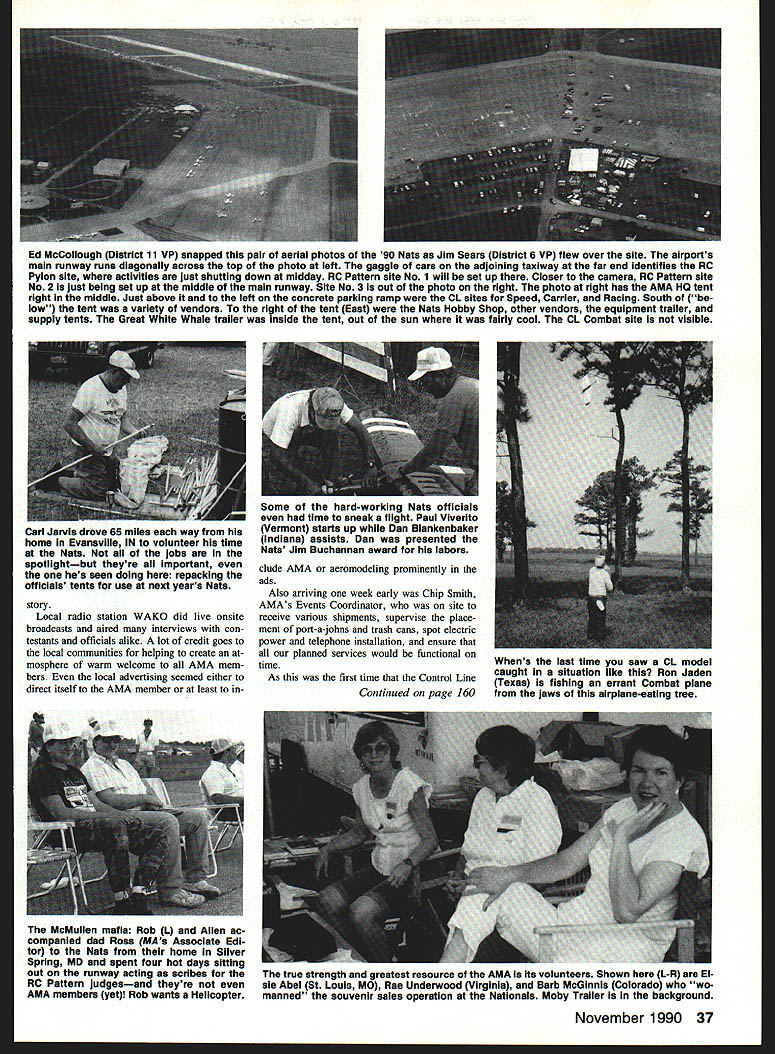
Also arriving one week early was Chip Smith, AMA's Events Coordinator, who was on site to receive shipments, supervise placement of porta‑johns and trash cans, spot electric power and telephone installation, and ensure planned services would be functional on time.
As this was the first time the Control Line and Radio Control National Championships were held on this site, some managers and directors came early to ensure a variety of surface and site preparations would take place in a timely fashion.
The Event Directors for the 1990 National Model Airplane Championships should be congratulated for assembling extremely good official crews. The '90 Nats was one of the smoothest‑running events in recent memory — perhaps the smoothest ever.
Events, sites, and schedule demands
There are many forces at work when judging whether a Nats is a good one. Local community enthusiasm — expressed in smiles, welcomes, advertising, banners and signs — seemed to put arriving contestants in a good mood. Excellent crews of officials kept the contest moving in good order. The Headquarters staff on site often pitched in with extra effort to help guarantee success. It is much easier to keep people happy when they arrive in a good mood than to try to change their minds if they arrive in a bad one.
In 1989 the RC Pylon and RC Pattern events were held on different sites, allowing an 8:00 a.m. to 5:00 p.m. schedule. The 1990 site did not permit separation of Pylon and Pattern, so the schedule ran from 7:00 a.m. (Quickie 500 Pylon started as early as 6:00 a.m.) until 8:00 p.m.
Comparing the two schedules, the 8:00–5:00 schedule is preferred. When Pylon Racing needs an extra hour, their start time can become 6:00 a.m. When Pattern runs over, the last flights may be held at twilight or darker. Early starts and very late finishes are annoying to competitors and oppressive to support crews who handle setup, teardown, cleanup and site maintenance. Concession stands and souvenir stands can never be open long enough to fully support events that run very early and very late.
The Soaring, Helicopter, and Control Line events have so far been spared the demands and strain imposed by the 7:00–8:00 schedule.
There was a time when the National Model Airplane Championships included only a handful of Free Flight events and site requirements were far simpler. Today, site needs are extensive:
- In the last half‑dozen years alone, the site requirement for Radio‑Controlled Helicopter has changed dramatically; RC helicopters now use a flying area comparable to RC aerobatics.
- RC Soaring has demanding requirements.
- Control Line requires 11 paved circles plus at least two on grass — that's 11 acres of smooth concrete plus three or four more acres of well‑maintained lawn.
In reality, a single location that fills the needs of all events does not exist. The 1990 Mid‑American Nats was no exception. Good flying sites were available for Pylon Racing, RC Aerobatics, RC Scale, Free Flight, Scale, and Control Line Combat. But Control Line Speed and Racing were held on less‑than‑perfect concrete. (Control Line Navy Carrier models must land and take off from an elevated wooden deck — the rest of the circle is the "ocean" — so concrete condition was of little concern for that event.) Control Line Precision Aerobatics events were held on an abandoned runway with a restricted width of 150 ft., which the CLPA fliers did not find ideal.
Both the city of Lawrenceville and the Mid‑American Air Center expended considerable time, energy, and equipment trying to sweep and clean the Control Line areas. Even the Speed and Racing contestants pitched in to help prepare the flying circles.
When it is understood that there is no perfect place for all events, it must also be accepted that at any location some events will experience compromise. In 1990 those compromises affected Control Line Aerobatics, Speed, and Racing. Nevertheless, many record performances occurred in Speed and turnout was excellent.
The level of competition in Control Line Racing was top quality, with world‑ and national‑class competitors and officials. In Precision Aerobatics there were a large number of entries and a very tough competition. Members of the U.S. Control Line FAI team and the Argentine FAI team left the World Championships in France to attend the U.S. Nationals.
Weather and attendance
Even the weather for the 1990 Nats was noteworthy. In the week prior to the Nats the temperature went from over 100°F on Monday to the low 60s with light rains and mist by midweek. During Nats week the weather from Saturday through Saturday was picture perfect.
However, on the last Saturday and the closing Sunday there were winds and light to heavy rains. Prior to that, the only notable rains affected the last two flights in RC Aerobatics, which were postponed and flown a half‑hour late. Sunday morning Scale flying started late due to rains and finished just prior to the anticipated afternoon showers.
Weather varied — cool, hot, dry, wet — but fortunately nothing had to be cancelled and only a few delays occurred.
There were 1,158 registered contestants at the Mid‑American Nationals. That number included:
- 170 Mechanics
- 39 Juniors
- 50 Seniors
- 899 Open contestants
This year's Nats also included competitors from the U.S.S.R., China, Japan, Australia, Argentina, and Canada. The Nats has long prided itself on being the world's largest model airplane contest, and growing foreign participation confirms that reputation.
Officials, awards, and appreciation
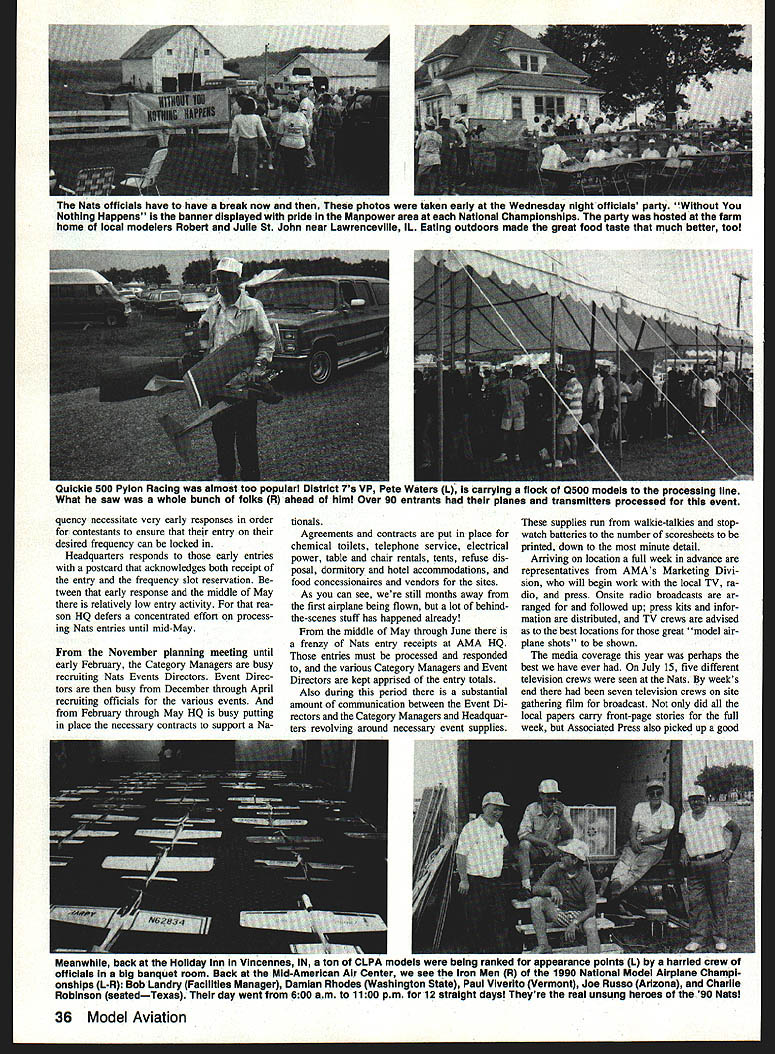
For those officials and workers who toil to make the National Model Airplane Championships a success, one brief moment during Nats week belongs to them. The officials' party, held midweek on Wednesday evening, was a special one. Robert St. John, Manpower Director of the 1990 Nats, and his wife Julie graciously made their home and yard available for the gathering. Away from the hustle and bustle, an atmosphere of good food and fellowship was provided to hardworking Nats officials.
At this gathering the Jim Buchannan Award is usually presented. Named after the late Jim Buchannan, the award goes to the Nats official who best exemplifies the friendly, warm enthusiasm vital to a national contest. This year the award was presented to Dan Blankenbaker of Terre Haute, IN.
Looking ahead — where are we going next year?
Toward the end of each year's Championships the question becomes, "Where are we going next year?" As of this writing there were five candidate cities prioritized by the AMA Executive Council:
- Chicopee, MA (Westover Air Force Base) — first choice
- Mid‑American Air Center — second choice
- Lincoln, NE — third choice
- Smyrna, TN — fourth choice
- College Station, TX — fifth choice
We have since received word that Lincoln had to withdraw its bid due to airspace complications.
A possible Nats at Chicopee is complicated by base availability: the base will be unavailable from July 14 through August 18, making a Chicopee Nats only possible June 30 through July 7 — which would include the 4th of July on Thursday of the Nats.
A return to Mid‑American would require resurfacing for the Control Line areas. The Tennessee and Texas sites are scheduled for initial investigative visits.
So while a definitive answer on next year's site was not yet available, planning and behind‑the‑scenes work for 1991 had already begun.
Transcribed from original scans by AI. Minor OCR errors may remain.

