
Genesis of the Big Bangers
Bob Beckman
Introduction
Have you ever thought about how the various chainsaw, blower, and weed-whip engines are adapted for Giant Scale model use? Our Giant Scale contributing editor provides a behind-the-scenes look at two examples—one manufactured that way, and the other an after-manufacture conversion.
For over two years the author, along with Kirby Crawford and Dick Roe, has been testing and reporting on some of the many small gasoline engines being made available for use in Giant Scale aircraft. These engines are classed as small by the manufacturers, but to most RC modelers accustomed to engines of less than one cubic inch displacement, they are Big Bangers, with total displacement ranging from about 1.2 cu. in. to over 6 cu. in.
Most modelers know that many of these engines started out as power plants for chainsaws. In addition, weed whips, backpack blowers, and any device needing a small, portable, self-contained power source can be the starting point for one of this new breed of model engines.
The first use of such engines was by individual modelers who did their own conversion work to prepare units for the relatively large models they wanted to build. Not everyone is equipped or inclined to do such work, however, so it wasn't long before those who were able to convert engines started providing converted units for the growing number of builders interested in larger models.
The Giant Scale movement has grown so rapidly that there are now literally thousands of such engines in daily use, but many Giant Scalers have little or no knowledge of the genesis of their power plants other than the general idea that they are "chainsaw engines." It would be impractical to detail the origin of every engine on the market, so two examples are chosen here as representative of the overall field: the Quadra (probably the best known of all the Giant Scale engines) and the Kawasaki, as converted by C.B. Associates.
The Quadra (TML 35 Engine)
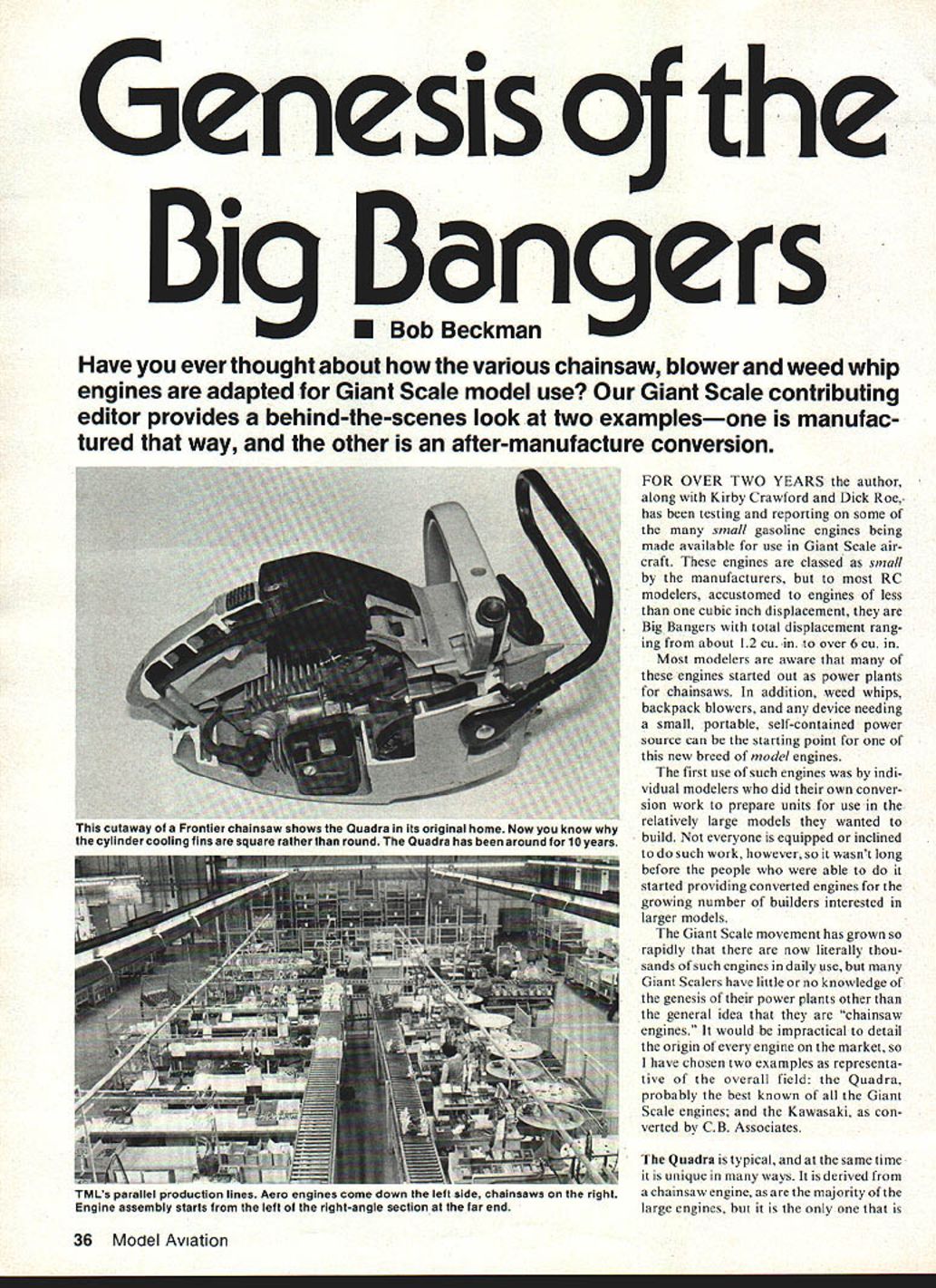
The Quadra is typical of many Big Bangers and unique in several ways. It is derived from a chainsaw engine, as are the majority of the large engines, but it is the only one built and offered by the manufacturer as an aero engine. It was the first engine available in substantial quantities and helped spur the rapid growth of the Giant Scale movement in the late 1970s. It has seen many minor—and some major—changes in its roughly ten-year existence, and it is soon to be joined by a larger version that is significantly different in design, construction, and size.
Brief history:
- The engine was first conceived in the early 1950s as part of a small chainsaw intended for general consumer use (as opposed to much larger professional saws).
- The first production engines appeared in August 1972.
- Quadra Manufacturing, with facilities in Trail, British Columbia, was formed to produce and market the Frontier Chainsaw. The unit was well received and was supplied under other brand names including Danarm, Husqvarna, Jobu, Jonsereds, Partner, and Pioneer.
- In 1974, Ron Shettler began working with engines taken from the saws, seeking a "large" power source for modeling and an RPV project for the RCAF. Because he required many engines, he began working with Quadra to produce an aero version.
- In 1977 the first production Quadras as we know them became available, providing the spark for modern Giant Scale activity.
- Quadra Manufacturing became Trail Manufacturing Ltd. (TML) and later, in 1982, TRINDEN (TRail INdustrial ENgines) Manufacturing Ltd. The Quadra name persisted for the aero engine.
TML expanded its product line beyond chainsaws and aero engines to include brush trimmers, ice augers, outboard motors, and bicycle drives—many powered by the Quadra engine. The new, larger engine has been designed from the ground up with aero use in mind but will also be used in similar applications.
Specifications and models:
- The TML 35 Engine (the Quadra's official name) is described as a "35cc class" engine; actual displacement is 34 cc (about 2.07 cu. in.). References to a 2.2 cu. in. Quadra are incorrect—the engine has always been 34 cc.
- The aero version is available in three distinct models, plus a marine version of each:
- Model I: The standard model, essentially the original engine. It uses a conventional ignition system with a magneto and mechanical points. Over the years, improvements have included cleaner cylinder castings, beefed-up mounting bosses, improved conrod and wrist-pin bearings, and other internal changes to meet Giant Scale needs.
- Model II: Replaces the standard ignition with a module that includes the magneto and electronic (capacitor discharge, CD) ignition.
- Model III: Adds a third main bearing in the space freed up by removing the points and condenser.
- The new 50 cc engine will be available with electronic ignition only.
Production:
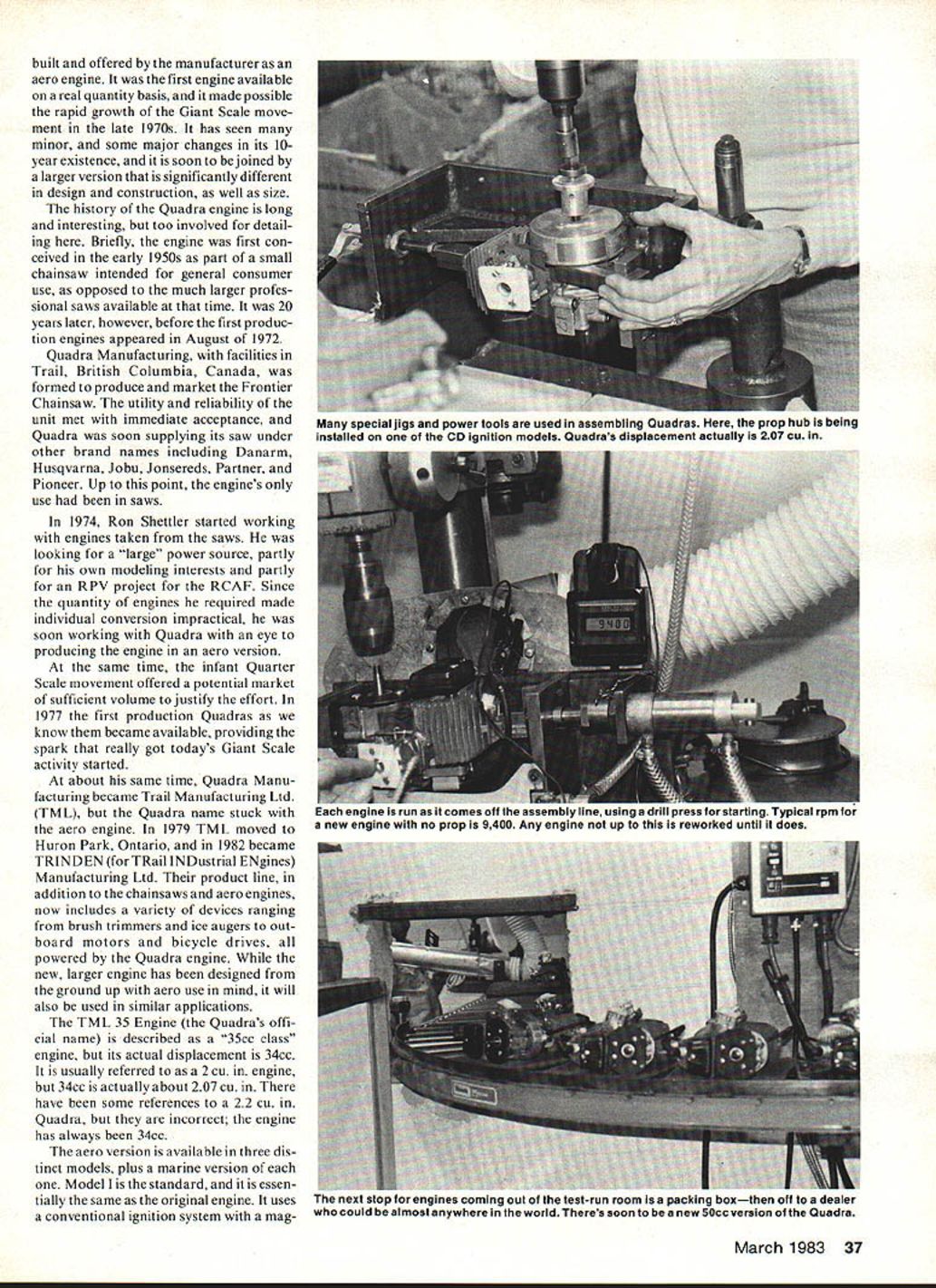
- TML has two parallel production lines. Many parts are identical, but differences appear early in assembly depending on the end product. For example, a chainsaw engine becomes part of the saw housing before the engine itself is completely assembled.
- Huron Park operations handle finish machining and assembly. Raw parts like cylinder and crankcase castings, pistons, rings, crankshafts, etc., come from subcontractors. TML performs drilling, tapping, grinding, and milling. Their engineering department handles design, specification, and testing.
- Quadra captured a large share of the Giant Scale engine market by being first with large quantities of a solid product and plans to continue development of the 34 cc version and introduce the 50 cc model. They also plan a new and expanded distribution network throughout the U.S. and worldwide.
Kawasaki Conversions (C.B. Associates)
The other side of the Big Banger picture is represented by Kawasaki engines converted by C.B. Associates—one 36 cc (2.22 cu. in.) and another 51 cc (3.15 cu. in.). Kawasaki conversions are also available from other sources, such as Horner Sales. The first important difference to note is the original purpose of these engines: they come from backpack blowers made in Japan. That difference in end use is significant.
Vibration and smoothness:
- Vibration has been a difficulty for Giant Scale modelers. Chainsaw engines can be quite "shaky," which is acceptable in a handheld saw but undesirable in aircraft.
- Engines intended to be carried on the back must be engineered for minimum vibration, which suits modeling requirements.
- Based on testing by the author, Kirby, and Dick, the Kawasakis are considered the smoothest-running engines they have seen. A close second is the 2.4 Kioritz, another blower engine.
Typical conversion steps by C.B. Associates:
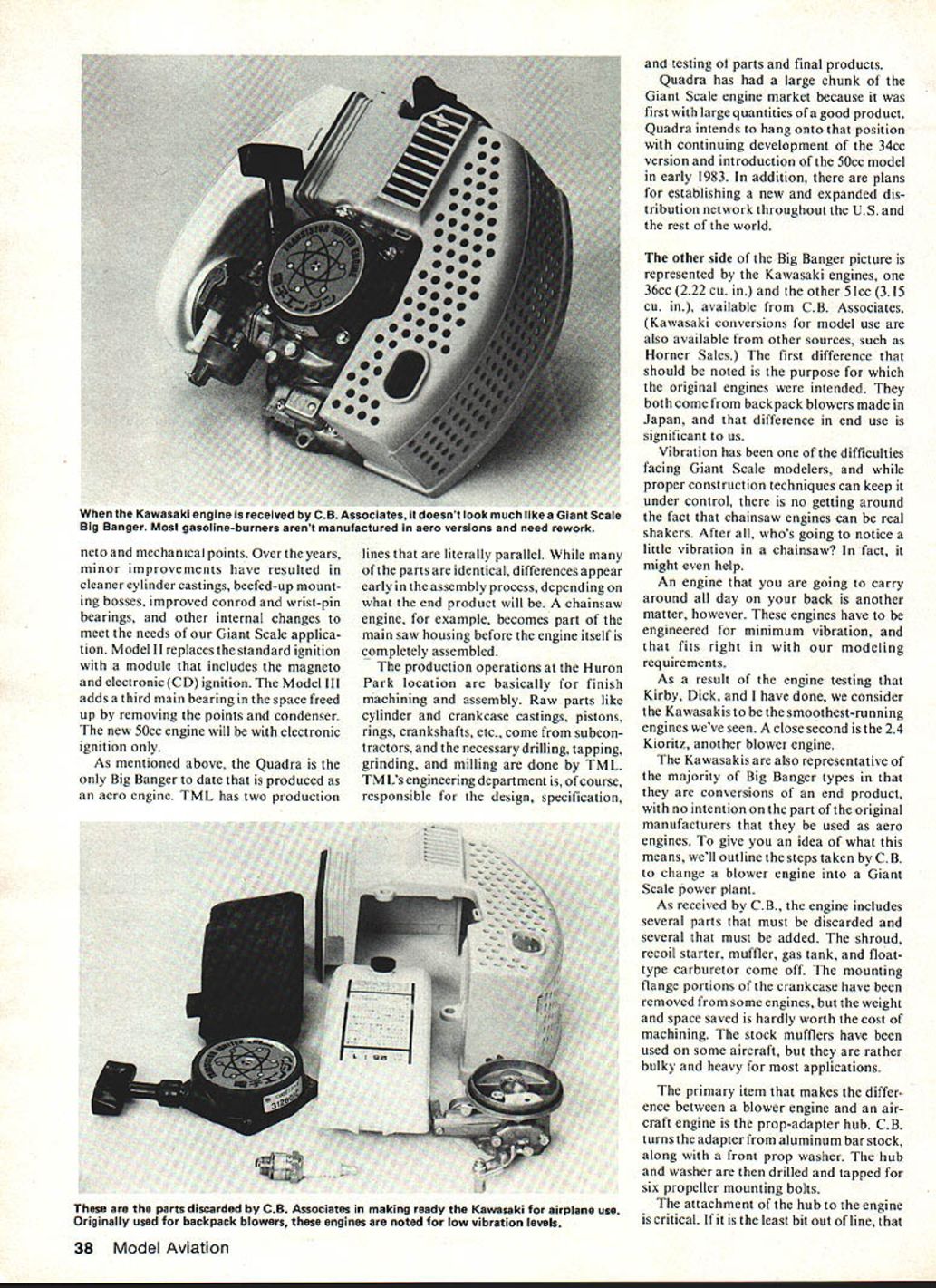
- Remove parts not needed for aircraft use: shroud, recoil starter, muffler, gas tank, and float-type carburetor.
- The mounting flange portions of the crankcase have sometimes been removed, but the weight and space saved rarely justify the machining cost.
- Stock mufflers have been used on some aircraft, but they are bulky and heavy for most applications.
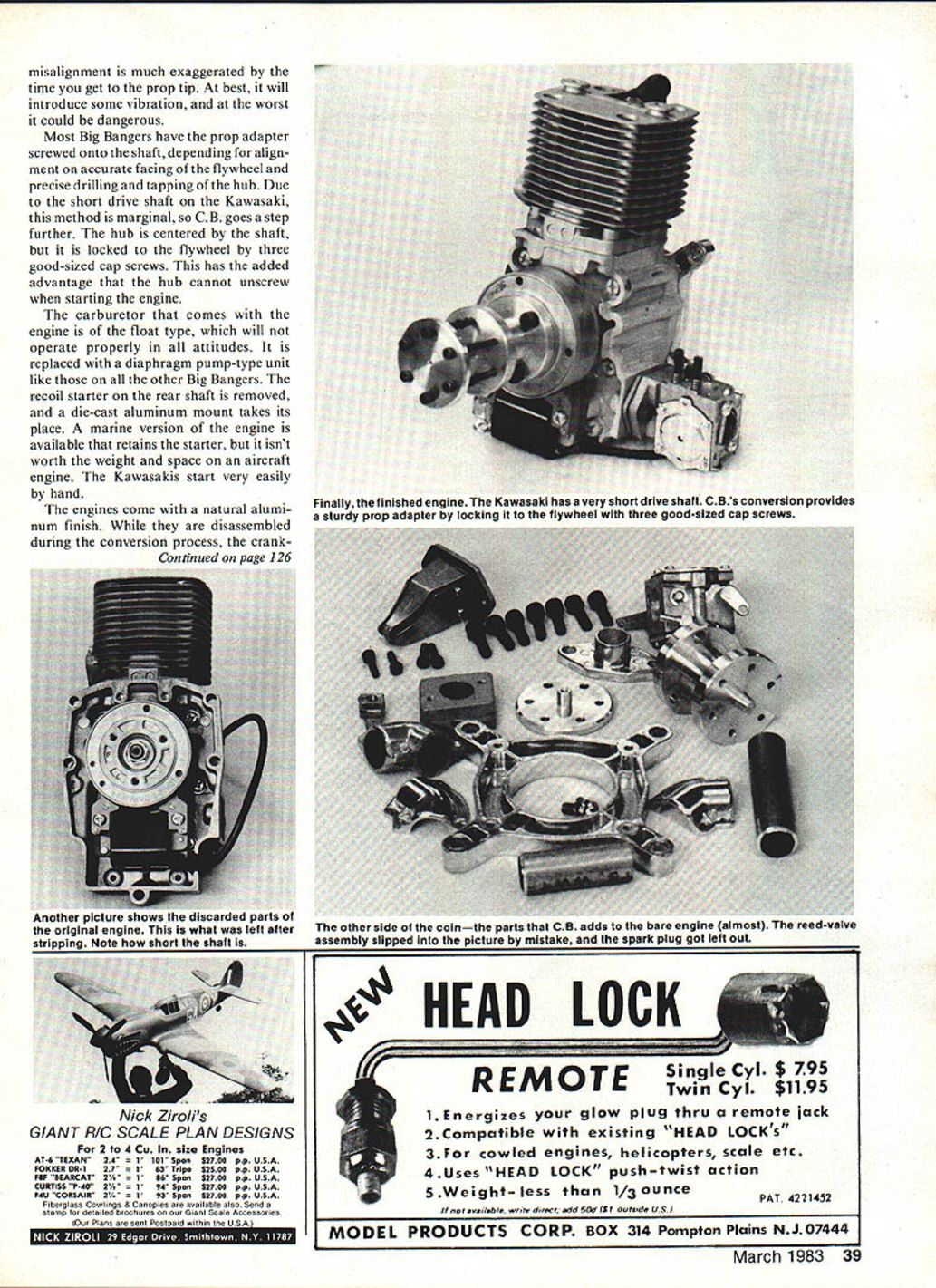
- The primary addition for aircraft use is the prop-adapter hub. C.B. turns the adapter from aluminum bar stock, along with a front prop washer. The hub and washer are drilled and tapped for six propeller mounting bolts.
- Attachment of the hub to the engine is critical. Any misalignment is exaggerated at the prop tip and can introduce vibration or be dangerous. Most Big Bangers have the prop adapter screwed onto the shaft, relying on accurate facing of the flywheel and precise drilling and tapping. Because of the Kawasaki's short drive shaft, C.B. further locks the hub to the flywheel with three good-sized cap screws. This also prevents the hub from unscrewing when starting the engine.
- Replace the stock float-type carburetor (which will not operate properly in all attitudes) with a diaphragm pump-type unit like those on other Big Bangers.
- Remove the recoil starter on the rear shaft and replace it with a die-cast aluminum mount. A marine version that retains the starter is available, but it is not worth the weight and space for aircraft. The Kawasakis start very easily by hand.
- Finish: engines come with a natural aluminum finish. During conversion the crankcases are painted red and the cylinders black. After reassembly, a die-cast aluminum manifold and aluminum tube exhaust pipe are added. Each engine is started and briefly test-run before shipping.
The final product delivered to the customer is one of the finest Big Bangers available today.
Other approaches and exceptions
While many converters follow a similar conversion process, there are exceptions. Hobby Lobby's Evra 190 is one example. This 1.9 cu. in. engine has a specially designed crankcase similar to smaller model engines; the rest of the parts come from a weed-whip engine. The crankcase design is owned by Hobby Lobby, and the engines are made by the manufacturer of the original engine, putting it in a category somewhat similar to the Quadra.
Conclusion
Whatever the source, the many fine Big Bangers available today make it possible for many of us to enjoy Giant Scale modeling. If everyone had to convert their own engines, events like the IMAA Fun Fly Festival, with hundreds of Giant Scale aircraft participating, would be far less likely to occur.
Transcribed from original scans by AI. Minor OCR errors may remain.

