
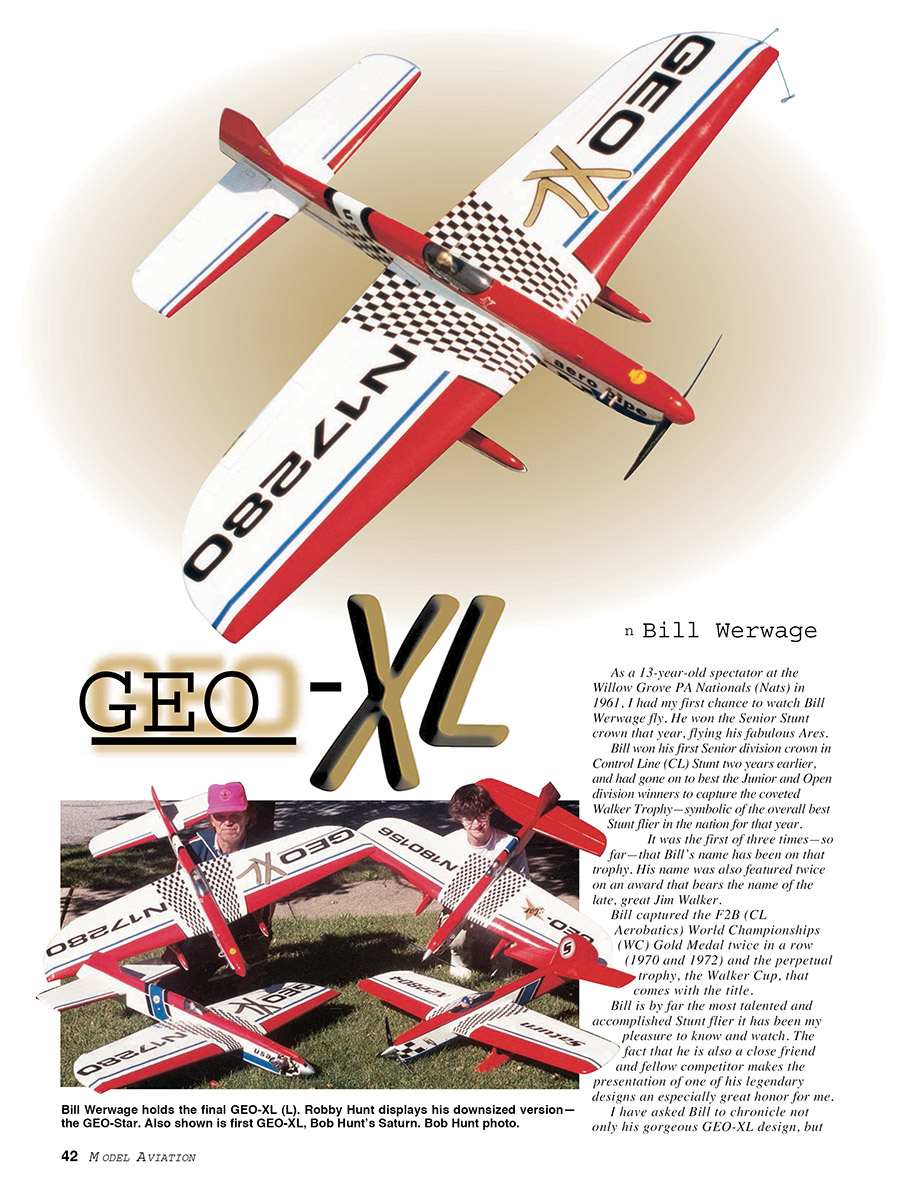
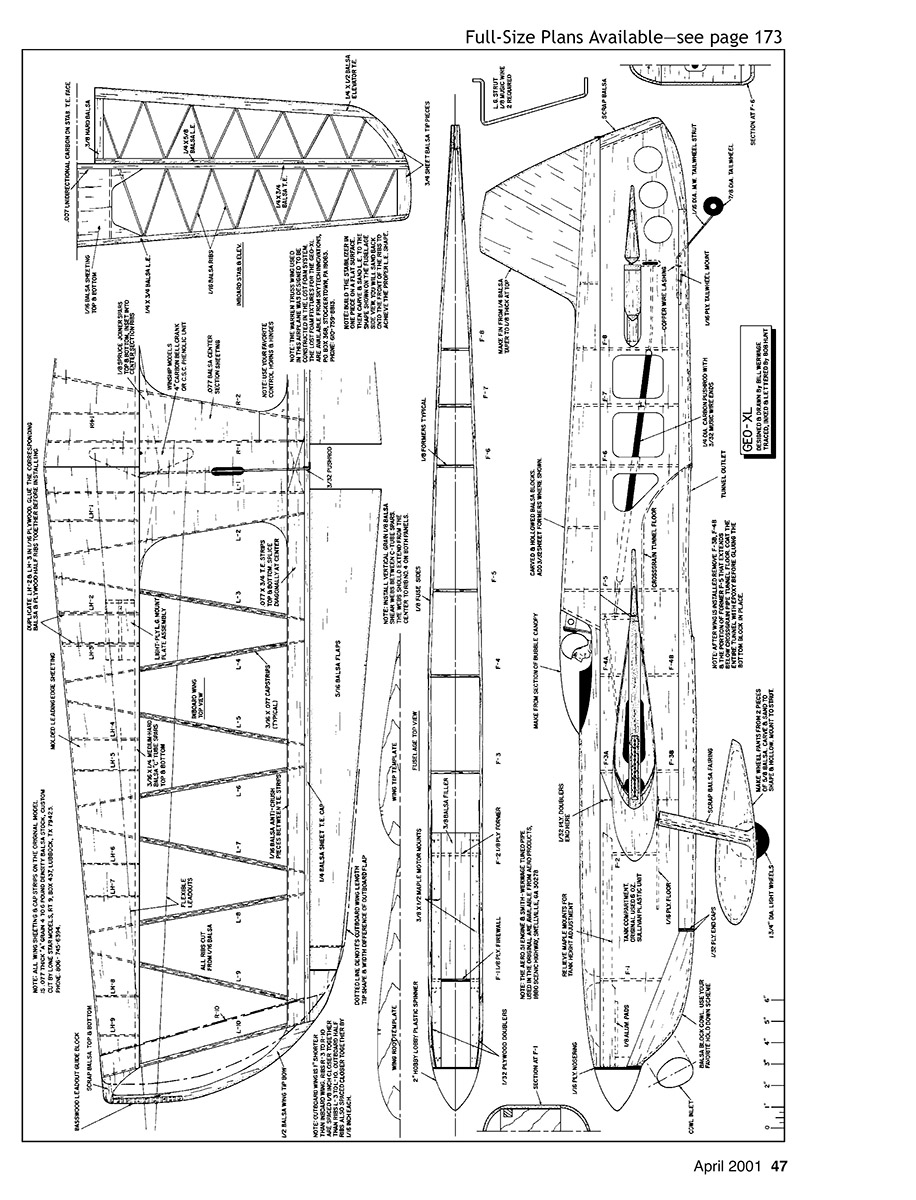
GEO-XL
As a 13-year-old spectator at the Willow Grove, PA, Nationals (Nats) in 1961, I had my first chance to watch Bill Werwage fly. He won the Senior Stunt crown that year, flying his fabulous Ares.
Bill won his first Senior division crown in Control Line (CL) Stunt two years earlier, and went on to best the Junior and Open division winners to capture the coveted Walker Trophy—symbolic of the overall best Stunt flier in the nation for that year.
It was the first of three times—so far—that Bill’s name has been on that trophy. His name was also featured twice on an award that bears the name of the late, great Jim Walker.
Bill captured the F2B (CL Aerobatics) World Championships (WC) Gold Medal twice in a row (1970 and 1972) and the perpetual trophy, the Walker Cup, that comes with the title.
Bill is by far the most talented and accomplished Stunt flier it has been my pleasure to know and watch. The fact that he is also a close friend and fellow competitor makes the presentation of one of his legendary designs an especially great honor for me.
I have asked Bill to chronicle not only his gorgeous GEO-XL design, but its lineage from roots in his legendary USA-1 series of Stunters. Bill is not one to talk much about himself or his accomplishments; he'd rather let his flying do the talking. I have asked Bill to make an exception in this case, and tell the technical story of this design and the background stories of the many models that led up to it, and their incredible competition record. His fellow competitors call him "The Man." The following story may help explain why.
—Bob Hunt
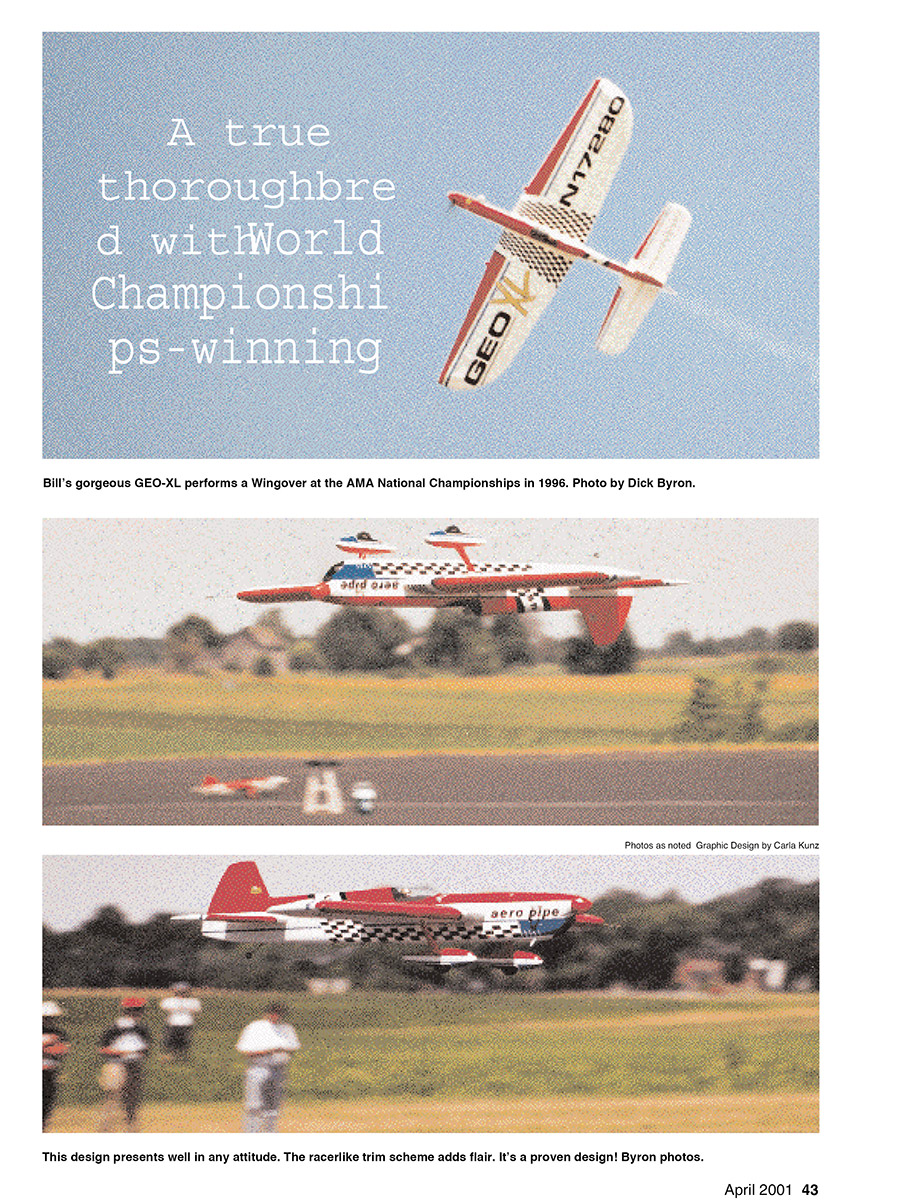
A true thoroughbred with World Championships–winning heritage.
THE YEAR 1961
The year 1961 brought the first serious change in competitive philosophy in the CL Stunt event since the implementation of the "modern" pattern in 1958. Up to that point, most successful modern flapped Stunters were powered by .35-size engines and were in the 525- to 575-square-inch wing-area range.
Lew McFarland threw a serious monkey wrench into that equation by winning two Nats in a row with his behemoth (at least for the time) Stunter—the Shark 45. Lew's performances at Willow Grove in 1961 and Glenview in 1962 served notice to the CL Aerobatics community that there was at least one more formula that would work and win in Stunt. His big Squalo (Shark) was powered by a K&B .45, and it produced a considerable balsa overhang with its approximately 680-square-inch wing area.
I flew in the Senior division with my original Ares design at both of those Nats. The Ares had been very good to me, netting three divisional wins (1959, 1961, and 1962) and one Walker Trophy Fly-Off victory (1959). The Ares was, and still is, a great-flying .35-size Stunter.
However, I liked the presentation of the larger model—especially on the expansive ramps at the Nats. The "normal" Stunters seemed small compared to Lew's Shark—on the ground and, more importantly, in the air. The Shark maneuvered with a smoothness that seemed to mesmerize the judges. In an event where impression is an important intangible, that was a signal to us all that this wasn't the last large Stunter we would see.
New power plants were emerging, and for the first time I could imagine myself flying a larger model competitively. The venerable Fox .35 was the main reason why the smaller aircraft were so successful; it was the perfect amount and type of power for Stunt. However, that was about to change.
My first meaningful experiment with larger Stunters began with what seemed to be a scaled-up Ares; it was actually a completely different set of numbers stretched onto an aesthetic package that had been successful for me. The Super Ares was a new airplane.
The model featured long nose and tail moments, a fairly high aspect ratio, swept-forward trailing edge, and I-beam wing. The wing thickness at the high point was 2 3/8 inches—not thick by today's standards, but beefy for the time.
The Super Ares was developed when I was serving as a combat engineer in the Army. Because of that service, I had little time to devote to development or competition flying. Still, the model proved to be good.
I took the Super Ares to the Nats in California in 1963, with almost no practice or trim time beforehand, and placed a close second in my first Open finals behind Bob Gialdini. He was flying his rakish Stingray.
I had to skip the 1964 Nats because of commitments to Uncle Sam. Jim Silhavy captured that contest, flying a traditional Fox .35-powered Nobler. Not on his heels were Mario Rondinelli with his largish (roughly 600 square inches of area) Venus (also powered by a Fox .35) and Larry Scanzini, who flew an original Fox .59-powered jetlike design called the Blue Angel.
The Blue Angel was designed, built, and finished in less than two months for that Nats, and it featured a 610-square-inch wing. From all accounts, its larger size was very impressive. It would have been interesting to see what would have happened had Larry been able to practice with and trim on the Blue Angel for a few months before competing with it.
Bob Gialdini brought his giant Eclipse to Willow Grove in 1965, and won the Nats with the 760-square-inch design. Bob's flying was excellent, as usual, but the impression of the large model certainly helped! I finished fourth (or fifth that year—it's getting harder to remember these things), again flying the Super Ares.
Bigger models were starting to score! The .35-size airplane wasn't dead, but it was in a mortal—and ultimately losing—battle. Smaller models won the remainder of the 1960s Nats, but more and more big aircraft were being flown, and were placing consistently high in major meets.
In approximately 1967, I began to realize that although the big airplanes were impressive, they were not flying all that much better than the smaller models. They were better in good conditions, but they suffered from a lack of power in wind. The engines of the time were not putting out enough additional power to make the larger airframes perform well in extreme conditions. We either had to make the models smaller again or find a way to make them fly better with the available power.
I was not ready to give up the impression that the larger model offered, and I began to look for ways to solve the problem. I reasoned that a thinner wing would be easier to "pull" through maneuvers, and would not put too much of a load on the engine. The thrust-over-drag factor would become better all around.
I wanted smoothness, so I opted for a fairly low aspect ratio, wide-chord wing. Extremely tight cornering was not the main goal at this time, but smoothness and penetration were very important. This would change in the future.
I didn't want this to look like a "barn-door"-type wing, so I swept the wingtips forward in a graceful curve. This gave the wing a distinctive shape.
Construction was the proven I-beam type that had worked so well on the Ares and the Super Ares. And this model was big, with a 62-inch span and 760 square inches of wing area! The airfoil thickness was 1 7/8 inches at the high point at the root. I also incorporated a bit more leading-edge sweep than normal, effectively lengthening the nose moment.
Instead of the K&B .45, I tried the SuperTigre .40. Jerry Worth had one in his Electra design, and I watched him fly it at a contest in Detroit. I was very impressed by the engine's smooth run and abundance of usable and tunable power. The SuperTigre .40 was very light, at slightly more than eight ounces. By adding a 3/4-inch-long aluminum shaft extension, which set the engine back, the center of gravity fell right on target. The result was a very streamlined, jetlike look at the nose.
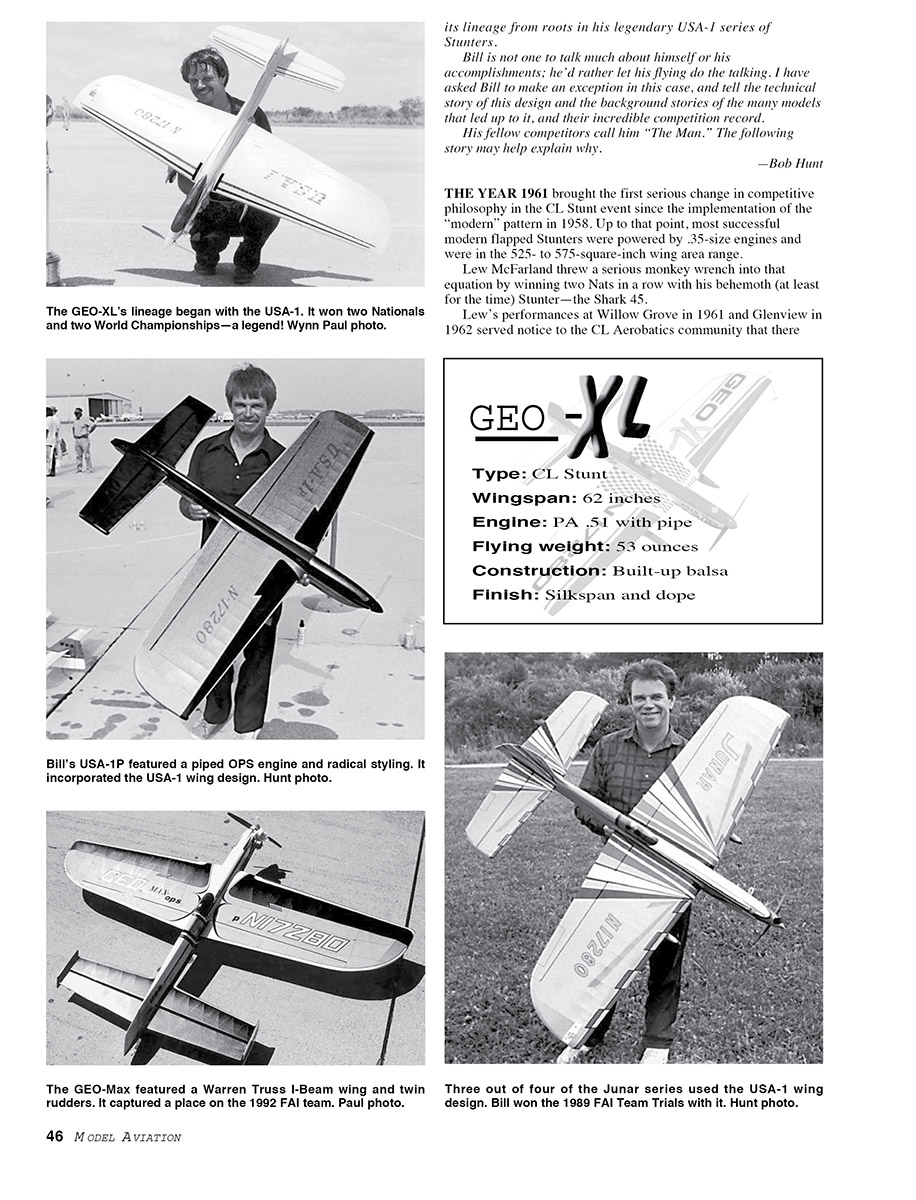
The original USA-1 was the first model with this new wing and engine setup. This design was flown to a disappointing fifth place at the 1969 Nats. I actually won the qualifying round and the first Finals round. I had to fly early in the last round, and the scores got higher as the round wore on. It was a beautiful flight. However, the other competitors seemed to like the model, and I liked the way it handled the wind. It never seemed short on power, and it dealt with turbulence very well.
Jerry Worth had built a new design called the Apterix, and it had some unique aesthetics that I liked. After the 1969 Nats, I changed my model's rudder shape to one similar to Jerry's design and the USA-1's final shape was established then.
The design was flown in this configuration before the end of 1969, making it legal for use in the Classic Stunt event in its original form and its final form.
I flew the USA-1 in this basic configuration in competition from 1970 off and on through 1984. It did pretty well for me, capturing:
- Two WC Gold Medals (1970 and 1972)
- Two National Championship titles (1971 and 1981)
- Several berths at US Team Trials (1969, 1971, 1973, 1975, and 1981)
During those years I designed, built, and flew a few other designs, including one of my other all-time favorites—the Juno.
I also built a one-of-a-kind USA-1 with a thicker (2 1/4 inches at the high point), higher aspect-ratio wing. It flew well, but was not as good as the original USA-1 design. I used that model to place third at the 1980 WC and the 1980 Nats. Bob Hunt borrowed the model to train the judges at the 1981 Team Trials, and he said it was the best-flying airplane he had flown. He really would have liked the original model!
Those interim designs were successful, but the original thin-winged USA-1 usually won in precontest flyoffs. That wing is really special, and its story doesn't end with the USA-1.
In a weak moment in 1986, I tried a Stunter powered by a SuperTrio .60. I wasn't sold on that engine, but it was having its share of success on the national Stunt scene. The original USA-1 wing design was pressed into service again. Even though that wasn't my most successful airplane, the great windy and turbulent-weather characteristics inherent in that wing design made it friendly to fly. I called it the Hungarian Bull, in tribute to the Hungarian WC in which it was flown that year.
The only change to the wing was in construction. I made it a D-tube wing, in place of the I-beam that had been used in the first two USA-1s. That made little or no difference in how the wing performed in the wind and turbulence.
That airplane was modified a year later to accept the OPS .40 and carbon tuned-pipe setup that Dean Pappas and Rich Tower had initially developed. The model came to life with that power system, and it was a very competitive package. It was named the USA-1P (the "P" standing for Pipe).
The aesthetics of that model were too far from the norm for me, and it didn't score as well as I thought it should have.
The piped OPS .40 and USA-1 wing combination was so compelling, I designed a new, more classically styled model around it for the 1989 season. This was the first of the Junar series of Stunters. (There were four, but one had a somewhat smaller wing.) The original Junar saw a great deal of contest service, and racked up more than 2,000 flights! I used it at the 1989 Nats in Pasco, Washington and finished a close second to Jim Casale, but scored a win with it at the Team Trials that year. I used the Junar for the next couple of years, flying it at the 1990 WC in France and the Nats that year.
In 1991, I used an interesting variant of the USA-1 wing in a model I called the GEO-Max. The "GEO" came from the angled, or "Warren Truss"-type ribbing scheme, and the "Max" came from the engine I used in that model—the O.S. Max .46 VF.
By this time, I had taken over the carbon-pipe producing business Bob Hunt had started, and this model was a great test bed for piped power system development. It featured I-beam wing construction and sported twin rudders—a radical departure for me in the looks department.
I tried a side-mounted engine and a soft mount, in an effort to reduce noise. It was, and still is, a great-flying model, but it was prone to breaking the custom-built headers that were necessary because of the unique engine system. It placed well for me at the 1991 Team Trials, earning a berth on the 1992 team.
I used the Junar for the 1992 WC, and along with that year's Champion Paul Walker and Bob Hunt, captured the first Team Gold for the US in 10 years. That was the first Fédération Aéronautique Internationale (FAI) team on which all Stunt models were powered by piped engines.
That WC was held in Czechoslovakia on an extremely turbulent field, and the USA-1 wing in the Junar proved to be a stable, predictable, smooth platform. And the piped OPS .40's extra horsepower didn't hurt.
I stripped the finish off of the GEO-Max design in the winter of 1992 and rebuilt it with a tall single rudder/fin. I refinished that model in a red, white, and blue scheme with black checkerboards, and renamed it the GEO-XL.
It continued to fly extremely well in that configuration, but it had a more classic look that I thought the judges might find more acceptable—and they did. The first GEO-XL flew to a close second at the 1993 Nats, and I was sure this was going to be another good one. It almost was.
The header problem got very bad at the Team Trials that year, and several broke that week. When the header broke, the engine went quiet, and competitive flying was impossible. I lucked out in competition flights for the first part of the contest, but Mr. Murphy (Murphy's Law) showed up in the finals and that meet was history.
I liked the model's looks very much, and the comments I received from other fliers and some judges convinced me to try another one with a more practical engine-mounting system.
I built the second version with a Warren Truss D-tube wing and incorporated the first radical change to the original USA-1 airfoil shape since its beginning in 1968. I blunted the nose of the airfoil with a larger radius.
This GEO-XL was great from the start. It flew through wind as well as all the other USA-1 variants, but it was even smoother! The biggest improvement this change made was in cornering. The one weak area of the low-aspect-ratio wing design was finally overcome.
The addition of ever-more horsepower throughout the years had also contributed to the performance of this wing, and I finally felt that this design string had reached its zenith. This was a thoroughbred Stunt weapon of which I could be very proud.
The GEO-XL presented here is a direct descendant of the original USA-1, with the same wingspan (62 inches), wing area (760 square inches), and shape. The only difference—and it's a major one, which brought the design up to modern cornering standards—is the increased leading-edge radius.
My choice for power was the amazingly powerful and consistent Precision Aero (PA) .51, fitted with a carbon-fiber tuned pipe that Randy Smith and I co-designed.
The finished weight of the GEO-XL was 53 ounces, which is a big part of why it performs so well. This model has to be built on the light side for you to really experience its advantages.
CONSTRUCTION
Fuselage/tail assembly
There is nothing too different from the norm in the construction of these areas. As with any model, these need to be built as accurate and light as possible. The plans are clear on the techniques involved.
Wing
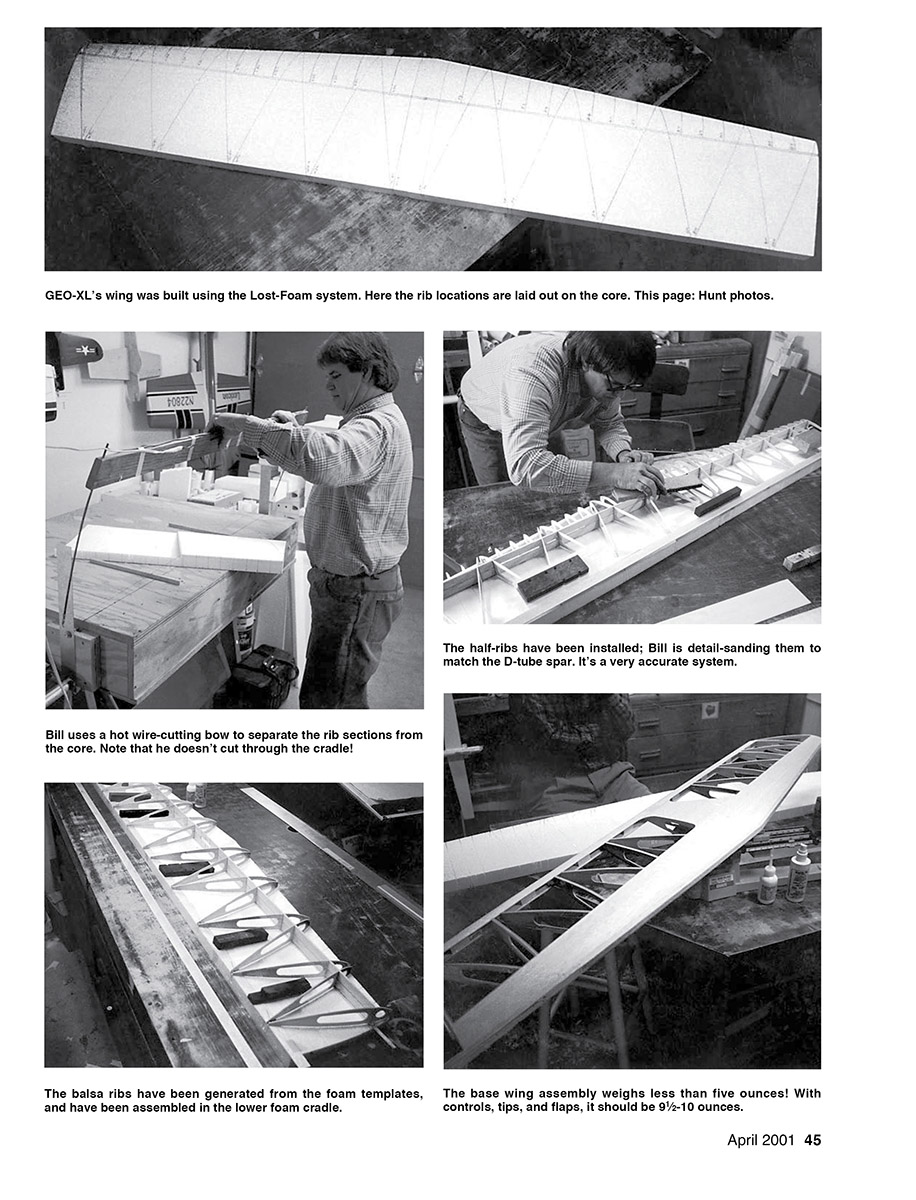
Here lies the real difference in building this design. Because of the nature of the Warren Truss ribbing arrangement, I used Bob Hunt's Lost-Foam Wing Building System. This wing would be difficult to build accurately in any other fixture. The unusual and involved nature of the Warren Truss configuration, and the precision rib shapes at each rib station, would be hard to plot.
The original GEO-XL's wing (shown in the construction pictures) featured a D-tube wing with a 1/16" sheet spar. Subsequent wings have been built with shear webbing installed between the top and bottom spars, from the center to just past the landing-gear mount area.
The C-tube has proven to be a much easier wing to construct accurately, and this is the type of wing construction shown on the plans.
In the Lost-Foam system, accurate rib shapes are obtained by laying out the entire ribbing scheme on the core with the location of the ribs marked. The spar location is also laid out on the core, on the top and bottom surfaces.
The exact ribbing scheme and spar positions are laid out again in the lower cradle halves, from which the cores are cut. The cradles are just as accurate a negative shape as the cores are a positive shape.
The corresponding rib positions on the core and the cradle are labeled with a ballpoint pen, then the core is accurately cut vertically at the rib stations, yielding perfect foam templates of the ribs. Because the spar was laid out prior to this cutting, its location is also accurate on each of the foam rib templates.
These foam templates are used to trace each rib onto 1/16" sheet balsa. The ribs are cut just outside the traced line, then each rib is realigned onto the foam template from which it was traced and pinned securely in place. Use a sanding block to bring the edges of the ribs down flush with the surface of the foam template.
Bob uses two-pound-density foam for these fixtures, and sanding the ribs against them will not distort the airfoil shape of the template. Dozens of wing-rib sets can be made from one set of templates.
In a Warren Truss wing, cutting the core vertically yields angled pieces of foam. There is a rib template on either side of the angled pieces, which allows you to pin one rib to each side of the foam piece and sand two ribs to the shape at once! The result is a perfect rib shape at each rib station.
Once all the ribs are cut and sanded, build the wing in the form-fitting lower cradle halves. This process sounds complicated, but it builds up very quickly once all the parts are fabricated.
The original GEO-XL wing built in this manner had a standard carved sheet-balsa leading-edge cap. Through the years, I have learned that a carved leading edge can be a source of accuracy problems. If the radius is not the same from the apex of the curve to the surface of the wing on both sides, the model can—and usually will—be difficult to trim. This problem can ruin an otherwise good model.
For this reason, I have switched to molded balsa leading edges. They are extremely accurate and are repeatable from model to model.
A detailed description of the Lost-Foam building process and the leading-edge molding technique would take more room to describe than I have here. Soon Bob will have a how-to article on the Lost-Foam system in Model Aviation.
If you have your own foam-cutting equipment, you should have little trouble producing Lost-Foam cradle and template sets and leading-edge mold bucks. The foam templates for cutting Lost-Foam wing fixtures are included on the plans. If you don't cut foam, Bob offers the GEO-XL among the many wing designs for which he produces the Lost-Foam system. Contact him at (610) 746-0106 or write to Robin's View Productions, Box 68, Stockton, PA 18083. Complete illustrated instructions are provided with each Lost-Foam system for building the wing and molding the leading edges.
The plans are complete, and should answer any other building questions you have.
Control System
This is one of the most critical parts of any Stunt model. Throughout the years, I have experimented with many types of bellcranks and control horns.
The best control-system hardware I have used is available from Winship Models. Dan Winship produces a four-inch carbon bellcrank that is hand-laid from carbon-tow material. It is bushed at both ends and at the pivot point.
Dan also provides these bellcranks with Mil-Spec flexible leadout wire installed. He runs the wire through annealed brass tubing, which rides in the bushed bellcrank ends. These are lightweight, strong, accurate units.
Dan produces a complete line of flap and elevator horns in a variety of sizes and types. I use his slotted/adjustable elevator horns in my models to allow me to adjust the ratio of elevator versus flap movement.
I like to dial out as much flap movement as possible, and fly more off the elevator. The result is less drag and tighter corners. These horns allow this fine-tuning quickly at the field.
You will know you have reduced the flap movement too much when the model shows a stall during hard cornering. You need enough flap movement to provide sufficient lift, and no more!
You must build a light model to really get the benefit of this adjustment. If your GEO-XL weighs less than 55 ounces, you will definitely be able to dial out some flap movement. If it weighs more than 56 ounces, you will probably have to stick with the one-to-one ratio setup.
Dan's elevator horn features a laser-cut upright that has a dogleg, to allow the horn to travel downward without the necessity to notch the stabilizer's trailing edge.
I highly recommend using Dan's horns and bellcranks in all competition Stunt models.
You can order this high-quality hardware from: Winship Models 5971 Oak Hill E. Dr. Plainfield, IN 46168 Tel.: (317) 839-8316
Engine
The PA .51 in the original GEO-XL is strong and reliable, and is excellent for powering a model this size. Also consider the PA .61, which has even more power. The PA .61 was not around when I was flying the GEO-XL in competition. I'd have used one if it had been!
The PA line of engines, the carbon-fiber tuned pipe, and the Bolly carbon-fiber propellers on the original GEO-XL are available from: Aero Products 1880 Scenic Hwy. N. Snellville, GA 30078 Tel.: (770) 979-2035
The best propeller used on the original GEO-XL was a 12 x 4 Bolly three-blade. I used 70 feet of .014-inch-diameter stress-relieved stainless-steel solid lines, and Sig 10% nitromethane content fuel with two fluid ounces of Aero-1 additive (available from Aero Products).
Finish
I recommend an all-Brodak system. Brodak's new dope finishes are the best I have used in my 47 years of Stunt flying. The only suggestion I have is to add a bit more plasticizer. I use Dave Brown Products' Flex-All; it is compatible with the Brodak dope.
I covered the model with 00 silkspan, which is available from Brodak Manufacturing.
This line of models built using this basic wing design were easy to fly and trim. It's an airplane you can "pick up and fly."
Build the GEO-XL light and straight, power it well, and practice, practice, practice!
Bill Werwage 111 Jacqueline Dr. Berea, OH 44017
Transcribed from original scans by AI. Minor OCR errors may remain.

