
George M. Myers Reports the 1991 WRAM Show
At this year's WRAM Show, the message was clear: building them light is the way to go in 1991. Our sharp-eyed reporter also had a good look at the latest in Soviet modeling products.
Soviet Visitors and Observations
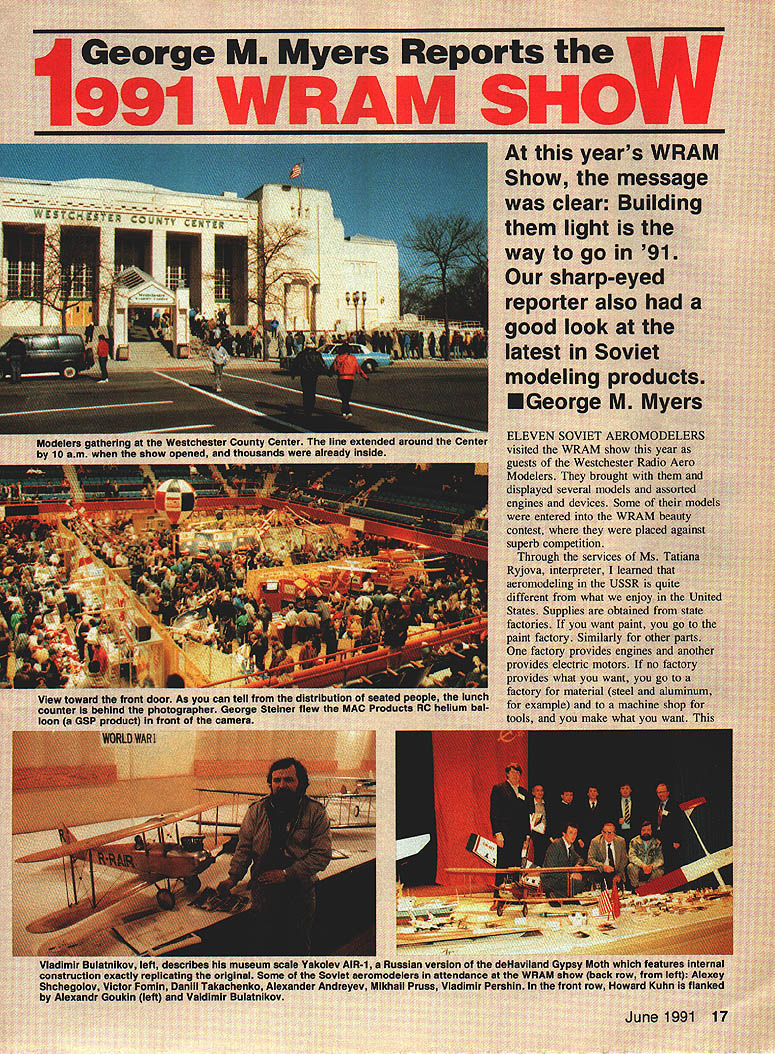
Eleven Soviet aeromodelers visited the WRAM show as guests of the Westchester Radio Aero Modelers (WRAM). They brought and displayed several models, assorted engines and devices. Some of their models were entered into the WRAM beauty contest and competed against superb American entries.
- The visitors displayed scale and sport models, engines, and other equipment.
- Several items shown were available for sale.
Through the services of Ms. Tatiana Ryjova, interpreter, I learned that aeromodeling in the USSR differs significantly from the U.S. Supplies are obtained from state factories: paint from a paint factory, engines from an engine factory, electric motors from another factory. If a factory does not make what you want, you obtain raw material (steel, aluminum) and go to a machine shop to fabricate parts. Aeromodeling in the USSR may involve using surplus materials and working on a non-interference basis.
There is one magazine for aeromodelling and one retail store for supplies. Under perestroika, plans were reported for more retail outlets. Direct importation is a problem because rubles were not convertible in international trade at that time, so transactions often had to be worked out on a barter basis.
There is a central organization for aeromodelling—similar to the AMA for rules-making and contests—that also supports educational activities embodied in Model Aviation, promotional films and videos, and other programs. The Central Sport Technical Club Air Modeling accepts members of any age. Club meetings and model construction take place in state buildings; the models belong to their builders, while flying occurs in state parks under state supervision.
Putting myself into the visitors' situation, it felt awkward: non-English-speaking guests in a bustling New York show environment, surrounded by thousands of fast-talking American modelers, hundreds of vendors in brightly colored stalls, and loud demonstrations. It would be like visiting a banquet with your jaw wired shut.
Notable Soviet Models and People
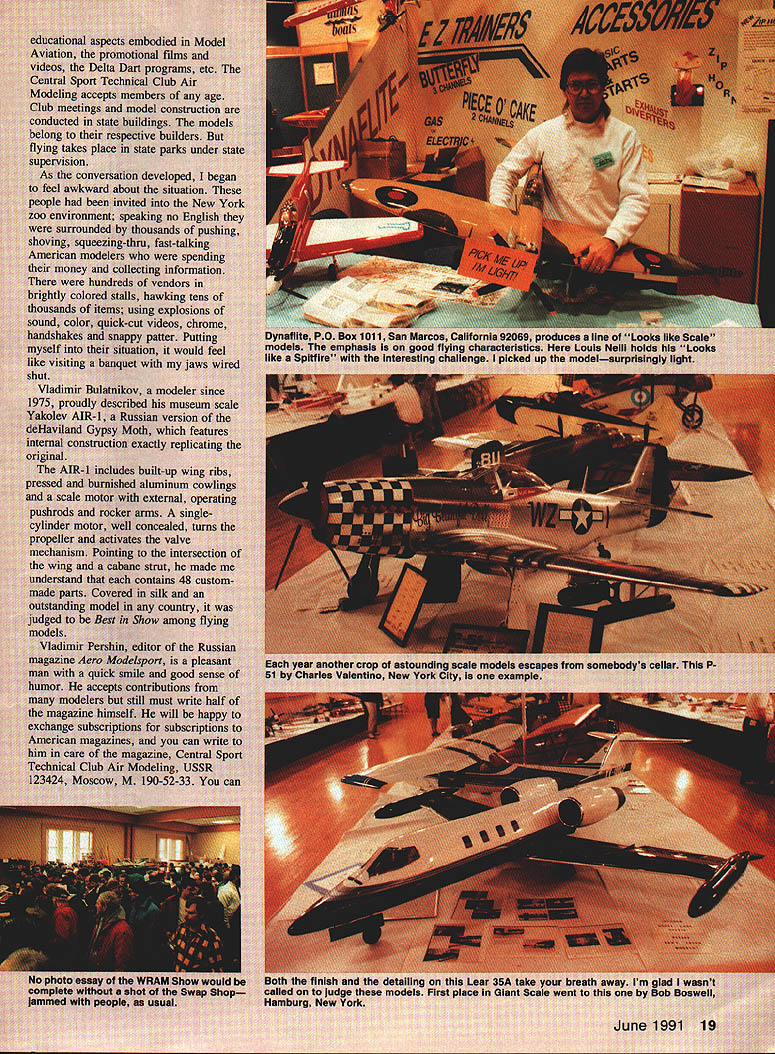
Vladimir Bulatnikov, a modeler since 1975, proudly described his museum-scale Yakovlev AIR-1, a Russian version of the de Havilland Gypsy Moth. The AIR-1 features internal construction that exactly replicates the original: built-up wing ribs, pressed and burnished aluminum cowlings, and a scale motor with external, operating pushrods and rocker arms. A single-cylinder motor, well concealed, turns the propeller and activates the valve mechanism. Bulatnikov pointed out that the intersection of the wing and a cabane strut contains 48 custom-made parts. Covered in silk and outstanding in workmanship, the AIR-1 was judged Best in Show among flying models.
Vladimir Pershin, editor of the Russian magazine Aero Model'sport, is a pleasant man with a quick smile and a good sense of humor. He solicits contributions from many modelers but still writes about half the magazine himself. He is willing to exchange subscriptions with American magazines. Correspondence can be sent care of: Central Sport Technical Club Air Modeling, USSR 123424, Moscow, M. 190-52-33. You may write in English.
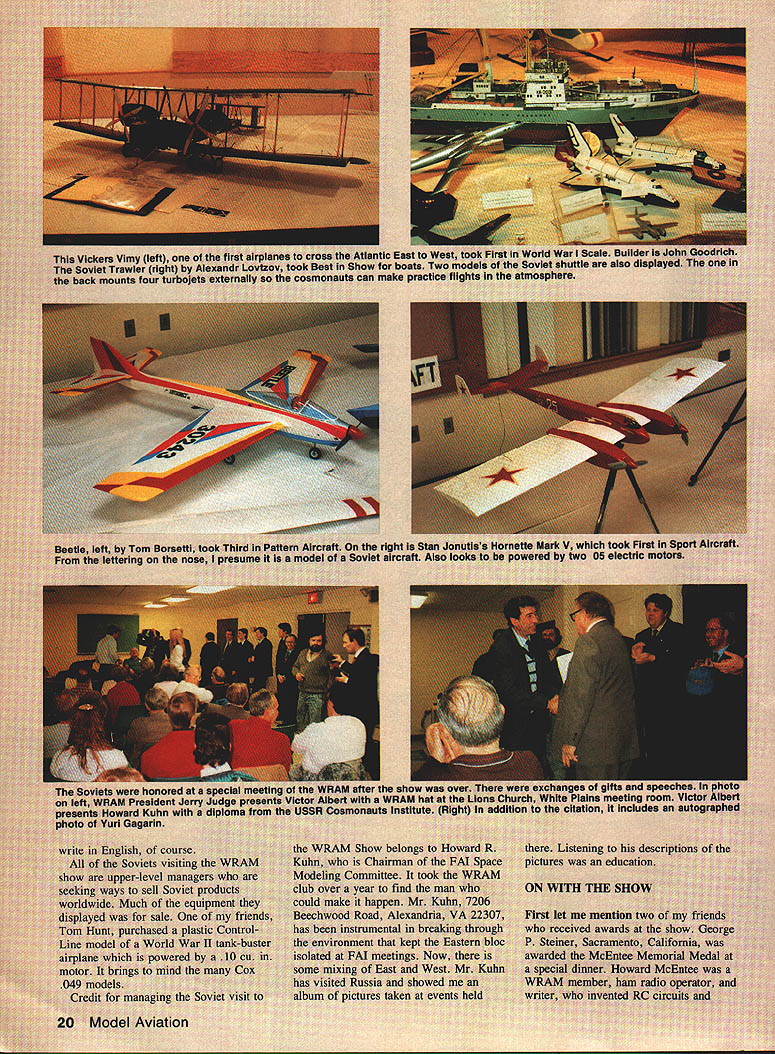
All of the Soviets visiting the WRAM show were upper-level managers seeking ways to sell Soviet products worldwide. Much of the equipment they displayed was offered for export. For example, one friend, Tom Hunt, purchased a plastic control-line model of a World War II “tank-buster” airplane powered by a .10 cu. in. motor, reminiscent of many Cox .049 models.
Credit for arranging the Soviet visit goes to Howard R. Kuhn, Chairman of the FAI Space Modeling Committee. It took WRAM over a year to find someone who could make it happen. Mr. Kuhn (7206 Beechwood Road, Alexandria, VA 22307) has been instrumental in breaking through the environment that kept the Eastern bloc isolated at FAI meetings. His visits to Russia and the photo album he showed were educational.
On with the Show
First, a few awards:
- George P. Steiner of Sacramento, California, received the McEntee Memorial Medal at a special dinner. Howard McEntee was a WRAM member, ham radio operator, and writer who invented RC circuits and contributed many magazine articles.
- A Distinguished Service Award was voted by the AMA Executive Council and presented to District H Vice President John Byrne.
- The WRAM club also recognized contributors to the hobby at the show; awards were presented by club president Jerry Judge.
Trends and Products
My primary observation at the WRAM show was a trend toward much lighter models. Chunky foam and slab balsa construction were out; stick-and-tissue construction appears to be coming back.
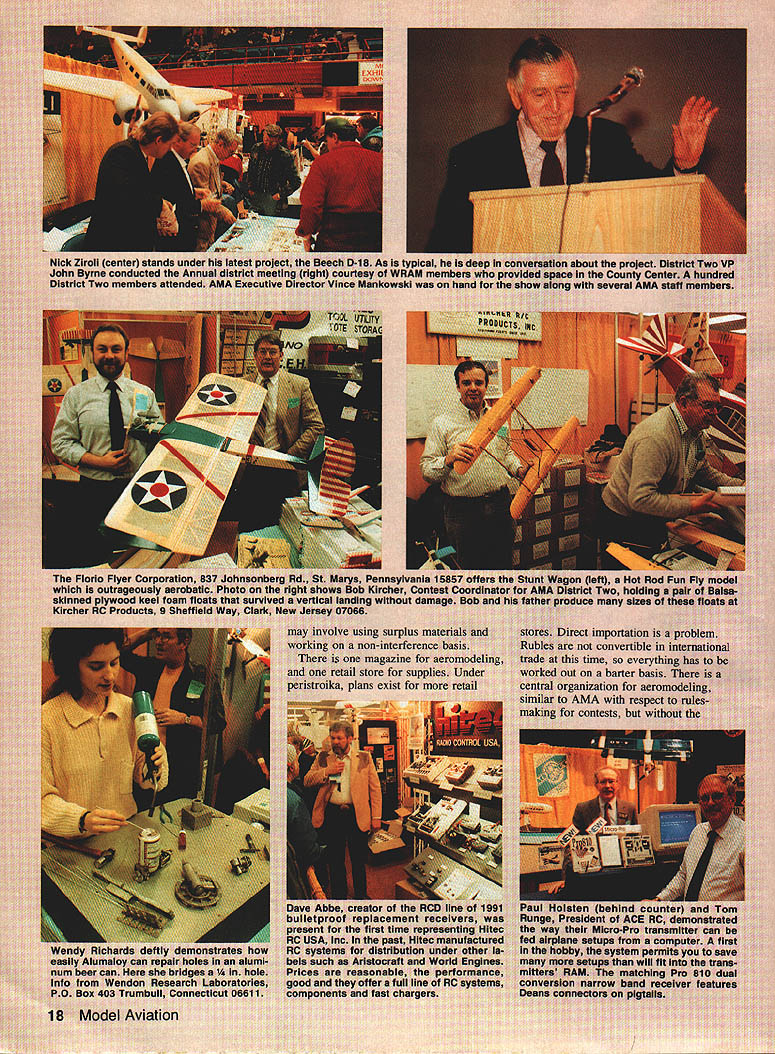
I did not see a new family of RC systems, but switch-selectable RC channels remain a desirable direction—cheaper to manufacture than individual crystals for every channel. Manufacturers now claim to offer crystals for all 50 of the 72 MHz Aircraft-Only RC channels. ACE R/C was cited as a source for 75 MHz and 50 MHz odd-channel crystals.
ACE R/C and other exhibitors showed careful extensions of existing product lines. Pacer Technology (Rancho Cucamonga, California) offered several items of interest:
- ZAP-Kicker for plastics: quick-sets ZAP without softening plastic the way older solvent-based kickers did.
- FLEX-ZAP: advertised as a very strong cyanoacrylate (CA) adhesive with a slightly flexible cured state, making it more shock-resistant—suitable for fiberglass.
- GOO’s transparent silicone adhesive, similar to GOOP.
Manufacturers state that their CA adhesives are not carcinogens and do not emit cyanide gas when heated, contrary to some reports.
Listening to exhibitors and friends at the show was both informative and entertaining. The WRAM show again proved to be a valuable gathering for exchanging ideas, viewing significant scale and sport models, and recognizing contributors to our hobby.
Transcribed from original scans by AI. Minor OCR errors may remain.

