
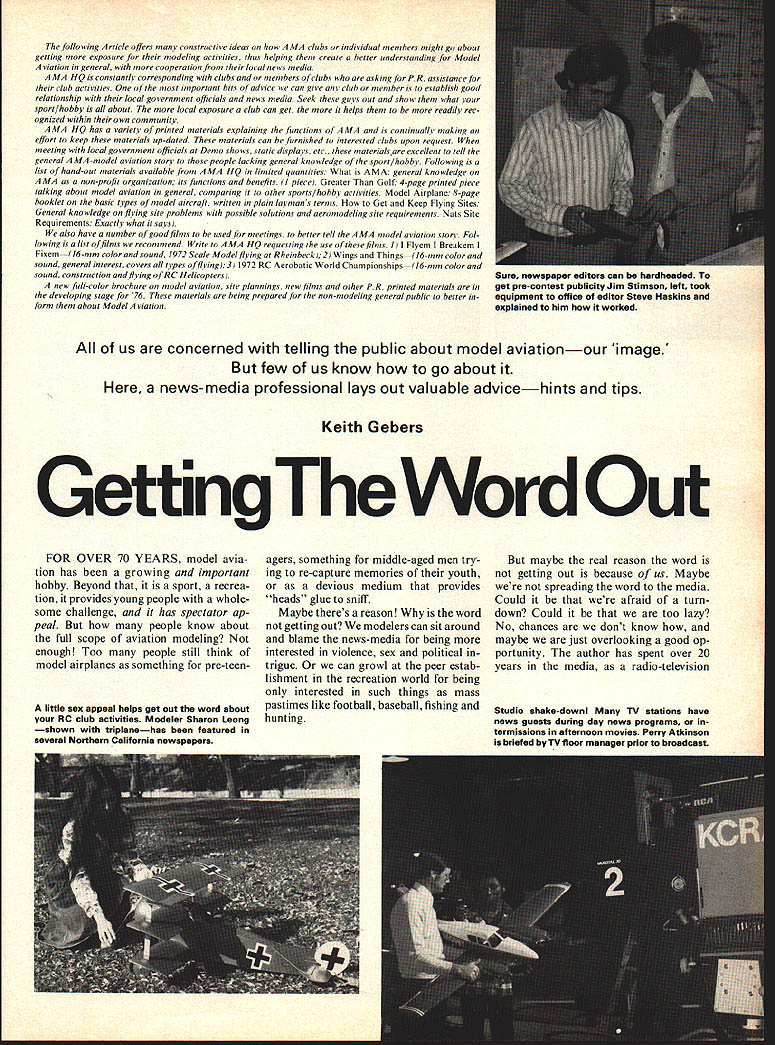
All of us are concerned with telling the public about model aviation—our 'image.' But few of us know how to go about it. Here, a news-media professional lays out valuable advice—hints and tips.
Keith Gebers
Getting The Word Out
FOR OVER 70 YEARS, model aviation has been a growing and important hobby. Beyond that, it is a sport, a recreation, it provides young people with a wholesome challenge, and it has spectator appeal. But how many people know about the full scope of aviation modeling? Not enough! Too many people still think of model airplanes as something for pre-teenagers, something for middle-aged men trying to re-capture memories of their youth, or as a devious medium that provides "heads" glue to sniff.
Maybe there's a reason! Why is the word not getting out? We modelers can sit around and blame the news media for being interested in violence, sex and political intrigue. Or we can growl at the peer establishment in the recreation world for being only interested in such things as mass pastimes like football, baseball, fishing and hunting.
But maybe the real reason the word is not getting out is because of us. Maybe we're not spreading the word to the media. Could it be that we're afraid of a turn-down? Could it be that we are too lazy? No, chances are we don't know how, and maybe we are just overlooking a good opportunity. The author has spent over 20 years in the media, as a radio-television
Getting the Word Out
reporter-newscaster, as a film cameraman, and as an editor-news director. He has spent those years rubbing shoulders with newspapermen, broadcasters, and magazine writers and editors. Newspeople are proverbial bull-sessioners, especially when bending an elbow at an all-night bar. More than once the author has spoken of his hobby at such sessions, and a fellow news person will perk up and say: "Hey, that's a great idea for a film story." I have honestly been taken back more than once, and thought: "Why didn't I think of that? After all, it's my hobby."
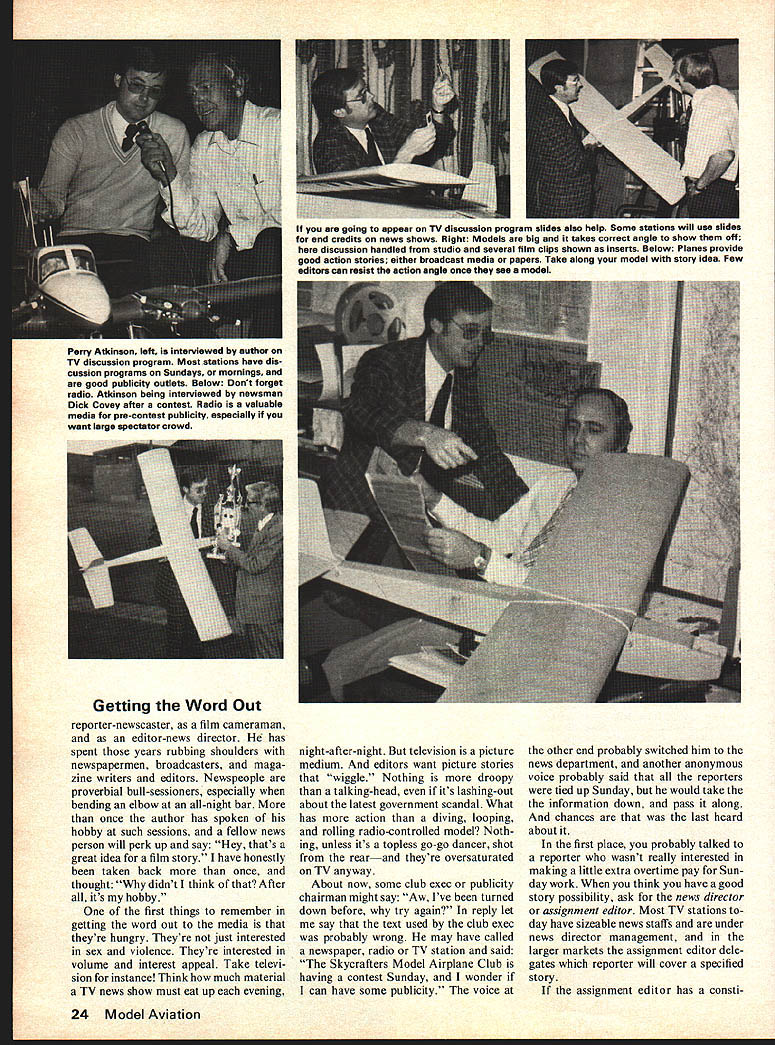
One of the first things to remember in getting the word out to the media is that they're hungry. They're not just interested in sex and violence. They're interested in volume and interest appeal. Take television for instance! Think how much material a TV news show must cut up each evening, night-after-night. But television is a picture medium. And editors want picture stories that "wiggle." Nothing is more droopy than a talking-head, even if it's lashing-out about the latest government scandal. What has more action than a diving, looping, and rolling radio-controlled model? Nothing, unless it's a topless go-go dancer, shot from the rear—and they're oversaturated on TV anyway.
About now, some club exec or publicity chairman might say: "Aw, I've been turned down before, why try again?" In reply let me say that the text used by the club exec was probably wrong. He may have called a newspaper, radio or TV station and said: "The Skycrafters Model Airplane Club is having a contest Sunday, and I wonder if I can have some publicity." The voice at the other end probably switched him to the news department, and another anonymous voice probably said that all the reporters are tied up Sunday, but he would take the information down, and pass it along. And chances are that was the last heard about it.
In the first place, you probably talked to a reporter who wasn't really interested in making a little extra overtime pay for Sunday work. When you think you have a good story possibility, ask for the news director or assignment editor. Most TV stations today have sizeable news staffs and are under news director management, and in the larger markets the assignment editor decides which reporter will cover a specified story.
If the assignment editor has a constitutional dislike for "hobby" stories, still ask him. He's human. You can usually find another station employee who will be interested — perhaps a feature writer, or someone on the radio side who would like a live remote. When you call, ask questions that make the editor visualize the pictures: "We'll have 50 radio-controlled models, some in combat. We have a full-scale World War I reproduction on display, and several pilots will demonstrate aerobatics. There will be a flying demonstration at 2 p.m., and the contest will run from 10 a.m. to 5 p.m." Don't be afraid to suggest film or slides that you can provide.
If you have only a few models, you can still be newsworthy if you have people — youngsters working on their first models, or a prominent civic leader flying a model, or an unusual scale ship. If you do have something special — a world-record attempt, or a demonstration by a famous pilot — be sure to stress it. And always be ready to provide a backgrounder, a typed press release giving the facts in inverted-pyramid style: who, what, when, where, why, and how. Give clear directions to the site, parking information, and a phone number for follow-up. Put the most important facts in the first paragraph.
Most newspapers will not print a release verbatim but will use it as the basis for a longer story. Radio news people want short, punchy soundbites — a line or two that will make it on the air. Television wants action and faces. Invite the crew to bring a still photographer as well as a TV crew. If you're dealing with a weekly paper, emphasize pictures and human interest; they have more space for features.
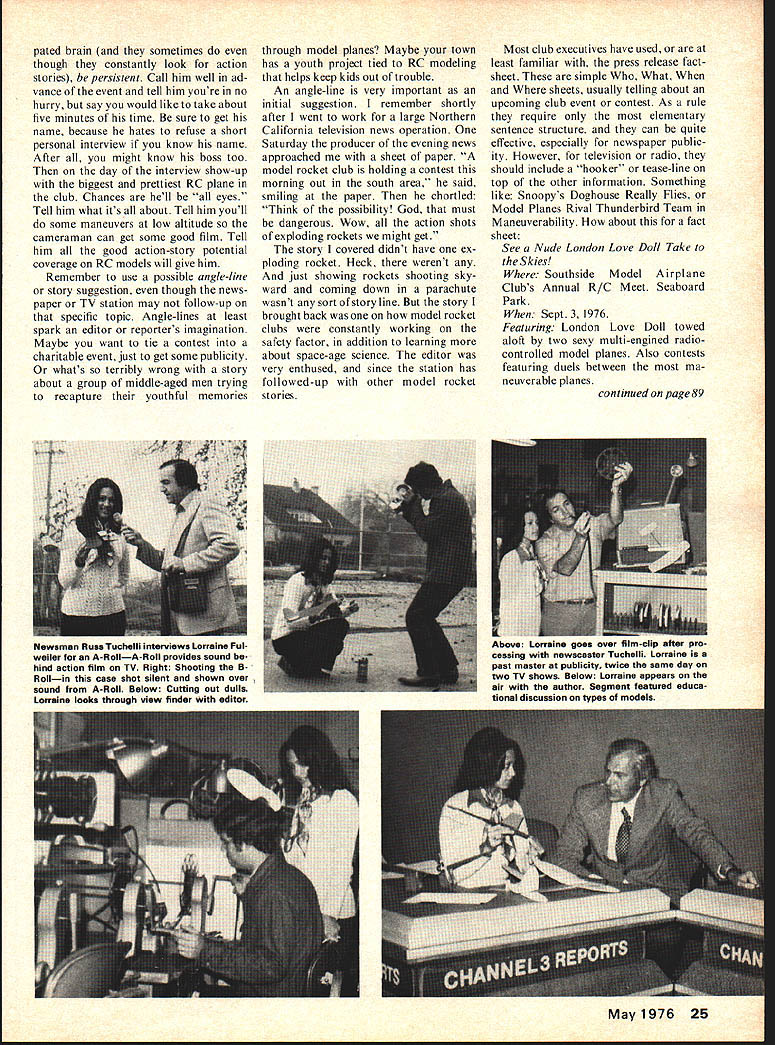
If you expect any controversy — noise complaints or possible trespassing — be prepared to supply a statement from city officials or written permission from the landowner. That solves a lot of problems. Be persistent. Call him well in advance of the event and tell him you're in a hurry, but say you would like to take about five minutes of his time. Be sure to get his name, because he hates to refuse a short personal interview if you know his name. After all, you might know how his boss thinks, too. Then on the day of the interview show up with the biggest and prettiest R/C plane in the club. Chances are he'll be "all eyes." Tell him what it's all about. Tell him you'll do some maneuvers at low altitude so the cameraman can get some good film. Tell him all the good action-story potential coverage on R/C models will give him.
Remember to use a possible angle-line or story suggestion, even though the newspaper or TV station may not follow up on that specific topic. Angle-lines at least spark an editor or reporter's imagination. Maybe you want to tie a contest into a charitable event, just to get some publicity. Or what's so terribly wrong with a story about a group of middle-aged men trying to recapture their youthful memories through model planes? Maybe your town has a youth project tied to R/C modeling that helps keep kids out of trouble.
An angle-line is very important as an initial suggestion. I remember shortly after I went to work for a large Northern California television news operation. One Saturday the producer of the evening news approached me with a sheet of paper. "A model rocket club is holding a contest this morning out in the south area," he said, smiling at the paper. Then he chortled: "Think of the possibility! God, that must be dangerous. Wow, all the action shots of exploding rockets we might get."
The story I covered didn't have one exploding rocket. Heck, there weren't any. And just shooting rockets shooting skyward and coming down in a parachute wasn't any sort of story line. But the story I brought back was one on how model rocket clubs were constantly working on the safety factor, in addition to learning more about space-age science. The editor was very enthused, and since the station has followed up with other model rocket stories.
Most club executives have used, or are at least familiar with, the press release fact-sheets. These are simple Who, What, When and Where sheets, usually telling about an upcoming club event or contest. As a rule they require only the most elementary sentence structure, and they can be quite effective, especially for newspaper publicity. However, for television or radio, they should include a "hooker" or tease-line on top of the other information. Something like: Snoopy's Doghouse Rally Flies, or Model Planes Rival Thunderbird Team in Maneuverability. How about this for a fact sheet:
See a Nude London Love Doll Take to the Skies! Where: Southside Model Airplane Club's Annual R/C Meet. Seaboard Park. When: Sept. 3, 1976. Featuring: London Love Doll towed aloft by two sexy multi-engined radio-controlled model planes. Also contests featuring duels between the most maneuverable planes.
continued on page 89
Getting The Word Out
Note to Editors: Interviews available with contestants and officials on the fascinating R/C hobby, if desired.
Include free radio public service announcements in your pre-event publicity. All radio stations are required to devote 20% of their air time to public service programming, and so your request for club publicity is welcomed. You may send your spot-announcement to the radio station, or if you phone or arrive in person ask for the program director or public service director. At most stations you'll be given a friendly reception. If you have a prepared announcement, so much the better. Public service announcements usually run 20, 30, or 60 seconds in length. Here's a sample of a 20-second announcement, using the theme (slightly modified for broadcasting) as in the fact sheet example:
See a beautiful girl towed through the air by two model airplanes. The Southside Model Airplane Club invites you to their annual radio control meet, Sunday, Sept. 3rd from 10 a.m. to 5 p.m. See exciting air races, just like the big ones. See combat flying at its best, plus precision stunting. It's fun for the whole family, at the Southside Model Airplane Club's Annual Radio Control Meet, Sunday at Seaboard Park.
TV interview programs, like those featured in early morning and mid-afternoon on many stations, are another good media outlet. Most interview segments run anywhere from five to ten minutes. These programs need lots of fresh material daily, so don't be hesitant in asking to be a guest. Your offer will probably be eagerly accepted. A good way to help put your presentation across is to take along some conventional 35-mm color slides in addition to a couple of models. Taking along some movie film footage is a good idea but not vital. Most TV stations use 16-mm film, rather than the popular Super-8, which is used by most home movie buffs.
Take advantage of all media outlets, even the Letters to the Editor column in your local newspaper. Here's a chance for club executives, acting as representatives of their organization to participate in all areas of aeromodeling, ranging from the glue-sniffing controversy to what model building does for youth, to say nothing of the enjoyment and recreation for adult builders—which can lead to lifelong psychological good health. You don't have to feel letters-to-the-editors open you up to criticism. Benjamin Franklin was among the most avid users of this expressive outlet.
Model aviation is a great and growing sport. Now is the time to get the word out. Instead of complaining about media indifference, make the media work with you. Editors and reporters may occasionally sound bored and detached. But remember, they need your story. Your persistence and imagination will turn any initial coldness into enthusiasm.
So get a "wiggle" going.
Transcribed from original scans by AI. Minor OCR errors may remain.

