
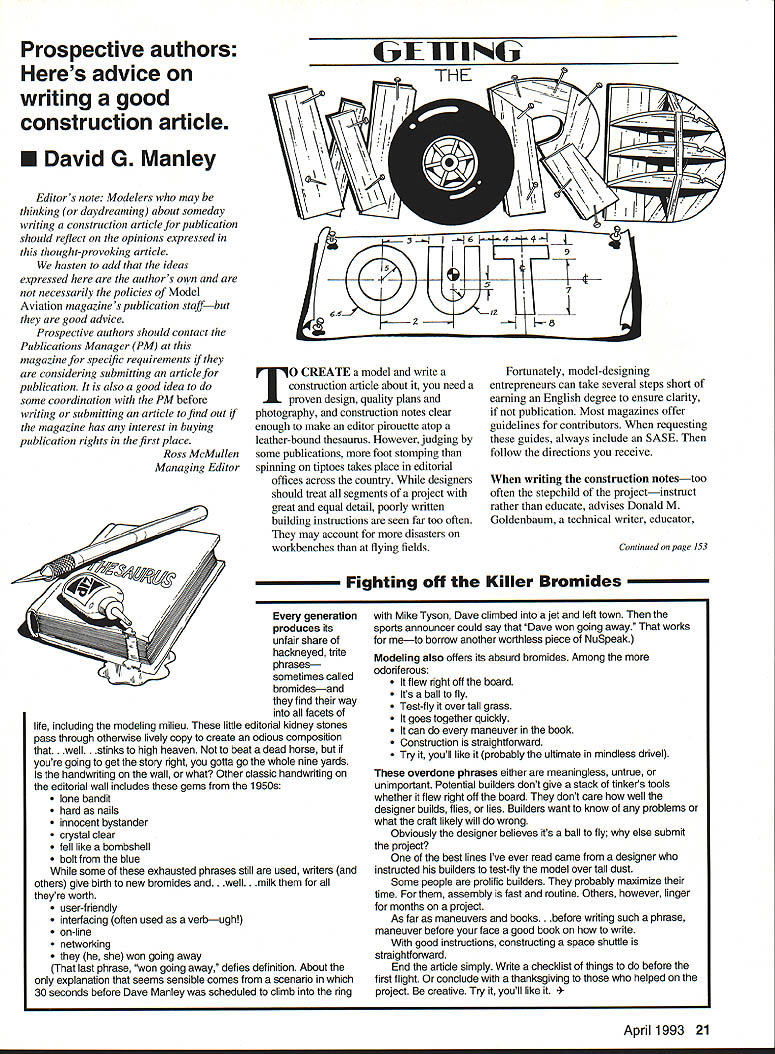
Getting The Word Out
David G. Manley
Editor's note: Modelers who may be thinking (or daydreaming) about someday writing a construction article for publication should reflect on the opinions expressed in this thought-provoking article.
We hasten to add that the ideas expressed here are the author's own and are not necessarily the policies of Model Aviation magazine's publication staff—but they are good advice.
Prospective authors should contact the Publications Manager (PM) at this magazine for specific requirements if they are considering submitting an article for publication. It is also a good idea to do some coordination with the PM before writing or submitting an article to find out if the magazine has any interest in buying publication rights in the first place.
Ross McMullen Managing Editor
To create a model and write a construction article about it, you need a proven design, quality plans and photography, and construction notes clear enough to make an editor pirouette atop a leather-bound thesaurus. However, judging by some publications, more foot stomping than spinning on tiptoes takes place in editorial offices across the country. While designers should treat all segments of a project with great and equal detail, poorly written building instructions are seen far too often. They may account for more disasters on workbenches than at flying fields. Fortunately, model-designing entrepreneurs can take several steps short of earning an English degree to ensure clarity.
Most magazines offer guidelines for contributors. When requesting these guides, always include an SASE. Then follow the directions you receive.
When writing the construction notes—too often the stepchild of the project—instruct rather than educate, advises Donald M. Goldenbaum, a technical writer and educator.
Fighting off the Killer Bromides
Every generation produces its unfair share of hackneyed, trite phrases—sometimes called bromides—and they find their way into all facets of life, including the modeling milieu. These little editorial kidney stones pass through otherwise lively copy to create an odious composition that, well... stinks to high heaven. Not to beat a dead horse, but if you're going to get the story right, you gotta go the whole nine yards. Is the handwriting on the wall, or what?
Other classic handwriting on the editorial wall includes these gems from the 1950s:
- lone bandit
- hard as nails
- innocent bystander
- crystal clear
- fell like a bombshell
- bolt from the blue
While some of these exhausted phrases still are used, writers (and others) give birth to new bromides and, well... milk them for all they're worth.
- user-friendly
- interfacing (often used as a verb—ugh!)
- on-line
- networking
- they (he, she) won going away
(That last phrase, "won going away," defies definition. About the only explanation that seems sensible comes from a scenario in which 30 seconds before Dave Manley was scheduled to climb into the ring with Mike Tyson, Dave climbed into a jet and left town. Then the sports announcer could say that "Dave won going away." That works for me—to borrow another worthless piece of NuSpeak.)
Modeling also offers its absurd bromides. Among the more odoriferous:
- It flew right off the board.
- It's a ball to fly.
- Test-fly it over tall grass.
- It goes together quickly.
- It can do every maneuver in the book.
- Construction is straightforward.
- Try it; you'll like it (probably the ultimate in mindless drivel).
These overdone phrases either are meaningless, untrue, or unimportant. Potential builders don't give a stack of tinker's tools whether it flew right off the board. They don't care how well the designer builds, flies, or lies. Builders want to know of any problems or what the craft likely will do wrong. Obviously the designer believes it's a ball to fly; why else submit the project?
One of the best lines I've ever read came from a designer who instructed his builders to test-fly the model over tall grass.
Some people are prolific builders. They probably maximize their time. For them, assembly is fast and routine. Others, however, linger for months on a project.
As far as maneuvers and books—before writing such a phrase, maneuver before you face a good book on how to write. With good instructions, constructing a space shuttle is straightforward.
End the article simply. Write a checklist of things to do before the first flight. Or conclude with a thanksgiving to those who helped on the project. Be creative. Try it, you'll like it.
The reader needs to know how to attach balsa part A to part B, not where the wood is grown or how it reaches the supplier. That information goes elsewhere in the story—if it needs to be included at all.
"Also, assume minimal background knowledge or understanding on the part of the reader," said Goldenbaum, founder and president of Applied Communications Group, Overland Park, Kansas. "Good instructions are written in a way that's logical to the user."
Before beginning with the step-by-step process, tell the builder what tools and materials will be needed. Give the reader all necessary information. The unique—and most unconventional—aspect of Goldenbaum's advice is to write the construction notes first. "Design the instructions first, the model second," he said. "Good instructions, under the best circumstances, are written before the device is designed and built. That way, the device (in this case, a model) conforms to the instructions, rather than the other way around."
Another rule is to go from specific to general: from what it is, to how to use it, to how it works. For example: "The 3/16 x 5/8-in. hard balsa stick serves as the backbone of the vertical stab. The built-up rudder will be covered and then attached to this post with Easiest Hinges (not supplied, of course)." The rudder always will turn the model two seconds too late to catch the nearest thermal.
Some other instructional specifics
- Focus on things difficult to complete; that is, the steps builders are likely to have trouble figuring out—seemingly invisible, not obvious.
- Tell what to do. Focus on behavior—"glue part A to part B." Do not say, "Assemble parts A and B."
- Create short and definite (and completable) steps. Explain the steps so the builder will know if each was properly completed.
- Write instructions that are self-contained. Do not force the builder to refer to other sources to complete a task—never include an instruction like "See article on hinging in the December issue of RCM Modeler Catalog."
- Present a single, linear building sequence. Don't send the builder on loops and branches that force backtracking.
- Give tips for avoiding problems (if any) in a given situation. And give the tips before the reader needs them.
- Tell what to do if something goes awry or doesn't work when attempted by the builder.
- Introduce no surprises. Good instructions do not force the builder to read ahead.
- Use active verbs, and use the active voice. Instead of "It was a less than magnificent takeoff," write, "the plane lumbered (or struggled) into the air." Instead of "I was going to incorporate flaps, but they made the design too complicated," try, "Flaps complicate the design."
Remember, the instructions should be task- and user-oriented. Their purpose is to help the builder finish the project.
Use common sense and the dictionary. Beg, borrow, or buy a copy of The Elements of Style. William Strunk Jr. and E.B. White can spare you numerous language blunders with their smallish, though excellent, tome. Use photographs to highlight difficult steps or complicated assemblies.
Absolutely, positively, do not write to impress the reader (or editor) with the brilliance of the designer. First, nobody gives a rat's rear region about brilliance in this situation. Second, brilliant designers don't try to write. Brilliant writers can't design. Enthusiasts—brilliant or otherwise—just want to finish the blasted project.
Test the construction notes before sending in the final version. Do not give the notes to a museum-quality builder—find a blithering novice. At the least, give the project to a novice. If the project can be completed without major problems (make corrections, if necessary), the notes proved workable. Sending in untested notes (or designs) for publication is unkind at best and despicably unethical or possibly illegal at worst. And its publication creates furrowed brows in most publishing circles.
Begin the body of the article with a good, strong lead paragraph. Instead of writing, "The Skyfire was designed to . . ." try, "The Skyfire ignites the air, torches the highest clouds, yet construction is simple, and the cost won't burn the wallet." That's a bit strong, but it serves the message: Use the active voice. Also, it tells potential builders what the craft can do in the hands of a good pilot. The strong words in that lead—"ignites," "torches," and "burn"—create heat, tone, and active messages. The weaker "was designed" is flat and lifeless. Be certain the article justifies the lead.
The Skyfire lead won't work if the plane in question is a hand-launched glider. Select an appropriate name for the model. Sky Anchor probably won't sell many sailplane plans. Depth Charge for a pattern plane conjures ground-breaking images. Few points are awarded for Figure 9s.
Because many modelers read the flight report first, consider including the flight characteristics early in the article.
Make the writing process manageable
Create a simple outline:
- The lead paragraph: Remember to use the active voice. Read lots of lead graphs from other modeling articles. Avoid leads that ask questions—"Do you want a sailplane with a great glide ratio . . . ?"—they seldom work.
- The article body: Use this to introduce in more detail the craft, its qualities (such as flying and building ease), and other important or interesting information.
- Construction notes: Read notes written by other builders. Read the manufacturer's instruction manual, for example.
- Conclusion: Perhaps a summary of points critical to the construction or performance.
Modeler Joe Wagner appeared in the February 1993 issue's Letters Editor section (page 11). The letter reads as follows:
I am commencing a home-built aircraft project. Metal components need priming before riveting is performed. I am aware some materials are dangerous when sprayed. Careful ventilation and appropriate mask protection are required; however, it is not clear what protections and/or precautions are required when the same substances are brushed onto interior surfaces or components. Atomized particulate materials present a hazard.
Transcribed from original scans by AI. Minor OCR errors may remain.

