
GHOULIES AND BEASTIES
Bill Evans
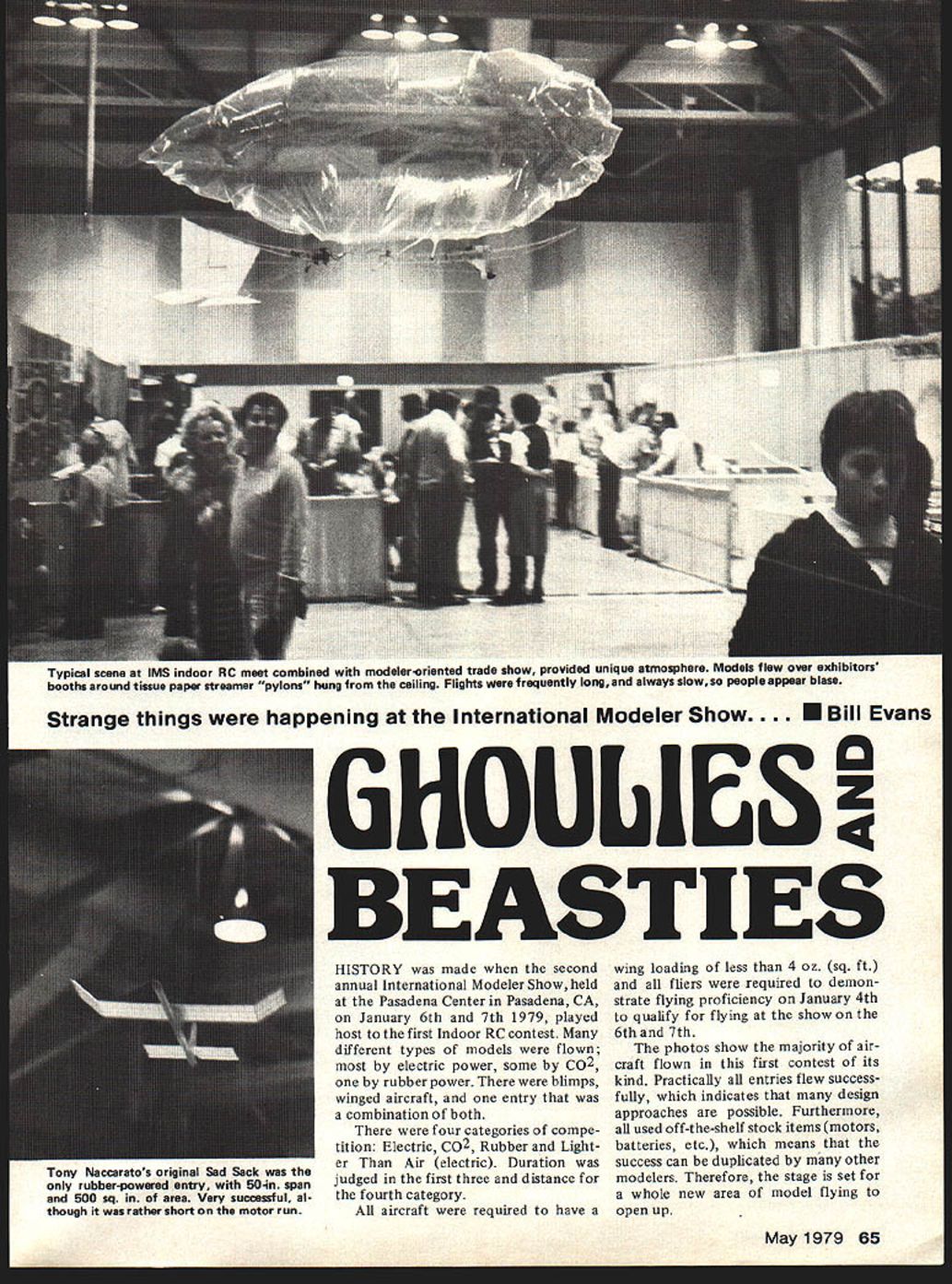
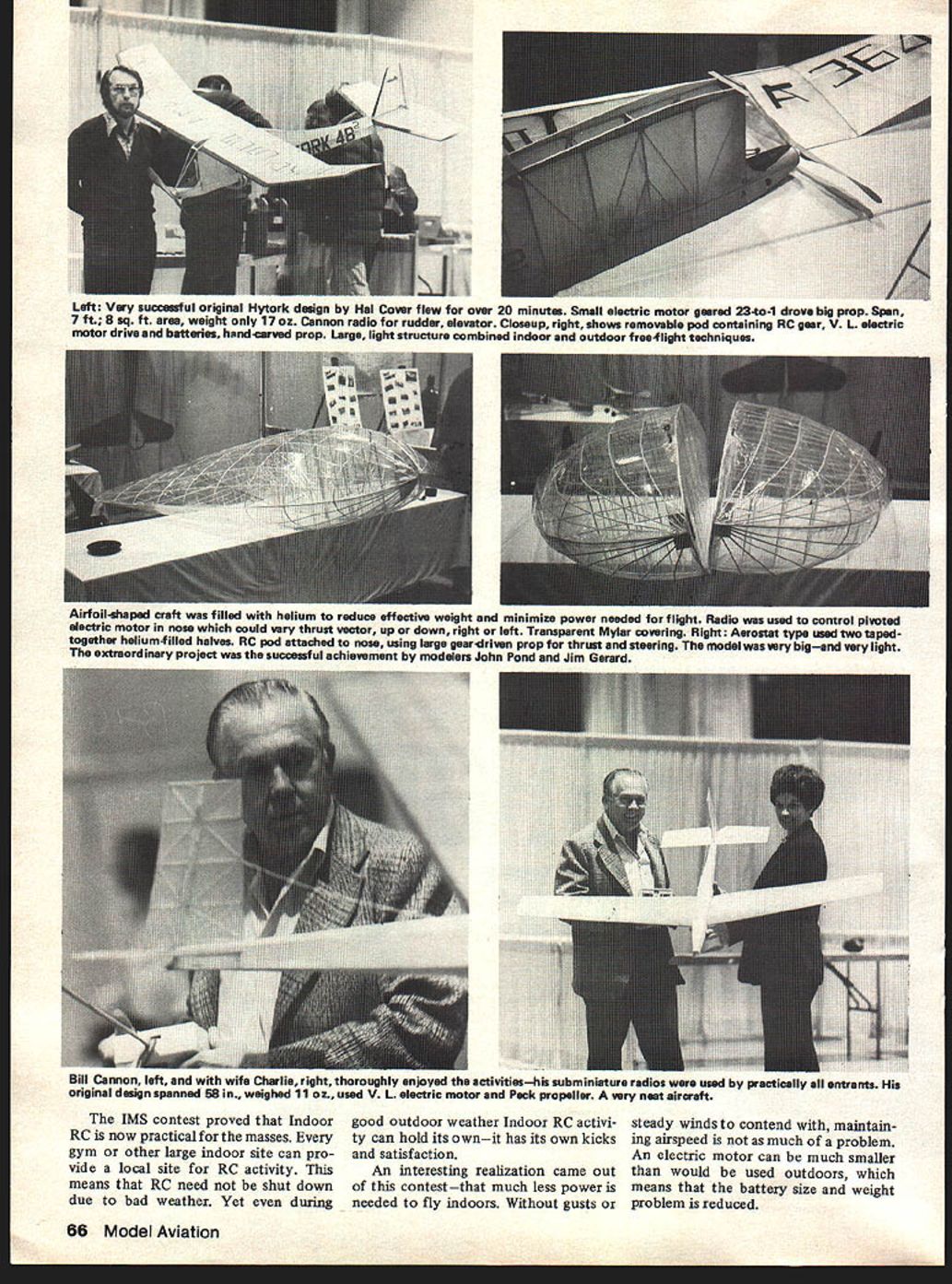
History was made when the second annual International Modeler Show, held at the Pasadena Center in Pasadena, CA, on January 6 and 7, 1979, played host to the first indoor RC contest. Many different types of models were flown—most by electric power, some by CO2, one by rubber power. There were blimps, winged aircraft, and one entry that was a combination of both.
Competition Categories
There were four categories of competition:
- Electric
- CO2
- Rubber
- Lighter-Than-Air (electric)
Duration was judged in the first three categories; distance was judged for the lighter-than-air category.
Rules and Requirements
- All aircraft were required to have a wing loading of less than 4 oz per sq. ft.
- All fliers were required to demonstrate flying proficiency on January 4 to qualify for flying at the show on January 6 and 7.
Practically all entries flew successfully, which indicates that many design approaches are possible. Furthermore, all used off-the-shelf stock items (motors, batteries, etc.), which means the success can be duplicated by many other modelers. Therefore, the stage is set for a whole new area of model flying to open up.
Observations and Insights
The IMS contest proved that indoor RC is now practical for the masses. Every gym or other large indoor site can provide a local site for RC activity. This means that RC need not be shut down due to bad weather. Even during good outdoor weather, indoor RC activity can hold its own—it has its own thrills and satisfactions.
An interesting realization from the contest was that much less power is needed to fly indoors. Without gusts or steady winds to contend with, maintaining airspeed is less of a problem. An electric motor can be much smaller than would be used outdoors, which reduces battery size and weight concerns.
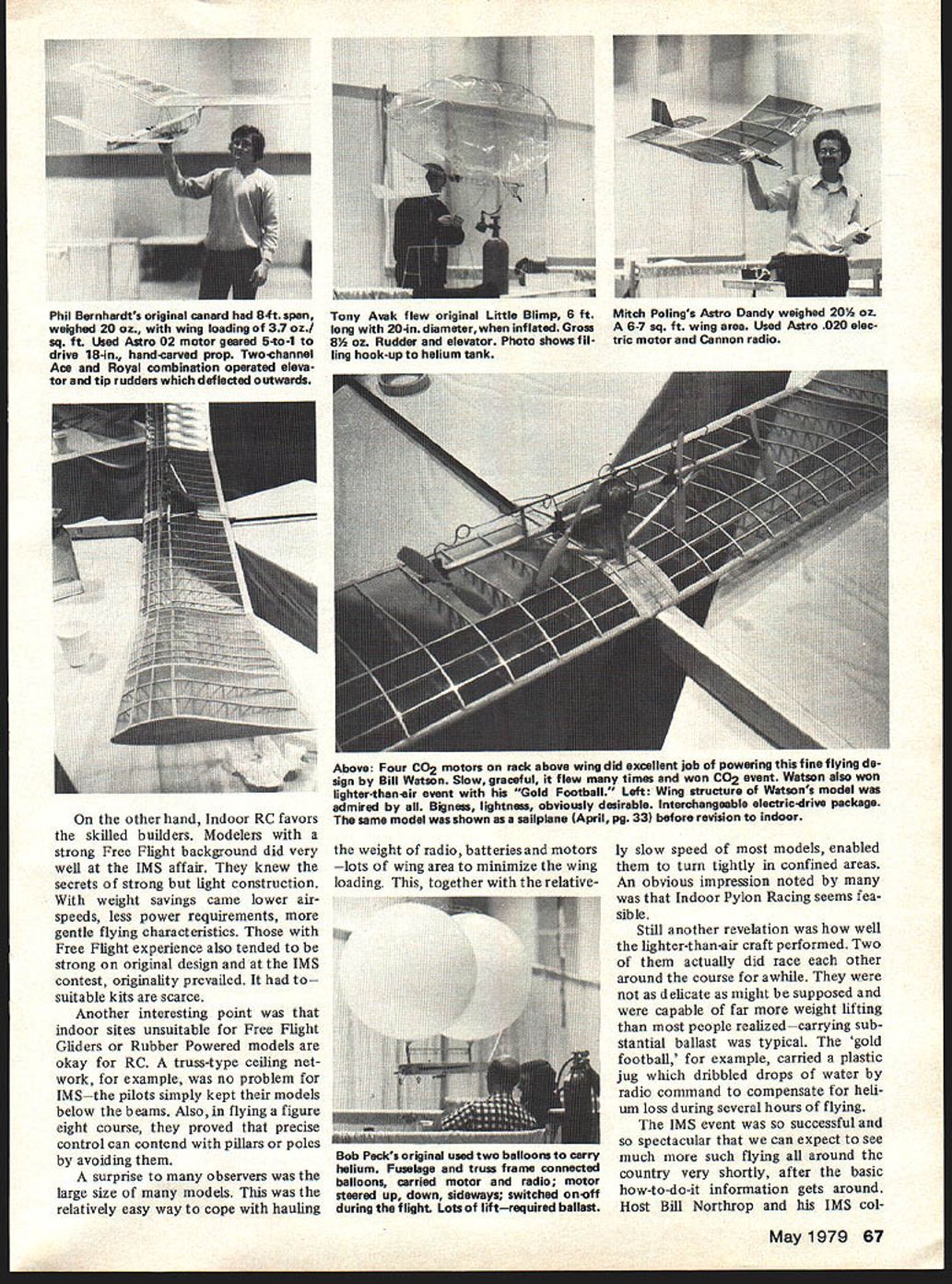
Indoor RC favors skilled builders. Modelers with a strong free-flight background did very well at the IMS affair because they knew the secrets of strong but light construction. With weight savings came lower airspeeds, lower power requirements, and gentler flying characteristics. Those with free-flight experience also tended to be strong on original design; at the IMS contest, originality prevailed—suitable kits are scarce.
Indoor sites that are unsuitable for free-flight gliders or rubber-powered models are often acceptable for RC. A truss-type ceiling network, for example, was no problem at IMS—the pilots simply kept their models below the beams. By flying a figure-eight course, pilots proved that precise control can contend with pillars or poles by avoiding them.
A surprise to many observers was the large size of many models. Increasing wing area was a relatively easy way to cope with carrying the weight of radio gear, batteries, and motors—lots of wing area minimizes wing loading. This, together with the relatively slow speed of most models, enabled tight turns in confined areas. An obvious impression noted by many was that indoor pylon racing seems feasible.
Lighter-Than-Air Performance
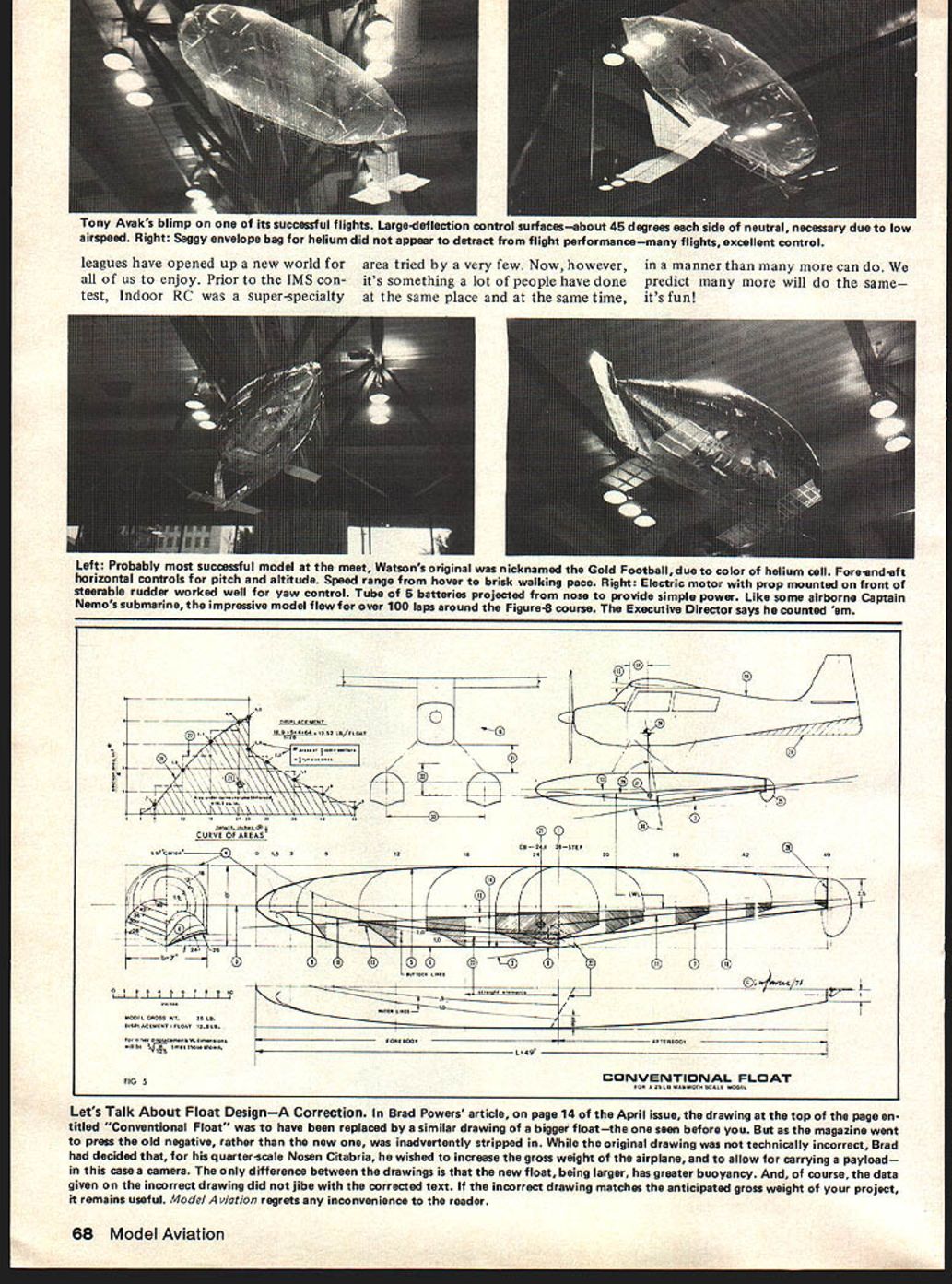
Lighter-than-air craft performed better than expected. Two of them actually raced each other around the course for a while. They were not as delicate as might be supposed and were capable of far more lifting power than most people realized—carrying substantial ballast was typical. The "gold football," for example, carried a plastic jug that dribbled drops of water by radio command to compensate for helium loss during several hours of flying.
Conclusion
The IMS event was so successful and so spectacular that we can expect much more such flying around the country very shortly, once basic how-to information spreads. Host Bill Northrop and his IMS colleagues have opened up a new world for all of us to enjoy. Prior to the IMS contest, indoor RC was a super-specialty area tried by very few. Now it is something many people have done at the same place and at the same time, in a manner that many more can duplicate. We predict many more will take it up—it's fun!
Transcribed from original scans by AI. Minor OCR errors may remain.

