
Giant Scale Cradle
Jay Evans
Background
The idea for this cradle came from the frustration of loading my Giant Scale models into my custom van. The constant in-and-out of airplanes, equipment, and gasoline was taking its toll on the interior. If even a little gas was spilled, the odor was difficult to eliminate. And unless I removed a couple of captain's seats, I could only take one airplane to my club field or fly-in.
I decided to get a trailer and purchased a Wells Cargo 10 x 5-foot trailer that fits nicely in my garage and is more than adequate to hold three or four airplanes. Having rented trailers before, I did not want to become burdened with tying down my airplanes and equipment every time I wanted to fly.
Concept
I designed a rack holder with cradles that would hold my airplanes without the need for tie-downs. The unit holds two airplanes in a trailer and cost only about $60, including all the T fittings and corner brackets. It should only take an afternoon to make.
Materials
- 2-inch PVC pipe for the four corner posts (a)
- 1-1/2-inch PVC pipe for horizontal rails (b) and the cradles (c)
- PVC T fittings, corner brackets, sliding T brackets (next size up for adjustability)
- 3 × 1/4-inch bolts and wing nuts (to secure joints without cement)
- PVC cement (for cradle joints)
- PVC clamps and pipe hangers (to secure corner posts against trailer walls)
- 3/8-inch bolt (to pin sliding T brackets)
- 1/2-inch bolt and wing nut (for L-shaped aluminum tubing)
- L-shaped aluminum tubing (12-inch piece for width adjustment)
- 3-inch foam cushions and cable ties
- Flange(s) for mounting to trailer floor
- End caps for the structure
Notes:
- PVC pipe typically costs about $2.75 for a 1-1/2 x 10-foot piece.
- Total unit cost was approximately $60.
Design and Construction
- Structure
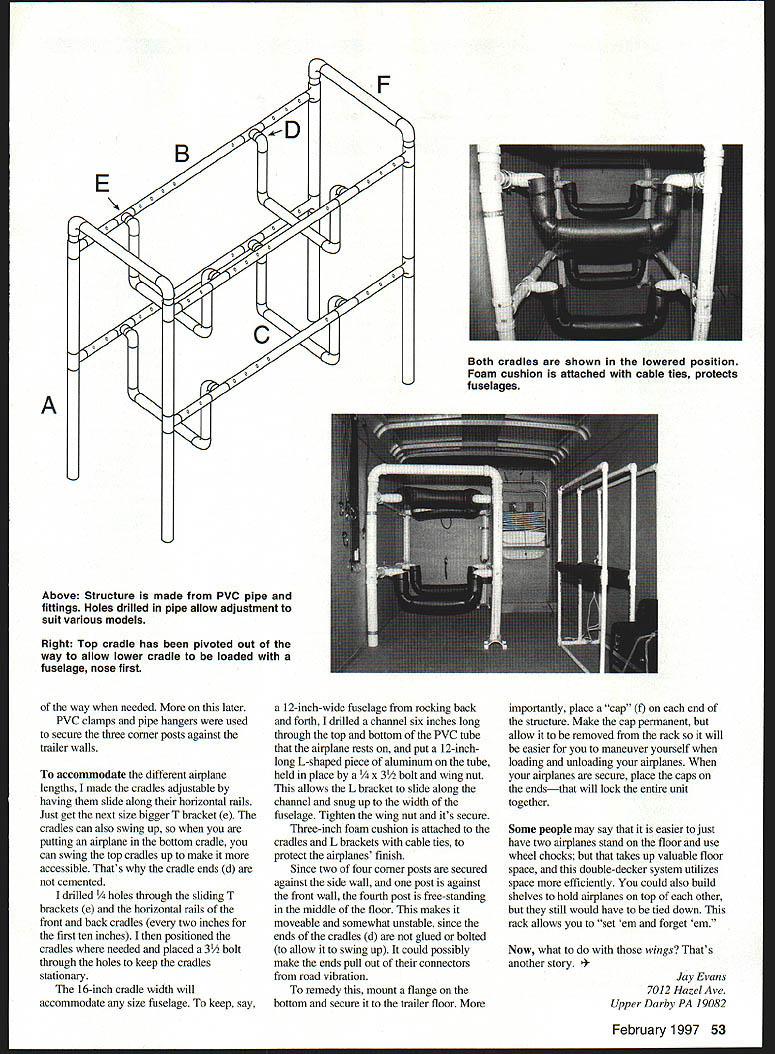
- Use 2-inch PVC for the four corner posts and 1-1/2-inch PVC for horizontal rails and cradles.
- I initially made the structure 80 inches long so airplanes could be placed through the side and fully encased, but this proved awkward in a narrow trailer.
- I shortened the rack to 48 inches so airplane tails can "hang out" of the rack. The tail section does not need cradle support because the weight concentrates in the nose, and leaving the tail out reduces the risk of damage from twisting while loading.
- Orientation and placement
- I prefer the rack toward the front of the trailer so the open space is in front when the door is opened. This makes it easier to access equipment and keeps most weight forward.
- If your trailer is wider than 5 feet, you could build a full-length rack, but it's usually unnecessary.
- Fastening philosophy
- I avoid permanent construction where possible. For the main structure I used three 1/4-inch bolts and wing nuts at the joints instead of PVC cement so the rack can be disassembled or modified later.
- Because of the airplanes' weight, I used PVC cement on the cradle joints so they hold securely.
- I did not use bolts or cement on the cradle end joints (d) so each cradle can swing up and out of the way for easier loading of the lower cradle.
Adjustability and Securing Cradles
- The cradles slide along the horizontal rails using larger sliding T brackets. Make the cradles adjustable by using the next size bigger T brackets.
- Cradles can swing up; load the airplane on the bottom cradle and swing the top cradle up for access.
- Cement the cradle ends (d) and drill holes for the sliding T brackets (e) on the horizontal rails at the front and back of the cradles. Use a 3/8-inch bolt through the holes to secure the cradles in position.
Width adjustment:
- A 16-inch cradle width will accommodate most fuselages.
- To prevent a narrow fuselage (e.g., 12 inches) from rocking, drill a 6-inch channel through the top and bottom PVC tubes the airplane rests on and install a 12-inch L-shaped piece of aluminum tubing that slides in the channel.
- Secure the L-bracket with a 1/2-inch bolt and wing nut to snug the bracket against the fuselage.
- Attach 3-inch foam cushions to the cradles' L brackets with cable ties to protect the airplane finish.
Stability and Mounting
- Two of the four corner posts are secured against a side wall and one post against the front wall; the fourth post is free-standing in the middle of the floor, which can make the unit somewhat unstable.
- Because the cradle ends are glued and bolted to allow swinging, road vibration could possibly pull them out of the connectors.
- Remedies:
- Mount a flange on the bottom to secure the structure to the trailer floor.
- Place end caps on the structure. Make the caps removable; it will be easier to maneuver yourself when loading and unloading airplanes. When the airplanes are secured in place, caps on the ends will lock the entire unit together.
Advantages
- Takes up less valuable floor space than having two airplanes stand on the floor with wheel chocks.
- The double-decker system utilizes vertical space efficiently and allows you to "set 'em and forget 'em" without repeated tie-downs.
- Cradles are adjustable and can swing to allow easy loading.
Final Notes
- You could build shelves to hold airplanes on top of each other, but they would still require tie-downs. This rack avoids that need.
- Wings require a separate storage solution.
Jay Evans 7012 Hazel Ave. Upper Darby, PA 19082
Transcribed from original scans by AI. Minor OCR errors may remain.

