
Giant Scale at Toledo
Bob Beckman
You know the flying season is just around the corner when the time comes for the annual Weak Signals RC Exposition. Even those of us in less-friendly climates for year‑round flying are getting set to unveil what our winter's efforts produced in the workshop. Then we go to Toledo and find all kinds of goodies we wish we could have had when we were building—and all kinds of beautiful models that other people built that make us want to hide our latest effort.
Did it ever occur to anyone that trade shows like Toledo should be in October? If held then, all of us would be snapping up the new items to use during the winter building season. Furthermore, the sight of all those beautiful models would inspire us to do a better job on our own pride and joy.
The show atmosphere
The general atmosphere and flavor of the show have been described many times, so I won't repeat much of that here. Besides, unless you've been there, you can't really get the feel of it. As usual, once the doors were opened to the public the show quickly became a solid mass of people all trying to move through the place where someone else was standing. I consider myself lucky to have been able to get in early and see things before the crowd arrived. If I hadn't, I wouldn't have been able to get the pictures.
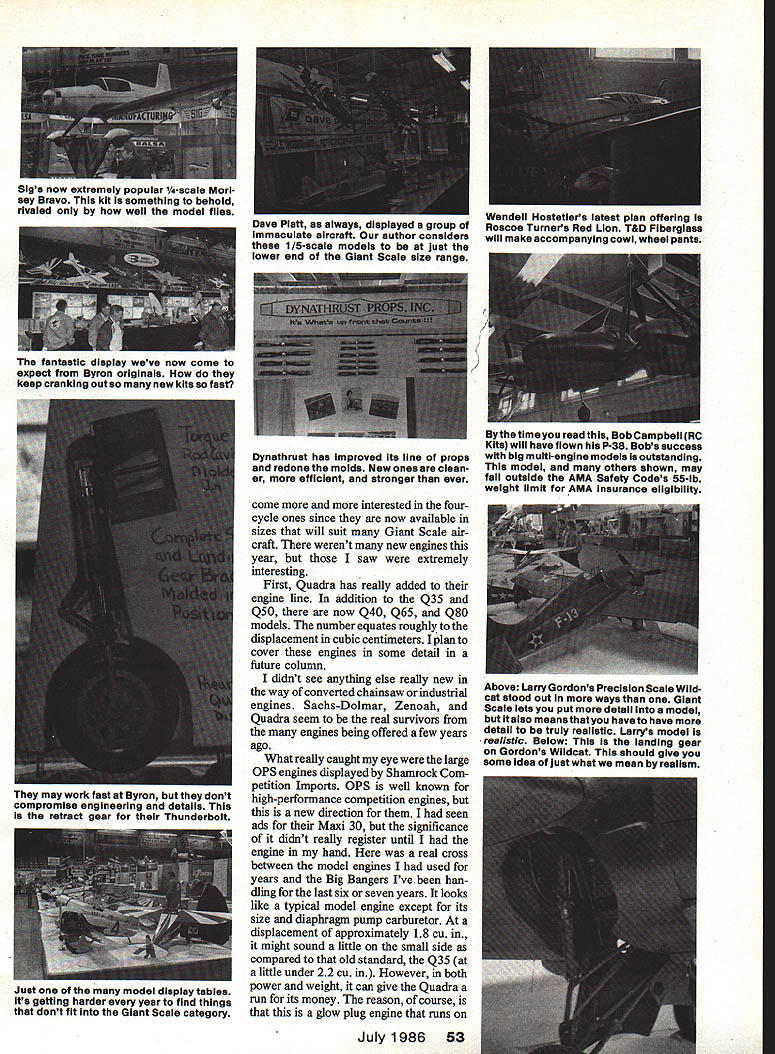
My particular interests, of course, are Giant Scale and large engines. In the years I have been reporting on the Toledo show I've seen large models progress from oddities that stuck out like a sore thumb to almost the opposite. The "small" models don't stick out now, but that's mostly because they are often hidden by the large ones on each side. Most of the aircraft models on display this year were 1/5-scale or larger. It seems that most modelers have now recognized the building and flying advantages of the larger models.
Engines and powerplants
In my search for new "Big Bangers" to tell you about, I was interested in both two-cycle and four-cycle engines. I became more and more interested in the four-cycle ones since they are now available in sizes that will suit many Giant Scale aircraft. There weren't many new engines this year, but those I saw were extremely interesting.
- Quadra: The Quadra line has been expanded. In addition to the Q35 and Q50, there are now Q40, Q65, and Q80 models. The number roughly equates to displacement in cubic centimeters. I plan to cover these engines in more detail in a future column.
- Other survivors: I didn't see anything else really new in the way of converted chainsaw or industrial engines. Sachs‑Dolmar, Zenoah, and Quadra seem to be the real survivors from the many engines being offered a few years ago.
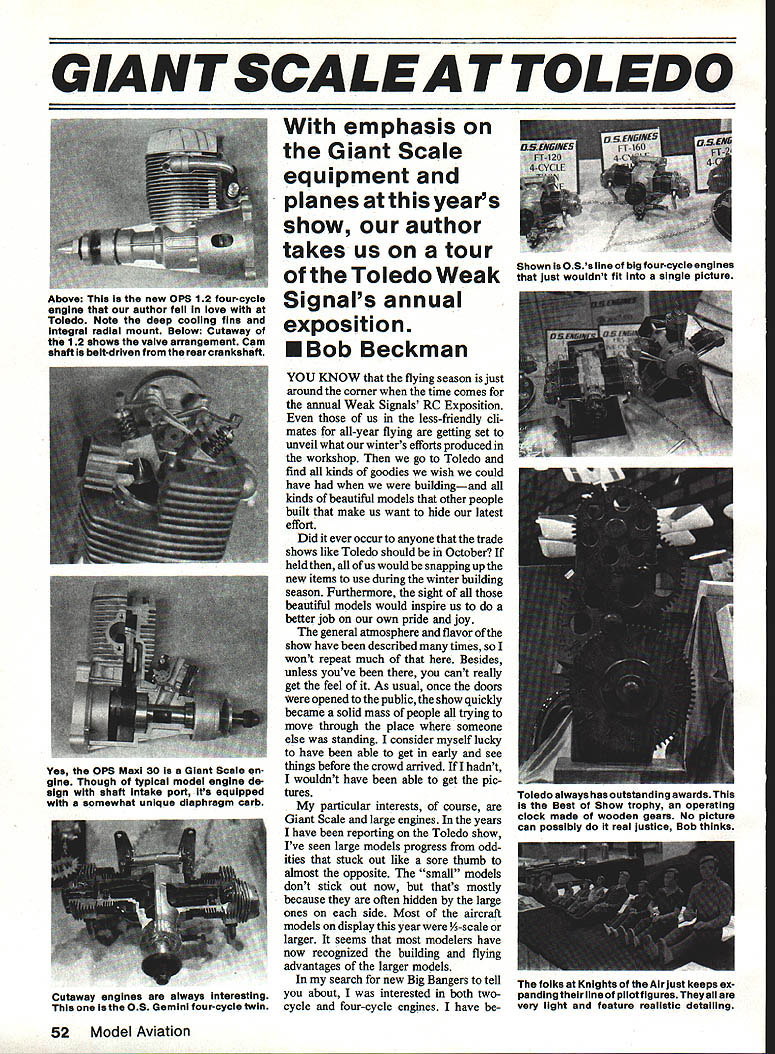
- OPS: What really caught my eye were the large OPS engines displayed by Shamrock Competition Imports. OPS is well known for high‑performance competition engines, but this is a new direction for them. I had seen ads for their Maxi 30, but the significance of it didn't really register until I had the engine in my hand. Here was a real cross between the model engines I've used for years and the Big Bangers I've been handling for the last six or seven years. It looks like a typical model engine except for its size and diaphragm‑pump carburetor. At a displacement of approximately 1.8 cu. in., it might sound a little on the small side compared to that old standard, the Q35 (a little under 2.2 cu. in.). However, in both power and weight it can give the Quadra a run for its money. The reason, of course, is that this is a glow‑plug engine that runs on methanol. By the time you read this, Bob Campbell (RC Kits) will have flown his P‑38. Bob's success with big multi‑engine models is outstanding. This model, and many others shown, may fall outside the AMA Safety Code's 55‑lb. weight limit for AMA insurance eligibility. I went to Giant Scale to get away from methanol and castor oil, but this engine could lure me back. They've got a twin version, too.
- OPS four‑cycle and personal purchase: Maybe one reason I'm feeling more tolerant toward the "greasy kid stuff" is that I have already committed myself to using some of it. I mentioned my growing interest in four‑cycle engines. At the show I bought one of the OPS 1.2 cu. in. four‑cycle engines and one of Bill Hinnant's 1/4‑scale Laser kits to put around it. The engine looks absolutely gorgeous, and I can't wait to get it on the test stand and see what it does, to say nothing of getting the engine and model into the air.
- Maloney 100: Another new engine that may be of interest to Giant Scale builders is the Maloney 100. Although somewhat small at just under 1 cu. in., it looks like a capable engine for the smaller and lighter models. It will also appeal to gasoline enthusiasts, since it is a gasoline‑fueled, spark‑ignition engine.
Friends and the IMAA
In addition to looking for new goodies, the big attraction of Toledo is the chance to see friends from all over the country. This is the one time each year when we're all in the same place at the same time. In particular, I looked forward to seeing many of the friends I've made in the International Miniature Aircraft Association (IMAA). With Dick Phillips as the new IMAA president, our organization is already showing signs of much‑needed change and progress. The IMAA festival this year will be July 17–20 in Lansing, MI, and it looks like it will be a great one. I hope to attend this year, and I hope to see you there.
Transcribed from original scans by AI. Minor OCR errors may remain.

