
Giants at No. 36
Col. John A. de Vries, USAF ret.
Overview
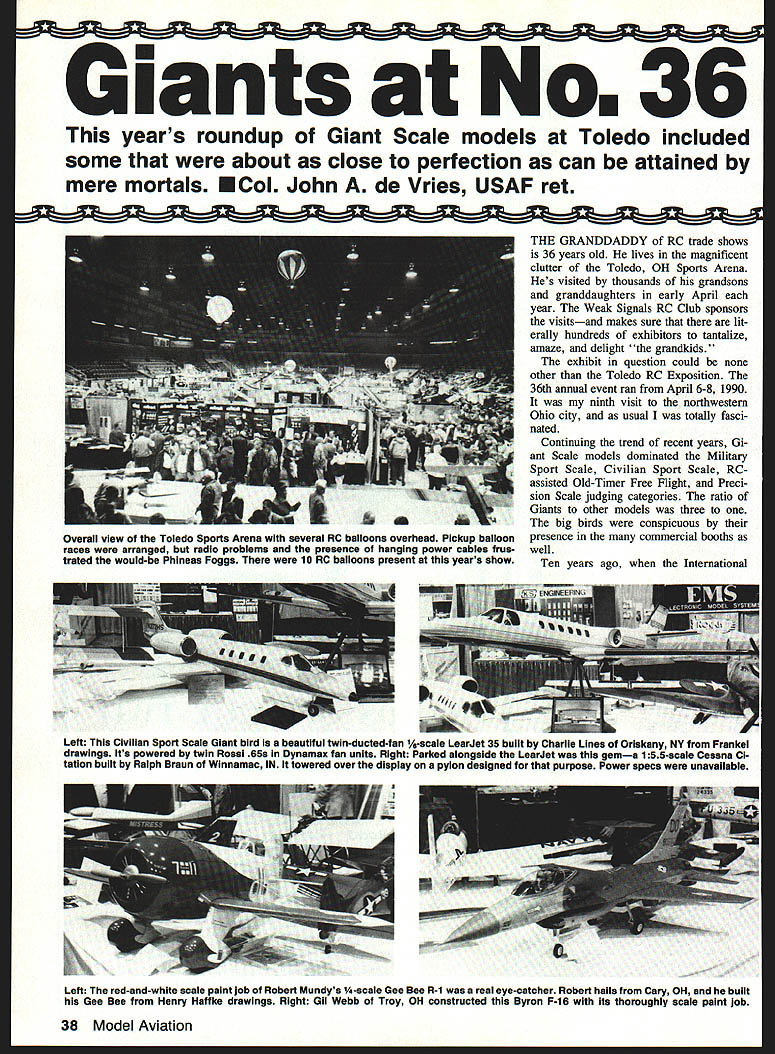
The granddaddy of RC trade shows is 36 years old. He lives in the magnificent clutter of the Toledo, Ohio Sports Arena. He is visited by thousands of his grandsons and granddaughters in early April each year. The Weak Signals RC Club sponsors the visits—and ensures that there are literally hundreds of exhibitors to tantalize, amaze, and delight "the grandkids."
The exhibit in question could be none other than the Toledo RC Exposition. The 36th annual event ran April 6–8, 1990. It was my ninth visit to the northwestern Ohio city, and as usual I was totally fascinated.
Continuing the trend of recent years, Giant Scale models dominated the Military Sport Scale, Civilian Sport Scale, RC-assisted Old-Timer Free Flight, and Precision Scale judging categories. The ratio of Giants to other models was about three to one. The big birds were conspicuous by their presence in many commercial booths as well.
Kits, engines, and accessories
Ten years ago, when the International Miniature Airplane Association (IMAA) was born at Toledo's Commodore Perry Hotel, practically all Giants were scratch-built from the few plan sets then available. Suitable engines were hard to find, and Giant accessories were almost nonexistent. Not so in 1990. Kits for big birds are universally available, as are the necessary bits and pieces to ease their construction and flying.
On display were:
- three Grumman F8F Bearcat kits
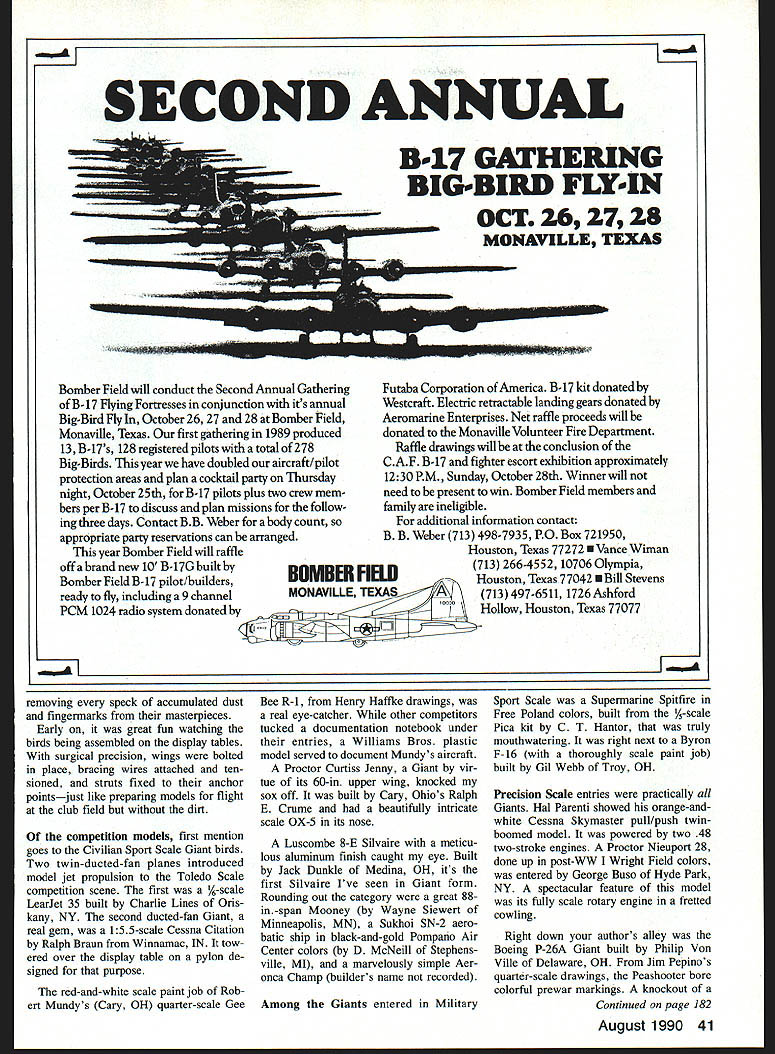
- two Giant Lockheed P-38s
- an AT-6/SNJ Texan in fiberglass and foam
- Extra 230s, Fleet Bipes, 1/3-scale Cubs, Weeks biplanes, and a host of others — all available as kits
Engines and related hardware included:
- Quadras, Aerorows, Zenoahs, Sachs-Dolmars, SuperTigres, and others in a variety of displacements and power ranges
- big, powerful servos and sophisticated radios
- Giant Scale accessories such as propellers, spinners, fiberglass cowls, wheels, and already-brazed or welded landing gear and tail-wheel assemblies
Plans, drawings, and documentation booths manned by model designers provided toothsome projects for scratchbuilders.
At the displays
The real stars of the Toledo show are the models entered in the various competition categories. The standards of model construction, detailing, and finishes are stratospheric—as close to perfection as can be attained by mere mortals. Throughout the show, proud entrants could be seen, polishing rags in hand, removing every speck of accumulated dust and fingermarks from their masterpieces.
Early on, it was great fun watching the birds being assembled on the display tables. With surgical precision, wings were bolted in place, bracing wires attached and tensioned, and struts fixed to their anchor points—just like preparing models for flight at the club field but without the dirt.
Competition highlights — Civilian Sport Scale
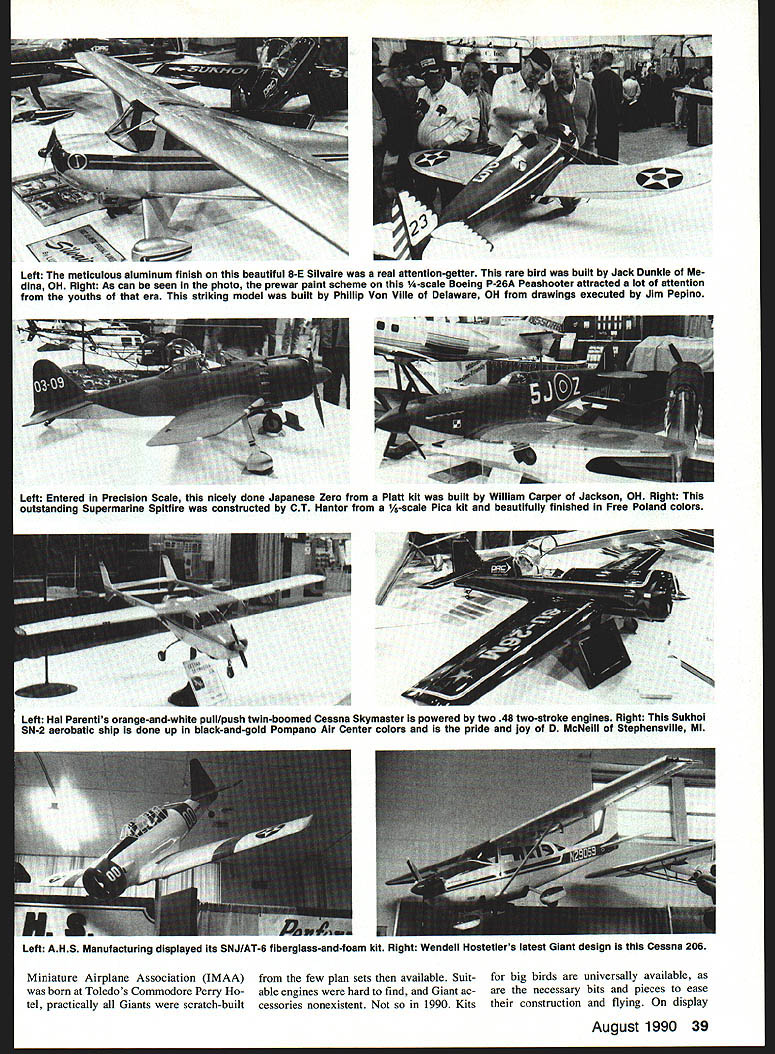
Of the competition models, first mention goes to the Civilian Sport Scale Giant birds. Two twin-ducted-fan planes introduced model jet propulsion to the Toledo Scale competition scene:
- a 1/4-scale Learjet 35 built by Charlie Lines of Oriskany, NY
- a 1:5.5-scale Cessna Citation by Ralph Braun of Winamac, IN, which towered over the display table on a pylon
Other notable Civilian Sport Scale entries:
- Robert Mundy's (Cary, OH) quarter-scale Gee Bee R-1, red-and-white from Henry Haffke drawings; a Williams Bros. plastic model served as documentation for Mundy's aircraft
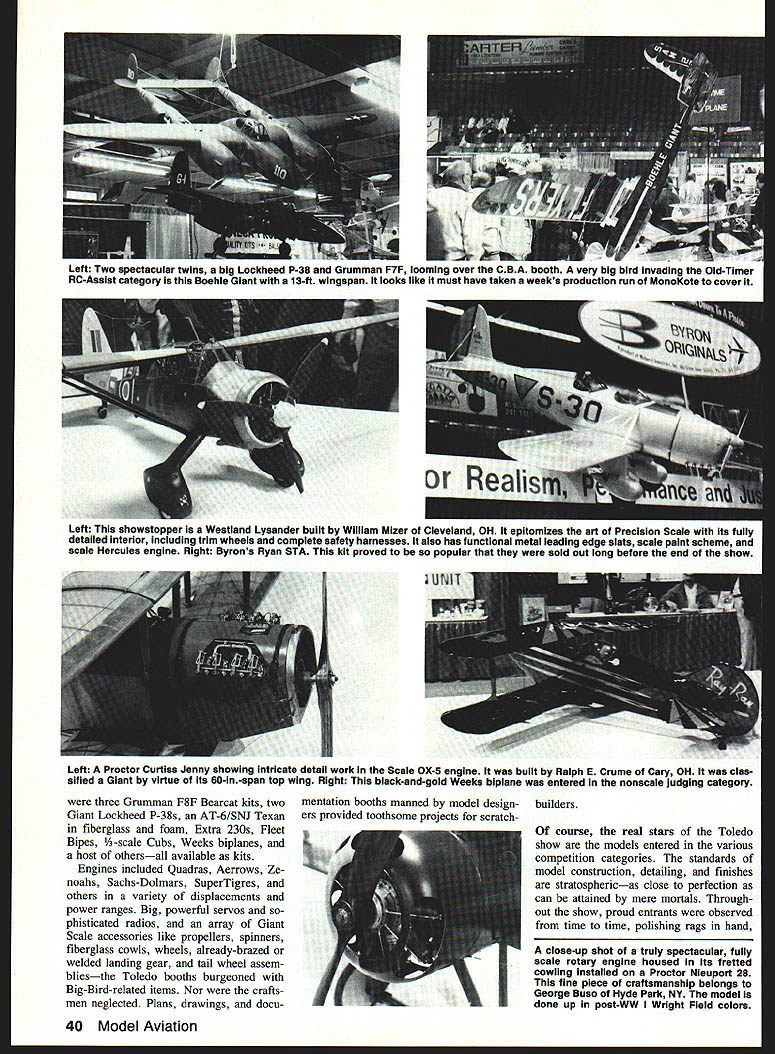
- a Proctor Curtiss Jenny (100-inch upper wing) built by Ralph E. Crume of Cary, OH, featuring a beautifully intricate scale OX-5 engine
- a Luscombe 8-E Silvaire with a meticulous aluminum finish, built by Jack Dunkle of Medina, OH (the first Silvaire seen in Giant form by this author)
- an 88-inch-span Mooney by Wayne Siweider of Minneapolis, MN
- a Sukhoi SN-2 aerobatic ship in black-and-gold Pompano Air Center colors by D. McNeill of Stephenville, MI
- an attractively simple Aeronca Champ (builder's name not recorded)
Military and Precision Scale
Among the Giants entered in Military Sport Scale was a Supermarine Spitfire in Free Poland colors, built from the 1/4-scale Pica kit by C. T. Hantor, which was truly mouthwatering. It stood next to a Byron F-16 with a thoroughly scale paint job, built by Gil Webb of Troy, OH.
Precision Scale entries were practically all Giants:
- Hal Parentis showed an orange-and-white Cessna Skymaster pull/push twin-boomed model powered by two .48 two-stroke engines.
- George Bono of Hyde Park, NY, entered a Proctor Nieuport 28 done up in post-WWI Wright Field colors; a spectacular feature was its fully scale rotary engine in a fretted cowl.
- Philip Von Yule of Delaware, OH, built a Boeing P-26A Giant from Jim Pepino's quarter-scale drawings; the Peashooter bore colorful prewar markings.
- William Carper of Jackson, OH, entered a striking Japanese Zero from the Platt kit.
The Precision Scale model that turned everybody's head was Frank Mizer's Westland Lysander. With its fully detailed scale interior — including trim wheels and complete crew safety harnesses — it epitomized the art of Precision Scale. Functional metal leading-edge slats, a scale paint job, and a scale Hercules engine were frosting on the cake.
Other entries and attractions
Giant Scale birds were also evident in non-scale judging categories. A black-and-gold Ryan Special Weeks biplane was entered in Sport Biplane. Big birds invaded the Old-Timer category as well. One Boeing Giant looked as if it must have taken a week's production of Top Flite's transparent MonoKote to cover it; it was so huge that even a wide-angle camera lens couldn't capture it.
One stalwart wasn't content just to display his model. Upon returning to the underground parking garage next to my hotel on Friday afternoon, I heard the unmistakable sound of an RC engine. I walked toward the hum and found a man flying his RC helicopter — and he was good, an opinion confirmed by three municipal employees who formed the audience.
As in 1989, RC helium balloons — I counted nine at various times — flittered above the crowd in the arena. Pickup balloon races were arranged, but radio problems and hanging power cables frustrated the would-be Phineas Foggs.
Conclusion
All in all, 1990 was a Giant year at the Toledo show. Given the continuing and increasing interest in large-sized Scale models, that isn't surprising.
Transcribed from original scans by AI. Minor OCR errors may remain.

