
Glider Flying
Why do the Russians excel at A/2 Glider competition? To find the answers, Jim Wilson went to the 1977 World Championships at Roskilde, Denmark, to watch them, talk with them, and analyze their every move and flight. Whatever your interest, his fascinating account is recommended reading.
I WOKE from a light nap with a start. My body said it's 2 a.m. and go back to sleep, but the sun outside my window said broad daylight and get up, lazy. Where am I? Oh, yea, KLM flight 67 going to Denmark. There's Irv Aker, sketching Wakefield designs to pass the time, and Bill Bogart looking out the window for shock waves on our 747 wing. Thus, started a pattern of confusion that would last several weeks.
I was on my way to Roskilde, Denmark, to watch the Russians fly A/2 glider at the 1977 Free Flight World Champs. The Russians are, as their contest results prove, the best glider fliers in the world, and developed most of the techniques we use to circle-tow and zoom-launch. I hoped to improve my own flying by observing them closely.
In my mind, I have a picture of the Russian and North Korean tables at the World Champs banquet. Both loaded with trophies. Several years ago, the Russians traveled to North Korea to teach modeling. I'd say they get high marks as teachers! The basic entry fee to the World Champs, which I paid to use the contest room and board, entitles you to compete to win, and I hoped to learn enough from these master teachers to do that at a future World Champs. Three Russian glider fliers came to the 1977 contest; four could have competed. Victor Chop, defending World Champ, explained foreign currency wasn't available for other travel. As 13 Soviets made the trip, eight fliers came; power flier Eugeny Virbitski reported ill and his ships were proxied. An interpreter, team manager and three political advisors accompanied the team.
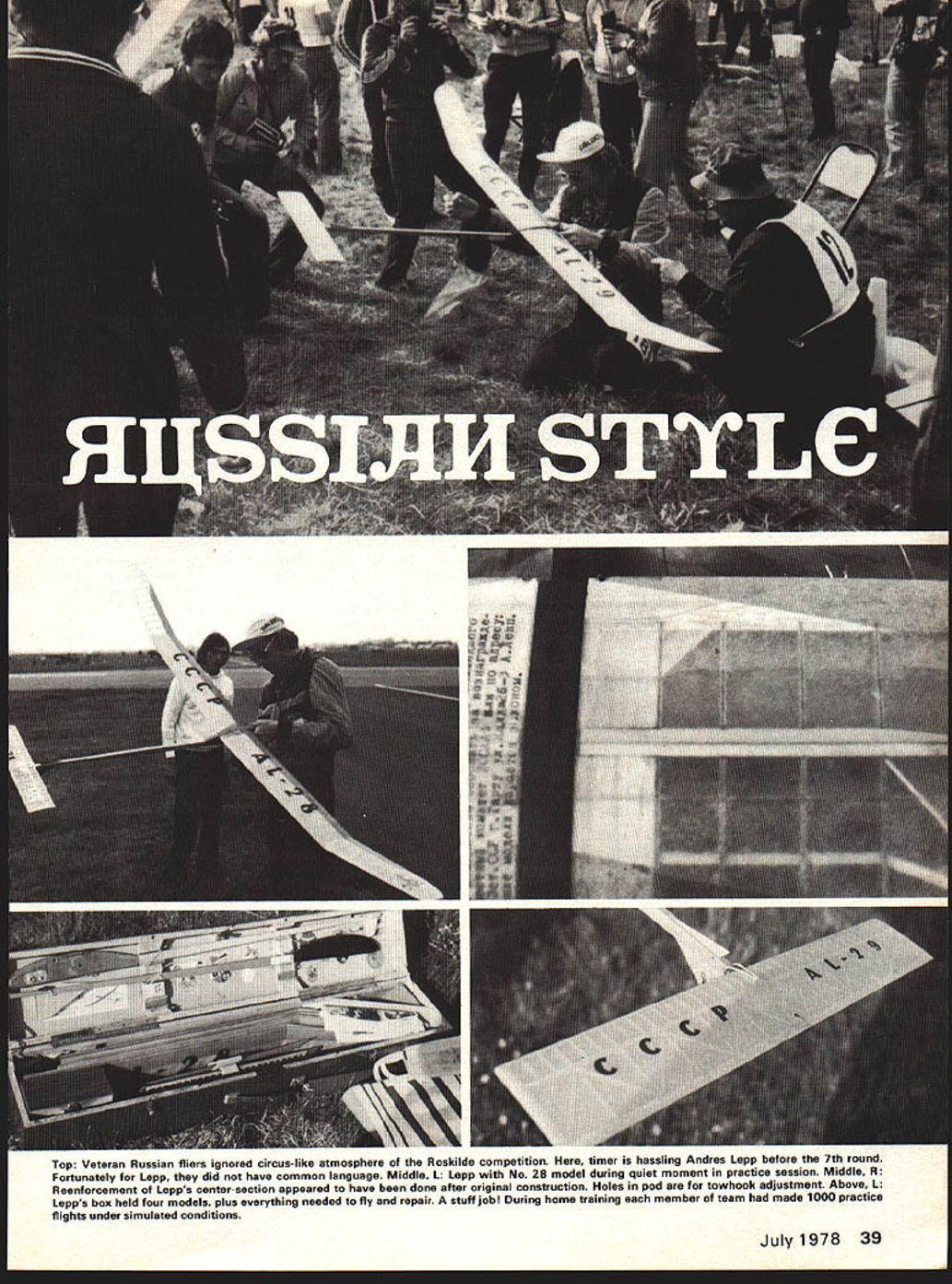
About the fliers: Andres Lepp, cool and confident, is from Tallinn, Estonia. He wore the same outfit as the others — the standard blue sweat uniform and a brown-and-yellow ripstop nylon FIA jacket and PIK-20 cap. Lepp has come close to the championship, finishing in the top ten in three previous world champs.
Young Victor Chop, of Odessa and the defending world champ, betrayed his nervousness by chain smoking. Third flier Victor Issaenko, of Kharkov, practiced with teammates; business turned into life — banquet, party and later dancing nonstop. Present were three seasoned, world-class competitors: Chop, having flown the last two championships; Issaenko, the last three; and Lepp, the last four. The Russians are excellent athletes — very slender and hard.
The Russians arrived Wednesday morning, 6 July, for the three contest days on the eighth, ninth and tenth, with glider being the second event. Some teams arrived earlier, including the U.S., and made the best use of their time practicing on small fields near Holbæk and Ringsted, both about 25 km (15 miles) from the school at Viby where many stayed during the contest. In the past, Russians have sometimes arrived very late before international contests; this time they practiced during the available period at Roskilde Airport, making about 60 flights in five separate sessions, followed by a two-week team practice near Moscow. Each glider flier made about 1,000 practice flights, concentrating on light-air training and flying a lot from midnight till 6 a.m., Lepp said. As a result of practice, he could expect to make 220-second flights in neutral air. The team usually relied on bus transportation provided by the Danes to get around; early practice sessions were usually among the last to leave and the first to arrive. On the first day, Wednesday the sixth, Roskilde Airport was open for model flying and the Russians were the first in the air without regard to the 15-20-mph wind.
While most people watched, the Russians flew. Their practice pattern was consistent. Take the model out of the box and assemble it, with some fiddling around with the wings due to their removable wing wires. Fly the model two or three times and make any required trim changes. Then, close the model box and practice flying skills. "Train don't trim" describes the practices. The Russians were comfortable in various weather conditions as they quickly adjusted their models for best results, then got on with the training.
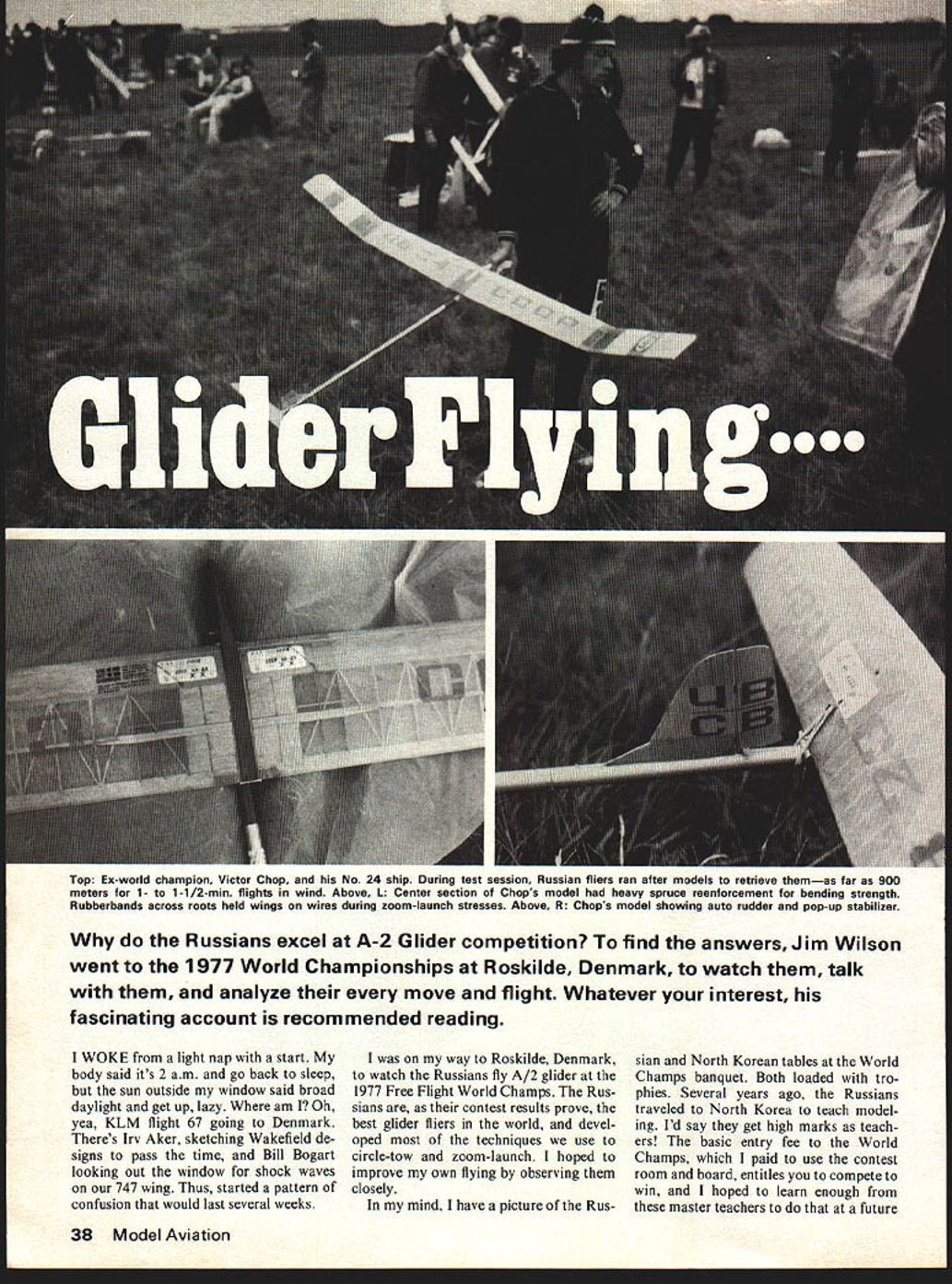
After a launch, the flier would watch the zoom and first glide circle, then run after the model to retrieve. This run was brutal in Wednesday's wind, being anywhere from 600-900 meters for a 1-1½ minute flight. It's obvious that the fliers had been on a deluxe conditioning program to repeat the practice pattern over and over. Issaenko told me that he runs five kilometers (three miles) every day for conditioning. I expect all three fliers could handle this training run in 21-23 minutes.
On opening Wednesday, the Russians showed what price they were willing to pay to be ready for contest Saturday. Lepp crashed one model by spiraling in on launch, and a second after DE'ing on a runway. Chop planted a ship on tow right up to the leading edge, when he got it flying downwind without enough slack to allow the circle to continue. He didn't throw the line, which would have saved the ship, but kept running just as he would have in the contest. The wind was just too much, however.
Wednesday, each flier made about ten flights. They practiced kiting, parking circles, and launches. Parking circles had a small radius for control in the wind and were surprisingly flat in bank angle. Circles were started by just giving slack to the towline. With little rake in the towhook, no stall or violent action was required to start a circle. Air speed in the circle was up so that the turn was steady and didn't hesitate once started. No auto-stab function was used. The parking circles were up high on the line, so there weren't any death-defying swoops that wipe out wings. During parking, the fliers stand sideways to the wind and handle the line. Rather like making big loops with a U-Control ship.
Every launch was a zoom, usually with a large-radius circle and low bank angle. Launches in the wind were made by rapidly taking in two or three arm lengths of line to unlatch, turning the model, and then letting go of the line to make a smooth release. All three fliers used a two-inch finger loop to hold on to the line, which was .034 inch thick monofilament, about a 50-60 lb. test. Their line was harder (less stretchy) than inexpensive blue monofilament, but was not as hard as "Stren" brand which is favored in Southern California, where I live.
Thursday morning the wind was lower and there was intermittent rain. The team was out flying different ships than on Wednesday and, by the end of the session, had trimmed and practiced with each of their four planes. Each brought three thermal ships, with layouts similar to their familiar ones already published, and one ship with a span longer by four to ten inches, aimed at improved glide. In the lower winds, the fliers would launch by taking five or six quick steps after the ship turned into the wind, then stop running and go through the arm motions to unlatch, turn, and launch. All three used the same technique and few launches were messed up. The average time from turning the ship into the wind to launch was under two seconds.
With the models being similar in layout and airfoils, the height gained on launch differed by the air speed the flier could generate by running, and arm speed during the launch sequence. Lepp is the best zoomer and, from my observations, could count on 30-feet altitude gain on every launch. Most of his launches were made by running backwards rather than forward. This has the advantage of making the launch timing easier, since he could see the model during the launch sequence. Lepp's legs appear to end up around his armpits and he can run backwards faster than most people can run forward. He would make a pretty good NFL cornerback.
After Thursday's opening ceremonies, the weather was the best of our Danish stay—clear skies with buoyant air and low wind that would take the models only 400-500 meters in three minutes. Practice was the same as before with the fliers working on air-picking and launches. Launches with good zooms were doubly rewarded in Roskilde's light air by elevating the ships into the hotter part of the thermal for a better climb, plus the extra flight time due to the climb itself. The calm-air launch sequence was the same as the medium wind sequence: Run five or six quick strides after the ship turns into the wind, hand-over-hand two or three arm lengths quickly, then turn loose of the line to release.
On Friday, Wakefield was flown and the glider team helped as the downwind retrieval group. After the contest, all three Soviet fliers had their busiest practice, each getting in about 20 flights. All of the time was spent on flying technique—no trimming. Only eight hours before the start of their contest, most other contestants were packing it in, or resting. The Russians, however, were out working their hardest. The only difference from previous sessions was that the longer-span fly-off models had inconsistent launches, compared to the shorter-span models. Whether this was due to design or construction quirks of those particular models, I don't know.
During each of these practices, neither the fliers nor team manager talked very much. The fliers worked with their own ships and didn't pay much attention to other countries' competitors. I only saw one camera, Lepp's, and it was out for only a short time. And, when the flying was finished, they left, either to eat or go back to their rooms. In short, this was pretty serious business. Even the model processing was serious. The entire team showed up before processing officially began on Thursday, and ran their ships through with no crowds around. I don't know how this was arranged, but it was effective.
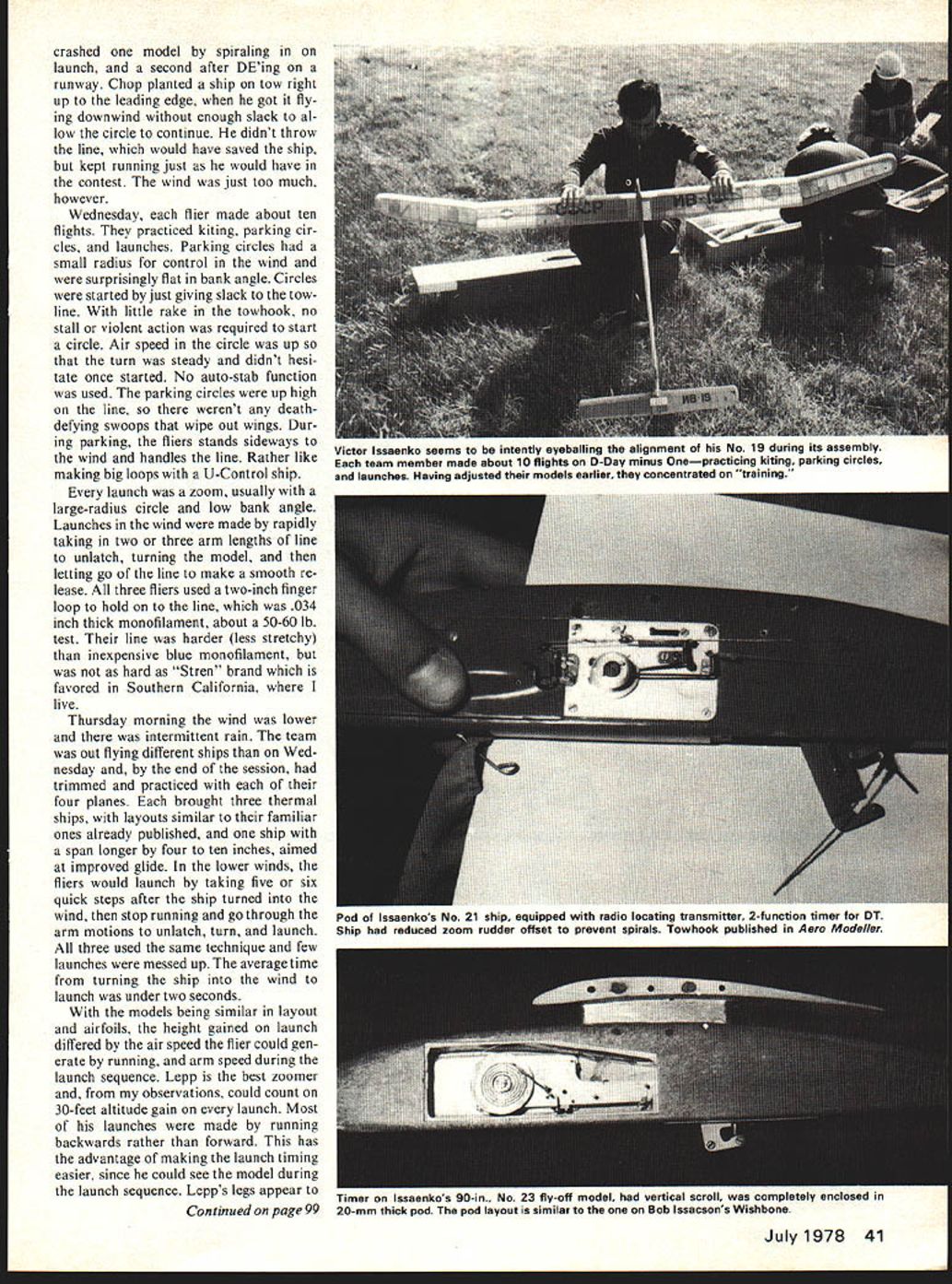
Saturday morning, the team was out early and made about five short flights each to warm up and test air. Field conditions affected the flying greatly as the airport was surrounded by grass areas, crops, and forest. Upwind of the launch line there was a large depression and, upwind of that, rough little hills and irregular terrain. The temperature was between 55-65°F and the sun was not directly visible until late in the day. Some strong thermals were generated right after 7 a.m., but otherwise lift was weak. Most rounds' thermals were just strong enough to maintain ships at line height or slow their descent. In the last round especially, when only ten of 82 fliers maxed, air conditions were dead.
The map of the field shows the general layout. Initials L, C, I, refer to Lepp, Chop, and Issaenko and their launch point on a particular flight. L1, for instance, is Lepp's first-round launch point. The Russians were the most mobile fliers on the field, although a majority of fliers were circle towing and did get fairly spread out.
The Russians have a simple strategy. They get downwind, in back of a good selection of other fliers, and wait in the air for someone to hand over a thermal. Their competition strength is execution. They park downwind patiently, pick air carefully, and make consistent launches. They practice the fundamentals until they can instinctively execute them. Their conditioning program has both long, slow distance runs for endurance, and interval workouts for speed. They practice gymnastics for launch agility. They are seasoned competitors who have the mental stability to cope with the carnival-like atmosphere of the World Champs. Their attention to basics and thorough preparation are similar to their approach in other international athletic events. They prepare to win.
If the wind is light (below roughly 10 mph), the flier just straight tows downwind after the initial towup and half circle. In higher winds, the flier circles and drifts downwind to his parking spot. If bonafide lift comes through, they will take it or, if forced by time, will go but would prefer to "fly with other sportsmen" as Victor Issaenko puts it. Two-thirds of their contest flights were piggybacking, and one third were solo.
My chart of the 21 Russian contest flights is taken directly from my log, written as each flight occurred. The notes are a bit terse, but the flavor of the competition is there.
Round I—350-450 hours, 6-8-mph wind, overcast sky, 24 of 82 fliers maxed.
Lepp: Wait four minutes after beginning of round. Park 200 meters downwind of line. Line tangle with Swede and crash. Return to line and refly right away. Park 300 meters downwind and avoid crowd. Piggyback single marker model that came straight at him. Smaller diameter zoom circle than in practice. Circles left. Max.
Chop: Go right after Lepp timed out. Park 100 meters downwind of line. Let one thermal go by when he couldn't reach marker model. Line tangle. Recover and make best zoom immediately. May have been a planned tactic with latest line tangle rule, although air was good. Circles right. Max.
Issaenko: Park 100 meters downwind. Bird's nest line foul-up. A real mess. Lepp and Chop untangle while Issaenko circles on 30 meters of line. Excellent team work. Finally launched by himself on tension. Fluttered right tip panel. Circles right. Max.
Round II—455-540 hours, 10-12-mph wind, 29 of 82 maxed.
Lepp: Park at right end of line away from crowd. Kites some, circles some, turned down one marked thermal. Took second with back-up zoom. Stall on launch but quick one-bob recovery. Air marked by three other ships. Fourteen-minute park before launch. Max.
Chop: Park 100 meters downwind of right end of line. Team manager (who had a radio to talk to the retrievers and stayed with the fliers while they towed) pointed out thermal and Chop chased marker model 400 meters crosswind. Made three test circles before launching to the right of the wind. Max.
Issaenko: Kite and park 100 meters downwind. Piggyback single model. Stally zoom and big, stally glide circle, but held altitude halfway through flight. Max.
Round III—545-630 hours, 8-10-mph wind, 35 of 82 maxed.
Lepp: Piggyback U.S.A.'s Jim Walters at the line. Made three test circles before making dynamite back-up zoom with small radius again. Was 200 meters upwind of Jim when he finally launched. Max.
Chop: Changed models after breaking tip on DT in second round. Park 200 meters downwind of center of line. Went by himself on tension when team manager's back was turned and earned frown. Easy max.
Issaenko: Added glide turn between rounds. Passed up two thermals from first park, then went 300 meters straight downwind in five moves chasing a big one but couldn't quite catch up. Held, then piggybacked two models, but zoom was flat and unstable thermal died. Trim OK now but ship only made 103.
Round IV—635-720 hours, 8-10-mph wind, 45 of 82 maxed.
Lepp: Usual park. One test circle near rapidly climbing model, had to pull down to get slack on test circle, back-up zoom, strong thermal. Max.
Chop: Crosswind move from park to air marked by three models. One test circle. Release while definitely going up in arc. Max.
Issaenko: 600-meter straight downwind sprint chasing biggest thermal of day, but pulled out when he couldn't quite catch up. Thus ran the outstanding athletic effort of the contest. Five minutes park catching breath, then went by himself after refusing two patches of marked air. Flat zoom. Max.
Round V—725-810 hours, 12-15-mph wind, 37 of 82 maxed.
Lepp: Crosswind immediately on right side of line to piggyback single model. Super zoom. Marker model came down but Lepp rode loft. Max.
Chop: Two test circles from park into great boomer marked by many models wheeling around, launch made 75 feet altitude gain and wound up higher than all the marker models after one half circle! Chop stayed 200 meters from line even though six fliers were in back of him. Czech, Ivan Horejsi, who finished fourth in 1975, took the same thermal and fluttered both main panels on zoom, cut down on altitude, but the thermal god intervened and the thermal petered out. Ivan hung on to max but Chop made only 170.
Issaenko: Piggyback single model from park. Tested air about 100 meters from marker then moved crosswind and tested air upwind of marker model before going. Max.
At 0800 the contest was 70% complete. Now the fliers had nine hours to stew around before the last two rounds. This timing added to the other World Champs pressures: strange food, languages, crowded conditions, all which reduce performances from home field levels.
Round VI—1705-1800 hours, 5-7-mph wind, mostly overcast, 24 of 82 maxed.
Lepp: Went 300 meters downwind immediately to avoid a gaggle of fliers. Parked 15 minutes before going by himself on tension. After about two minutes into flight ship did two flat turns with increasing speed that lost altitude before slowing and recovering. Max.
Chop: Went for one thermal from park but missed it and pulled out. Was third into next thermal. Nice standard zoom. Max.
Issaenko: Fifteen-minute park in dull gray period. Finally went after two test circles on good tension with two other ships wheeling around and climbing, but air was weak and ship sank into crops for 174.
Round VII—1805-1900 hours, calming and clearing, 10 of 82 maxed.
Lepp: Removed glide turn in test flight far downwind. Then had a heartbreaker after 12-minute park in dead conditions. Went by himself after one test circle. Good zoom and position but was sucked down by crops downwind. Lepp's hole was born. Lepp was the only flier to make six consecutive maxes and this drop pushed him to second place. 164.
Chop: 800-meter downwind move to control tower area looking for lift around a hot spot. Dropped line once while parking but recovered after great sprint. Went by himself finally, on orders from team manager to allow time for Issaenko. Smooth zoom but no air for 137.
Issaenko: Park at left end of line until nearly the end of round, finally going by himself on what looked like good tension as ship made several small circles at top of line, but crops got him also for 172.
Later the Danes commented that Round VII was during the time of day that the sea and land winds cancel one another and produce air with little vertical motion. Flight times certainly confirm this.
I arrived in Denmark with the feeling that the Russians were larger than life, that no matter what they did, they would somehow win. Well, they aren't and they didn't this time. They are excellent competitors, but if the air is unstable they try the same things everyone does to find lift and, without it, their times are down. In the last round, all three were around the obvious hot spots looking for lift, but couldn't connect. Racer's luck applied to everyone.
With the Russian competitive philosophy, they need good, dependable airplanes, not ultimate glide performance. Their ships are above average in structural design and construction, but conventional in aerodynamic design. Issaenko's and Chop's are developments from the Sokolov school of the early 1960's. Lepp's is his own layout dating back about ten years. The models have been modified from the original concept to make room for the circle-two apparatus and zoom-launch flight requirements. Wing center sections have beefy spars for bending strength and many diagonals for torsional rigidity. The models vary enough within conventional limits that I believe their warp-free structures have more to do with their flight performance than any design feature, such as "keel effect," low dihedral, or wing incidence relative to some reference line.
Chop's models were similar in layout to his Plovdiv winner. He has varied rib layout, working toward more flutter-free and reliable structures. His latest model, #26, has many features: completely enclosed timer only 18-mm thick that was a machinist's dream — carbon-fiber ultralight boom, and a streamlined spring/magnesium stab tongue that was the most impressive trick I saw on any model at the Champs.
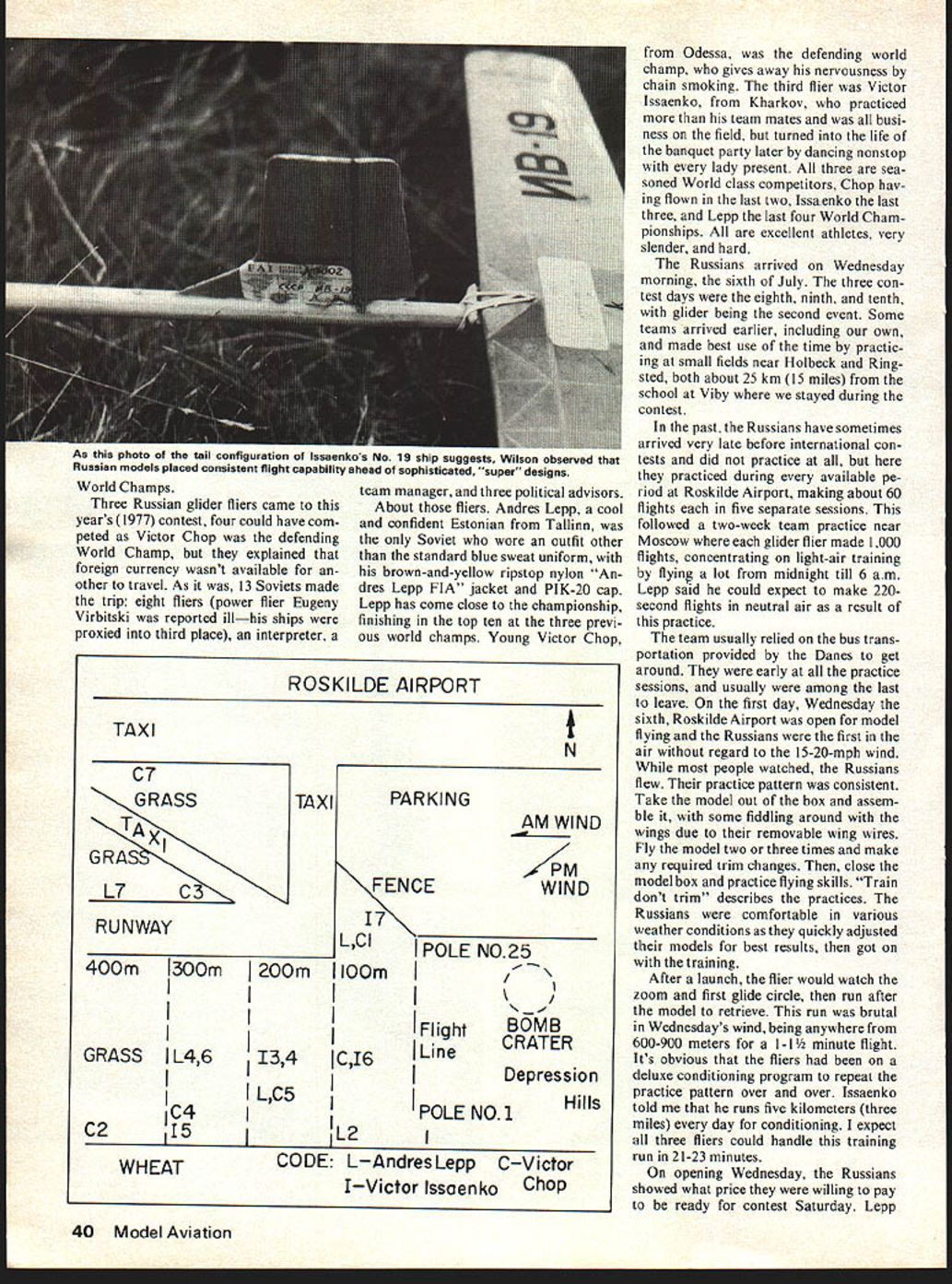
Issaenko flew #19 — the same ship as at Plovdiv. His #23 "fly-off" ship was interesting, with some ideas from Bob Isaacson's Wishbone, this year's NFFS A/2 of the year. He also had some of the same tricks as Chop, built to a lower construction standard. There is a real difference over there for the World Champion.
Lepp's models are most conventional by comparison. His ships have few tricks and his towhooks are the same design he has used for at least six years. It's a measure of his contribution to the sport to count the many World Champ competitors who used a Lepp hook. Chop and Issaenko, to show some independence, used similar sheet-metal towhooks that were published last year.
The aileron of two years ago has been replaced by a timer-controlled rudder stop that limits rudder deflection during zoom to prevent spiral dives. While most of their models were equipped with this feature, sometimes they used it and sometimes they didn't — possibly depending on the expected wind speed during the flight.
My contacts with the Russians were cordial but Orwellian. During the day, when the political advisors were around, everything was business. In the evening, after the advisors went to bed, great parties flowed in the school halls. The Russians really can have a great time and drink the vodka at the smallest excuse. They can't handle straight shots of Wild Turkey quite as well. So it's a matter of both sides doing some adjusting. We sure had fun getting adjusted.
In the evening, they were free with details of their hardware. Especially after the contest, they were very willing to take out their models and explain all the functions. Issaenko spoke fairly good English, and Lepp spoke German, so communication was easy. All three fliers showed off their ships with great pride, just as we would in a similar situation.
For us, A/2 glider flying still can be simple modeling at its best — at the local level. World Class glider flying, though, is a strenuous sport. A sport played with mind and legs just like defensive basketball. And this is where the Russians' organization and practice have paid off. To be state-supported helps, and there is no night baseball or T.V. to take up time either. But I think they can be beaten with initiative and passion. Free flight's greatest strength, after all, is that contest success is governed by split-second decisions, molded by logic and emotion.
What to do if you want to win a World Championship in A/2 glider? First, you must want to win, real bad. Set your goal on winning a World Championship, not flying without crashing, nor merely placing at the semi-finals, not just flying at the Champs, but winning there. Team members who have taken this contest seriously have told me that the price is very high to do everything you could possibly do to prepare. Even then, your number of variables is high and luck still plays a role. A team approach helps — find someone to tow you, someone to time, someone to assess conditions. Practice under contest-like situations, work on zooms and position, and train to be fit and alert. may not come up, but with incomplete preparation it certainly won't. You'll need a high goal to resist the urge to build the latest all-time high-lift special with a 27-to-1 aspect ratio, or whatever, instead of an ordinary layout that will make it, and you're contest ready. A high goal to remember that it is flying that decides the contest, and that you can't do anything in competition until you've done it in practice — many, many times.
My goal on this trip was to watch the Russians fly and learn from them. It worked for me so far as I came back from Denmark and maxed out at the Taf semifinals doing some things I hadn't done before. Areas that we can all improve on in comparison to the Russians are field mobility, zooms, and air-picking in the extreme conditions—dead calm and high winds. Hopefully, this article will fuel our efforts in solving these problems. If you have questions about all this, write me and I will try to answer them. My address is 10300 Avenue D. Redondo Beach, California 90277.
Transcribed from original scans by AI. Minor OCR errors may remain.

