
Gloster
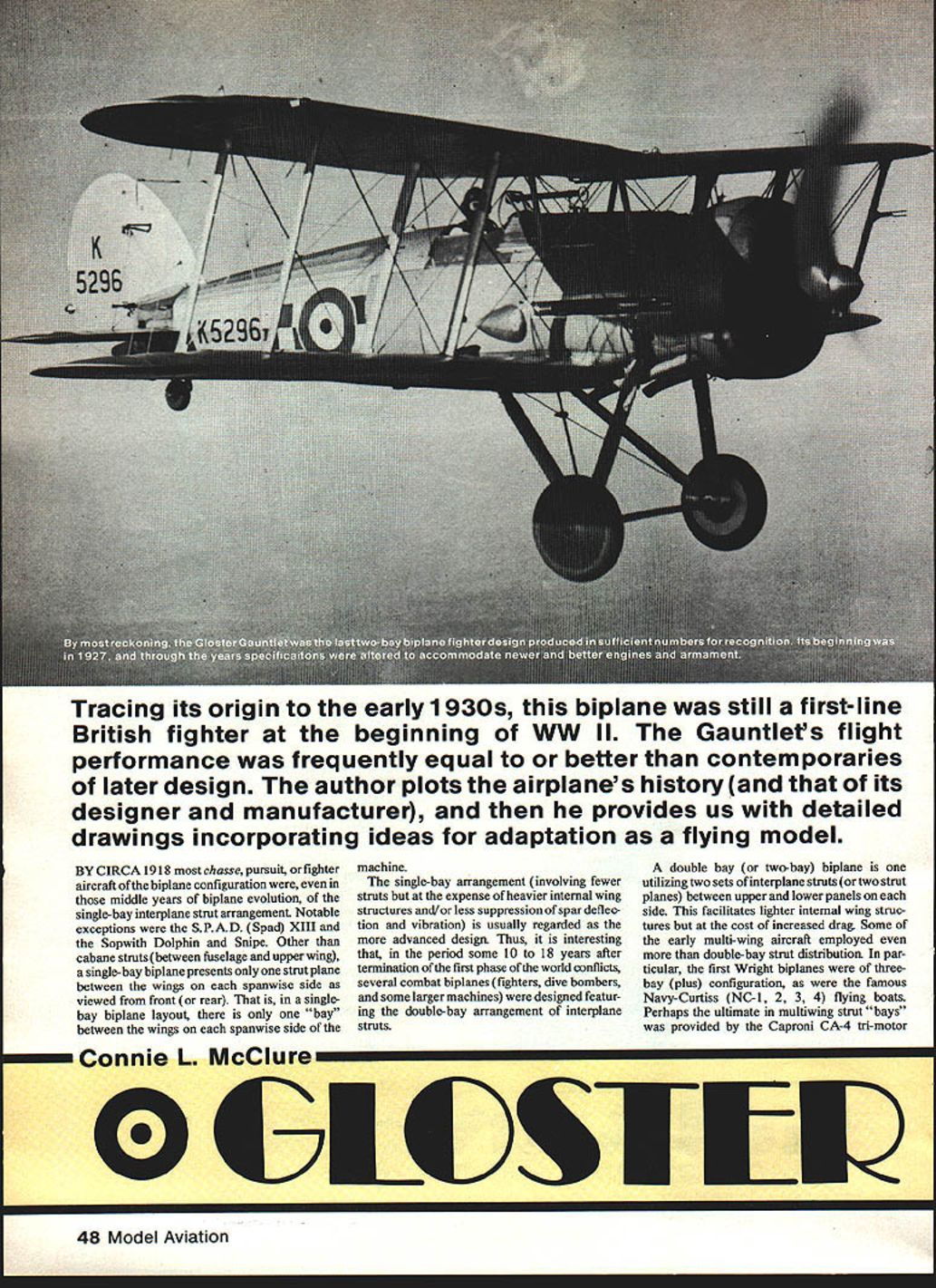
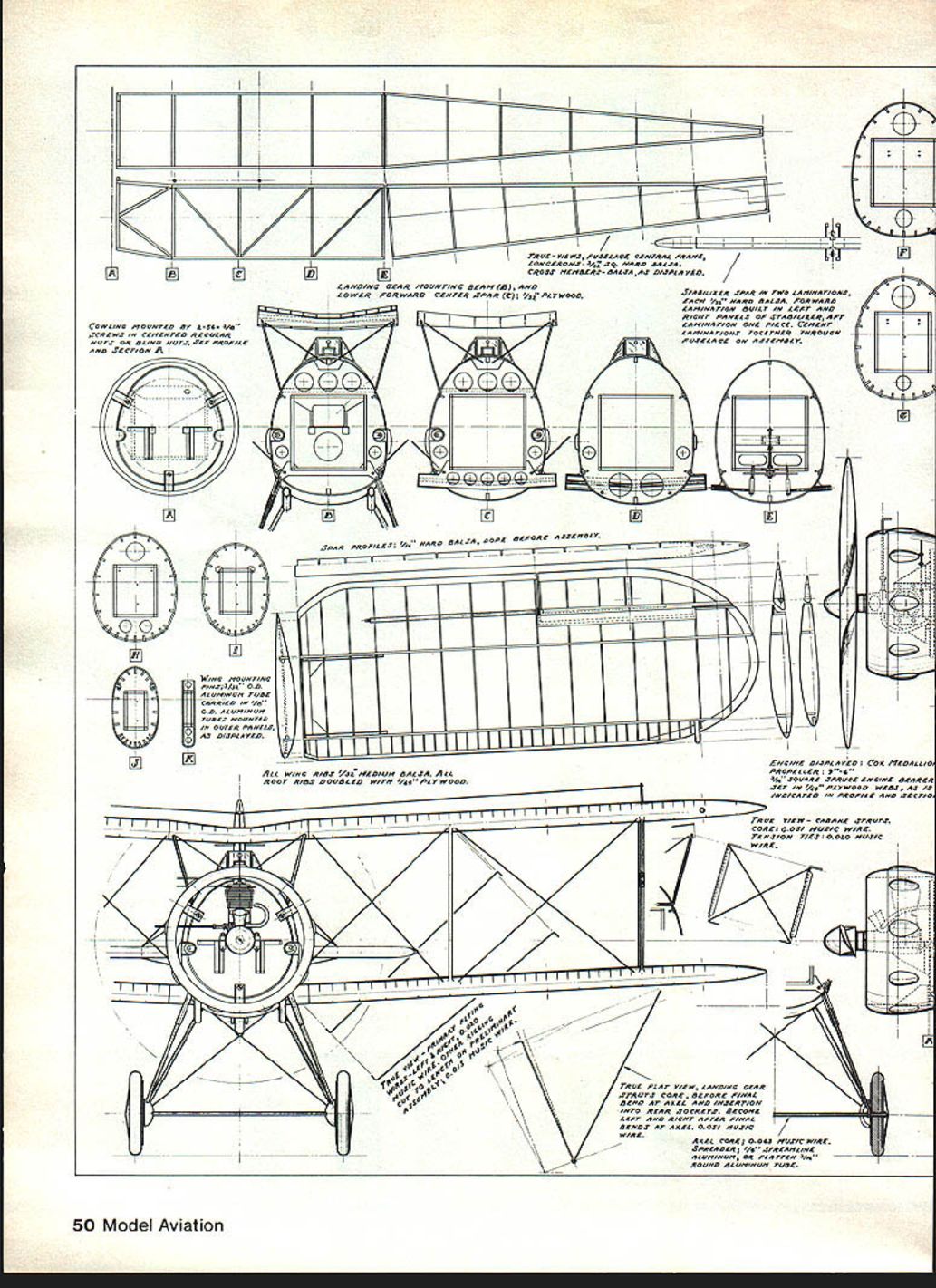
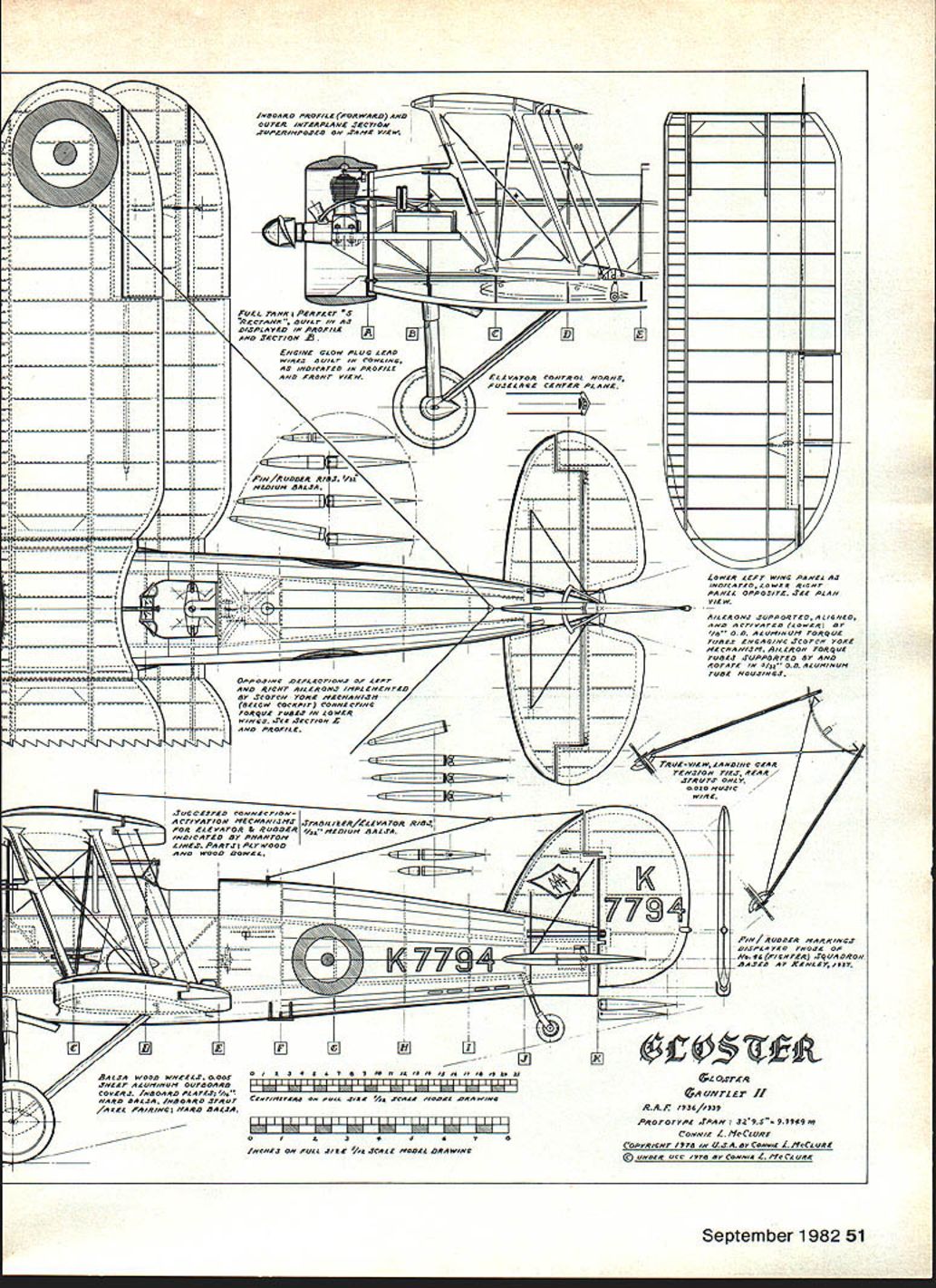
Tracing its origin to the early 1930s, the Gloster Gauntlet biplane was still a first-line British fighter at the beginning of World War II. The Gauntlet’s flight performance was frequently equal to or better than contemporaries of later design. This article traces the airplane’s history (and that of its designer and manufacturer), and provides detailed drawings and ideas for adaptation as a flying model.
Biplane configurations: single-bay and double-bay
By circa 1918, most chase, pursuit, or fighter biplanes were of the single-bay interplane strut arrangement. Notable exceptions were the S.P.A.D. (Spad) XIII and the Sopwith Dolphin and Snipe. Other than cabane struts (between fuselage and upper wing), a single-bay biplane presents only one strut plane between the wings on each spanwise side as viewed from the front (or rear). That is, in a single-bay biplane layout, there is only one "bay" between the wings on each spanwise side of the machine.
The single-bay arrangement, involving fewer struts but requiring heavier internal wing structures and/or less suppression of spar deflection and vibration, is usually regarded as the more advanced design. Thus it is interesting that, 10 to 18 years after the First World War, several combat biplanes (fighters, dive bombers, and some larger machines) were designed with the double-bay arrangement of interplane struts.
A double-bay (or two-bay) biplane uses two sets of interplane struts (two strut planes) between upper and lower panels on each side. This facilitates lighter internal wing structures but increases drag. Some early multi-wing aircraft used even more than two bays: the first Wright biplanes were of three-bay (plus) configuration, as were the Navy-Curtiss NC flying boats. Perhaps the ultimate in multiwing strut "bays" was the Caproni Ca.4 tri-motor bomber of 1915 — a six-bay triplane (six two-tiered strut planes on each spanwise side).
With advancing materials, fabrication techniques, and design refinement, the use of struts and bracing wires decreased in both multi-wing and single-wing aircraft. Nonetheless, prevailing requirements and specifications of the late 1920s to the mid-1930s dictated selection of double-bay strut arrangements in several late biplanes. While these were the middle years of the great days of the biplane, they were the latter years of major emphasis on first-line biplane design.
Contemporaneous with the Gloster Gauntlet, other double-bay biplanes from this era included:
- Fieseler Fi 98 (dive bomber, one prototype)
- Fieseler Fi 167 (multi-purpose shipboard aircraft intended for the Graf Zeppelin; 12 built)
- Heinkel He 50 (dive bomber; built in some quantity and saw service into 1943)
- Heinkel He 51 B-3 (long-span, high-altitude version of the He 51 fighter)
Any emphatic statement that the Gloster Gauntlet was the last two-bay biplane fighter put into production must be qualified with respect to the Fiat CR.42 Falco — truly the last large-quantity-production fighter biplane. Put into production in 1939, the CR.42 might qualify as a double-bay biplane only by virtue of its Warren-truss interplane bracing (intersecting strut planes rather than parallel planes defining bays in the usual sense). With that exception, the Gloster Gauntlet I and II appear to be the last two-bay biplane fighter design produced in sufficient quantity for wide historical recognition.
Origins and designer
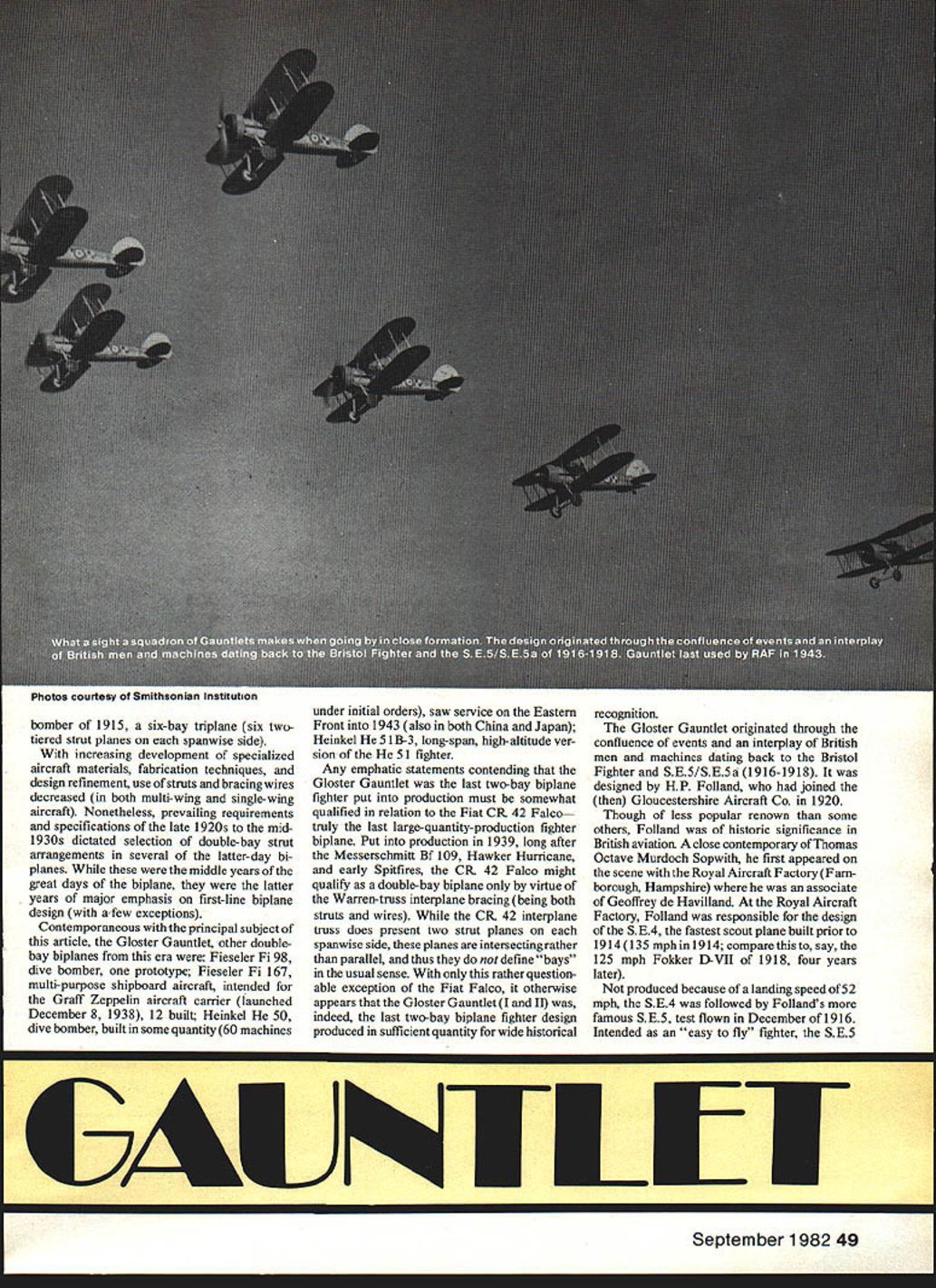
The Gloster Gauntlet originated through events and an interplay of British men and machines dating back to the Bristol Fighter and the S.E.5/S.E.5a (1916–1918). It was designed by H. P. Folland, who had joined the Gloucestershire Aircraft Co. in 1920.
Folland was of historic significance in British aviation. A close contemporary of T.O.M. Sopwith, he first worked at the Royal Aircraft Factory (Farnborough) where he was an associate of Geoffrey de Havilland. At the Royal Aircraft Factory, Folland was responsible for the S.E.4, the fastest scout plane built prior to 1914 (reported 135 mph in 1914). The S.E.4, not produced because of a high landing speed, was followed by Folland’s more famous S.E.5, test flown in December 1916. Intended as an "easy to fly" fighter, the S.E.5 became an important fighter of the First World War.
For a time Folland was with the British Nieuport Co., where he was involved in the design of the Nieuport Goshawk, a racing plane with an unfortunate history. Harry G. Hawker (of Sopwith fame) was killed in the Goshawk on July 12, 1921. Prior to that tragedy, Folland had joined the Gloucestershire Aircraft Co., initially as a consultant and then as designer and chief engineer in 1920, attracted by David Longden and H. Martin to expand in-house design and development. This was the beginning of an historic association.
Early Gloster aircraft and Schneider Trophy racers
Officially named the Mars I, the Bamel racing machine was the first Folland/Gloster creation. It was an equal-span, equal-chord, single-bay biplane (one strut) of 23 ft span, with almost square tips on the lower wing. The Mars I was powered by a Napier 450-hp inline engine and was very successful — winner of three consecutive Aerial Derby races (1921–1923).
Around this time the Gloucestershire Aircraft Co. became the Gloster Aircraft Co., Ltd., and subsequent airplanes bore the Gloster name. Following the Mars I came the high-speed seaplanes designed for the Schneider Trophy races: the Gloster II (1923), Gloster III (1925), Gloster IV (1927), and Gloster VI (1929). The Gloster IV, a single-bay biplane, set a speed record of 295 mph in 1927. The Gloster VI, a low-wing monoplane (two constructed) called the Golden Arrow, established 336 mph in 1929. Notable Schneider-era seaplanes also include the Sopwith Tabloid, the Supermarine S.6B, and the Macchi M.C.72 (post-Schneider seaplane record of 440.681 mph set in 1934).
Concurrent with the speed-quest activities, Folland and Gloster designed and built single-place fighters for the Royal Air Force. The Gloster Grebe entered service in fall 1923 — a single-bay biplane powered by a Bristol Jaguar radial with a top speed of 152 mph. The Grebe evolved into the better-known Gloster Gamecock, entering service in 1926. The Gamecock was a single-bay biplane powered by a Bristol Jupiter radial (425 hp) with a top speed around 155 mph and a service ceiling near 22,000 ft. About 90 production Gamecocks were delivered.
The Gamecock was declared obsolete in 1933 with the advent of the Bristol Bulldog and the Hawker Fury. Until the de Havilland Mosquito appeared in the 1940s, the Gamecock was frequently cited as the last RAF fighter of essentially wooden structure. It was also among the first to incorporate side gun troughs (low on each side of the fuselage), a distinctive feature of subsequent Gloster biplane fighters.
Development of the Gauntlet
The immediate origin of the Gloster Gauntlet was a double-bay prototype known as the S.S.18, Gloster’s response to RAF Specification F.20/27 (1927). In that year Gloster absorbed the Steel Wing Company, a pioneer in using light steel strip in aircraft construction.
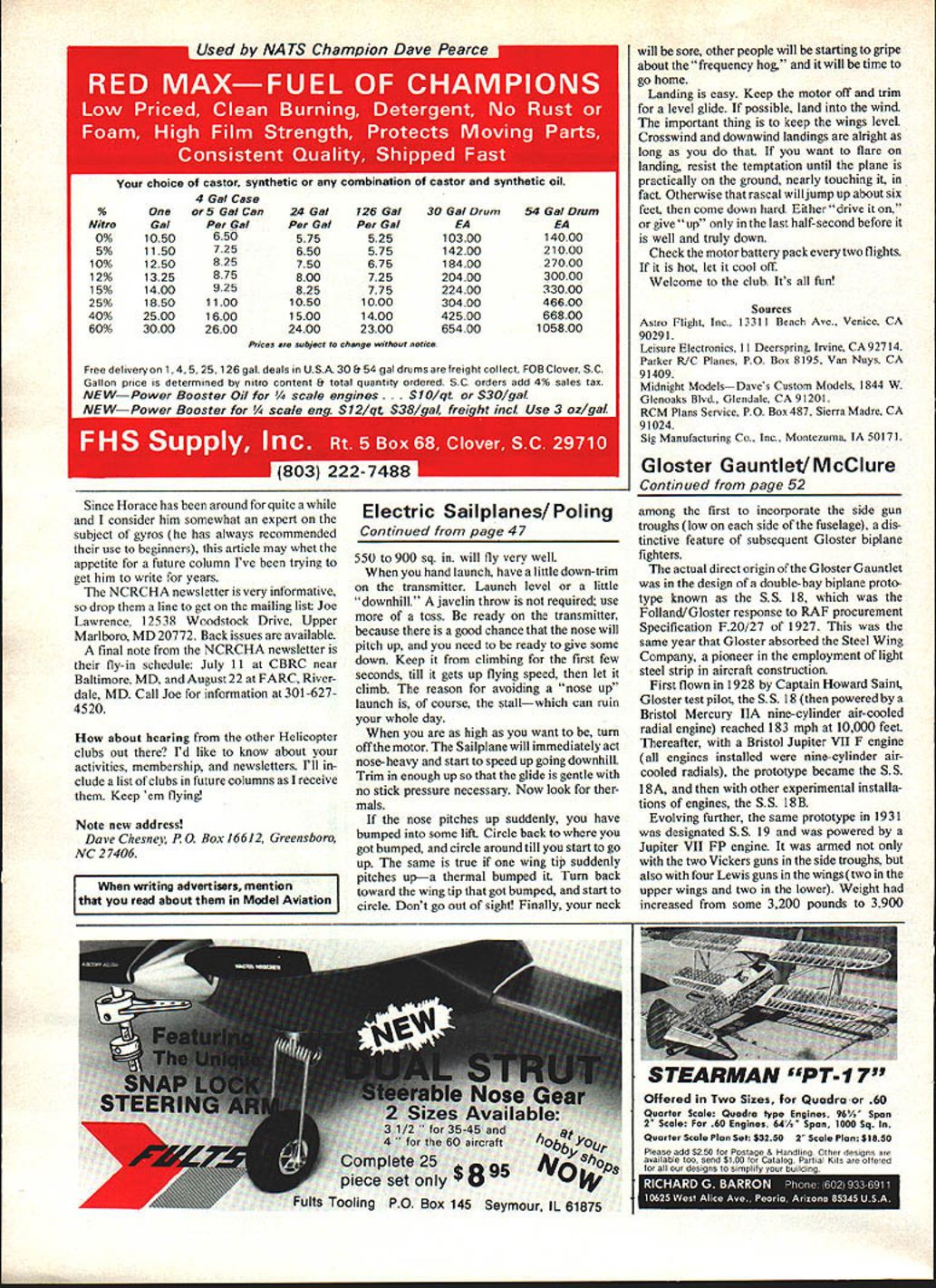
First flown in 1928 by Captain Howard Saint (Gloster test pilot) and initially powered by a Bristol Mercury IIA nine-cylinder radial, the S.S.18 reached 183 mph at 10,000 ft. With a Bristol Jupiter VII F engine the prototype became the S.S.18A, and later the S.S.18B with other experimental engines.
Evolving further, the same prototype in 1931 was designated S.S.19 and powered by a Jupiter VII FP. It was armed with two Vickers guns in the side troughs and four Lewis guns in the wings (two upper, two lower). Weight increased from about 3,200 lb to 3,900 lb and maximum speed dropped from 197 mph to 186 mph.
The Gauntlet I (S.S.19A) then went into production, followed by versions with more powerful Jupiters and structural refinements. In one notable sequence, the original S.S.18 airframe (serial J9125) underwent numerous engine installations and alterations and eventually became the Gloster S.S.19B, powered by a Bristol Mercury VIS of 536 hp at takeoff. This machine became the Gauntlet I prototype, reaching 212 mph at 14,500 ft. Subsequent service testing with the Mercury VIS2 (570 hp) produced 215 mph at 16,500 ft.
Specification 24/33 (September 1933) called for production of 24 Gloster Gauntlet I interceptors by March 1935; by the contract issue in February 1934 the Mercury VIS2 (640 hp) and Vickers Mark V guns were stipulated.
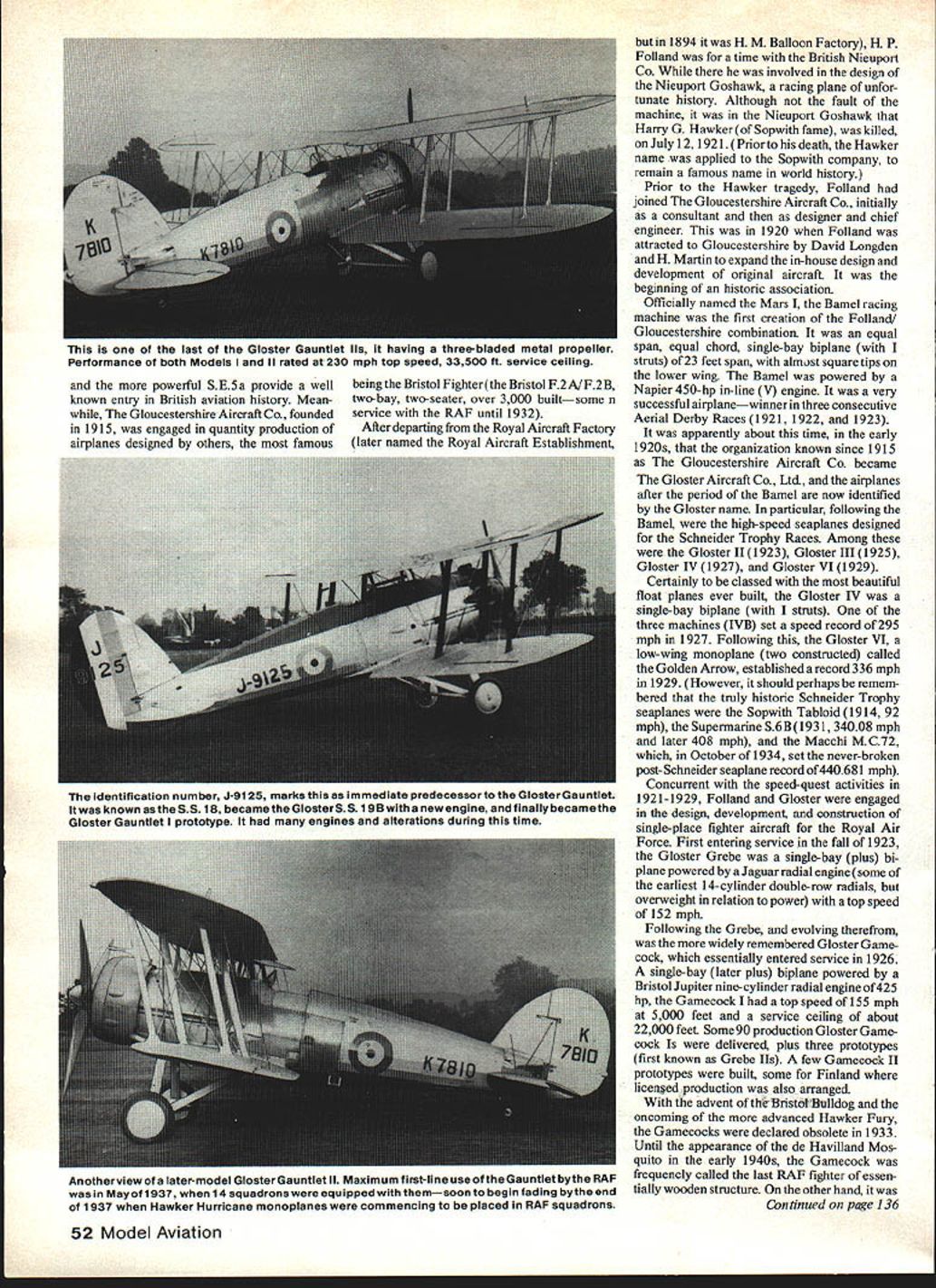
Before the first production Gauntlet I (Service No. K4081) was ready for initial test flight in December 1934, the Gloster Aircraft Co. Ltd. of Brockworth, Gloucester, had been acquired by Hawker Aircraft Limited. One of Hawker’s managing directors was T.O.M. Sopwith. After the amalgamation, the test pilot first flying the Gauntlet I (K4081) was P.E.G. (Gerry) Sayer. The Gauntlet I climbed to 20,000 ft from standstill in 9.5 minutes, had a top speed of 230 mph at 15,800 ft, and a service ceiling of 33,500 ft — considerably faster and higher than the Hawker Fury, not bad for a double-bay biplane.
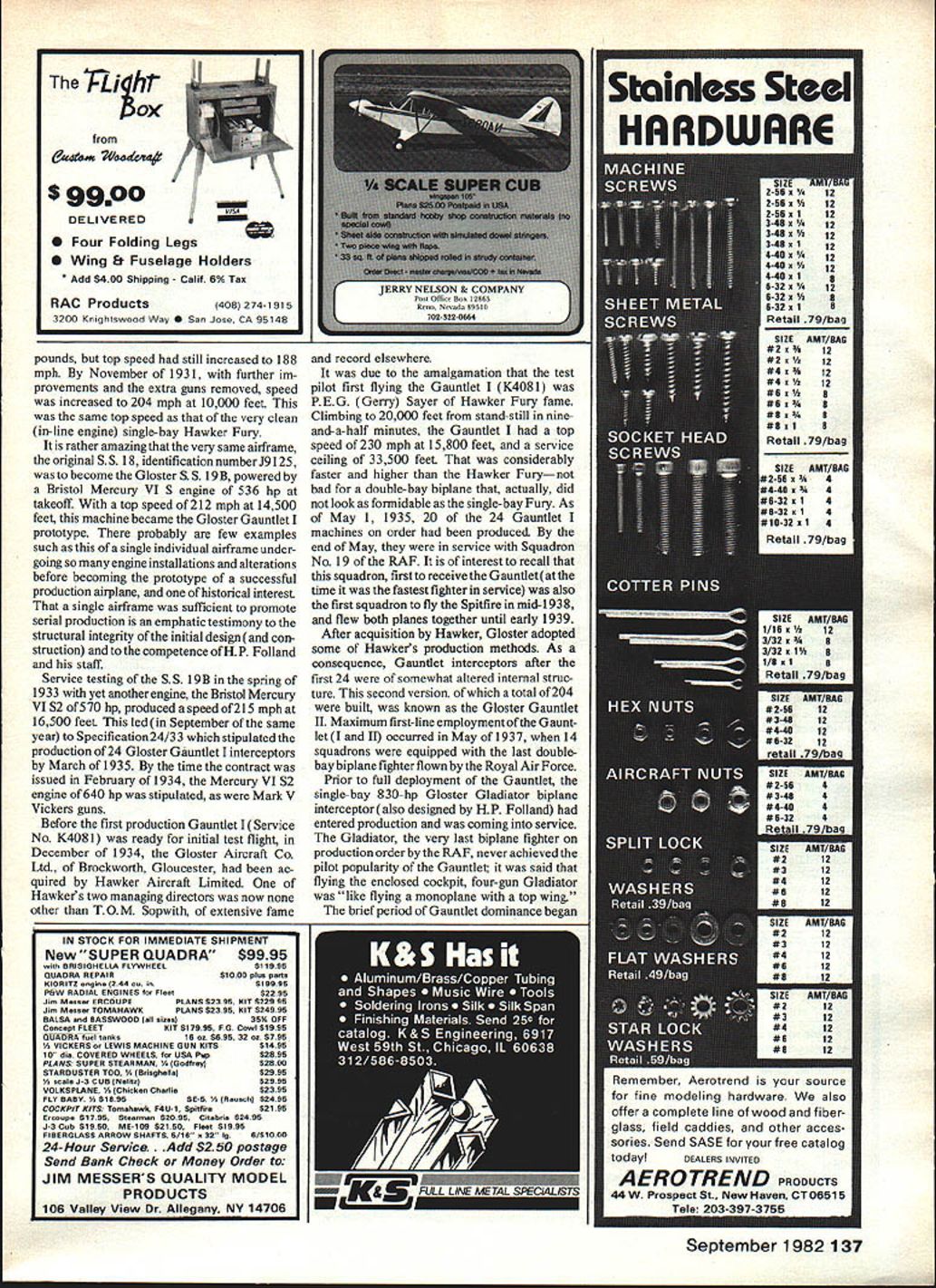
By May 1, 1935, 20 of the 24 Gauntlet I machines on order had been produced. By the end of May they were in service with No. 19 Squadron RAF. After Hawker’s acquisition, Gloster adopted some of Hawker’s production methods; Gauntlets after the first 24 had somewhat altered internal structure. This second version, of which 204 were built, was known as the Gloster Gauntlet II. Maximum first-line employment of the Gauntlet (I and II) occurred in May 1937, when 14 squadrons were equipped with the last double-bay biplane fighter flown by the RAF.
Service history and decline
Prior to full deployment of the Gauntlet, the single-bay, 830-hp Gloster Gladiator (also designed by H. P. Folland) had entered production and was coming into service. The Gladiator — the very last biplane fighter on RAF production order — was more enclosed and four-armed; it was said flying the Gladiator was "like living in a monoplane with a top wing."
The Gauntlet’s period of dominance began to end in December 1937 when the Hawker Hurricane monoplane began appearing in squadrons. On September 29, 1938 (when Neville Chamberlain signed the Munich Agreement), the air defence of England still depended heavily on biplanes: three Hawker Fury squadrons, five Gloster Gladiator squadrons, eight Gloster Gauntlet squadrons, and only two Hawker Hurricane squadrons. Spitfires were not yet operational.
Less than a year later, on September 3, 1939, only one home-defence squadron still employed Gauntlets (No. 616, South Yorkshire). Careful examination of records suggests the fighter force that matured on aircraft such as the Gauntlet helped prepare the RAF for later success in the Battle of Britain.
Subsequently, Gauntlets were used as trainers and secondary machines in some Gladiator and mixed-type squadrons. The last recorded active employment of the Gloster Gauntlet by the RAF was in 1943 in East Africa. Two Gauntlets were sold to Rhodesia, two to Finland, and two to South Africa.
Physical description and specifications
Gloster Gauntlet I and II (small differences indicated)
- Type: Single-place day and night interceptor
- Dimensions:
- Wingspan: 32.808 ft (10.00 m)
- Length: Gauntlet I — 26 ft 2 in.; Gauntlet II — 26 ft 5 in.
- Wing area: 315 sq. ft.
- Engine: Bristol Mercury VIS2 640-hp nine-cylinder air-cooled radial (common); two-blade Watts wooden propeller (I and II); some late IIs fitted with a three-blade Fairey metal propeller
- Weight (Gauntlet II): Empty 2,775 lb; loaded 3,970 lb
- Performance (I and II):
- Top speed: 230 mph at 15,800 ft
- Stalling speed: 59 mph
- Service ceiling: 33,500 ft
- Range: 455 miles
- Time to 20,000 ft: 9 minutes
- Armament: Two Vickers Mk. V synchronized machine guns (600 rounds each)
- Wing structure: Two steel web-and-strip spars, aluminum alloy ribs, fabric covered (fabric attached to main drag ribs by Gloster wire-on method). All strut ends and bracing wire fork-ends inside the fabric line.
- Fuselage structure: Three sections — forward engine mount; center section of square tubes with wrapped joints and tie-rods; aft section of round tubes squared at strut points. Warren girder (truss) in side view, braced in plan by tie-rods. Fuselage faired to oval; light metal panels forward, fabric covered aft.
- Empennage structure: Steel tubes, aluminum ribs, fabric covered; adjustable tailplane.
Related developments and final notes
Of related interest, in March 1938 Gloster received the contract for the E.28/39 experimental aircraft, which became the first British jet. It was test flown on May 15, 1941 by P.E.G. Sayer (of Fury and Gauntlet fame).
A final technical and historical note: although it might seem that the aerodynamics and flight mechanics of the monoplane should be simpler and older than those of the biplane, the opposite is true in certain respects. The biplane mechanism (load distribution, downwash, drag contributions, etc.) can be represented by an arrangement of vortices, providing relatively simple analysis. This was established by Prandtl and Betz (Göttingen) and later simplified by Munk, years before a satisfactory general theory of the monoplane had been established.
Transcribed from original scans by AI. Minor OCR errors may remain.

