
Gluing
L. F. Randolph
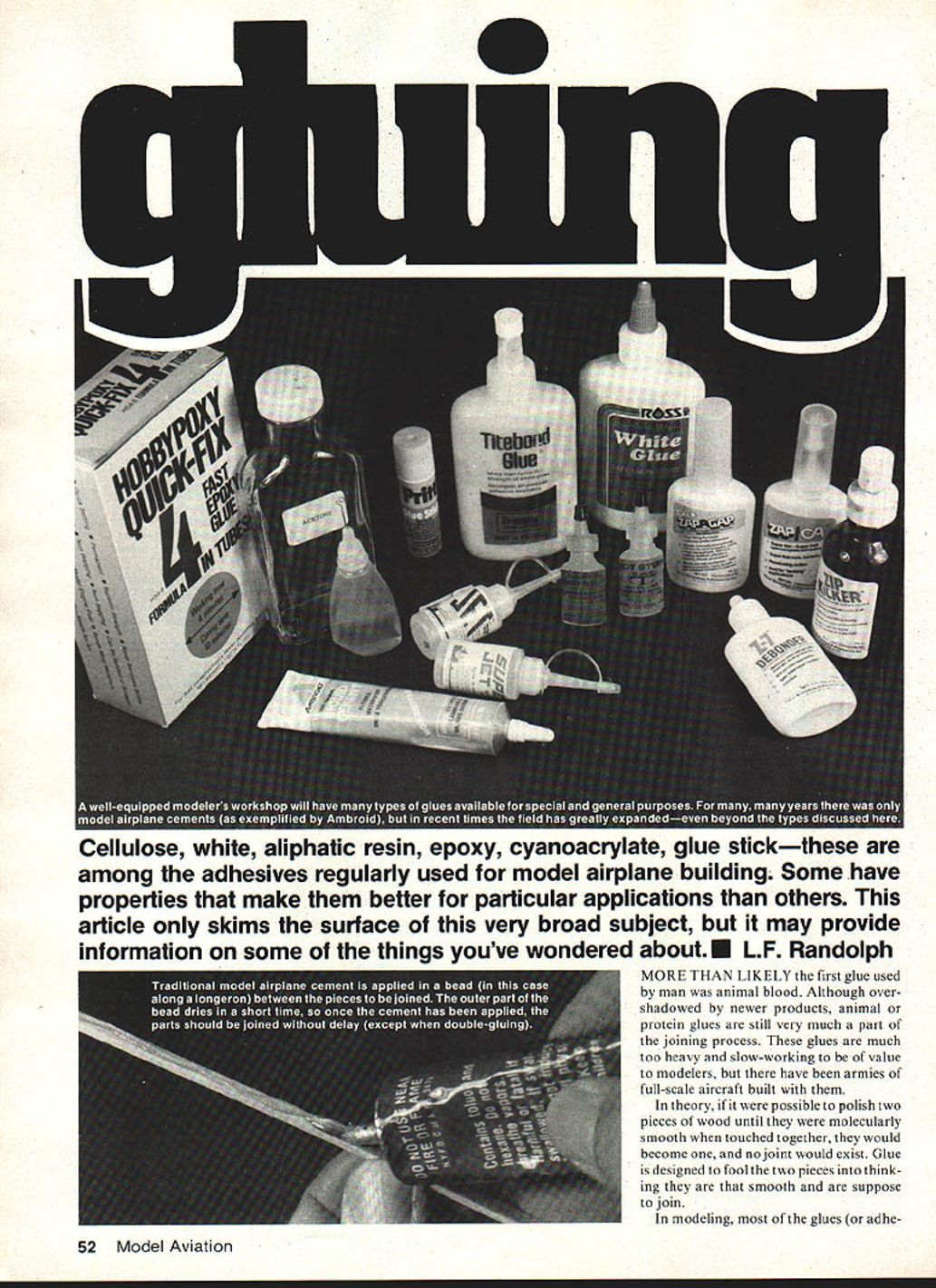
Cellulose, white, aliphatic resin, epoxy, cyanoacrylate, glue stick—these are among the adhesives regularly used for model airplane building. Some have properties that make them better for particular applications than others. This article skims the surface of this broad subject and may answer some questions you have.
Common adhesives
- Nitrocellulose (model airplane cement)
- White glue
- Aliphatic resin glue
- Epoxy
- Cyanoacrylate (CyA)
- Glue stick
Cellulose (nitrocellulose, model airplane cement)
More than likely the first glue used by man was animal blood. Although overshadowed by newer products, animal protein glues are still part of the joining process. They are too heavy and slow-working for most modelers, though full-scale aircraft have been built with them.
Nitrocellulose glues were supreme for years, and the term "model airplane cement" is synonymous with them. Early publications mention Ambroid cement, and the term was used both generically and as a brand name. Model airplane cements (Ambroid, Comet, Testors, etc.) are aromatic glues that cure by drying or evaporation of a carrier (acetone). They reigned until glow engines became common, since glow fuel dissolves them. Yet many models built with these glues 30–40 years ago still fly. They remain popular for rubber models, gliders, and the internal structure of small RC models. They were the first "fast drying" glues.
Properties and use:
- To a degree these cements are gap-filling and will bridge parts that are not in intimate contact, but they shrink as they dry and can pull away from wide joints, leaving voids. Shrinkage is an advantage in tight joints because it pulls pieces together, creating a very strong joint.
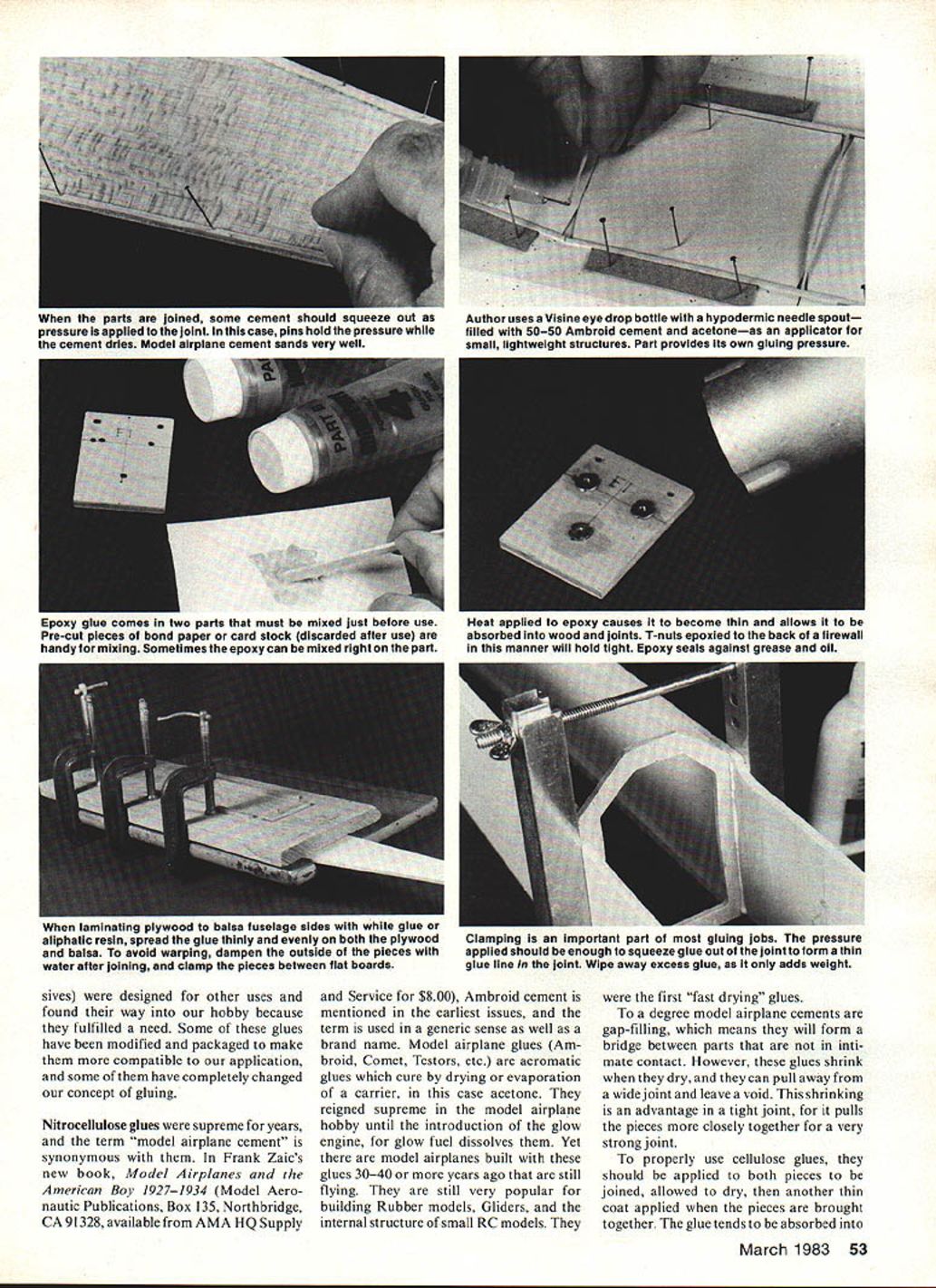
- Proper technique: apply to both mating surfaces, allow to dry, then apply another thin coat and bring parts together. Glue is absorbed into the wood; some cement should squeeze out under pressure. Use pins to hold joints while cement dries. These cements sand very well and tend to disappear when sanded smooth.
- For small lightweight structures, a 50:50 Ambroid–acetone mix in an eye-drop applicator (Visine bottle with a hypodermic needle spout) works well; the part itself provides clamping pressure. This mix is fast drying and ideal for lightweight work.
Summary: model airplane cements are fine for balsa structures that will not contact alcohol fuel. Properly made joints are stronger than the wood, and the dried glue is very lightweight. For plywood and hardwood there are better glues, but a tube of model airplane cement belongs in every modeler’s workshop.
White glues and aliphatic resin glues
White glues were the first widely used alternatives to model airplane cements in engine areas where alcohol fuel was present. Later, aliphatic resin glues replaced whites for many applications. Both are water-based and air-cure like model airplane cement; both can be used similarly.
Properties and use:
- For best joints, clamp parts to force the glue into the wood and form a thin glue line. Wipe away excess glue.
- Aliphatic resins sand well and do not soften or become brittle with age.
- When laminating two sheets (e.g., plywood doublers), the water in the glue can cause wood to expand; moisten the opposite side of the sheets to help eliminate warping.
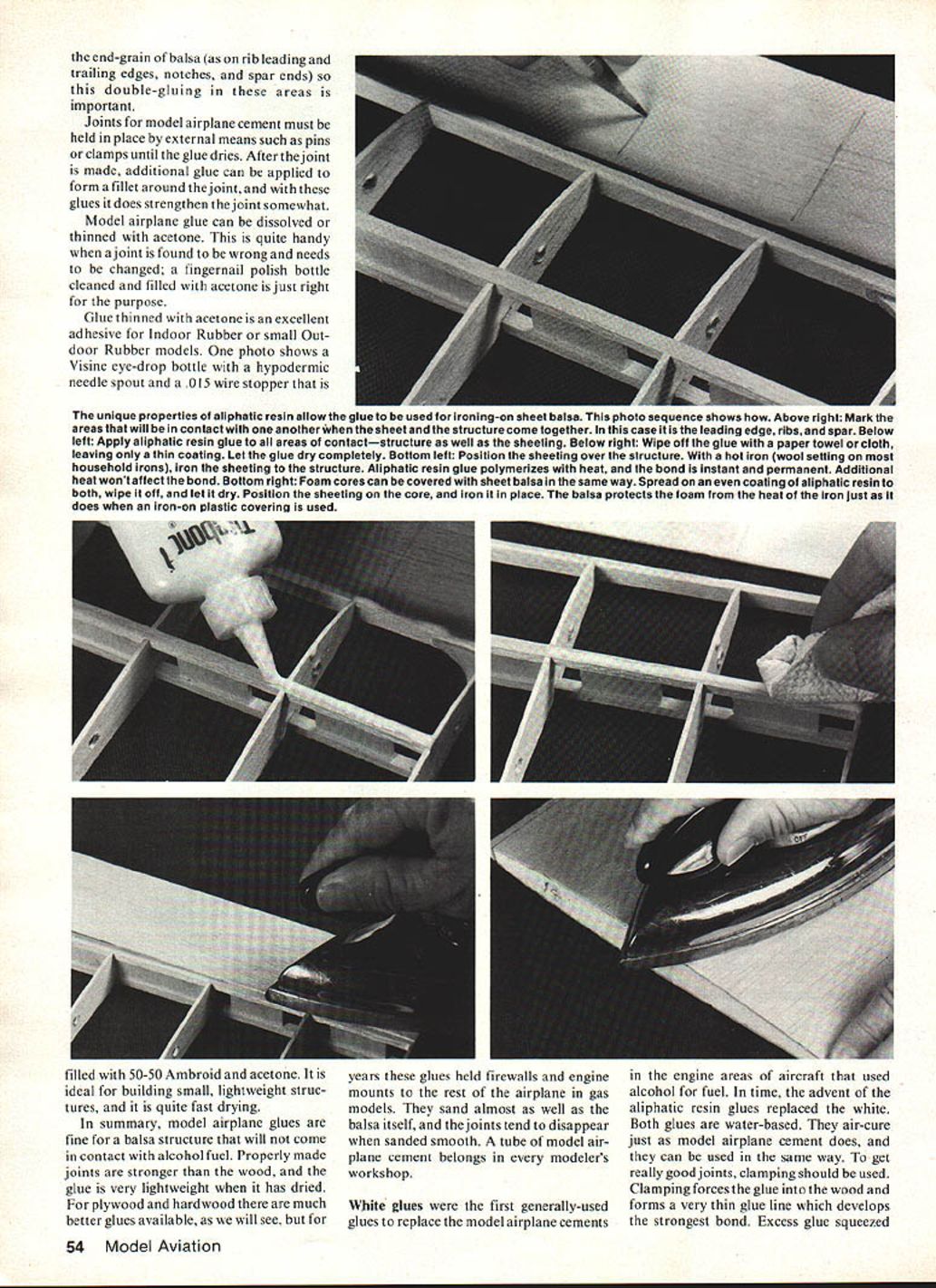
- Heat causes aliphatic resins to polymerize, enabling "iron-on" bonding for sheet balsa: apply glue, wipe it off and let dry, then iron the sheet onto the framework (wool-setting). The bond is instantaneous once polymerized. This is an excellent method for applying balsa skins to foam cores: coat both foam and balsa, wipe off, allow to dry, then press and iron; further heat will not affect the bond after polymerization.
- White glue can be thinned with water and used as a brushing adhesive for tissue, silkspan, or silk. After drying, the bond resists water or dope application.
- Both white and resin glues work well on foam, plywood, and hardwood. Resin glues sand better than white glues. Both can be cleaned from hands with soap and water before they cure completely.
Glue stick
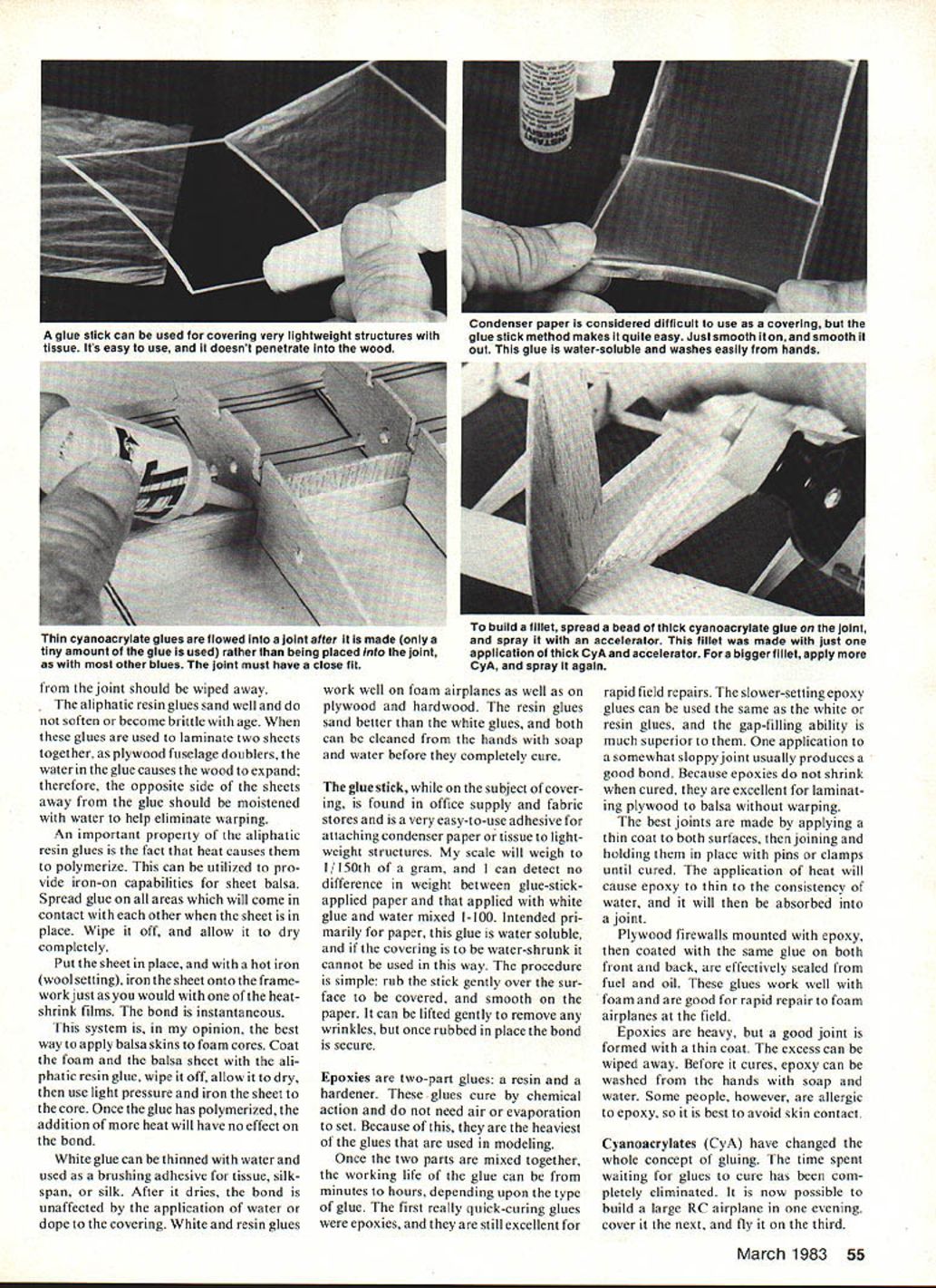
Available in office and fabric stores, glue sticks are very easy to use for attaching condenser paper or tissue to lightweight structures. They are water-soluble and therefore unsuitable where the covering will be water-shrunk. Procedure: rub the stick gently over the surface and smooth on the paper. The bond can be adjusted briefly to remove wrinkles; once rubbed in place the bond is secure. Glue-stick-applied paper is essentially as light as paper applied with a very dilute white glue solution.
Epoxies
Epoxies are two-part adhesives (resin and hardener) that cure by chemical reaction and do not require air or evaporation. Because they do not cure by loss of solvent, they are heavier than most modeling glues.
Properties and use:
- Working life after mixing ranges from minutes to hours, depending on formulation. Quick-curing epoxies are excellent for rapid field repairs. Slower-setting epoxies can be used like white or resin glues, with superior gap-filling ability.
- Best practice: apply a thin coat to both surfaces, join, and clamp or pin until cured. Epoxy does not shrink, making it excellent for laminating plywood to balsa without warping.
- Application of heat thins epoxy to a watery consistency and can allow it to be absorbed into a joint.
- Plywood firewalls mounted with epoxy and coated on both sides are effectively sealed from fuel and oil.
- Epoxies work well with foam and are good for rapid field repairs to foam models.
- Epoxies are heavy, but a good joint requires only a thin coat; excess can be wiped away. Before curing, epoxy can be washed from hands with soap and water. Some people are allergic to epoxy—avoid skin contact.
Cyanoacrylates (CyA)
Cyanoacrylates have changed the concept of gluing by eliminating wait time for cures. They allow rapid construction—one evening to build, next day cover, third day fly.
Background:
- Discovered at Eastman Kodak labs; the initial formula was marketed as Formula 910. In the hobby market, CyAs are sold under many names (Zap, Jet, Hot Stuff, etc.).
Types and techniques:
- Two main types: thin, rapid-curing CyAs and thicker, gap-filling CyAs that cure slightly slower.
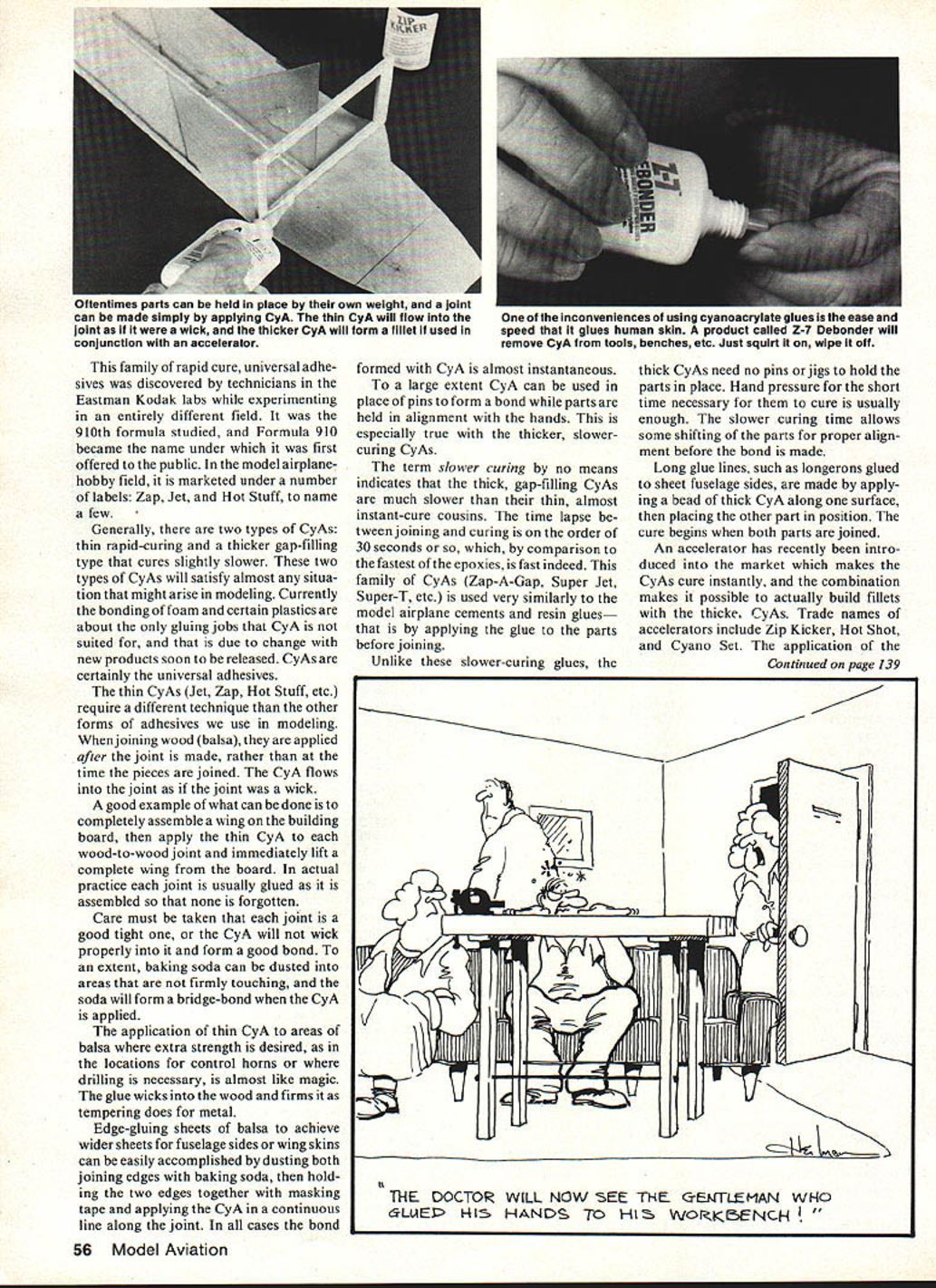
- Thin CyAs: applied after a tight joint is assembled. They wick into wood joints like a capillary. Example: assemble a wing on the building board, then apply thin CyA to each wood-to-wood joint and lift the completed wing. Thin CyA is excellent for reinforcing areas where extra strength is needed (control horns, drill locations), as it wicks into and firms the wood.
- Thicker (gap-filling) CyAs: used like model airplane cements or resin glues—applied to parts before joining. They usually require only hand pressure for a short curing time (~30 seconds) and allow some alignment before cure.
- Edge-gluing balsa sheets: dust joining edges with baking soda, hold edges together with masking tape, then apply CyA along the joint for a rapid, strong bond.
- Baking soda can be dusted into gaps where parts do not contact; when CyA is applied, the soda forms a bridge-bond.
- Accelerators (Zip Kicker, Hot Shot, Cyano Set) make CyAs cure instantly and reduce curing fumes. The combination of thick CyA plus accelerator allows building fillets and filling large voids.
- Debonders: CyA bonds skin and items instantly; Z-7 Debonder or similar products remove CyA from skin, workbenches, tools, etc., much faster than old methods.
- Storage: keep unused CyA in the refrigerator or freezer to extend shelf life; allow it to return to room temperature before opening and use.
- Drawback: CyAs lose bonding strength with age—after about 10 years, they may have lost over half their original strength.
Safety and general advice
- Most adhesives are hazardous if used carelessly. Model airplane cements are flammable; epoxies and CyAs give off fumes during cure that should be avoided.
- Always read and follow manufacturer instructions and safety warnings before use.
- Avoid skin contact when possible; use gloves or tools and have debonder available if working with CyA.
Manufacturers and suppliers
- Ace RC, Inc., Box 511E, Higginsville, MO 64037 (Cyano Set)
- Ambroid Company, Inc., P.O. Box 1089, Taunton, MA 02780 (Ambroid cement)
- Borden, Inc., Dept. CP, Columbus, OH 43215 (Elmer's glue)
- Carl Goldberg Models, 4735 West Chicago Ave., Chicago, IL 60651 (Jet, Super-Jet)
- Franklin Glue Co., 2020 Brack, Columbus, OH 43207 (Titebond)
- Hobbypoxy Products, Pettit Paint Co., P.O. Box 378, Rockaway, NJ 07866 (Hobbypoxy)
- Pacer Technology & Resources, Inc., 1600 Dell Ave., Campbell, CA 95008 (Zap, Zap-A-Gap, Zip Kicker, Z-7 Debonder)
- Satellite City, P.O. Box 836, Simi, CA 93062 (Hot Stuff, Super-T, Hot Shot)
- Testors Corp., 620 Buckbee St., Rockford, IL 61101 (Testors cement)
Transcribed from original scans by AI. Minor OCR errors may remain.

