
Go Fly a Kite
By Sal Iasilli
Windy weather or another group's special event on your flying field got you grounded? Try getting your feet off the ground with one of these high-performance stunt kites. It's really great flying.
What do you do when you're grounded? Spring and fall on Long Island can generate excellent thermal flying conditions. Many one- to three-hour flights have been achieved during these times of year. Unfortunately, these seasons can also produce high winds that make flying literally impossible, so many flightless weekends may quietly and sadly pass by. For a person who loves to fly, this can be terribly frustrating.
In the summertime, when the air is much more stable, my club occasionally shares our flying field (a 360-acre nature preserve) with other special interest groups. These groups use the field at times for horse shows and soccer competition, which they schedule in advance, and we're grounded again.
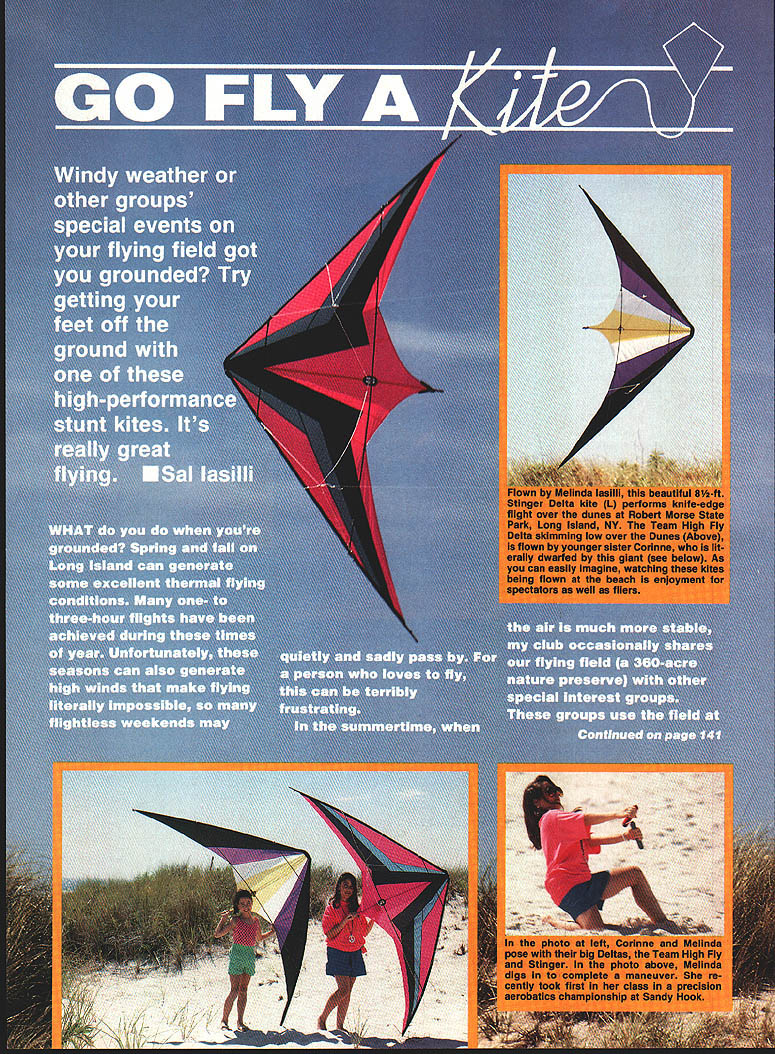
Recently, on such an occasion, I decided to spend the day at the beach, and I discovered a most incredible phenomenon: high-tech, high-performance delta stunt kites. I was fortunate to be there at the right time when some of the best fliers in the Northeast were practicing for an upcoming competition.
The maneuvers these big delta kites perform are just as complex as any described in our AMA rule book, and the degree of precision with which they executed those maneuvers—especially when a team of four was flying—is reminiscent of the Blue Angels flying in formation.
The spectacle was so impressive that I couldn't ask enough questions that day. I learned as much as I could about the construction techniques and materials the fliers use in these stunt kites. Ironically, I found that much of the high-tech aerospace material used in these kites is very similar to that used in our models—carbon fiber wing spars, 3/4-ounce ripstop nylon for the sails, and Spectra for the flying lines. Gone are the days of paper and spruce.
The price range of these kites varies from $50 to $500, but the average high-performance competition deltas go for somewhere between $150 and $200.
After just one day at the beach I was hooked; I had to have one. It was then and there that I realized what an excellent substitute this would be for us when we can't fly our models. The kites are exciting, challenging, and fun to fly.
I got hold of some books and papers, and after reading as much as I could on the subject, I chose two of the best-built and best-flying kites made in the U.S.A. One is the Team High Fly Pro, distributed by the High Fly Kite Company in Haddonfield, New Jersey (Tel. 609-429-6260). It weighs 10 ounces, has an 8-1/2-foot wingspan, and can be flown in winds from three to 20 mph. It flies very fast and very precisely and is excellent for team flying. In fact, the team that flies this kite performs demos throughout the country all year long.
The other kite I have is called the Stinger 1000, distributed by Keely's Kites (1-800-487-KITE). This kite weighs 13.8 ounces, has an 8-1/2-foot wingspan, and can be flown in very strong winds (up to 25 mph); it has a very strong pull. It was designed by Vince Bobrosky, a national stunt kite champion.
This kite is very forgiving. It's precise and responsive, and it's outstanding for edge flying (knife-edge in model terminology). Its graphics and color scheme are among the most appealing on the market.
If you have never flown a large stunt kite, you are in for a truly wonderful surprise. In a strong wind it can drag a flier across the ground or lift him sprightly into the air. Pull is directly related to wind speed, so in light winds (2 to 8 mph) a kite may be very easy to fly. In stronger winds (15 to 30 mph) it becomes more of a challenge; you may find yourself flying along, gracelessly scraping random patterns in the sand.
So next time it's too windy to fly at the field or the field has been taken over by another special event, don't get frustrated. Have a ball. Go fly a kite.
Transcribed from original scans by AI. Minor OCR errors may remain.

