
The Golden Age of Air Racing
For the scale modeler, Oshkosh ’91 was a full week of sensory overload. For air-racing fans young and old, it was a dream come true. For wild-eyed devotees of 1930s racing planes, it may have just been the beginning.
During the first week of August 1991, one corner of vast Wittman Field, on the south side of ordinarily quiet Oshkosh, Wisconsin, looked like nothing so much as the pit areas of the 1930s National Air Races crammed together. There were four of Benny Howard’s racers and four (count ’em, four!) Gee Bees, along with racers from the minds and hands of Art Chester, Jimmy Wedell, and others who made the Golden Age of Air Racing the most glamorous thing that ever happened to flying machines.
It isn’t easy to steal the show at the annual Experimental Aircraft Association Fly-In, what with more than 2,000 display airplanes (homebuilts, antiques, classics, and warbirds) vying for attention—not to mention maybe 9,000 ordinary airplanes parked on the field. But 19 brilliantly colored original and reproduced racers from 1929–1939 surprised even veteran EAA officials with their ability to draw a crowd. Only the still-eerie Lockheed F-117 Stealth fighter rivaled the racers as a focus of interest—and a target for cameras—at the 1991 edition of this annual sport-aviation folk festival.
The idea for this Golden Age revival began with Bill Turner, who was the first to recreate the old race planes with his Brown B-2. When Bill collected several of these vintage craft for the Disney Studio movie The Rocketeer, he realized that there were more than enough of them for a colorful display at Oshkosh. And Bill knew how air-show crowds reacted to his new-old race planes when he showed them off. If the enormous gathering at Oshkosh could be expected to respond the same way, it would be worth almost any amount of effort to get the airplanes there. The people at EAA, especially President Tom Poberezny, agreed.
Bill went to the phone, calling owners of new and old 1930s racers and others deeply involved in preserving the history of air racing through their work with groups of enthusiasts. The reaction was almost unanimously enthusiastic, strongly suggesting that a bunch of airplanes long scattered among museums and private collections could be brought together for one big celebration of a bygone era.
Once Bill began talking to museum officials, he received promises of participation from Ed Maloney’s Planes of Fame in Riverside, California, and from the Fred Crawford Collection, presided over by Dave Holcombe at the Western Reserve Museum in Cleveland, Ohio. Joe Binder agreed to drag his long-dormant and seriously-in-need-of-work Howard Ike out of the garage. Lou Russo, owner of the rare Brown B-1 (predecessor of Miss Los Angeles), permitted the airplane to be shipped to the EAA shops where restoration could be completed. Turner set his crew of volunteers loose.
The list grew to over 30 airplanes—half originals—including several big, beautifully restored biplanes that had flown in minor races. As the time for dismantling and shipping neared, a lot of prospects fell by the wayside—owners perhaps afraid of damage or of crowds pressing to get a closer look. Nineteen remained: eight actual 1930s airplanes in various states of restoration and eight others newly built as accurate reproductions. Several replicas flew; others were almost ready.
The clipped-wing race planes arrived at Wittman Field—named for longtime manager and air-racing great Steve Wittman, who lives across the field—on large trucks. As opening day of the fly-in approached, pieces were deposited in a large Kermit Weeks hangar operated by the EAA commercial side of the airport and were assembled out of sight. The gathering mob could almost imagine the Thompson, Bendix, and Greve Trophy starting lines and the pointy spinners—the atmosphere of the 1930s National Air Races reborn.
One plane was towed to a grassy plot in front of a three-pointed white tent that served as the center of the celebration. Parked at odd angles on the taxiway, crews applied last-minute cosmetic touches and were soon surrounded by a knowledgeable crowd drawn like a magnet.
Not surprisingly, people had lots of praise and sighs of admiration for the skill and dedication of those who had rescued treasured old airplanes from oblivion and returned them to their original (and sometimes better-than-original) glory. They were no less appreciative of those who had turned photographs and small drawings into realistic reproductions of airplanes not seen for a half-century or longer.
The crowd was also stirred in a way that no one had fully anticipated. Scores and then hundreds of old-timers found themselves gasping in amazement at the three-dimensional images of the airplanes that had propelled them into aviation so many years ago. The exploits of the men and women who flew these planes in the National Air Races had influenced their admirers to become airline or military pilots, aeronautical engineers, or flight instructors. Their lives had been changed forever by the airplanes now returned from the history books and spread out before them.
Over and over, they could be heard remarking to friends (or to no one in particular), “I never thought I’d see these airplanes again!” Their younger counterparts chimed in, “I never thought I’d see them, period!” Hardly anyone among the thousands wandering through the surrealistic pit area had known that more than a couple of the old racers existed anywhere. After all, they had led pretty violent lives and then been rendered obsolete by the eruption of technical progress during the Second World War. To see eight of the original racers and as many modern copies was almost more than some of them could handle. Childhood memories of shapes and colors presumed to have vanished forever flooded back with startling accuracy.
But here they were—19 race planes in one place (and a familiar place to most of the spectators), each with stories to tell: stories of bravery and creativity, stories of danger, stories of exploring the unknown.
When these folks attended races in the 1930s, the planes had been on the other side of the fence, and only the anointed had been allowed to get close enough to smell the dope and oil. The rest could only lean on the fence and imagine themselves walking around these glorious machines, even cautiously touching them, all the while talking to their heroes who were about to do battle around the pylons.
At Oshkosh ’91, anyone with a field pass (available to all those with proof of their aviation connections) could stroll up to the Schoenfeldt Firecracker or Roscoe Turner’s gold Wedell-Williams and be magically transported back to the Cleveland Airport of 1938. One needed only an average imagination to turn Wittman Field into the site of the National Air Races. The crowd was certainly big enough; there were aerobatic and military planes to fill the time between races; and the atmosphere was full of electricity.
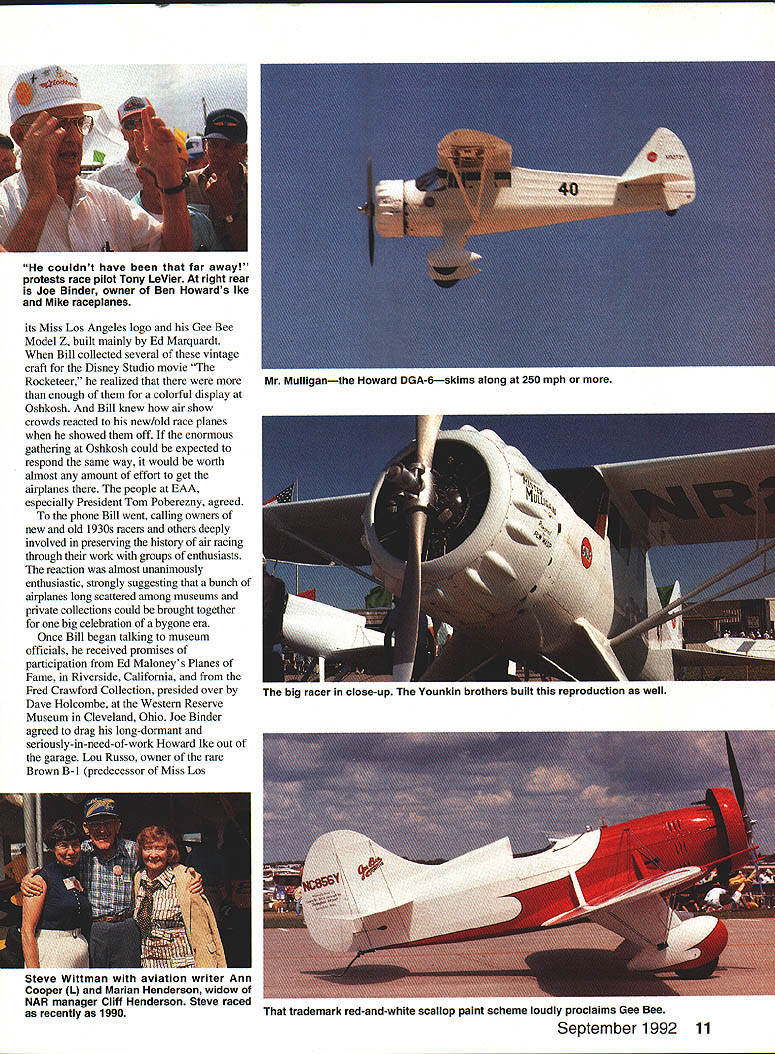
Try hard enough, and that guy standing in front of Mr. Mulligan becomes the great Harold Neumann, who won the 1935 Thompson Trophy Race in the gleaming white high-wing. Look a little closer, subtract 50 years, and it almost is Harold. Walk up and listen to his stories, study the lines on his face, and suddenly it’s no longer a fantasy. That’s Harold Neumann in the flesh, telling about racing in the 1930s!
The fellow holding forth to a fascinated audience near the Firecracker is Tony LeVier. And that quiet, studious-looking gentleman chatting with old friends is Steve Wittman, whose racing career—so far!—spans 1926 to 1992. Thanks to the friendly atmosphere of the giant fly-in, these racing heroes seemed more like ordinary people than demigods.
They were there to talk to you and answer your questions. They were there to tell you what it was like to tear around the course at Cleveland in some of the hottest airplanes ever built. They were there to tell you what it meant to have been part of a truly historic era, and how it felt to be back among the airplanes and some of the people who had meant so much.
Four race planes (Howard’s Ike in its bare bones, Turner’s Wedell, the little-known Brown B-1, and the modern home-built reproduction of the cute little Command-Aire Little Rocket) under a big white tent served as the focal point of the display. At the far end were a podium and folding chairs for about 75 people to park on while listening to talks by air-racing greats and historians.
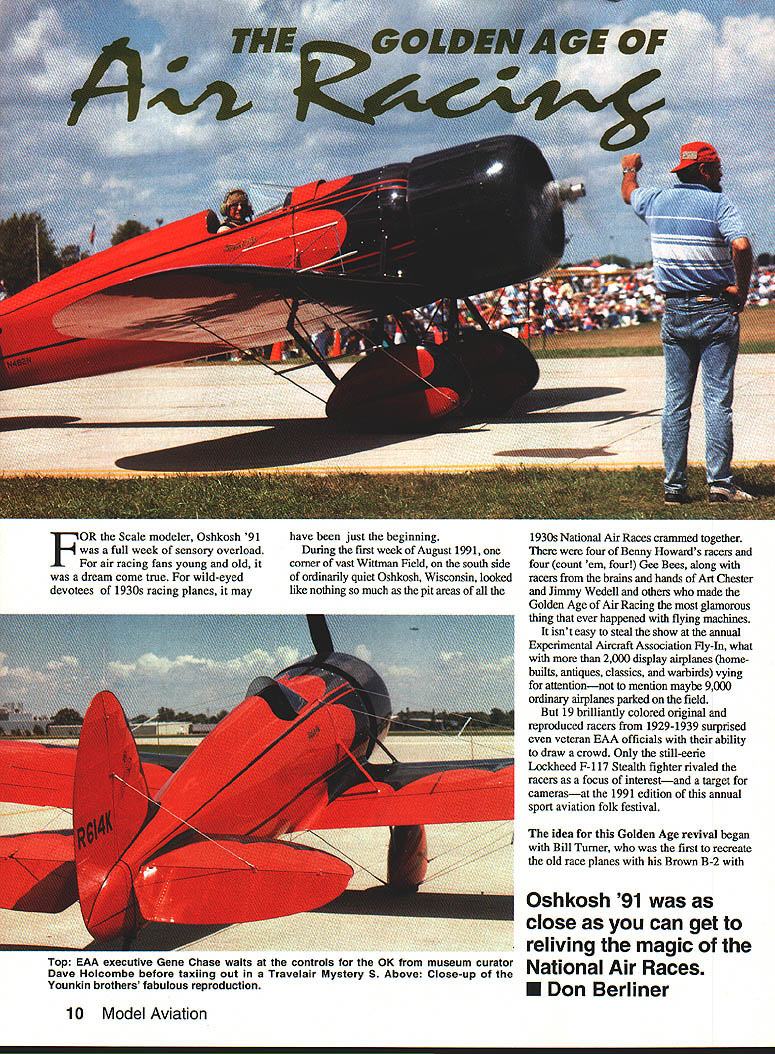
Every afternoon before the formal air show, several of the racer reproductions would take to the air to show off their lines and give the throng—a crowd of some 815,000 for the week—a taste of Golden Age sights and sounds. When Mr. Mulligan, the Travel Air Mystery S, and the Wedell-Williams #44 sped around a make-believe racetrack in a flyby, the only thing preventing it from becoming an all-out race was EAA’s firm rule against passing.
The three race planes looked totally authentic. Whenever they took off, the sighs of the enamored became a great wind from the past. Sure, this was Wisconsin 1991, not Ohio 1936. Still, thanks to a lot of people who had agreed that the Golden Age of Air Racing was worth celebrating, it looked and sounded and felt like the real thing.
Aircraft on display
- Gee Bee R-2 Super Sportster. This barrel-shaped airplane remains the permanent symbol of speed, even though the last of the R series crashed in 1935. This accurate reproduction was built by Steve Wolf of Eugene, Oregon. At Oshkosh, all it lacked was some fairings. Wolf’s replica made its first flight on December 23, 1990.
- Gee Bee Z. The second reproduction built by Ed Marquardt for Bill Turner, this Gee Bee Z has probably racked up more flying time than all the original Gee Bee racers combined. After a long period of display in the Smithsonian Institution, Washington, D.C., it was flown in the movie The Rocketeer, but was not expected to fly again. The original Model Z carried Lowell Bayles to victory in the 1931 Thompson Trophy Race.
- Gee Bee Y Sportster. One of the many sport racers from the Granville Brothers factory, the Gee Bee Y was a two-seater converted temporarily to a pilot-only airplane for racing. This reproduction was built a few years earlier by Ken Flaglor and belonged to Jack Venaleck of Painesville, Ohio. It was flown to Oshkosh by Bill Rose and his wife.
- Gee Bee E Sportster. The Gee Bee E was smaller than the Model Y. Jim Jenkins’s reproduction was considered one of the best-built airplanes at the fly-in regardless of category. It made its first flight later in 1991.
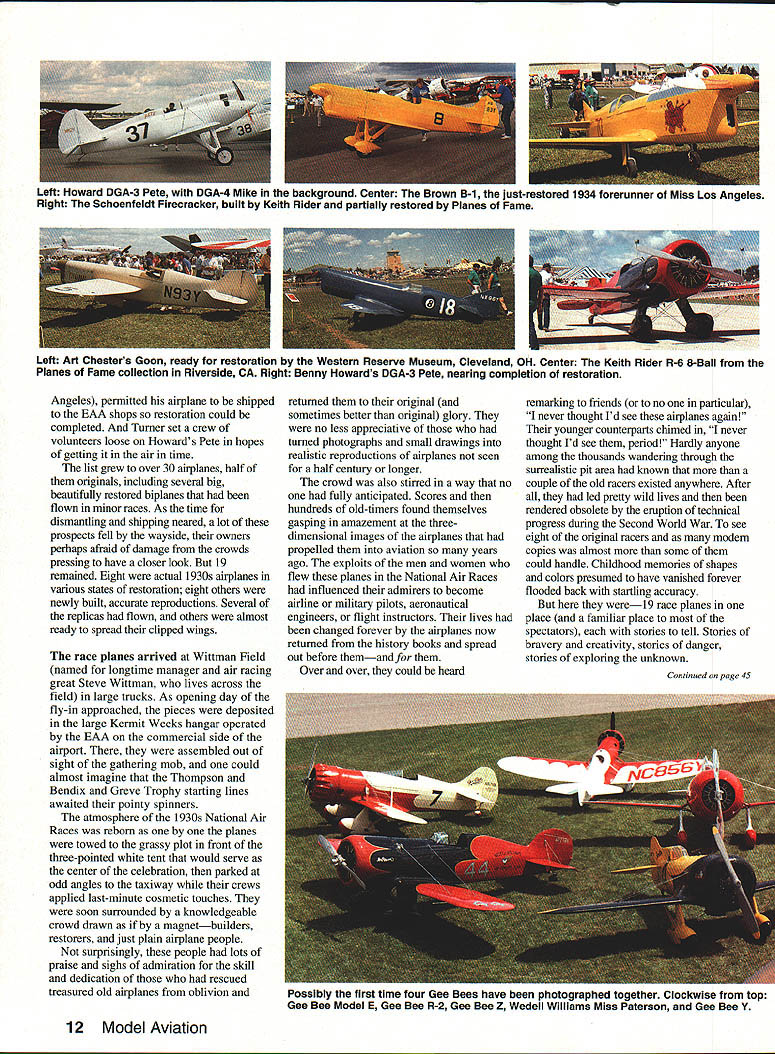
- Howard DGA-3 (“Pete”). This is an actual early-1930s racer, rescued from oblivion by Bill Turner. Ben Howard flew it to third place in the 1930 Thompson Trophy Race despite its tiny engine. Subsequent spin-offs included a 1947 Goodyear racer and a home-built by EAA founder Paul Poberezny. The plan was to fly the original again soon.
- Howard DGA-4 (“Mike”). Another original, dating back to 1932 and owned since the late 1940s by Joe Binder of Fremont, Ohio. It raced from 1932 to 1936 and was on long-term loan to the Western Reserve Museum in Cleveland. There were no plans to fly it.
- Howard DGA-5 (“Ike”). Also an original, the Ike had been owned for decades by Joe Binder, who stored it at home. Little work had been done on the racer, though Binder had plans to restore it. Ike was displayed uncovered, giving viewers a good look at the construction of 1930s racers. Ben Howard flew it to seventh place in the 1932 Thompson Trophy Race.
- Howard DGA-6 (“Mr. Mulligan”). This was the only reproduction among the four Benny Howard racers. The original crashed in the 1936 Bendix Trophy Race; parts were recovered in the 1970s, and a partially restored reproduction was flown to a world speed record before crashing in turn. The reproduction was flown at the show. The original had an historic double win in 1935, when Ben Howard captured the Bendix Trophy and Harold Neumann took the Thompson.
- Wedell-Williams #57. Col. Roscoe Turner won two Bendix trophies and one Thompson trophy in this gold, Pratt & Whitney–powered plane, which raced from 1932 to 1939. In the Cleveland area since 1939, it was restored for exhibition at the Western Reserve Museum. Curator Dave Holcombe used the inertia starter several times during the fly-in, allowing the prop to turn over and letting the crowd enjoy the special sound.
- Wedell-Williams #44. This reproduction of the 1933 Thompson Trophy and 1934 Bendix Trophy winner was created by Jim Clevenger and Budd Davisson and is owned by Davisson. The plane had been on display in the Wedell-Williams Memorial Museum in Patterson, Louisiana, and had flown many times, including daily high-speed laps at Oshkosh.
- Brown B-1. Raced only briefly—by Ralph Bushey in 1934—before being badly damaged in an accident, the Brown B-1 was reincarnated in 1947 as a Goodyear midget racer. It had long been owned by Lou Russo of Chicago. Restoration was completed by the EAA staff.
- Command-Aire Little Rocket. Joe Araldi of Lakeland, Florida, built this reproduction in the late 1980s with the advice of the designer. Built in 1930, the original competed in long-distance races.
- Travel Air Mystery S. The Younkin brothers of Fayetteville, Arkansas, built this reproduction, which had been flown to Oshkosh previously. The original inaugurated the Golden Age of Air Racing when Doug Davis beat the best the military could offer in the 1929 race that inspired the Thompson Trophy Race.
- Keith Rider R-4 (“Schoenfeldt Firecracker”). This partially restored original is owned by Ed Maloney’s Planes of Fame Museum in Riverside, California. It finished high in three Thompson Trophy races. Roger Don Rae came in third in the 1936 race; Gus Gotch took seventh place in 1937; and Tony LeVier was the second-place finisher in 1939. LeVier also flew the Firecracker to victory in the 1938 Greve Trophy Race.
- Keith Rider R-6 (“8-Ball”). Another partially restored original from the Planes of Fame Museum. Joe Jacobson raced it to sixth place in the 1938 Thompson Trophy Race and to third place in the Greve race of the same year.
- Chester Goon. An original in need of extensive restoration, the Goon was sold by longtime owner John Cale to Cleveland’s Western Reserve Museum, where officials planned to complete the work. Designer/builder Art Chester flew the plane to second place in the 1938 Greve Trophy Race, then won the trophy in 1939. Thompson Trophy Race starts in those years were unsuccessful.
There’s no way to predict what lies in store for these and other original and reproduced 1930s racers. The success of the Oshkosh display suggested that more of the same would please a lot of new and old race fans. Some of the airplanes that didn’t make it to the EAA Fly-In might be available for shows closer to home.
No formal Golden Age display was planned for Oshkosh ’92, but some of the race planes would be flown and trucked there anyway. Steve Wolf hoped to fly his Gee Bee R-2 to, and at, the festival, and that alone would constitute a major event. Present plans called for a formal display in 1993.
—Don Berliner
Transcribed from original scans by AI. Minor OCR errors may remain.

