
Golden-Age Racing Planes
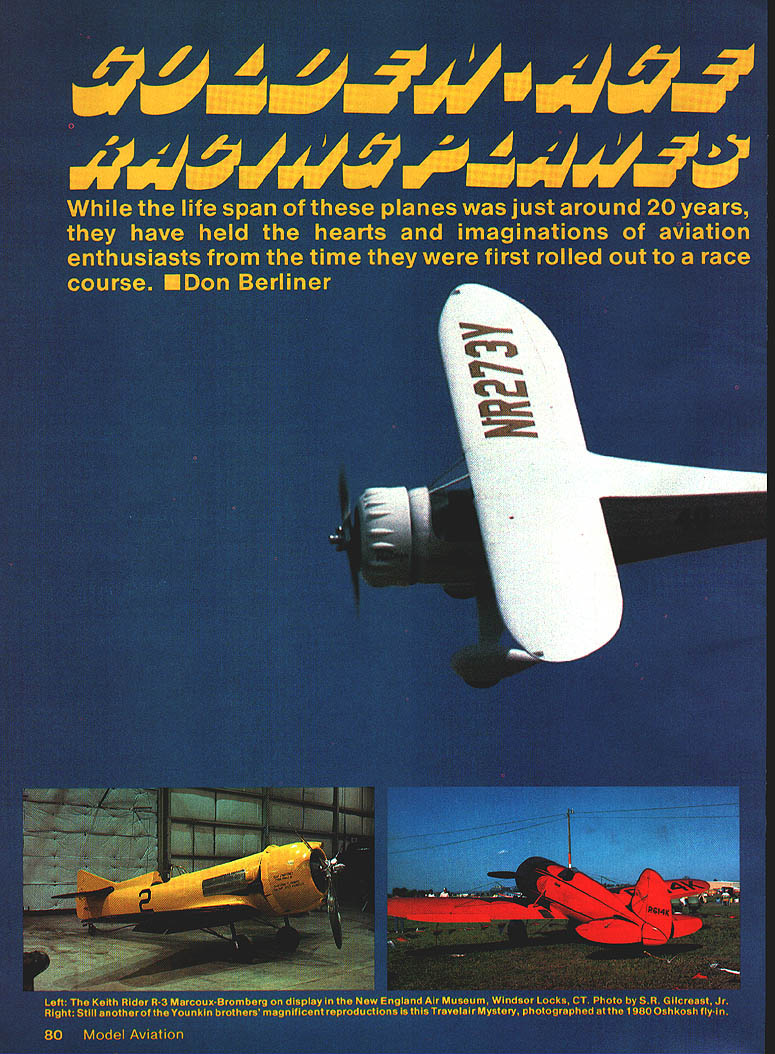
While the lifespan of many of these planes was only around 20 years, they have held the hearts and imaginations of aviation enthusiasts since they first roared onto race courses. They were the airplanes that made the Golden Age of Air Racing—the 1920s and 1930s—the most exciting time imaginable for pilots, designers, builders, and young boys. They inspired a generation of Americans and brought names like Doolittle and the Gee Bee into common usage.
Characteristics of the Golden-Age Racers
- Extremely fast for their day: engines pushed the limits of technology, and airframes were often the bare minimum required to carry the power.
- Emphasis on speed over stability and control: long on power, short on boring things like stability.
- Marginal low-speed lift and poor visibility: ground loops and cartwheels were common.
- Tail‑heavy tendencies from last‑minute fuel tank additions; engine failures often forced dangerous landings.
- Frequent crashes were part of the story: planes were busted up, repaired, and raced again as long as a few large pieces remained.
Prewar Races and Trophies
James Gordon Bennett
- The James Gordon Bennett Trophy began at Reims, France, in 1909. Early racers were extremely fragile; surviving examples from this era are rare.
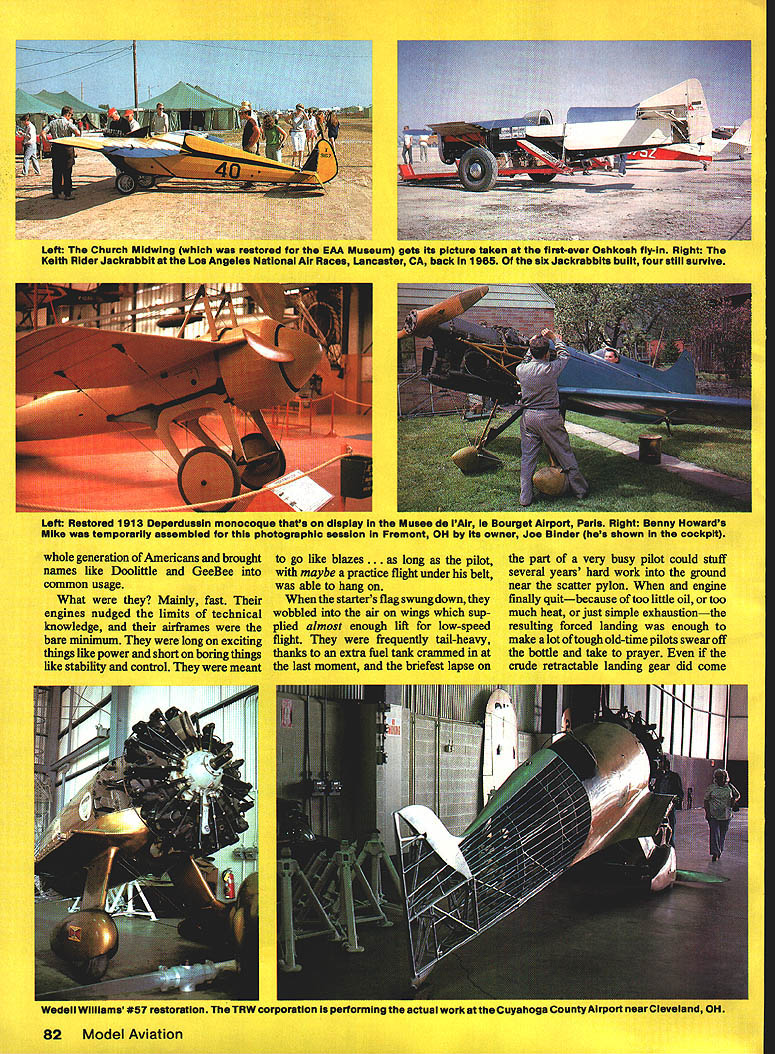
- Notable survivals: Musée de l'Air (Le Bourget) — 1910 Baby Wright Racer and a 1913 Deperdussin monocoque.
Schneider Trophy (seaplanes)
- Ran from the same early period until 1931 and drove major advances in engines and aerodynamics.
- Survivors: Supermarine Sea Lion I hull (Science Museum, London); Supermarine S.6B (first to top 400 mph, Science Museum); S.6A (Hall of Aviation, Southampton).
Coupe Deutsch (France)
- A long-course contest in the 1930s that emphasized durability as well as speed.
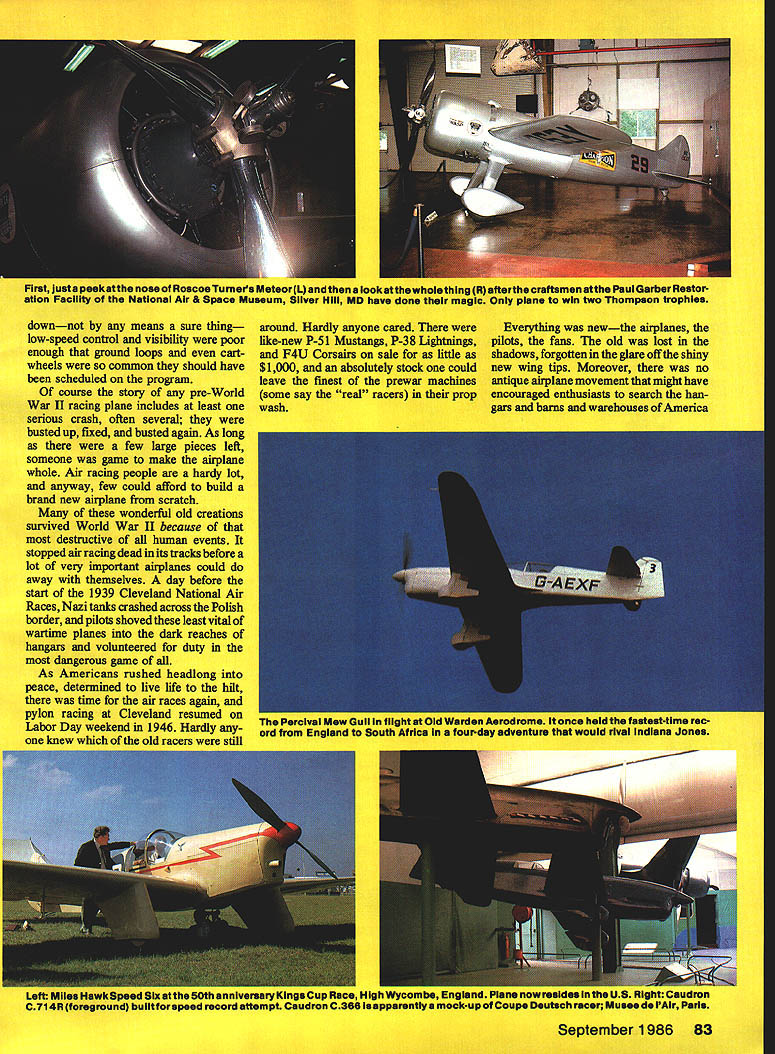
- Musée de l'Air displays include a Caudron mock-up (accurate depiction of the C.36), a Potez 53 (likely the 1933 winner), and a Caudron C.714R.
Pulitzer Trophy (U.S., 1920–1925)
- Military event producing colorful early racers (Curtiss Army and Navy biplanes).
- Survivals are scarce: a wing panel from a Curtiss R-6 (U.S. Air Force Museum, Dayton, OH) and the Curtiss R3C-2.
Cleveland National Air Races (1929–1939)
- The prewar Cleveland Air Races produced numerous famous racers; more than 20 prewar airplanes are known to survive and continue to appear from unexpected places.
World War II and the Postwar Revival
- World War II halted air racing and inadvertently helped preserve many prewar racers: the day before the 1939 Cleveland races, war in Europe began and pilots put machines into storage or volunteered for duty.
- Pylon racing at Cleveland resumed Labor Day weekend, 1946. By then, surplus P-51 Mustangs, P-38 Lightnings, and F4U Corsairs were cheap and plentiful—often raced stock—and eclipsed many prewar specialty racers.
- No organized antique‑airplane movement yet existed, so many old racers remained hidden in hangars, barns, and warehouses until restorers and museums began seeking them out.
- Little by little the old racing planes re-emerged; some were broken up for parts or training, others were restored and displayed. Nostalgia grew as survivors reappeared.
Survivors, Restorations, and Reproductions
Many classic racers survive in museums, private collections, or as reproductions. Highlights:
Brown Racers
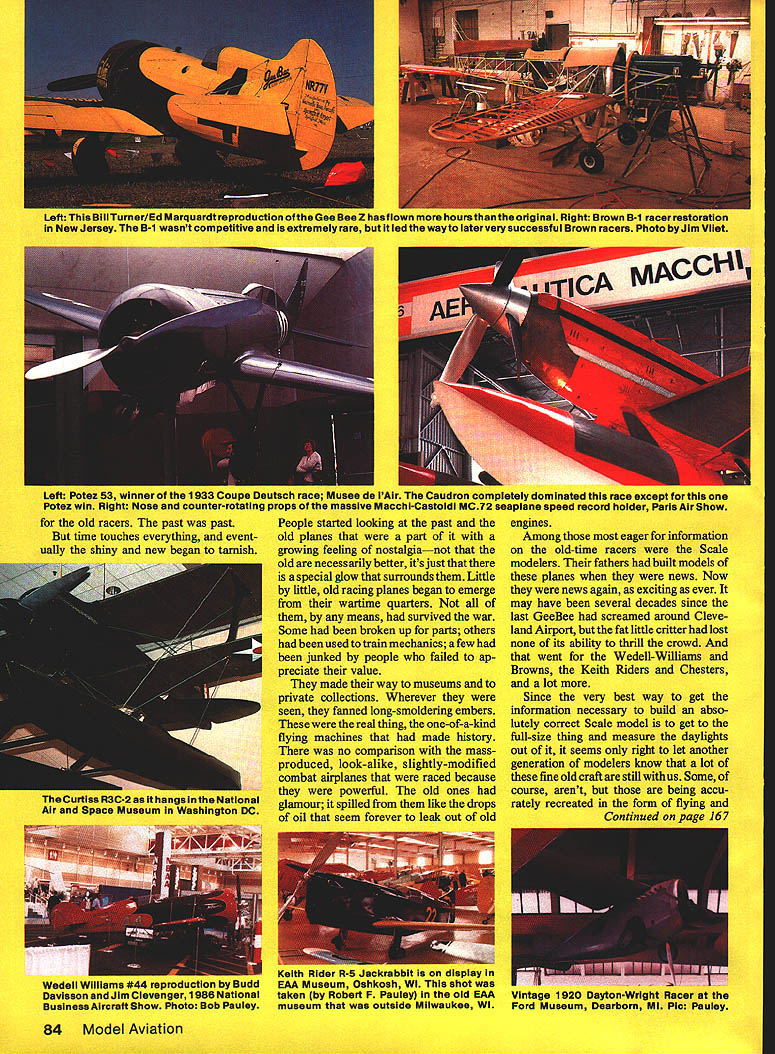
- Brown B-1: undergoing restoration in Pittstown, NJ.
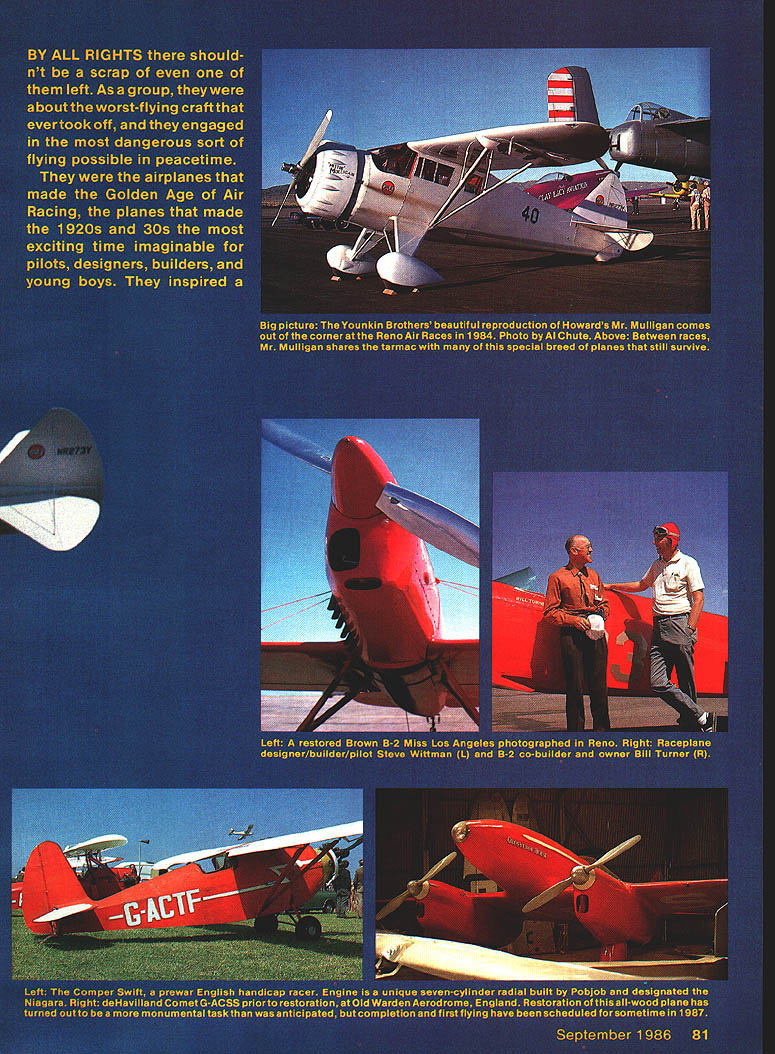
- Brown B-2 "Miss Los Angeles": a reproduction built by Bill Turner and Ed Marquardt in Southern California.
Art Chester
- Both of Chester’s classic racers, the Jeep and the Goon, survive.
- The Goon (raced in the final prewar Thompson and Greve Races) is complete and was reported to be owned by historian John Calder (Los Angeles area).
- The Jeep was cannibalized for parts in 1947; its remains are being restored by EAA volunteers for eventual display at the EAA Museum, Oshkosh, WI.
Benny Howard
- Of Howard’s four great racers, Ike and Mike belong to Joe Binder (Fremont, OH); he intends to restore at least one.
- Mr. Mulligan was restored in 1977 and later wrecked during a speed record attempt; the Younkin brothers of Fayetteville, AR, fly a superb reproduction.
- Pete Howard’s first racer was converted to a sport plane long ago by Paul Poberezny.
Laird Racers
- Solution: being restored at the New England Air Museum (Windsor Locks, CT).
- Super Solution: only the steel-tube fuselage remains at NASM’s Paul E. Garber Restoration Facility (Silver Hill, MD); a high-quality reproduction is being built there by Paul Gerber.
- A reproduction of the Super Solution (built under Matty Laird’s direction) is in the EAA Museum.
Keith Rider
- Six racers were built; four survive in various states.
- R-3: restored and on display at the New England Air Museum.
- R-4 "Firecracker": parts at the Planes of Fame Museum (Chino/Los Angeles).
- R-5 "Jackrabbit": restored and in the EAA Museum.
- R-6 "Eight-Ball": portions stored in California.
Travel Air Mystery
- Of four racers, two remain:
- NR-613K: located in California; restoration paused after the death of owner Pancho Barnes.
- Texaco #13: in the Museum of Science and Industry, Chicago.
- A flying reproduction of NR-614K (the plane in which Doug Davis won the first Thompson Trophy) was built by the Younkin brothers.
Steve Wittman
- Chief Oshkosh (later modified into the Goodyear winner "Buster") — on display at the National Air & Space Museum as Buster.
- Bonzo — in the EAA Museum.
- Steve Wittman continued building small, fast aircraft well into his eighties.
Wedell-Williams
- Of seven Wedell-Williams racers, only model #57 survives: Roscoe Turner’s 1934 Thompson Trophy winner, newly restored and displayed at the Western Reserve Historical Society (Cleveland, OH).
- Reproductions are in the works; a completed reproduction by Bud Davisson and Jim Clevenger has been displayed in the Wedell-Williams Museum (Patterson, LA).
Roscoe Turner
- Turner’s #29 Meteor (won 1938 and 1939 Thompson races) is displayed at NASM’s branch facility in Silver Hill, MD, along with many of his trophies and his stuffed lion, Gilmore.
Lesser-Known Racers
- Staggerwing Mercury: restored in Detroit; the restoration highlighted how tricky the type is. Destined for the Glenn Curtiss Museum (Hammondsport, NY).
- Church Midwing (similar to a Heath Baby Bullet): restored in Dayton and sent to the EAA Museum.
- Pearson-Williams "Mr. Smoothie": reportedly exists in California.
- Tilbury-Fordy Flash: restored by EAA members and displayed at the McLean County Historical Society Museum (Bloomington, IL).
Gee Bee and Reproductions
- Gee Bee Z (as flown by Lowell Bayles to win the 1931 Thompson): a reproduction by Bill Turner and Ed Marquardt has been temporarily housed at the National Air & Space Museum.
- Turner and Marquardt also completed a Miles & Atwood racer and plan a de Havilland Comet twin.
- Several Gee Bee R-type "Flying Milk Bottle" reproductions are under construction; at least one (for static display) is being built for the New England Air Museum by designer Howell Miller.
Long-Distance and Transport Racers
- Boeing 247 (Roscoe Turner & Clyde Pangborn, third in the 1934 London-to-Melbourne race): on display at NASM.
- Howard Hughes’ racer (transcontinental and 3‑km speed records) is at NASM.
- Travel Air "Woolaroc" (Art Goebel’s winner of the 1927 Dole Race): in Bartlesville, OK.
- Gee Bee Q.E.D. (built for the London-to-Melbourne race): fully restored and displayed at the City Museum in Ciudad Lerdo, Mexico.
British Survivals
- de Havilland Comet "Grosvenor House" (London-to-Melbourne winner): nearing completion and potentially airworthy again.
- Percival Mew Gull: badly damaged in 1985; a difficult restoration likely.
- Miles Hawk Speed Six: now in the U.S.
- Other British prewar handicap racers (Comper Swifts, Arrow Active) appear at fly-ins and rallies.
Museums, Access, and Research
- Most museum displays are protected by barriers; many museums will make special arrangements for serious researchers—ask first.
- Private owners also deserve respect; always make a formal request before visiting a privately held racer.
Resources
- If old racing planes are in your heart and you want to keep up on their status, consider joining the Society of Air Racing Historians. Members receive the bimonthly newsletter Golden Pylons.
- Membership: $10. Send to:
Jim Butler, Treasurer 37825 Lake Shore Blvd. Eastlake, OH 44094
Transcribed from original scans by AI. Minor OCR errors may remain.

