
Golden Anniversary of the Cleveland National Air Races
Don Berliner
The golden age of air racing began in the last year of the "roaring twenties" and, like moths to a flame, swarmed the hero pilots and never-to-be-forgotten airplanes. To the public, Cleveland—the site of the annual National Air Races—for many years was every bit as glamorous as Indy. This issue relives the wonderful prewar years. The October issue covers the postwar period.
It was the most glamorous time in the long and colorful history of aviation. It began in the mushrooming excitement that followed Lindbergh's electrifying flight across the Atlantic, and the first phase ended literally as the Second World War was exploding across Europe.
The Cleveland National Air Races became a symbol of the purity of flight: airplanes meant for speed at the expense of all that was sensible and practical; men and women willing to risk everything in a wild lunge for the brass ring. Those who grabbed it are legends. Those who missed are the cost of progress.
On Labor Day weekend, 1979, those who remember will gather at Lakefront Airport, Cleveland, Ohio, to celebrate all that went before. The talk will be of Gee Bees and Wedell-Williams and Lairds and Folkerts and Howards. And of Doolittle and Turner and Chester and Haizlip and Cochran.
And of a man whose story is right out of Hollywood fiction. He was there when it began, and he was there when it ended with the crash of Nazi tanks across Poland. He was there when it started up again after the war, and when that era ended. He was there when it began for a third time—and he's still there in the cockpit of a racer he created with his bare hands and brilliant mind.
He is the legendary Steve Wittman, dean of the world's motor racers. His Cleveland Air Races career began in a stock Pheasant biplane and progressed through his prewar "Chief Oshkosh" and "Bonzo" to a modified Bell Kingcobra, the long-lived "Bonzo" midget racer and finally his newest Formula Vee. The 50th anniversary of the Cleveland Races will also be the 50th anniversary of Steve's racing at Cleveland.
For Witt and many others, the memories will be vivid: brave men and fast airplanes, waving flags and cheering crowds—and, of course, twisted wreckage and plumes of black smoke. It wasn't all fun and games. It wasn't all checkered flags and glistening trophies and garlands of flowers. There was also sadness and tears.
But the failures were few compared with the successes. It was a success every time someone poured his heart into a brave effort to win. The gold and silver went to the few whose names we recall on anniversaries. But the honor of having raced at Cleveland went to all who turned a pylon at the airport on the southeast side of the city on Lake Erie.
The Beginning (1929)
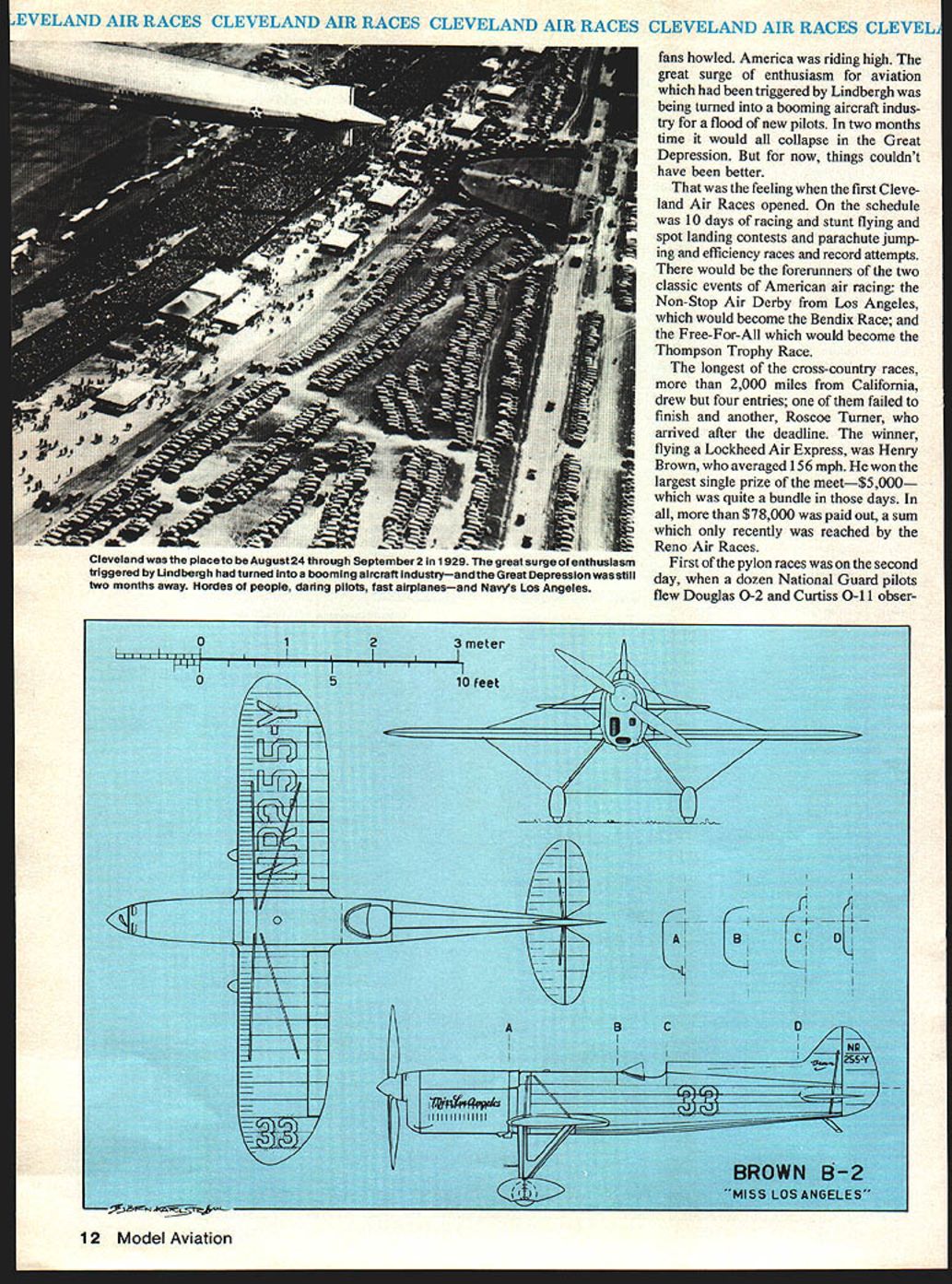
In 1929, Cleveland was no joke. From Aug. 24 to Sept. 2, the engines roared and the fans howled. America was riding high on the great surge of enthusiasm in aviation triggered by Lindbergh. The booming aircraft industry was flooded with new pilots. Two months later it would collapse into the Great Depression, but at the moment things couldn't have been better.
The first Cleveland Air Races opened a schedule of ten days: racing, stunt flying, spot-landing contests, parachute jumping, efficiency races and record attempts. They were forerunners of two classic events in American air racing: the nonstop air derby to Los Angeles, which would become the Bendix Race; and the free-for-all that would become the Thompson Trophy Race.
The longest cross-country races, 2,000 miles to California, drew four entries; three failed to finish. Roscoe Turner arrived after the deadline. The winner, Henry Brown, flying a Lockheed Air Express, averaged 156 mph and won the largest single prize of the meet—$5,000—a considerable sum in those days.
The first pylon races, on the second day, had a dozen National Guard pilots flying Douglas O-2s and Curtiss O-11 observation planes. They flew seven laps around a 10-mile course. Prophetically, the winner was disqualified for having streamlined a stock airplane; the stock-plane races were for airplanes powered by Liberty OX-5 engines.
There were also women’s races and classes limited by engine displacement. A pylon race for multi-engined planes and a four-pilot relay race were held Aug. 28. Event #8, the OX-5 race, drew Travel Airs, Curtiss Robins, an Eaglerock, a Waco 9 and a Pheasant H10 flown by young Steve Wittman. Befitting his limited experience, Wittman placed last and won no money. Fourth was taken by Art Chester, who, with Wittman, would later play a major role in the development of Formula One racing.
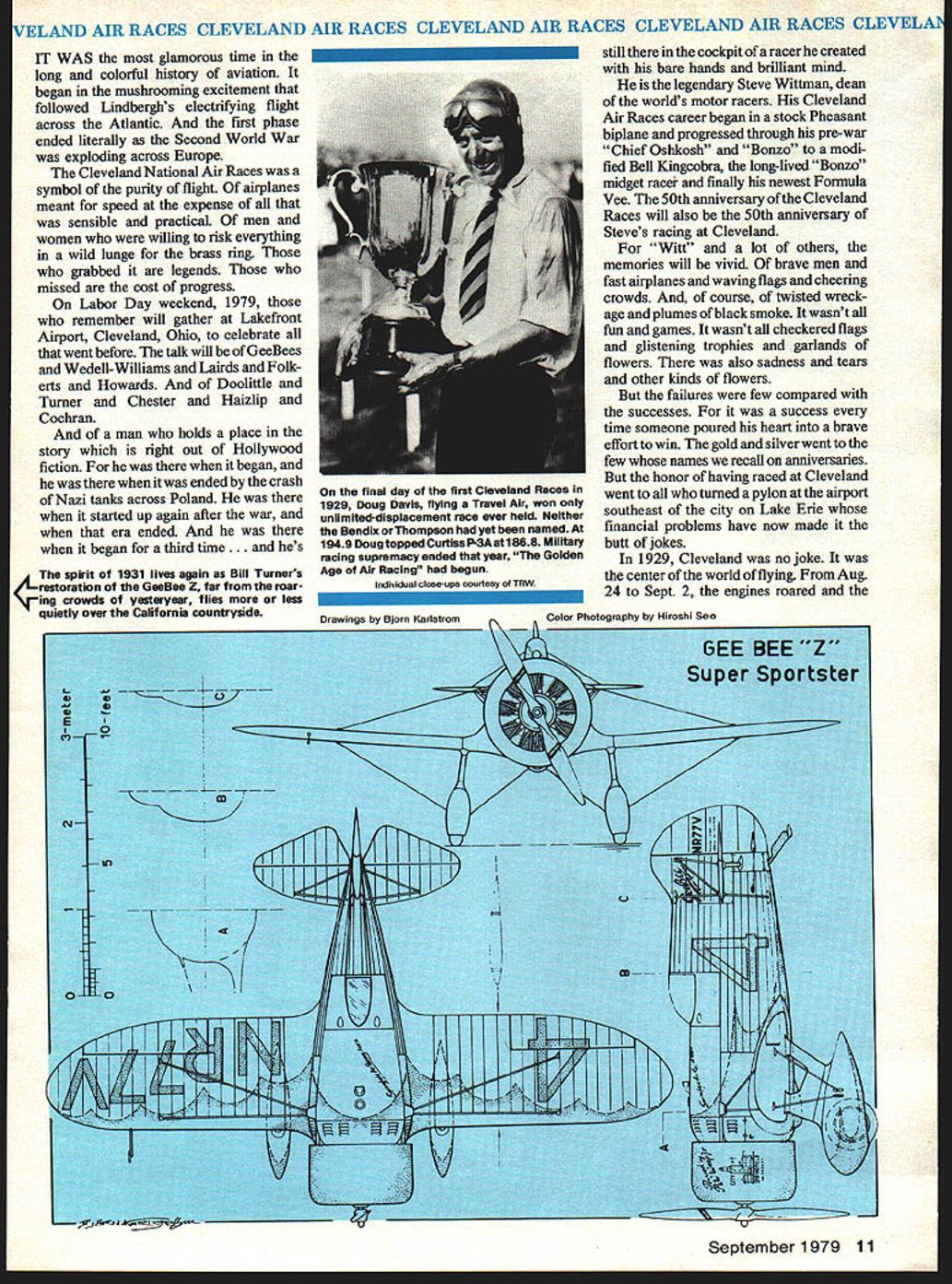
On the final day of the 1929 races, the only unlimited-displacement pylon race was held. It pitted nine civilian airplanes against two military entries, and for the first time in history civilians won. Doug Davis, in a red-and-black Travel Air, beat R. G. Breene in a Curtiss P-3A by 194.9 mph to 186.8 mph. From then on, the Army and Navy would often play second fiddle to backyard mechanics and their custom-built racers. The Golden Age of Air Racing had begun.
1930–1932: Growth and Rivalries
The 1930 National Air Races moved to Chicago, but were back in Cleveland for 1931. In just two years, the entire picture had changed, as most now-famous names were on the scene. There were race planes by Keith Rider, Wedell-Williams, Chester, Wittman, Laird, Howard and the Granville Brothers. Pilots included Doolittle, Turner, Chester, Wittman, Haizlip, Howard, Livingston, Bayles and Roger Don Rae.
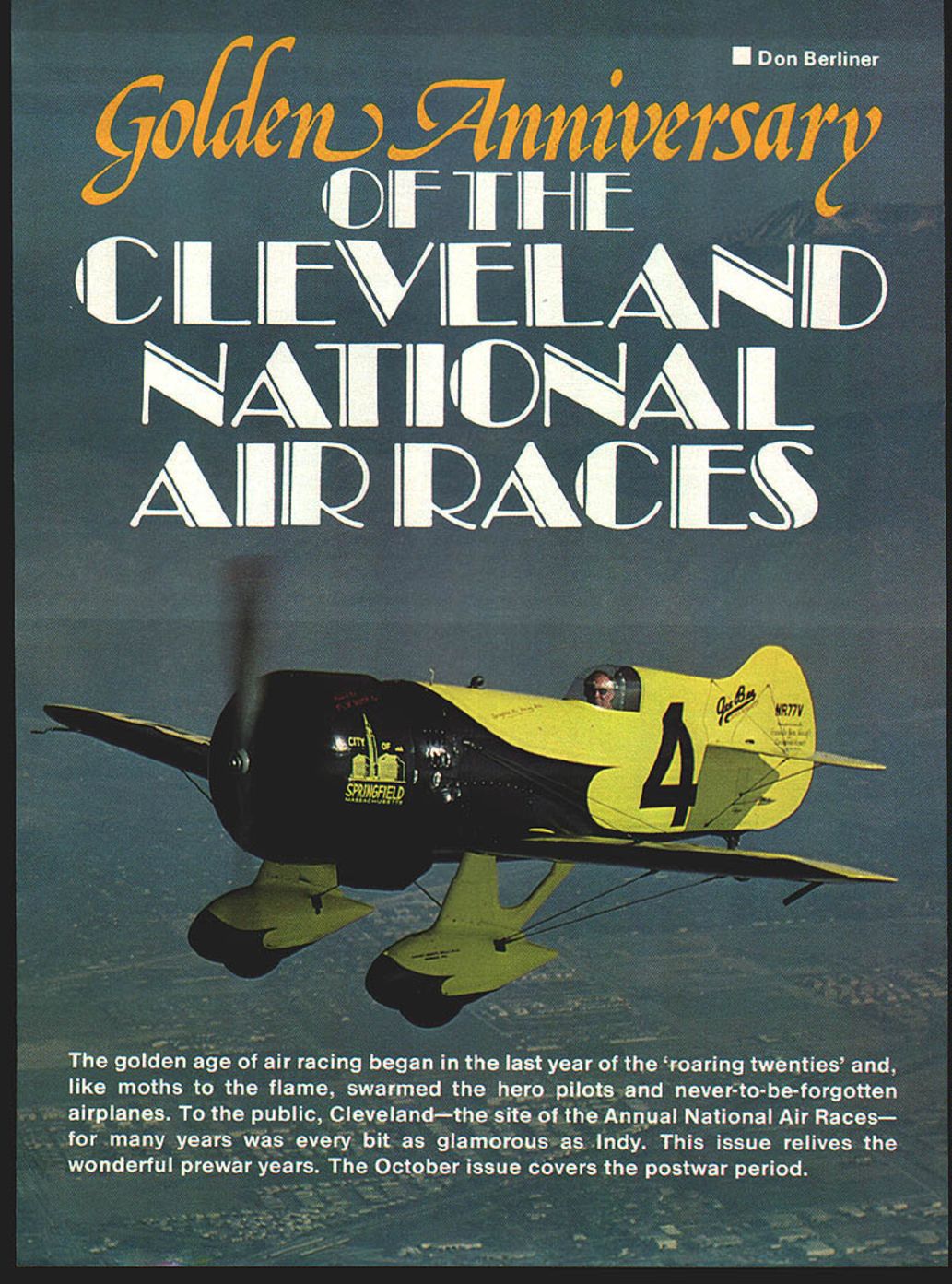
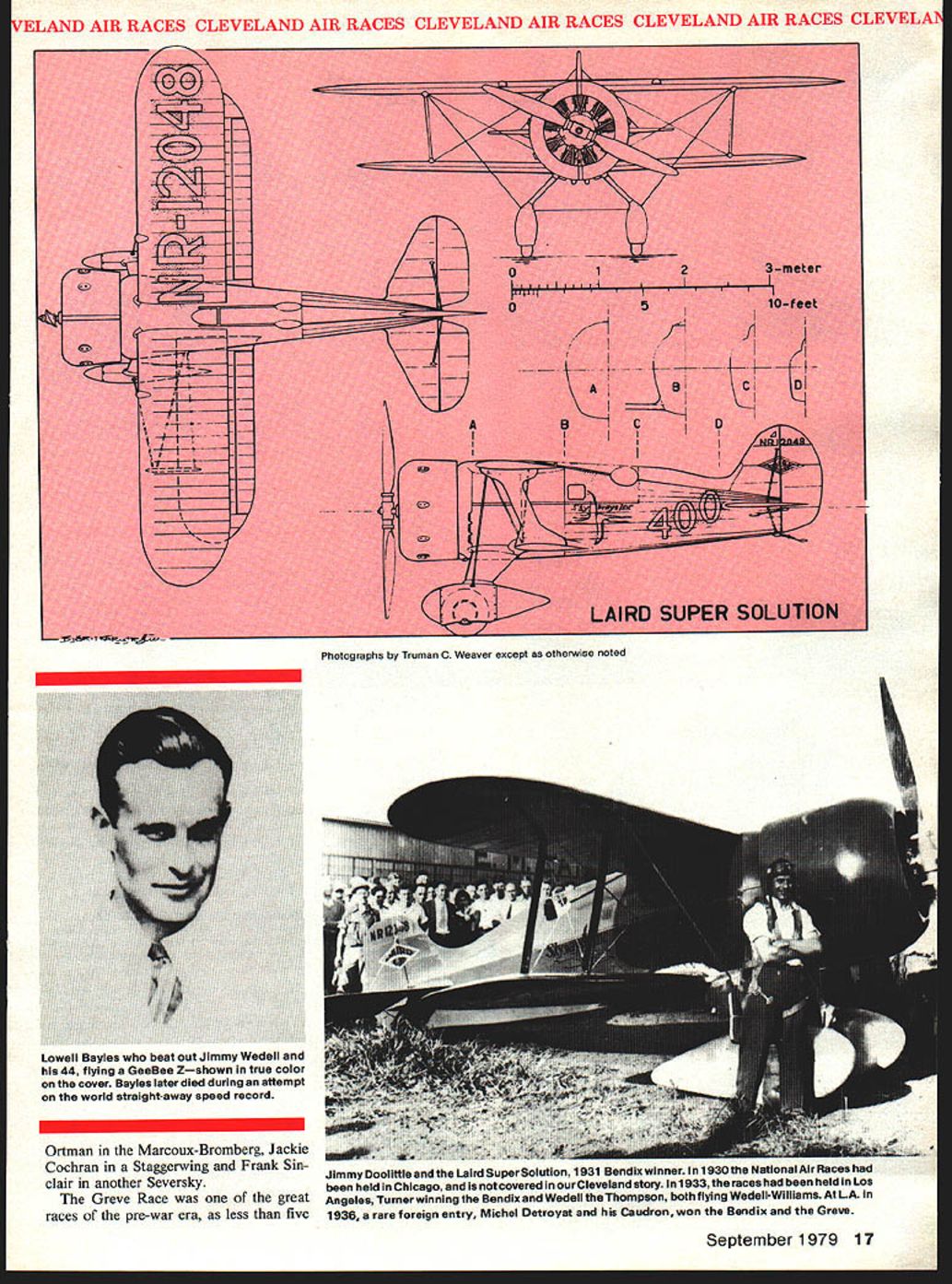
The undisputed star of the 1931 races was the fierce yellow-and-black Gee Bee Model Z, flown by Lowell Bayles. It captured the imagination of the crowd and the nation like no speed plane before it. The Gee Bee was all business, with a hefty Pratt & Whitney radial in the nose and minimal fuselage behind it. Bayles won the Thompson Race by almost a full minute ahead of Jimmy Wedell, averaging 236.2 mph to Wedell's 228.0 mph.
Bayles passed the fast-starting Wedell on the fifth of ten laps, while Jimmy Doolittle was gaining fast until he blew a cylinder on lap 7. Doolittle had earlier won the Bendix Race from Santa Monica by more than an hour over five Lockheeds, flying the Laird "Solution," now being restored by the Connecticut Aeronautical Historical Association.
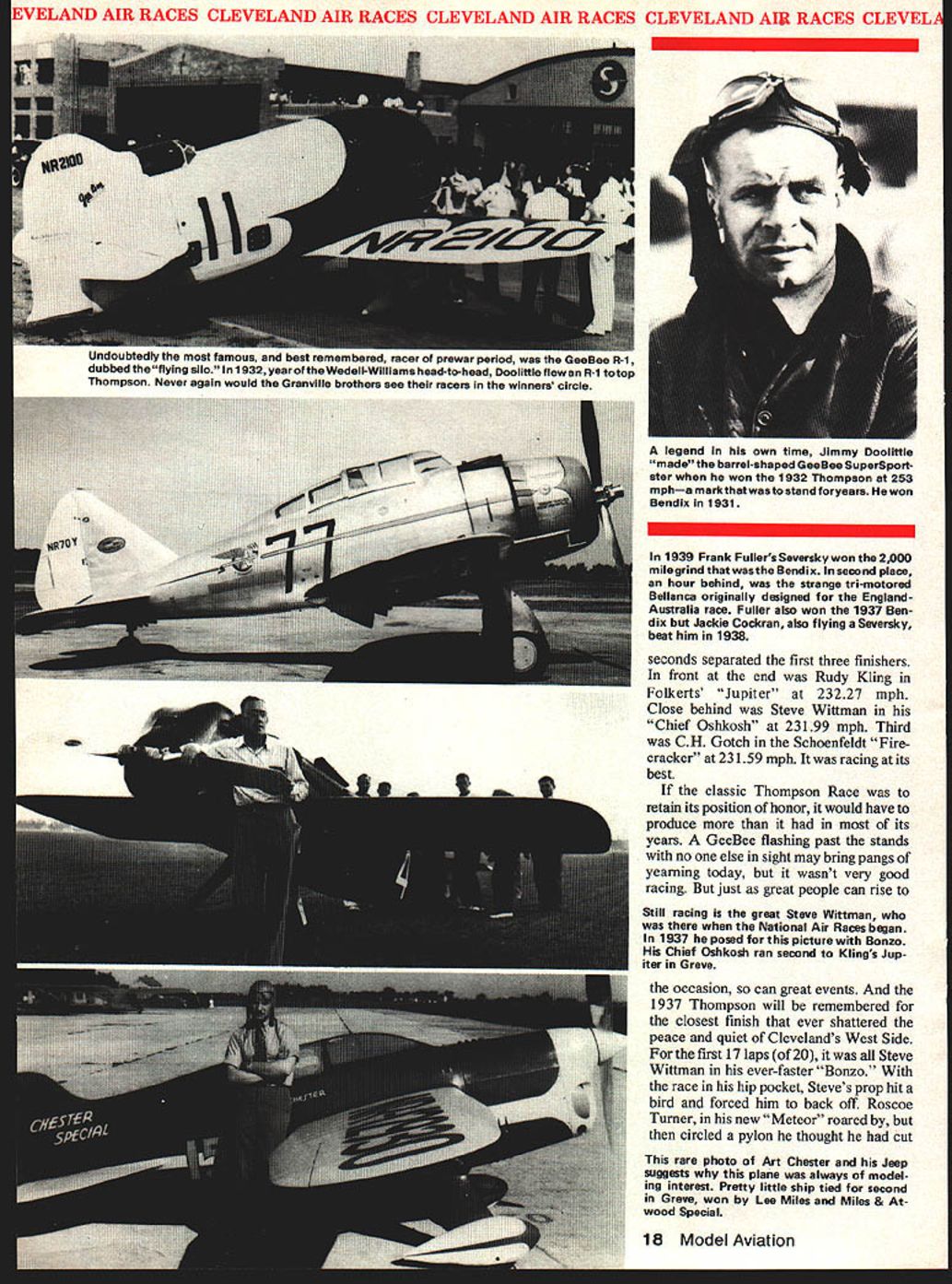
In 1932, improvements came so fast that there was no time for anyone to get bored. It may have been the greatest year, the year of Gee Bee versus Wedell-Williams. Two new barrel-shaped Gee Bee Super Sportsters and three Wedell-Williams racers (#44, #92 and #121) swept both the Bendix and the Thompson. In the 2,000-mile race from Burbank to Cleveland, Wedell-Williams dominated: Jimmy Haizlip first at a record 245 mph, Wedell second at 232 mph, and Roscoe Turner third at 226 mph. Lee Gehlbach was fourth in Gee Bee #7 at 210 mph.
The Thompson Trophy went to Doolittle, who made the Gee Bee's reputation for all time, winning with a 253-mph record that would stand for years. Wedell, Turner and Haizlip followed, with Gehlbach fifth in the other Gee Bee R-1. It was the height of success for the Granville Brothers, who never again would see their amazing racers in the winners' circle.
1933–1934: Tragedy and Transition
The 1933 National Air Races returned to Los Angeles, where Turner won the Bendix and Wedell won the Thompson. Accidents had put the Gee Bees out of action, and a training crash would later take Jimmy Wedell's life.
Though Jimmy was gone, his airplanes were not. The Bendix Race to Cleveland in 1934 was won by Doug Davis in #44, with John Worthen second in #92. Their speeds were below record, but winning is what counts. The only other starter was Gehlbach in the stretched Gee Bee "Q.E.D.," who landed after the 6 p.m. deadline.
In the Thompson Trophy Race, Turner, Davis and Worthen in Wedell-Williams dominated a field of smaller Menasco-powered machines. Turner's superior horsepower paid off: he won by almost three full laps of the 5-mile course ahead of Roy Minor in the Brown "Miss Los Angeles." Turner spent much of the race passing slower airplanes, lapping some as many as five times in the 20-lap contest.
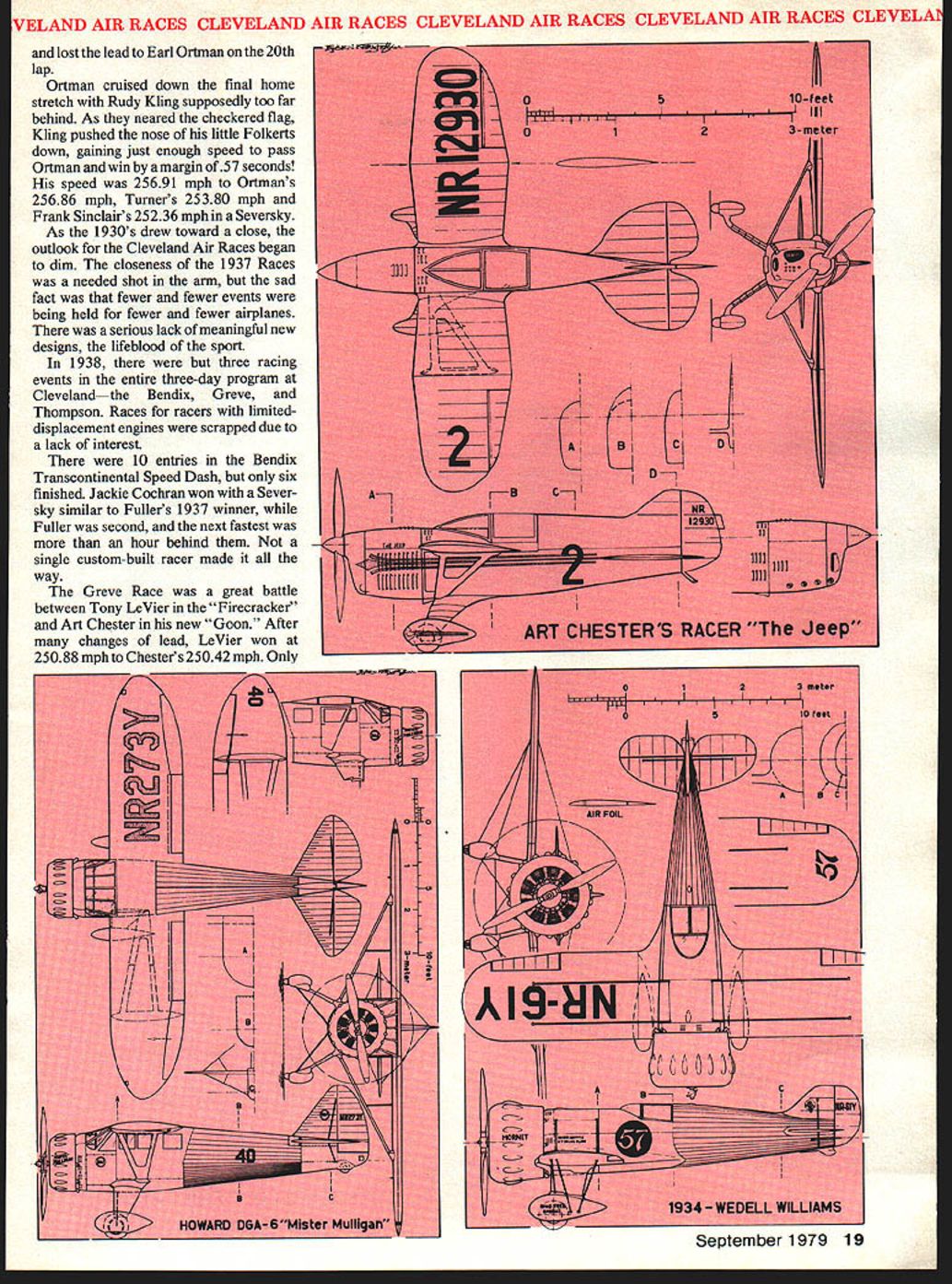
The new Greve Trophy Race, limited to 550 cu. in. engines, emphasized airframe design and piloting skill. Lee Miles won in his Miles & Atwood Special with a best speed of 206 mph. Art Chester in his "Jeep" and Roger Don Rae in the Keith Rider "San Francisco" tied for second, despite Don Rae posting a best speed of 211 mph to Chester's 203 mph.
Battle lines were drawn between proponents of potent radials of up to 1,000 hp and those favoring long-nosed Menasco inline engines. So far, the big radials were dominant, but the day of the in-line seemed to be coming.
1935–1937: New Winners and Closer Racing
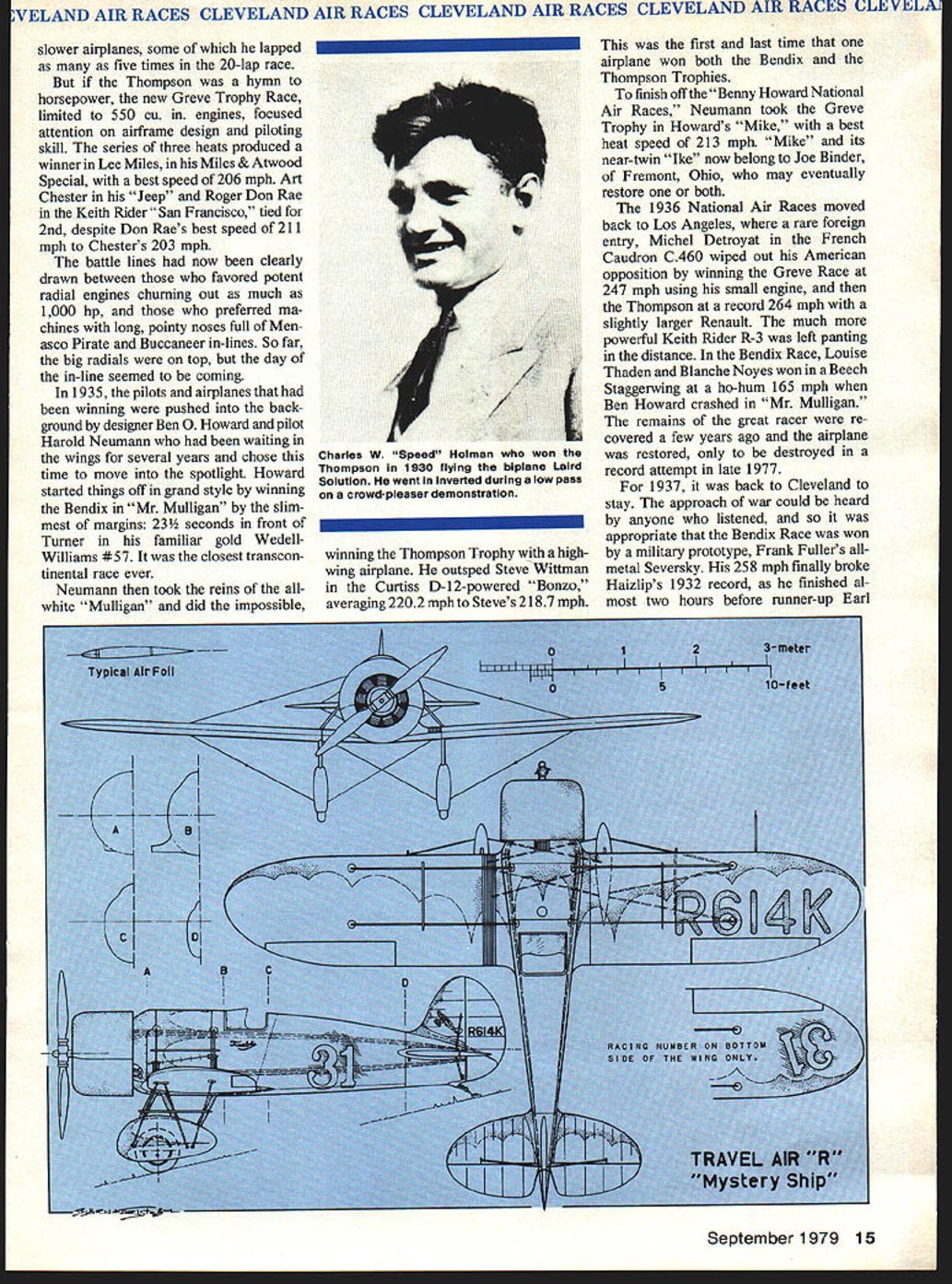
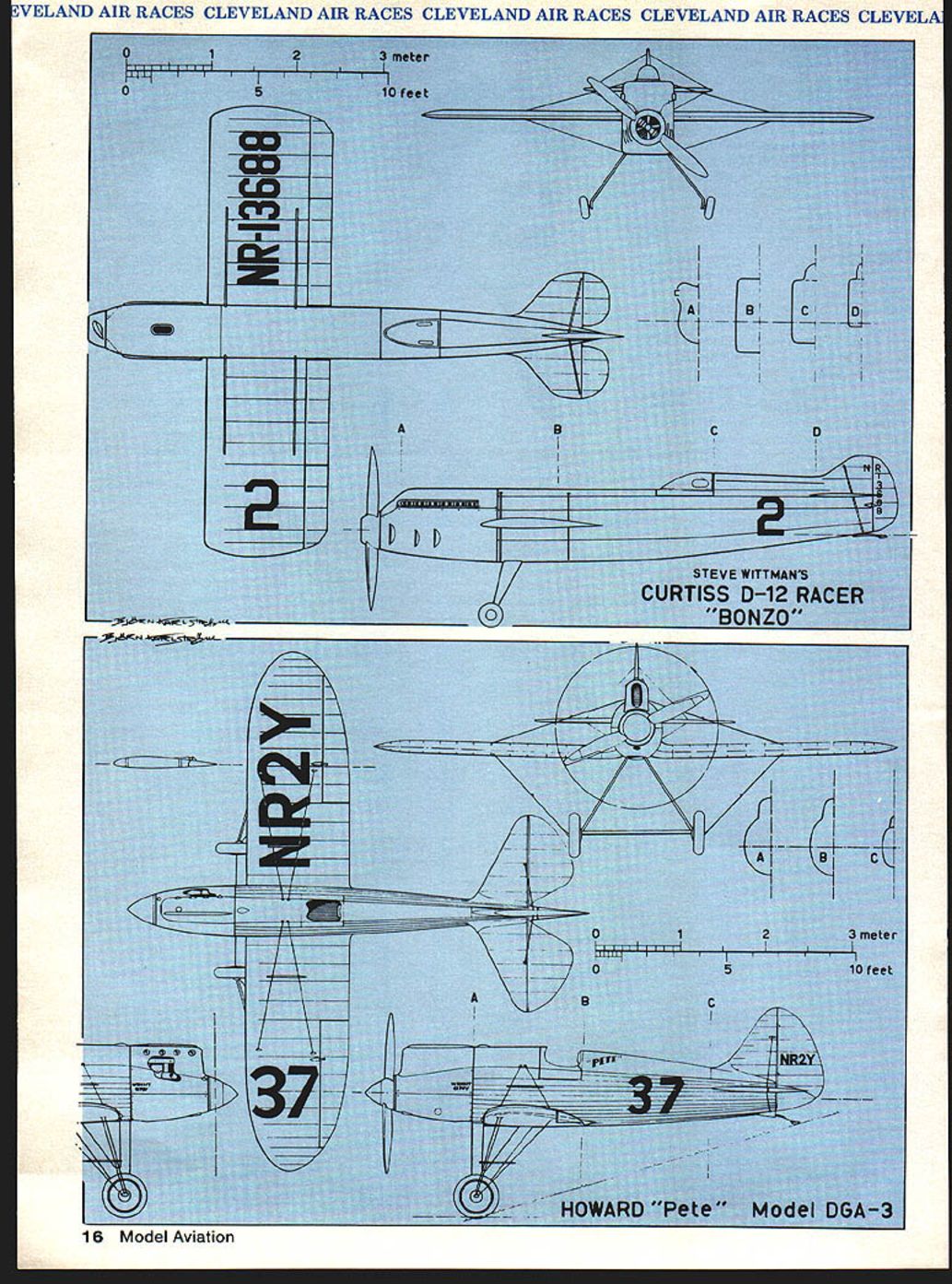
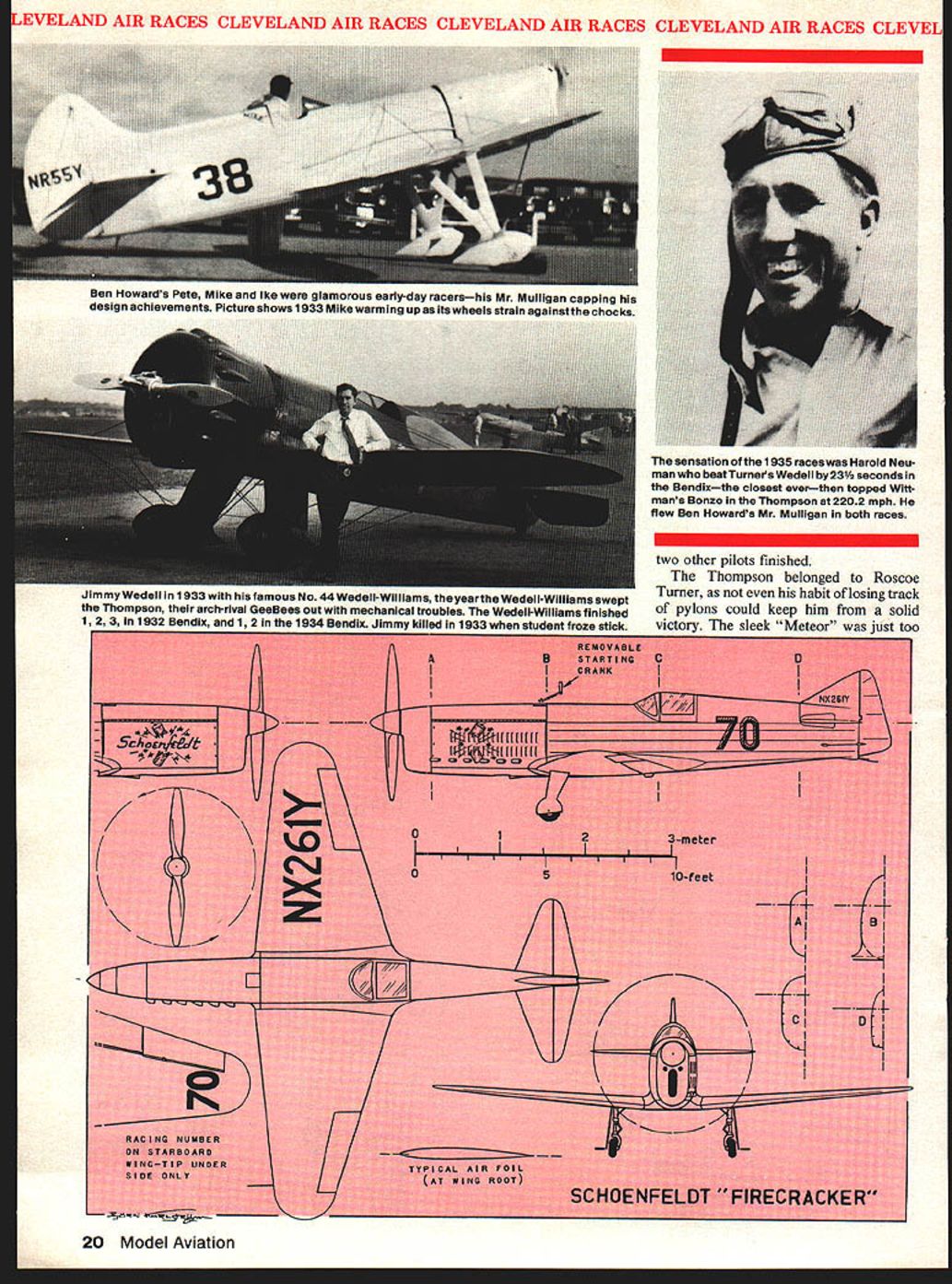
In 1935, designer Ben O. Howard and pilot Harold Neumann moved into the spotlight. Howard won the Bendix in "Mr. Mulligan" by the slimmest of margins—23½ seconds ahead of Turner in his gold Wedell-Williams #57. Neumann then won the Thompson Trophy in the high-wing "Mulligan," outpacing Steve Wittman in the Curtiss D-12-powered "Bonzo," averaging 220.2 mph to Wittman's 218.7 mph. This was the first—and last—time one airplane won both the Bendix and the Thompson Trophies.
Neumann finished the "Benny Howard National Air Races" by taking the Greve Trophy in Howard's "Mike," with a best heat speed of 213 mph. "Mike" and its near-twin "Ike" later belonged to Joe Binder of Fremont, Ohio, who may restore one or both.
The 1936 races were in Los Angeles. French pilot Michel Detroyat, in the Caudron C.460, swept American opposition by winning the Greve at 247 mph with a small engine and the Thompson at a record 264 mph with a slightly larger Renault. Keith Rider's powerful R-3 was left trailing. In the Bendix, Louise Thaden and Blanche Noyes won in a Beech Staggerwing at 165 mph after Ben Howard crashed in "Mr. Mulligan." The remains of that great racer were recovered years later, restored, and then destroyed in a 1977 record attempt.
In 1937 the races returned to Cleveland to stay. The approach of war was becoming evident. The Bendix was won by Frank Fuller in an all-metal Seversky at 258 mph, breaking Haizlip's 1932 record as he finished almost two hours before runner-up Earl Ortman in the Marcoux-Bromberg. Jackie Cochran flew a Staggerwing and Frank Sinclair another Seversky.
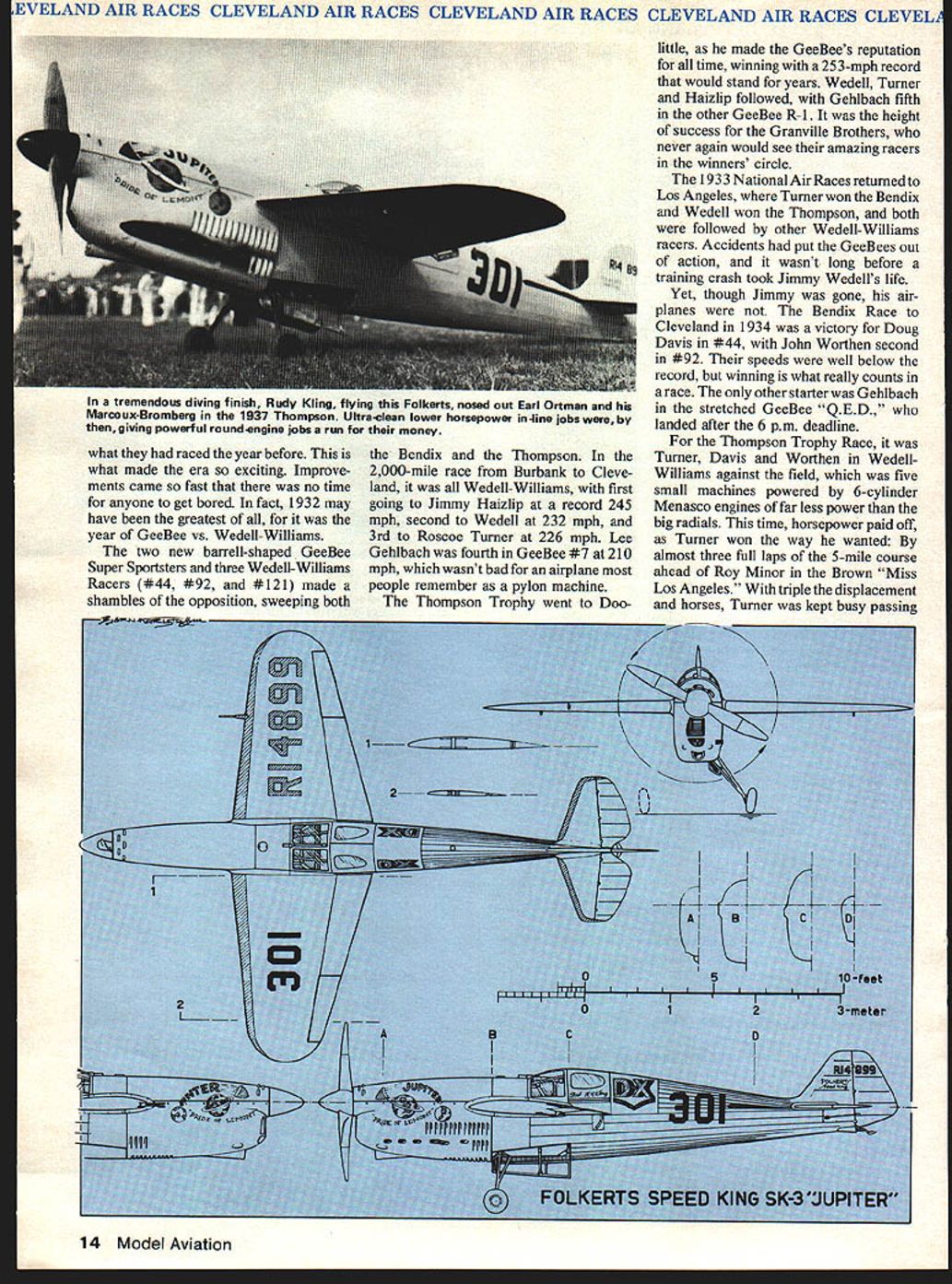
The Greve Race was one of the great prewar battles—less than five seconds separated the first three finishers. Rudy Kling, in Folkerts' "Jupiter," won at 232.27 mph. Close behind was Steve Wittman in "Chief Oshkosh" at 231.99 mph, and third was C. H. Gotch in the Schoenfeldt "Firecracker" at 231.59 mph. It was racing at its best.
The 1937 Thompson produced the closest finish ever. For the first 17 laps it was all Steve Wittman in his ever-faster "Bonzo." A bird strike forced him to back off; Roscoe Turner roared by but then circled a pylon he thought he'd cut and lost the lead to Earl Ortman on the 20th lap. Ortman seemed safe, but Rudy Kling pushed his little Folkerts down the final straight and passed Ortman to win by 0.57 seconds—256.91 mph to Ortman's 256.86 mph. Turner was third at 253.80 mph and Frank Sinclair fourth at 252.36 mph.
1938–1939: Decline and the Last Prewar Races
As the 1930s drew toward a close, the outlook for the Cleveland Air Races dimmed. Fewer events were being held for fewer airplanes; there was a serious lack of meaningful new designs, the lifeblood of the sport.
In 1938, the three-day program at Cleveland included only three racing events—the Bendix, Greve and Thompson. Races for limited-displacement engines were scrapped due to lack of interest.
Ten entries started the Bendix Transcontinental Speed Dash, but only six finished. Jackie Cochran won in a Seversky similar to Fuller's 1937 winner; Fuller was second, the next fastest more than an hour behind. Not a single custom-built racer completed the course.
The Greve was a close battle between Tony LeVier in the "Firecracker" and Art Chester in his new "Goon." After many lead changes, LeVier won at 250.88 mph to Chester's 250.42 mph. Only two other pilots finished.
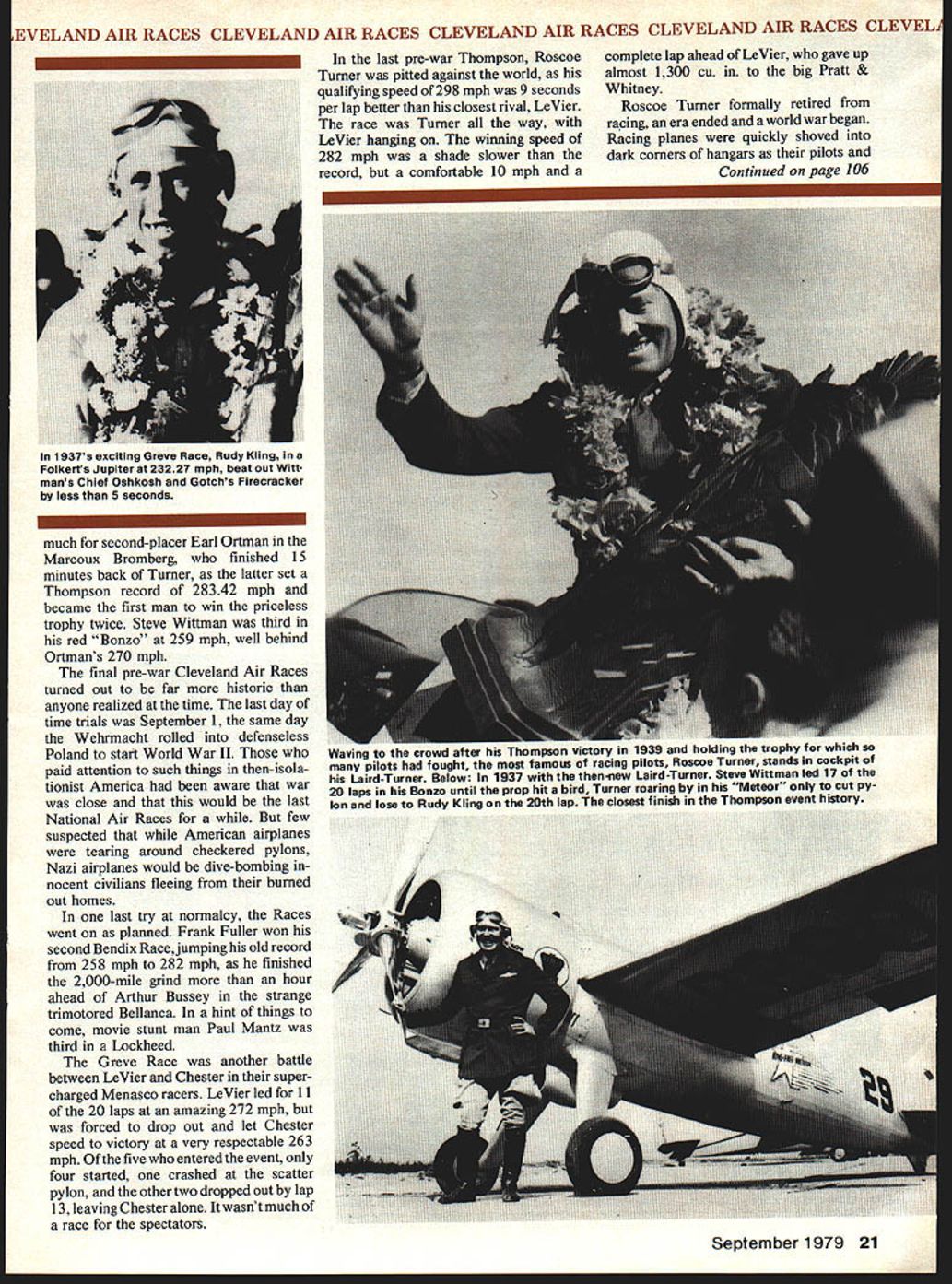
The Thompson belonged to Roscoe Turner, who set a Thompson record of 283.42 mph and became the first man to win the trophy twice. Earl Ortman in the Marcoux-Bromberg was second, about 15 minutes back, and Steve Wittman was third in his red "Bonzo" at 259 mph.
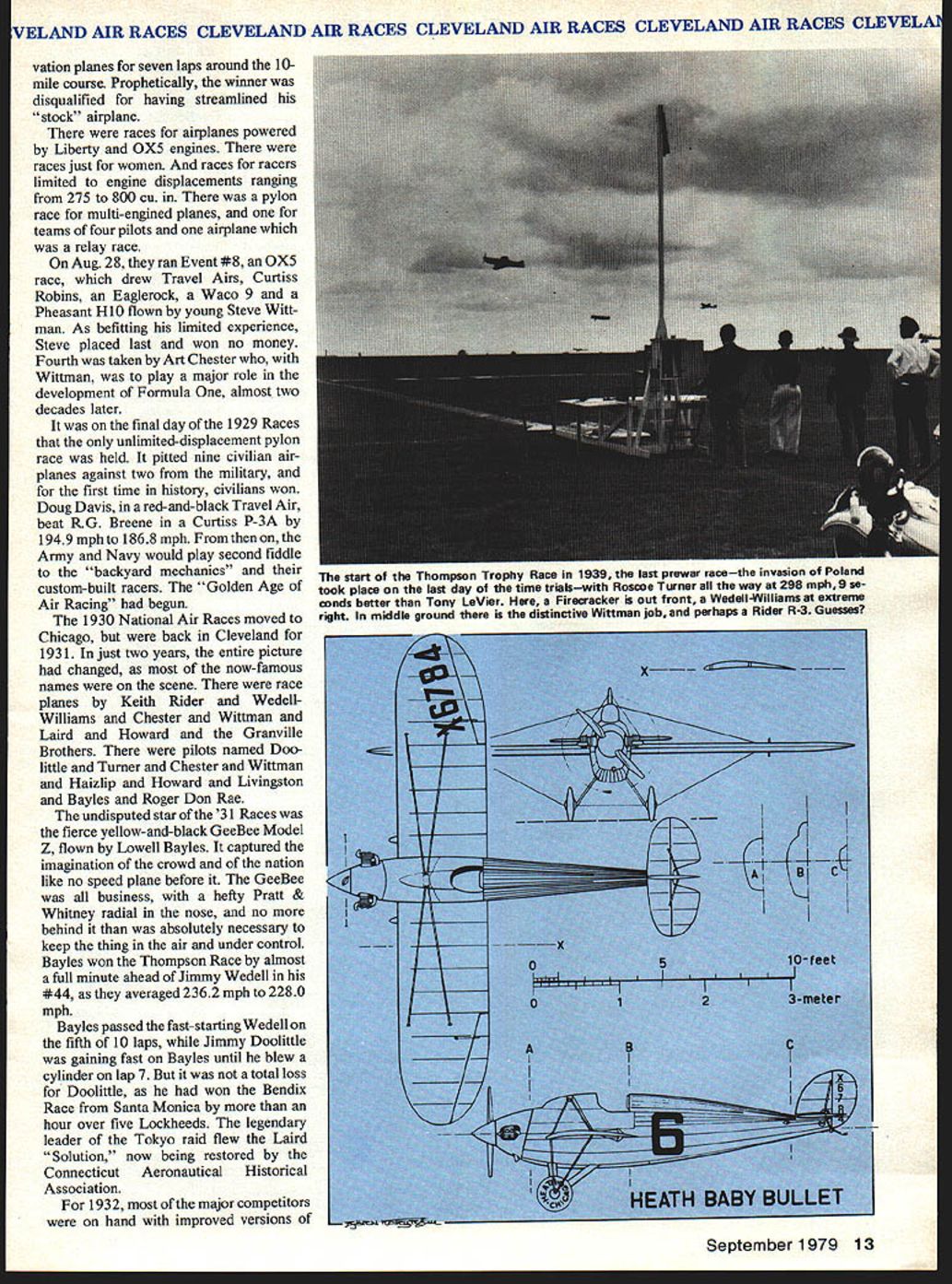
The final prewar Cleveland Air Races proved more historic than anyone realized. The last day of time trials was Sept. 1, the same day the Wehrmacht rolled into Poland and started World War II. Many Americans were aware the world was close to war, and this would be the last National Air Races for a while. Few suspected that while American airplanes circled checkered pylons, Nazi airplanes would be dive-bombing civilians fleeing burned-out homes.
In one last try at normalcy, the races went on. Frank Fuller won his second Bendix Race, raising his record from 258 mph to 282 mph, finishing the 2,000-mile grind more than an hour ahead of Arthur Bussey in the trimotored Bellanca. Movie stunt man Paul Mantz placed third in a Lockheed.
The Greve was another LeVier–Chester duel. LeVier led for 11 of 20 laps at an astonishing 272 mph but dropped out, and Chester sped to victory at 263 mph. Of five who entered, only four started; one crashed at the scatter pylon, and two others dropped out by lap 13.
In the last prewar Thompson, Roscoe Turner was dominant. His qualifying speed of 298 mph was nine seconds per lap better than his nearest rival. Turner won easily, at 282 mph—about 10 mph slower than the record—but a complete lap ahead of LeVier, who surrendered almost 1,300 cu. in. of engine displacement to the big Pratt & Whitney.
Roscoe Turner formally retired from racing. An era ended and a world war began. Racing planes were quickly shoved into dark corners of hangars as their pilots, builders and mechanics prepared to enter a much more serious race.
Aftermath and Legacy
Not one of the prewar racing airplanes ever raced again. Turner's two-time Thompson-winning "Meteor" is now on display in the National Air and Space Museum in Washington. LeVier's "Firecracker" survives only in pieces in California. Chester's "Goon" exists complete on the West Coast but does not fly. Earl Ortman's Marcoux-Bromberg is being restored in Connecticut, while Wittman's "Bonzo" is in the EAA Museum near Milwaukee. Most of the others simply seemed to disappear, though a few enthusiasts continue to follow faint leads.
Of the pilots, a few raced briefly after the war, but only Steve Wittman stuck with it. His racing career stood at 52 as these words were written, with the end not yet in sight. The only other prewar racing name who remains active is Harold Neumann, winner of the 1935 Thompson and Greve Races, who regularly places well in aerobatic contests flying a Monocoupe painted like his old racer and called "Harold's Little Mulligan." Thanks to them and to the memories of so many others, the Golden Age of Air Racing is still alive.
(To be continued)
Transcribed from original scans by AI. Minor OCR errors may remain.

